The Linguistic Distortion of Ekklesia: A Case for Reclamation
Introduction
The language of the New Testament is not a canvas for modern reinterpretation, but a fixed record of divine intent. Terms such as logos, charis, and pneuma are defined by the rigid boundaries of their original Greek context. Yet, one term—ekklesia—has been subjected to a profound and systematic distortion.
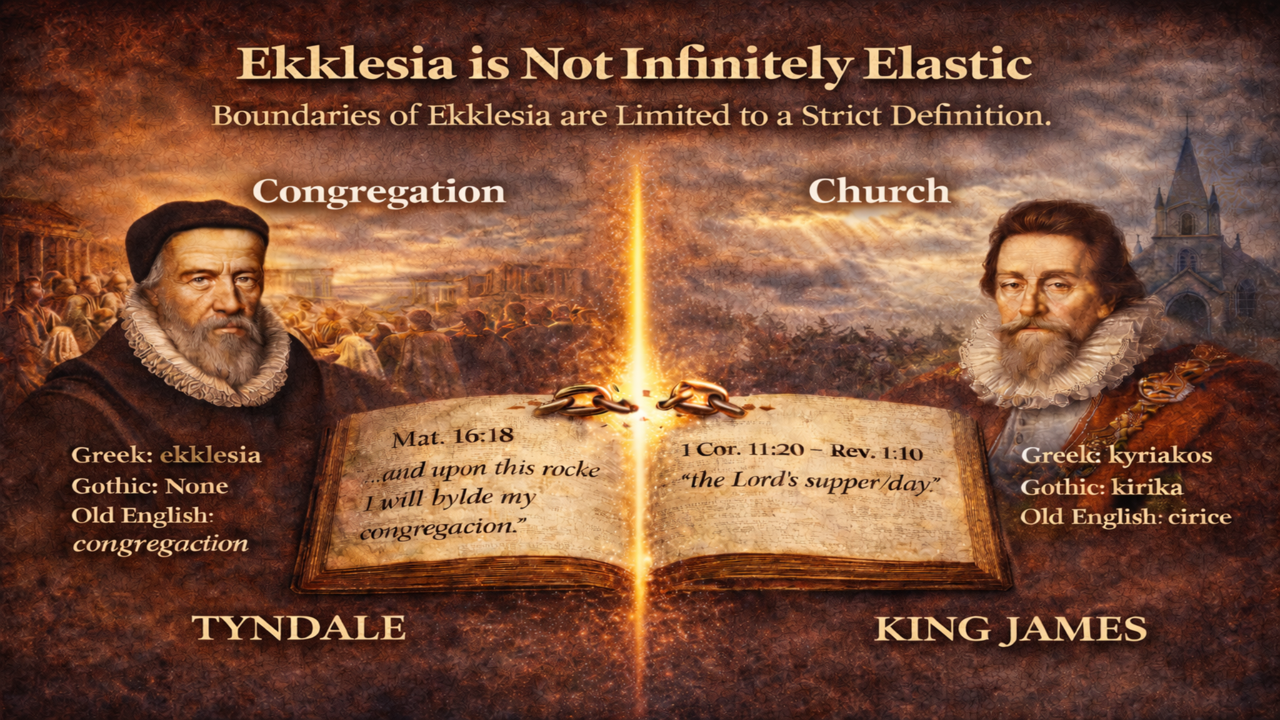
For centuries, the rendering of ekklesia as the English word “church” has introduced an “elasticity” to the text, allowing for meanings that range from a physical building to a global, hierarchical institution. This paper examines that translation shift, exposing how the substitution of the Greek kyriakon for the apostolic ekklesia has fundamentally altered the believer’s understanding of their identity in Christ.
By returning to the original linguistic markers, we remove the artificial elasticity imposed by religious tradition and recover the singular, local, and sovereign assembly that Christ intended.
Linguistic Collision vs. Translation
The term ekklesia (ἐκκλησία) in the Greek world was a concrete, political reality. It denoted the kletai (the called-out ones) who were summoned to assemble. When you apply the principle of non-elasticity, ekklesia signifies a specific event of assembly. There is no capacity within the term for it to mean a “building” or a “world-wide hierarchy,” because those concepts were alien to the word’s function in the polis.
By contrast, kyriakón (κυριακόν)—the substantivized neuter form of kyriakós—is defined as “the Lord’s place” or “property.” Both of these Greek words are derived from kýrios (Lord). Kyriakós is the adjective (belonging to) and kyriakón is the noun, which is the ancestor of our English word “church” (via the Germanic kirikā).
To emphasize: ekklesia has no etymological link to kýrios. It is derived from ek (out of) and kaleo (to call). By superimposing kyriakón onto ekklesia, translators moved the focus from the active assembly of persons to a static location or institution.
This is the shift that introduces the “elasticity.” Once you define the term as “church,” you can stretch it to cover any number of things that have nothing to do with a gathered body of believers. This explains why people speak of “going to church” (a building) or “The Church” (an institution). Neither usage corresponds to the New Testament ekklesia.
The Mechanics of Elasticity
The elasticity identified serves a specific purpose for those in positions of power. If a term is “elastic,” it can be used to justify authority that the original Greek text never sanctioned. With the significance of “elastic” defined, we examine how this sanctioned authority functions:
Institutionalization: An “assembly” requires physical presence and mutual responsibility. An “institution” requires only adherence to a brand. Elasticity allows the institution to expand its reach indefinitely.
The Universalization Myth: Once the word is “church,” it becomes easy to argue for a “universal church” that transcends local boundaries. Ekklesia in the New Testament is consistently local and visible. By replacing it with an elastic term, translators paved the way for ecclesiologies that emphasize power structures over the actual assembly of Christ’s people.
Decoupling from the polis: Translators “pacified” the ekklesia by replacing it with an elastic term, stripping it of its status as a distinct, self-governing assembly. This evolution concluded as the “church” became a factitious entity: a state-sanctioned corporation. By adopting legal “trustees” and registering under civil code, these organizations shift their final accountability from Christ to Caesar.
The Linguistic Case Against Church
The analysis of ekklesia is accurate because “non-elasticity” is the hallmark of honest hermeneutics. When you study logos or pneuma, you rely on lexical definitions to prevent them from becoming vague metaphors. Yet, with ekklesia, the industry of Bible translation has largely chosen to embrace ambiguity.
If one admits that ekklesia is not elastic, one must logically admit that:
- “Church” is a mistranslation. It is rooted in a different Greek word (kyriakón) that carries a different semantic load.
- Universalism is a fabrication. If the word must refer only to a called-out assembly in a given location, then the concept of a singular, worldwide, hierarchical “Universal Church” collapses under its own weight.
- The Temple is human, not structural. By maintaining the strict definition of ekklesia, this reinforces the position that the believers—the living stones—are the temple, rejecting the focus on physical assets that the term “church” implies.
Conclusion
Restoring the theological integrity of the ekklesia requires more than a simple vocabulary adjustment; it demands a total rejection of the kyriakón-derived translation that has enabled the rise of “churchianity.” When we apply basic common sense to our hermeneutics, it becomes clear that ekklesia is not an elastic concept but a fixed reality: a called-out, self-governing people.
The institutional status quo relies upon the current ambiguity to maintain authority and corporate functionality, but this structure collapses when the biblical definition is strictly applied. Rejecting the mistranslation of “church” in favor of Christ’s assembly is not merely an academic exercise—it is an act of liberation. It moves the believer from a system of state-sanctioned corporate identity back to the physical, organic, and divinely ordained reality of an assembly that answers to no head other than the Lord Jesus Christ.
This study isn’t merely about doing philology; it’s engaging in the necessary work of dismantling the theological condition that has obscured the true nature of Christ’s ekklesia for centuries. Remember: an assembly requires a “coming together”—a physical reality that no online meeting or abstract institution can ever replicate.ured the true nature of Christ’s ekklēsía for centuries. Focus on the fact that an assembly requires a “coming together”—a physical reality that no online meeting or abstract institution can ever replicate.