
Introduction
Few biblical terms have been as widely misunderstood and misapplied as the word antichrist. In popular Christian teaching, it is often treated as a future singular world ruler, a political tyrant yet to arise at the end of history. This assumption, however, does not arise from the text where the term itself appears. Rather, it is the result of an interpretive move that abandons careful exegesis and imports meaning from unrelated passages.
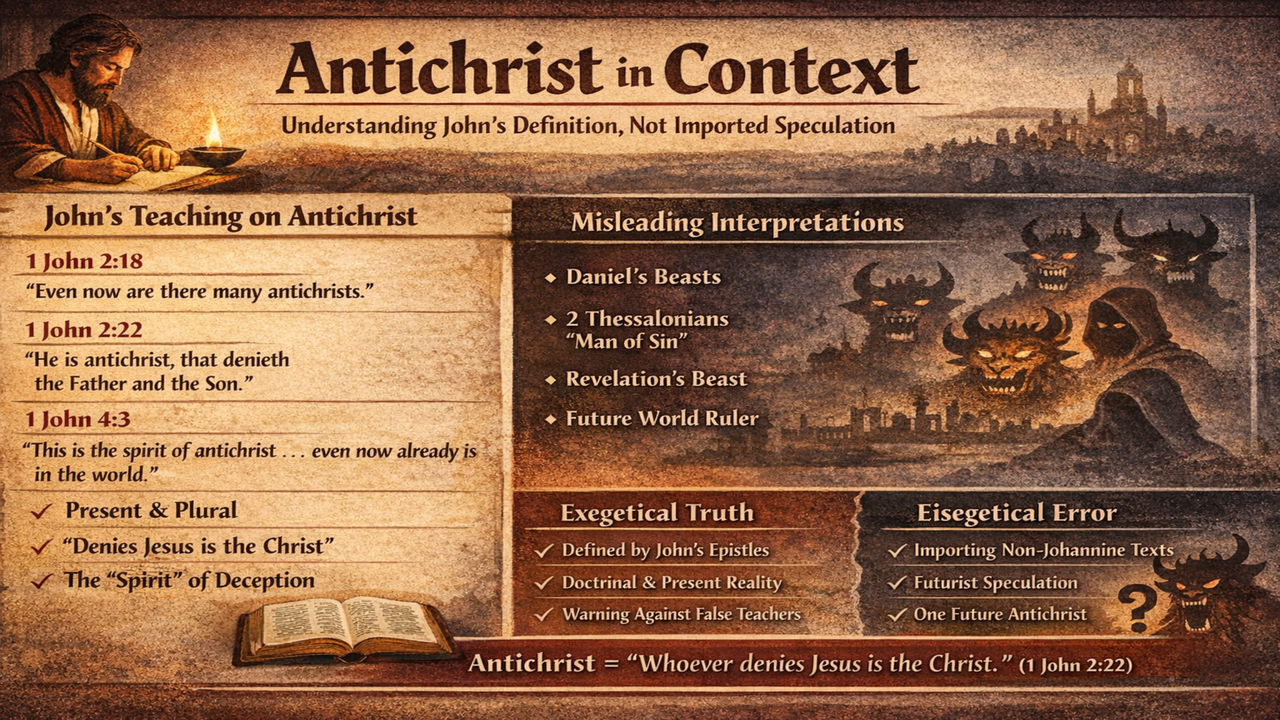
This essay argues that the apostle John defines antichrist clearly and sufficiently within his epistles, and that moving outside those texts to redefine the term violates sound exegetical principles. When John’s words are allowed to stand on their own, the concept of antichrist is revealed to be present, plural, doctrinal, and pastoral in nature—not futuristic, political, or speculative.
The Proper Starting Point: Exegesis of John’s Text
Exegesis begins by drawing meaning out of the text under consideration, not by searching elsewhere for ideas to impose upon it. The term antichrist appears only in four passages in Scripture:
- 1 John 2:18
- 1 John 2:22
- 1 John 4:3
- 2 John 7
No Old Testament prophet uses the term. Jesus does not use the term. Paul does not use the term. John alone employs it, and therefore John alone must be allowed to define it.
This immediately establishes a foundational rule: the meaning of antichrist must be determined from John’s writings before any attempt is made to correlate it with other biblical themes.
John’s Temporal Framework: “It Is the Last Time”
John opens his discussion with an unmistakable temporal marker:
“Little children, it is the last time: and as ye have heard that antichrist shall come, even now are there many antichrists; whereby we know that it is the last time.” (1 John 2:18)
Several exegetical observations are unavoidable:
- John speaks in the present tense.
- He addresses a current audience (“little children”).
- He identifies many antichrists already active.
- Their presence is evidence that “the last time” is underway.
Nothing in the passage suggests a distant future fulfillment. On the contrary, John grounds the concept of antichrist firmly in the lived experience of his first-century readers.
John’s Explicit Definition of Antichrist
Any remaining ambiguity is removed in the very next definition statement:
“Who is a liar but he that denieth that Jesus is the Christ? He is antichrist, that denieth the Father and the Son.” (1 John 2:22)
This sentence is decisive. Grammatically, John uses a direct identification: “He is antichrist.” Antichrist is not described as a political leader, a military figure, or an eschatological tyrant. It is defined as a theological position—the denial that Jesus is the Christ, and by extension, the denial of the Father and the Son.
John does not leave the category open-ended. He does not suggest multiple tiers or a future culmination. He defines antichrist in doctrinal terms, not prophetic imagery.
Antichrist as a Present Spiritual Reality
John further clarifies the nature of antichrist:
“And every spirit that confesseth not that Jesus Christ is come in the flesh is not of God: and this is that spirit of antichrist, whereof ye have heard that it should come; and even now already is it in the world.” (1 John 4:3)
Here, antichrist is explicitly described as a spirit, not a man. It operates through deception, false teaching, and denial of Christ’s incarnation. Once again, John emphasizes present activity: “even now already is it in the world.”
This interpretation is confirmed in his second epistle:
“For many deceivers are entered into the world, who confess not that Jesus Christ is come in the flesh. This is a deceiver and an antichrist.” (2 John 7)
The pattern remains consistent: plural, present, doctrinal, and active.
Where Interpretation Goes Astray
The common error in Christian teaching occurs when interpreters abandon John’s definitions and seek to reconstruct antichrist using passages where the term does not appear.
Daniel’s beasts, Paul’s “man of sin,” and Revelation’s beast from the sea are frequently labeled “the Antichrist,” despite the fact that Scripture never uses that title for them. This move is not exegetical; it is synthetic and speculative. It assumes a theological system first and then forces John’s language into that system afterward.
Such an approach violates a basic interpretive rule:
A term must be defined by the author who uses it, in the context in which he uses it.
To redefine antichrist using texts that do not contain the word is to replace exegesis with eisegesis.
The Pastoral Purpose of John’s Teaching
John’s concern is not end-times curiosity but present-day faithfulness. He writes to protect believers from deception already affecting the church. His warnings are practical, immediate, and pastoral. By shifting antichrist into a distant future figure, modern teaching unintentionally dulls the force of John’s message and relocates the threat away from the church’s present responsibility.
Ironically, this deferral allows the very deception John warned about to flourish unchallenged.
Conclusion
When the apostle John is allowed to speak for himself, the meaning of antichrist is neither mysterious nor speculative. Antichrist is not a singular future ruler but a present reality manifested through false teaching that denies Jesus as the Christ. John’s language is clear, consistent, and contextually grounded.
The error arises not from Scripture, but from the decision to leave John’s epistles and import meaning from elsewhere in order to support a preconceived theological model. Faithful exegesis resists this impulse. It listens first, defines terms locally, and allows Scripture to interpret Scripture without altering what the author plainly states.
If John wanted believers to look for a future Antichrist, he would have said so. Instead, he told them to be alert to those already among them. That warning remains just as relevant today.

