
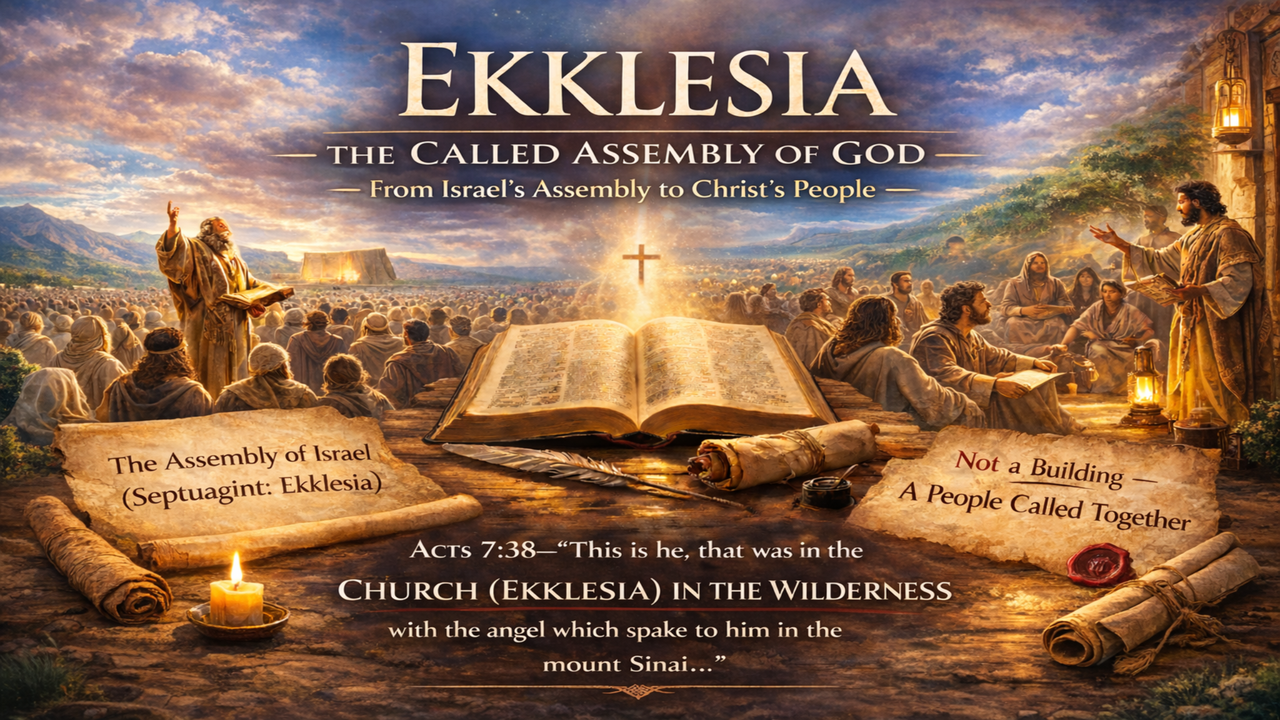
~ Language, Authority, and the Loss of the Gathered Church ~
Preface — Why This Study Matters
What if one of the most familiar words in the New Testament has quietly shaped Christian thinking in ways the apostles never intended?
Scripture teaches that the words God chose to reveal His truth are not accidental. The meaning of those words shapes how believers understand doctrine, authority, and the nature of God’s people.
Yet throughout history, translation and tradition have sometimes introduced terms that gradually influence how readers interpret the biblical text. Over time these inherited expressions can shape theological assumptions in ways that differ from the meaning carried by the original languages of Scripture.
One of the clearest examples of this can be seen in the word commonly translated “church.” Few words in the New Testament carry as much weight—and as many inherited assumptions—as the word commonly translated “church.”
This study examines the meaning of the Greek word ekklesia, how it was used in Scripture, and how later translation choices influenced the way Christians understand the people of God.
For centuries, English-speaking Christians have read this word without questioning whether it accurately conveys the meaning of the Greek word the Holy Spirit inspired the apostles to write: ekklesia.
This book is not an attempt to provoke controversy, diminish sincere believers, or undermine Christian fellowship. It is an invitation to return carefully and humbly to the language of Scripture itself. Words matter because God chose them. Doctrine is shaped not only by what we believe, but by the terms through which we interpret what we believe.
The Greek word ekklesia did not originate as a religious label. It referred to an assembly—a gathering of people called together for a purpose. When the apostles used this word to describe the followers of Christ, they did so intentionally. The term already carried established meaning in civic life and in the Septuagint’s translation of the Hebrew Scriptures. It described a people assembled.
Over time, however, the English word church gradually absorbed institutional, hierarchical, and abstract meanings that were not inherent in ekklesia. This linguistic shift has shaped how Christians understand authority, structure, unity, discipline, and even the ordinances themselves. The question is not whether believers are sincere, nor whether Christian history has produced good fruit. The question is whether the categories through which we read Scripture align with the inspired language of Scripture.
This study proceeds carefully:
- First, by examining the authority of the original languages.
- Then, by tracing the meaning of ekklesia in Scripture.
- Next, by observing how translation and history reshaped its understanding.
- Finally, by considering the theological and practical consequences of that shift.
The goal is not to win arguments, but to recover clarity. If Scripture defines ekklesia as a gathered assembly, then that definition must shape how believers think about authority, unity, and obedience. If tradition has blurred that clarity, then reform begins not with hostility, but with careful listening and humble reexamination.
Throughout church history, renewal has often begun with returning to the text itself. That is the spirit in which this work is offered. May we approach the Word not defensively, but faithfully—willing to be corrected, strengthened, and refined by what God has actually said.
If the language of Scripture has been misunderstood, then clarity must begin where God began—with the words He chose to reveal His truth. The study that follows explores the biblical and historical use of the word ekklesia and the implications that flow from its meaning.
The video player provided below features a distinct visual representations of the Preface. This concise visual summary of the concepts discussed may assist in solidifying the main ideas before proceeding.
~ V i s u a l – S u m m a r y ~
─────────────

Continue to Table of Contents to explore the next stage of the study.
Table of Contents (TOC)
The following TOC outline provides a guided path through the study. Each section examines a key aspect of the biblical meaning of ekklesia and its implications for understanding the people of God.
Table of Contents
1.1 — The Authority of Scripture Begins With the Words God Chose
All serious discussions about doctrine must begin with a simple but foundational conviction: Scripture is inspired. The authority of the Bible does not rest on tradition, ecclesiastical endorsement, or majority opinion. It rests on the fact that “All scripture is given by inspiration of God” (2 Timothy 3:16).
The word translated “inspiration” (theopneustos) means “God-breathed.” Scripture did not originate in human reflection about God; it originated in God’s revelation to humanity. Peter confirms this when he writes:
“Holy men of God spake as they were moved by the Holy Ghost.” (2 Peter 1:21)
This means that the authority of Scripture lies not merely in its ideas, but in its words. Jesus Himself grounded doctrinal arguments in specific linguistic details. In Matthew 22:32, He bases His argument for the resurrection on the present tense of the verb “I am” — “I am the God of Abraham.” Likewise, in Matthew 5:18, He affirms:
“Till heaven and earth pass, one jot or one tittle shall in no wise pass from the law, till all be fulfilled.”
A “jot” (iōta) is the smallest letter in the Hebrew alphabet. A “tittle” refers to a small stroke distinguishing one letter from another. Christ’s statement demonstrates that divine authority extends even to the smallest elements of language.
If words matter to that degree, then careful attention to the words of Scripture is not academic pedantry. It is reverence.
1.2 — The Scriptures Were Given in Hebrew and Greek
The Old Testament was written primarily in Hebrew (with small portions in Aramaic). The New Testament was written in Greek. These were not accidental linguistic choices.
God did not reveal His Word in English. He revealed it in particular languages, with specific grammar, vocabulary, and nuance. The New Testament authors, under the guidance of the Holy Spirit, selected Greek terms with precision. Tense, voice, mood, and syntax all contribute to meaning.
Greek, in particular, provided extraordinary clarity for theological expression. Terms such as:
- logos (word)
- charis (grace)
- diathēkē (covenant)
- pneuma (spirit)
- ekklesia (assembly)
…carry rich and defined meaning within their linguistic context. These meanings are not infinitely elastic. They function within semantic boundaries shaped by usage, grammar, and historical context.
Translation, therefore, is an act of interpretation. It is necessary and good—but it is not identical with inspiration. The inspired text exists in the original languages. Every translation attempts to represent that text as faithfully as possible, but no translation can perfectly reproduce all nuance, range, and connotation.
This reality does not undermine confidence in Scripture. It strengthens the responsibility to examine what the text actually says.
1.3 — Why Translation Matters More Than We Often Realize
For many believers, the English Bible is treated as if it were itself the inspired linguistic form. Yet translation always involves decisions:
- Which English word best represents the Greek term?
- Should consistency be maintained, or readability prioritized?
- Should traditional renderings be preserved?
- How should theological vocabulary be handled?
These decisions are sometimes purely linguistic. At other times, they are influenced—consciously or unconsciously—by theological or institutional assumptions.
History provides examples of this dynamic. Early English translators, such as William Tyndale, sought to render Greek terms as directly as possible into English equivalents that preserved their meaning. Later translation efforts sometimes prioritized continuity with established ecclesiastical vocabulary.
The issue is not whether translators were sincere. Most were deeply committed to the authority of Scripture. The issue is that language shapes perception. When a Greek word with a concrete meaning is translated into an English word that carries institutional or abstract associations, the reader may inherit those associations without realizing it.
Over generations, such linguistic inheritance becomes assumed theology.
1.4 — The Subtle Power of Terminology
Words do more than describe reality; they frame it.
If a word in the original language refers to a physical gathering, but its English rendering suggests an institution, a denomination, or a building, readers will naturally interpret passages through that later lens. The shift may be subtle, but its cumulative effect can be profound.
Over centuries, vocabulary can absorb meanings that were not originally present. This does not mean the underlying Scripture has changed. It means the interpretive framework of readers may have shifted.
When such shifts occur, two dangers emerge:
- The original meaning of the text becomes obscured.
- The inherited meaning becomes so familiar that questioning it feels destabilizing.
Faithfulness to Scripture requires the willingness to distinguish between what the inspired text says and what tradition has come to assume.
1.5 — Precision Is Not Pedantry
Some may ask whether examining Greek words closely is unnecessary or overly technical. But the New Testament itself models careful attention to language.
Paul builds arguments on singular versus plural forms (Galatians 3:16). He distinguishes between closely related terms when nuance matters. The apostles assume their readers will attend to what is written.
When disagreement arises over doctrine, believers instinctively return to the text. That instinct presupposes that the text has determinate meaning.
Examining the meaning of a word such as ekklesia is not an attempt to unsettle faith. It is an attempt to understand what the Spirit-inspired authors meant when they used it. If a modern term carries meanings not inherent in the Greek, clarity demands that distinction be made.
This approach is not revolutionary. It is reformational. Throughout church history, renewal has often begun when believers returned to the text itself rather than inherited assumptions.
1.6 — From Language to Theology
This book does not begin with institutional critique. It begins with language.
If the Holy Spirit chose a specific word to describe the gathered people of God, then that word must define our understanding. If that word has been translated in ways that introduced additional connotations, those connotations must be examined in light of Scripture.
The question is not whether believers are united in Christ. Scripture affirms that clearly. The question is whether the term used by the New Testament authors—ekklesia—has been understood in accordance with its linguistic and historical meaning.
Before asking how the assembly should function, or what authority it carries, we must first ask: What is it?
Language precedes structure. Definition precedes doctrine. Words shape theology.
1.7 — A Humble Commitment to the Text
This study proceeds from a simple commitment:
Let Scripture define its own terms.
Where inherited vocabulary aligns with the inspired meaning, it should be retained. Where it obscures or stretches that meaning, it should be clarified.
The goal is not to provoke controversy, but to remove confusion. The authority of Scripture is not strengthened by avoiding careful examination. It is strengthened by it.
If God inspired particular words, those words deserve our attention.
With that foundation established, we now turn to the word at the center of this study: ekklesia — the term chosen by Christ and His apostles to describe the gathered people of God.
1.8 — Chapter Recap Visualization
The video player provided below features two distinct visual representations of this chapter. This concise visual summary of the concepts discussed may assist in solidifying the main ideas before proceeding.
~ V i s u a l – S u m m a r y ~
─────────────
Continue to Chapter 2 to explore the next stage of the study.
→ For a full historical analysis on Translating the Greek New Testament Word “Ekklesiahere:
Deep-Dive Answer: Translating Greek New Testament Word “Ekklesia”
Deep-Dive Answer: Translating Greek New Testament Word “Ekklesia”
Chapter 2
2.1 — Beginning With the Word Itself
The discussion must now move from general principles about language to the specific term at the center of this study: the Greek word ἐκκλησία (ekklesia).
This word appears over one hundred times in the New Testament. It is the term Jesus used when He said:
“I will build my church.” (Matthew 16:18)
It is the word used throughout Acts to describe gathered believers. It is the term Paul repeatedly employs in addressing Christian communities. And yet, despite its frequency, the meaning of ekklesia is often assumed rather than examined.
In ordinary Greek usage—both before and during the New Testament era—ekklesia referred to an assembly: a gathering of people called together for a purpose. It was not a mystical concept, nor an abstract identity detached from physical presence. It described people assembled.
By the first century, the word did not function primarily as a compound (“called out” from ek + kaleō) in a theological sense. Its meaning had stabilized through common usage. Just as the English word “butterfly” does not require us to think about butter and flies, ekklesia did not require first-century readers to analyze its etymology. It simply meant an assembly.
The consistent elements of the term include:
- living participants
- physical gathering
- identifiable membership
- shared purpose
- the ability to convene and disperse
These features are not theological additions. They are linguistic realities.
2.2 — Ekklesia in Civic Life: Assembly in Action
The clearest New Testament demonstration of the ordinary meaning of ekklesia appears in Acts 19.
In Ephesus, a riot broke out over the preaching of the gospel. Luke describes the crowd repeatedly using the word ekklesia:
- “For the assembly was confused…” (Acts 19:32)
- “It shall be determined in a lawful assembly.” (Acts 19:39)
- “He dismissed the assembly.” (Acts 19:41)
This gathering was not Christian. It was not doctrinally correct. It was not morally upright. Yet it was called an ekklesia because it was a physical assembly of people.
The decisive moment comes when the town clerk dismisses the gathering. When the people disperse, the ekklesia ceases to exist. The individuals remain, but the assembly does not.
This narrative illustrates what the word inherently means. An ekklesia exists while people are assembled. When they are no longer assembled, the ekklesia is no longer present.
This baseline meaning is crucial. The apostles did not invent a new religious word. They used an existing term with established meaning and applied it to the gathered followers of Christ.
2.3 — The Old Testament Bridge: Qahal and the Septuagint
The New Testament use of ekklesia did not emerge in isolation. It stands in continuity with the Old Testament.
The Hebrew Scriptures frequently use the word קָהָל (qahal) to describe the assembly of Israel. This term appears over one hundred times and refers to the gathered congregation of God’s covenant people.
For example:
- “The day of the assembly” (Deuteronomy 9:10)
- “In the midst of the congregation will I praise thee.” (Psalm 22:22)
- “All the congregation of Israel.” (1 Kings 8:14)
When the Hebrew Scriptures were translated into Greek in the Septuagint (LXX), qahal was commonly rendered as ekklesia. This translation choice created a visible linguistic bridge between the Old and New Testaments.
The same Greek word used to describe Israel assembled before the Lord at Sinai was later used by the apostles to describe believers gathered under Christ.
This continuity is reinforced in Acts 7:38, where Stephen refers to Israel in the wilderness as:
“the church in the wilderness.”
The Greek word is ekklesia. If translated according to its meaning, it reads naturally:
“the assembly in the wilderness.”
Stephen explicitly applies the term to Israel gathered before God. This demonstrates that ekklesia was not a departure from Old Testament categories but a continuation of them.
From qahal in Hebrew, to ekklesia in the Septuagint, to ekklesia in the New Testament, the concept remains consistent: God’s people assembled before Him.
2.4 — The New Testament Pattern: Gathered Presence
When the apostles speak of the ekklesia, they consistently assume physical gathering.
Paul writes to the Corinthians:
“When ye come together in the church…” (1 Corinthians 11:18)
“When ye come together into one place…” (1 Corinthians 11:20)
“When ye come together…” (1 Corinthians 11:33)
The Greek phrase epi to auto (“into one place”) removes ambiguity. The assembly is not metaphorical. It is spatial.
The writer of Hebrews exhorts believers:
“Not forsaking the assembling of ourselves together.” (Hebrews 10:25)
The noun for “assembling” (episynagōgē) emphasizes gathering together. It describes an event, not merely an identity.
In each case, the word assumes:
- proximity
- visibility
- shared participation
- embodied presence
The ekklesia is something believers do. It is not merely something they are in theory.
2.5 — What Ekklesia Does Not Naturally Mean
Because the meaning of ekklesia is tied to gathering, certain modern applications require careful examination.
The word does not inherently describe:
- a building
- a denomination
- a hierarchical institution
- a timeless invisible entity incapable of assembling
- a virtual network of dispersed individuals
While theological reflection may speak of spiritual unity, the word itself refers to assembly. Stretching it beyond that semantic boundary introduces tension between linguistic meaning and theological usage.
This does not deny that believers across time are united in Christ. Scripture clearly teaches spiritual unity. The question is whether the inspired term ekklesia was intended to describe that invisible totality—or whether it was intended to describe local gatherings where that unity is expressed.
Language sets limits. A word meaning “assembly” cannot naturally describe a body incapable of assembling.
2.6 — The Stakes of Definition
This discussion is not about preference in vocabulary. It is about definition.
If ekklesia means assembly, then:
- authority is exercised within gathering
- discipline assumes presence
- shepherding requires proximity
- ordinances presuppose shared participation
- unity is embodied
If ekklesia is redefined as an abstract or institutional reality, then authority can become detached from physical community, and practices may shift accordingly.
Definition shapes structure. Structure shapes practice. Practice shapes theology.
For that reason, clarity about ekklesia is foundational, not peripheral.
2.7 — From Sinai to Corinth
The trajectory is clear:
- Israel gathered as a qahal before the Lord.
- The Septuagint rendered that gathering as ekklesia.
- The apostles used ekklesia to describe believers assembled under Christ.
- The New Testament consistently portrays it as a gathered body.
From Sinai to Corinth, the meaning remains stable.
The next step is to observe this assembly not merely as a lexical definition, but in narrative motion. Acts 19 provides a vivid picture of what an ekklesia is—and when it exists.
2.8 — Chapter Recap Visualization
The video player provided below features two distinct visual representations of this chapter. This concise visual summary of the concepts discussed may assist in solidifying the main ideas before proceeding.
~ V i s u a l – S u m m a r y ~
─────────────
Continue to Chapter 3 to explore the next stage of the study.
Chapter 3
3.1 — Why Acts Ch-19 Matters
In the previous chapter, we examined the meaning of ekklesia lexically and historically. We saw that in both civic life and Old Testament continuity, the word consistently referred to an assembly—a gathering of people physically present together.
Acts 19 now allows us to see that meaning in motion.
Few passages provide such a clear, narrative demonstration of what ekklesia is and how it functions. Significantly, the scene in Acts 19 does not involve Christians assembling for worship. It involves a civic disturbance in Ephesus. Yet it is precisely in this secular context that the meaning of the word becomes unmistakable.
The clarity of the term emerges not from theological abstraction, but from observable action.
3.2 — The Scene in Ephesus
In Acts 19:23–41, the apostle Paul’s preaching disrupts the local economy. Demetrius, a silversmith whose trade involved crafting shrines to the goddess Diana (Artemis), gathers fellow craftsmen and stirs them into agitation. Their concern is financial, but it quickly becomes emotional and political.
Luke describes what happens next:
“Some therefore cried one thing, and some another: for the assembly was confused…” (Acts 19:32)
The word translated “assembly” is ekklesia.
This gathering was:
- not Christian
- not orderly
- not doctrinally sound
- not reverent
Yet it is repeatedly called an ekklesia because it was a physical assembly of people gathered in one place.
Luke continues:
“But if ye enquire any thing concerning other matters, it shall be determined in a lawful assembly.” (Acts 19:39)
Again, the word is ekklesia. Here it refers to the recognized civic assembly—the official body convened according to legal process.
Finally, after calming the crowd, the town clerk dismisses them:
“And when he had thus spoken, he dismissed the assembly.” (Acts 19:41)
The moment of dismissal is critical. When the people disperse, the ekklesia ceases to exist.
The individuals remain. The crowd dissolves. The assembly ends.
3.3 — The Defining Principle
Acts 19 establishes a simple but decisive principle:
An ekklesia exists only while people are assembled.
It is not defined by:
- moral quality
- doctrinal purity
- divine approval
- institutional status
It is defined by gathering.
The riotous crowd is an ekklesia. The lawful civic meeting is an ekklesia. When dismissed, neither remains an ekklesia.
This narrative clarity prevents the word from being spiritualized beyond recognition. The term does not float free from its physical context. It refers to something that can be:
- convened
- confused
- addressed
- warned
- dismissed
Those verbs only make sense if the assembly is physically present.
3.4 — What This Means for the Christian Use of Ekklesia
When the apostles used ekklesia to describe believers, they did not redefine the word. They invested it with spiritual significance, but they retained its concrete meaning.
A Christian ekklesia is not less of an assembly than the Ephesian riot. It is more ordered, more holy, more covenantal—but it is still an assembly.
This is why New Testament instructions repeatedly assume physical gathering:
- “When ye come together…” (1 Corinthians 11:17–20)
- “If therefore the whole church be come together into one place…” (1 Corinthians 14:23)
- “Tell it unto the church…” (Matthew 18:17)
These commands presuppose presence. One cannot address, rebuke, or discipline a body that is not assembled.
Acts 19 provides the linguistic anchor. The same word describing a civic crowd describes believers gathered under Christ. The difference lies not in the definition of the word, but in the purpose and allegiance of the gathering.
3.5. — The Visibility of Assembly
One of the most important insights from Acts 19 is that ekklesia is observable.
You can see it.
The assembly fills the theater. It is noisy. It is chaotic. It is real. When dismissed, it is no longer present.
This visibility matters. It prevents ekklesia from becoming an abstract label for an invisible totality incapable of gathering.
An invisible body across centuries cannot be convened in the Ephesian theater. It cannot be dismissed. It cannot be warned of legal consequences. It cannot be described as confused.
The word’s usage sets its boundaries.
3.6 — Assembly Versus Institution
If ekklesia meant “institution” in Acts 19, the passage would be nonsensical. The riotous crowd was not an institution. It was not an enduring organization. It was a gathering.
Similarly, when believers assemble, they form an ekklesia. When they disperse, the assembly ends—even though their identity in Christ remains.
This distinction is crucial:
- Identity in Christ continues beyond the gathering.
- The ekklesia exists in the act of gathering.
The New Testament certainly teaches enduring spiritual union. But the word ekklesia itself describes the gathered expression of that union.
3.7 — Why This Passage Must Anchor the Discussion
Acts 19 guards against two extremes:
- Reducing ekklesia to a mystical abstraction detached from assembly.
- Redefining ekklesia according to later institutional meanings.
Because the passage uses the term in an ordinary civic sense, it strips away theological assumptions and returns us to the core meaning: assembly.
From there, theological reflection may proceed—but it must not contradict the linguistic foundation.
3.8 — From Motion to Structure
Having seen ekklesia in motion, we now turn to how the New Testament describes its order and structure.
If the assembly exists only when gathered, how is it governed?
Who exercises oversight?
What defines its boundaries?
How is unity maintained?
The next chapter will examine the apostolic pattern of the gathered body—how leadership, discipline, and mutual accountability function within the assembly Christ established.
4.1 — Does Ekklesia Mean Assembly
If Acts 19 demonstrates that an assembly exists only while gathered, the next question is unavoidable: How did the apostles structure that gathered body?
The New Testament does not present the assembly as an unorganized crowd. Nor does it portray it as an abstract spiritual network without local expression. It describes identifiable gatherings of believers who met together in one place, under recognized leadership, with defined responsibility and accountability.
4.2 — The Pattern is not Accidental
There is this pattern that’s consistent from the earliest chapters of Acts, believers are described as continuing “steadfastly in the apostles’ doctrine and fellowship, and in breaking of bread, and in prayers” (Acts 2:42). This description assumes more than shared belief. It assumes shared presence. Doctrine was taught. Fellowship was experienced. Bread was broken. Prayers were offered—together.
As the assemblies multiplied, leadership was not centralized into a distant hierarchy but established locally. Paul and Barnabas, revisiting the cities where disciples had been made, “ordained them elders in every church” (Acts 14:23). The phrase is instructive. Elders were appointed in every ekklesia. Leadership was not detached from the assembly; it existed within it.
Later, Paul instructs Titus to “ordain elders in every city” (Titus 1:5). Again, leadership corresponds to identifiable gatherings. Oversight is not abstract. It is exercised among people who assemble.
4.3 — Peter Reinforces This Pattern
The repetition of the phrase “among you” is not incidental.
“The elders which are among you I exhort… Feed the flock of God which is among you, taking the oversight thereof…” (1 Peter 5:1–2)
Shepherding presupposes proximity. Oversight requires knowledge. Care requires presence. The metaphor of shepherd and flock loses coherence if the flock is invisible, scattered beyond relational contact, or incapable of gathering.
The same embodied assumption governs discipline. In Matthew 18, Jesus outlines a process that culminates in the instruction: “Tell it unto the church.” The assembly is envisioned as a body capable of hearing, discerning, and responding collectively. In 1 Corinthians 5, Paul commands the gathered believers to act in discipline when they are “come together.” The authority of the assembly operates in its gathered state.
4.4 — Several Consistent Features of the Apostolic Pattern
This structure reveals: First, leadership is local. Elders are appointed within assemblies, not imposed as distant administrators detached from the gathered body. Their authority is pastoral and relational.
Second, accountability is mutual. The New Testament is filled with “one another” commands—love one another, exhort one another, bear one another’s burdens. These imperatives assume shared life, not intermittent observation.
Third, discipline is corporate. It is not merely an internal spiritual reality but an action carried out within the assembled body.
Fourth, unity is expressed visibly. Paul does not appeal to invisible harmony alone but to shared participation in doctrine, ordinances, and fellowship.
The assembly is therefore not defined merely by belief but by ordered gathering under Christ’s authority. The presence of structure does not convert it into an institution in the later hierarchical sense. Rather, the structure exists to preserve the health of the gathering.
4.5 — What the New Testament Does Not Describe
In the New Testament it important to note it does not portray a permanent institutional “church” operating independently of assembly. Nor does it depict leadership functioning without relational proximity. Authority flows through presence.
This has practical implications. Shepherding requires knowing the flock. Discipline requires shared life. Oversight requires observation. These realities cannot be detached from gathering without altering the nature of the assembly itself.
The apostolic pattern therefore confirms what the meaning of ekklesia already suggested: the physical local gathered body is the locus of authority and obedience. The assembly is where doctrine is taught, ordinances are observed, discipline is exercised, and unity is lived out.
4.6 — Identity in Christ Extends Beyond the Meeting
The functions assigned to the ekklesia operate within it. The distinction matters. If the assembly is reduced to an abstract spiritual identity, structure becomes optional and accountability becomes diluted. If it is understood as a gathered body, then order, oversight, and mutual responsibility are not institutional additions—they are biblical necessities.
Having seen the pattern of leadership and accountability within the gathered body, we must now ask how this understanding shifted historically. How did a word meaning assembly come to be associated primarily with institution?
That question turns our attention to the historical development that reshaped the language itself.
5.1 — Introduction
Up to this point, our study has moved within the pages of Scripture. We have examined the meaning of ekklesia, observed its continuity from qahal, and seen its visible, gathered nature demonstrated in Acts and structured through apostolic oversight.
We now turn to history—not to displace Scripture, but to understand how linguistic and structural shifts developed after the apostolic era.
This chapter must proceed carefully. The goal is not to caricature history or assign motives where evidence is uncertain. Nor is it to suggest that sincere believers ceased to exist after the first century. Rather, the purpose is to trace how the social and political environment of Christianity altered the way the assembly was perceived and described.
The transition was gradual. But it was significant.
5.2 — The Pre-Constantinian Assembly
For the first three centuries, Christian gatherings were largely informal, decentralized, and often persecuted. Believers met in homes, in private spaces, and sometimes secretly. Leadership structures existed, but they were local. Authority was relational and pastoral rather than imperial.
In this environment, the meaning of ekklesia naturally aligned with its function. The assembly was the gathering. It had no civil recognition. It owned no official buildings. It possessed no state authority.
The term described what believers did: they assembled.
This does not mean disputes or developments did not occur. Early church fathers wrote extensively about order, unity, and orthodoxy. But the fundamental reality remained: the Christian ekklesia was a gathered body without political status.
That condition would change dramatically in the fourth century.
5.3 — The Conversion of Constantine and Legal Recognition
In A.D. 313, the Edict of Milan granted legal tolerance to Christianity within the Roman Empire. Under Emperor Constantine, Christianity moved from persecuted minority to legally protected—and eventually privileged—religion.
With legalization came transformation.
Public buildings were constructed for Christian worship. Bishops gained civic influence. Councils were convened with imperial support. The Christian community was no longer merely a gathering of believers; it began to take on the characteristics of a recognized public institution.
This shift did not happen overnight, nor was it entirely negative. Legal protection ended persecution. Public structures allowed for larger gatherings. Councils addressed doctrinal disputes.
But recognition by the state inevitably altered perception.
When an assembly becomes a legally recognized entity with property, hierarchy, and civic standing, language begins to shift. The term associated with that body begins to absorb institutional meaning.
5.4 — From Assembly to Ecclesiastical Structure
As Christianity became embedded within imperial structures, leadership became increasingly formalized. Bishops oversaw regions. Administrative divisions emerged. Ecclesiastical authority began to mirror, in certain respects, the political organization of the empire.
The word ekklesia continued to be used, but its lived expression expanded beyond local gathering. It began to signify not only the assembled body in a city, but also the broader ecclesiastical structure connecting multiple assemblies.
Over time, the Latin term ecclesia carried this expanded sense into Western Christianity. The word no longer referred primarily to the act of assembling but increasingly to the institution recognized across regions.
This development was gradual and complex. It involved theological reflection, pastoral necessity, and political influence. Yet the cumulative effect was clear: the concept of “church” began to function as an enduring institutional entity rather than primarily as a gathered assembly.
Language followed practice.
5.5 — Buildings and Identity
One of the most visible consequences of legalization was the construction of dedicated buildings for Christian worship. Previously, believers gathered wherever they could. Now basilicas and public structures were erected and identified with Christian worship.
Over time, the place of gathering became associated with the people who gathered. The word referring to the assembly began, in common usage, to refer to the building.
This linguistic shift may seem minor, but it is not insignificant. When a term that originally described people assembled comes to describe a structure of stone, perception changes. The focus moves from gathered presence to designated location.
Even today, many instinctively use the word “church” to refer to a building rather than a people. That usage is not derived from the Greek ekklesia. It is the product of historical development.
5.6 — Institutional Authority and Linguistic Weight
As Christianity’s public status increased, so did the authority of its leaders. Councils such as Nicaea were convened with imperial backing. Creeds were formulated. Doctrinal boundaries were enforced with political support.
Again, doctrinal clarification was often necessary and beneficial. The defense of Christ’s deity against Arianism, for example, was a crucial development.
But with institutional consolidation came linguistic consolidation. The term associated with the Christian body began to carry the weight of institutional authority. “Church” increasingly signified a structured organization with recognized leadership and jurisdiction.
Over centuries, this institutional meaning became embedded in Western Christianity. When later English translations rendered ekklesia as “church,” readers inherited not only a word but a historical trajectory.
The semantic field of “church” had expanded far beyond the simple notion of assembly.
5.7 — Guarding Against Oversimplification
It would be historically inaccurate to suggest that Constantine singlehandedly transformed Christian theology or that every development following legalization was corruption. History is more complex.
Many faithful believers lived and died during these centuries. The canon of Scripture was recognized. Doctrinal clarity was preserved. Worship continued.
The issue is not the sincerity of early Christians. It is the cumulative effect of political recognition on linguistic perception.
When the Christian body becomes intertwined with state structures, its terminology inevitably absorbs institutional connotations. Over time, the word once used for assembly begins to signify something broader, more permanent, and more hierarchical.
This historical reality sets the stage for later translation decisions in the English-speaking world.
5.8 — From Imperial Christianity to English Vocabulary
By the time the Bible was translated into English, Christianity had been institutionally established in Europe for over a thousand years. The word “church” already carried centuries of accumulated meaning.
It referred not merely to a gathering but to an established religious body, often closely aligned with political authority.
When translators rendered ekklesia into English, they did so within that historical context. Their decisions cannot be separated from the linguistic environment in which they worked.
To understand how “assembly” became “church” in English, we must now examine the translation history that cemented this shift. The next chapter will trace the path from early English translators to the King James Version, examining how vocabulary choices shaped theological perception in the English-speaking world.
6.1 — Introduction
If the fourth century marked the institutional consolidation of Christianity, the sixteenth and seventeenth centuries marked the linguistic consolidation of that institutional inheritance in the English-speaking world.
The transition from ekklesia to “church” did not occur in a vacuum. It occurred within a charged historical moment shaped by reform, authority, and competing visions of Christian structure.
To understand how the English word “church” became standard, we must begin with William Tyndale.
6.2 — William Tyndale and “Congregation”
In the early sixteenth century, William Tyndale sought to translate the New Testament directly from Greek into English. His work was revolutionary, not merely because it placed Scripture into the hands of common people, but because of the translation choices he made.
When Tyndale encountered the Greek word ekklesia, he did not render it as “church.” He translated it as “congregation.”
This was not accidental. “Congregation” closely reflects the idea of gathered people. It emphasizes assembly rather than institution. Tyndale’s choice aligned more naturally with the lexical meaning of ekklesia.
Likewise, he rendered presbyteros as “elder” rather than “priest,” and metanoeō as “repent” rather than “do penance.” These choices challenged established ecclesiastical vocabulary and, by extension, established authority structures.
For this reason, Tyndale’s translation was not merely a linguistic project; it was perceived as a structural threat. If Scripture spoke of congregations rather than a centralized church, then authority appeared more localized and less hierarchical.
Tyndale’s work was condemned. He was eventually executed in 1536. While political and theological complexities surrounded his death, his translation choices were part of what made his work controversial.
His linguistic instinct, however, deserves careful attention: he attempted to translate the word according to its meaning rather than according to inherited institutional terminology.
6.3 — The King James Translation Context
Nearly a century later, the King James Version (1611) emerged within a very different political and ecclesiastical environment.
England had broken from Rome, but it had not abandoned ecclesiastical structure. The Church of England maintained episcopal governance under royal authority. Stability—both political and religious—was a pressing concern.
King James I convened the Hampton Court Conference in 1604, which led to the commissioning of a new English translation. The translators were instructed to work within certain guidelines. Among those guidelines was a commitment to retain traditional ecclesiastical terms.
One of the rules given to the translators stated that “the old ecclesiastical words” were to be kept. This included terms such as “church.”
This directive is significant. It reveals that translation was not viewed as a purely neutral linguistic exercise. Established terminology was to be preserved.
As a result, when the translators encountered ekklesia, they rendered it as “church” rather than “congregation.”
The decision solidified a vocabulary that had already been shaped by centuries of institutional development.
6.4 — The Word “Church” Itself
The English word “church” does not derive directly from ekklesia. Its linguistic roots trace back to the Greek word kyriakon, meaning “belonging to the Lord.” Through Germanic development (kirche, kirk), it entered English usage.
By the time of the King James translation, “church” carried established associations:
- a recognized religious body
- hierarchical leadership
- parish structures
- physical buildings
- national religious identity
When this word was used to translate ekklesia, those associations accompanied it.
The result was not necessarily a mistranslation in a strict sense. In many contexts, “church” functioned as the accepted English equivalent. But the semantic range of “church” in English was broader and more institutional than the Greek term required.
Over generations, readers encountered the word “church” and naturally interpreted passages through the meaning already attached to that term.
Language formed expectation.
6.5 — Consolidation of Vocabulary
The influence of the King James Version cannot be overstated. For centuries, it shaped English-speaking Christianity. Its phrasing became embedded in preaching, liturgy, and theological reflection.
Because it consistently rendered ekklesia as “church,” the identification became fixed. Alternative renderings faded from common use.
As a result, when believers read:
“I will build my church” (Matthew 16:18)
they did not hear “I will build my assembly.” They heard a term already saturated with institutional meaning.
This linguistic consolidation gradually made it difficult to separate biblical usage from historical development. The word was assumed to carry the weight of centuries.
6.6 — The Subtle Shift in Perception
Once “church” became the default rendering, certain conceptual shifts became easier:
- The church could be viewed primarily as an enduring institution rather than a gathered assembly.
- Authority could be conceptualized as flowing through structures rather than within gatherings.
- The building itself could be called “the church.”
- National or denominational identity could be attached to the term.
None of these developments are explicitly demanded by the Greek word ekklesia. They are the result of accumulated linguistic inheritance.
This does not mean that every institutional development was illegitimate. Nor does it mean that the King James translators acted in bad faith. It means that translation decisions occur within historical contexts—and those decisions shape theological imagination.
6.7 — Recovering Clarity Without Dismissing History
It would be neither wise nor accurate to dismiss centuries of Christian history as uniformly misguided. Many faithful believers worshiped, taught, suffered, and served under the vocabulary they inherited.
The question is not whether God worked through institutional structures. The question is whether the inspired term ekklesia is best understood through those later structures—or through its original meaning.
Recovering lexical clarity does not require rejecting historical Christianity. It requires distinguishing between what Scripture says and what later vocabulary came to imply.
When that distinction is made carefully and humbly, clarity strengthens faith rather than undermines it.
6.8 — The Turning Point
By the seventeenth century, the linguistic shift was effectively complete in the English-speaking world. The word “church” stood firmly in place of ekklesia. Generations of believers inherited the term without questioning its range of meaning.
The result was not immediate doctrinal collapse. Rather, it was a gradual shaping of how believers conceptualized authority, unity, and structure.
And this shaping would eventually influence debates about the nature of the “universal church,” denominational authority, and the relationship between local gatherings and broader Christian identity.
To explore those implications, we must now consider what happens when a word meaning assembly is stretched to describe something that never assembles.
7.1 — Introduction
With the historical background now in view, we come to one of the most significant theological questions arising from this study: What happens when the word ekklesia, which naturally describes an assembly, is applied to something that never actually assembles?
The concept commonly called the “universal church” has become deeply embedded in modern Christian vocabulary. It is often described as the totality of all believers everywhere—past, present, and future—united spiritually in Christ. Many sincere Christians use the term to emphasize the shared salvation and unity that believers possess in Christ.
Yet the question before us is not whether believers are spiritually united. Scripture affirms that clearly. The question is whether the word ekklesia was intended to describe that invisible, global reality—or whether it was intended to describe the gathered body where that unity becomes visible and active.
To answer that question, we must again return to the meaning of the word itself.
7.2 — The Linguistic Tension
As we have seen in earlier chapters, ekklesia consistently refers to an assembly. In civic life, it described citizens gathered for deliberation. In the Septuagint, it translated qahal, the assembly of Israel gathered before the Lord. In the New Testament, it refers to believers gathered together in identifiable communities.
The defining characteristic remains the same: people assembled.
When the word is applied to a body that is never gathered—indeed, cannot gather because its members span centuries and continents—a linguistic tension arises. The word describing assembly is now used for something that never assembles.
This does not mean the doctrine of spiritual unity is incorrect. Scripture plainly teaches that all believers share life in Christ. Paul writes:
“For by one Spirit are we all baptized into one body.” (1 Corinthians 12:13)
Believers across the world share the same Lord, the same gospel, and the same Spirit. But unity in Christ does not automatically determine how the word ekklesia functions.
The issue is definitional. A word meaning assembly cannot naturally describe a body incapable of assembling.
7.3 — The New Testament Pattern
When the New Testament uses ekklesia, it almost always refers to identifiable gatherings.
Paul writes to:
- the church of God which is at Corinth (1 Corinthians 1:2)
- the churches of Galatia (Galatians 1:2)
- the church of the Thessalonians (1 Thessalonians 1:1)
Each reference points to believers in a specific place. These assemblies could gather, hear instruction, exercise discipline, and participate together in the ordinances.
Even when the word appears in a broader sense—such as “Christ loved the church, and gave himself for it” (Ephesians 5:25)—the imagery still assumes a body capable of presentation and purification. The metaphor draws from the lived reality of assemblies known to the readers.
Nowhere does the New Testament explicitly describe ekklesia as an invisible entity spread across time that never gathers.
7.4 — Unity Versus Assembly
Part of the confusion arises because Scripture teaches both unity and assembly, but these are not identical concepts.
Believers are united spiritually through Christ. They share one faith, one Spirit, and one salvation. This unity transcends geography and culture.
But the ekklesia is where that unity becomes embodied.
Within the gathered assembly:
- the Word is taught
- discipline is exercised
- ordinances are practiced
- mutual care occurs
- leadership functions
These actions require presence. They cannot occur within an abstract body that never gathers.
The New Testament therefore portrays unity as a spiritual reality and assembly as its visible expression.
7.5 — The Practical Consequences
When ekklesia is interpreted primarily as an invisible universal entity, certain practical consequences tend to follow.
Authority can become detached from identifiable gatherings. Discipline may be neglected because the body responsible for exercising it becomes unclear. Oversight becomes conceptual rather than relational.
The ordinances themselves illustrate the issue. Baptism and the Lord’s Supper are not merely personal acts; they are communal actions involving the gathered body. Paul speaks repeatedly of believers “coming together” to break bread (1 Corinthians 11).
If the church is primarily understood as an invisible global body, the connection between ordinances and the gathered assembly becomes less obvious.
The word itself no longer anchors practice.
7.6 — Historical Development of the Idea
The concept of a universal church did not arise from a single moment of theological innovation. Rather, it developed gradually as Christianity expanded geographically and institutionally.
As believers across different regions recognized shared doctrine and fellowship, language emerged to describe that broader unity. Over time, the term “church” began to function not only for local gatherings but also for the wider Christian body.
This development was understandable. Christians wished to affirm that they belonged to something larger than a single congregation.
Yet the question remains whether the inspired word ekklesia was intended to carry that meaning—or whether later theological vocabulary expanded the term beyond its natural boundaries.
Recognizing this distinction does not deny Christian unity. It simply clarifies the language used to describe it.
7.7 — Preserving What Scripture Emphasizes
The New Testament consistently directs attention to the local, gathered assembly. It is within that assembly that the life of the body is experienced.
Believers know one another. Elders shepherd the flock among them. Discipline protects the purity of the body. Ordinances proclaim the gospel visibly.
These realities cannot function within an invisible entity.
The early Christians did not need the concept of a universal church in order to understand their unity. Their unity was expressed through shared faith and through fellowship between assemblies, not through redefining the meaning of ekklesia itself.
7.8 — Clarifying Without Dividing
This discussion can easily become contentious if handled carelessly. For that reason, it is important to emphasize what is not being argued.
This study does not deny that all believers belong to Christ. It does not suggest that Christians outside one’s local assembly are not brothers and sisters in the faith. Nor does it attempt to fragment the body of Christ into isolated communities.
Rather, the goal is to clarify how the New Testament uses the word ekklesia. If the word describes a gathered assembly, then that meaning should shape how we think about authority, discipline, and worship.
Unity in Christ remains real. But the assembly remains the place where that unity is lived out.
7.9 — Preparing for the Question of Authority
Once the meaning of ekklesia is clarified, a further question naturally arises: Where does authority reside?
If the assembly is the primary expression of the body of Christ, then authority cannot be abstract or detached. It must operate within identifiable gatherings under the oversight of those appointed to shepherd them.
This realization leads directly to the next stage of our study: how definition shapes authority.
If we misunderstand the word ekklesia, we will inevitably misunderstand the structures that flow from it.
8.1 — Introduction
In the previous chapters, we have examined the meaning of ekklesia, observed its use in Scripture, and considered how translation and historical developments shaped the way the word is understood in the English-speaking world. We have also explored the tension that arises when a term meaning “assembly” is applied to a body that does not assemble.
At this point, the discussion moves from definition to implication. Words do not merely describe realities; they shape how those realities are structured. If ekklesia means assembly, then the exercise of authority within the Christian community must correspond to that definition.
Authority cannot operate in abstraction. It must exist where the body exists. And according to the New Testament, the body described by the word ekklesia is a gathered body.
This does not mean authority originates from the assembly itself in a democratic sense. The New Testament consistently presents Christ as the head of the body. All authority ultimately belongs to Him. Yet the way that authority is exercised among believers follows the pattern of the assembly.
Understanding this relationship between definition and authority helps clarify several important aspects of New Testament practice.
8.2 — Christ as the Head of the Assembly
The New Testament repeatedly affirms that Christ Himself is the head of the body.
Paul writes:
“And hath put all things under his feet, and gave him to be the head over all things to the church.” (Ephesians 1:22)
Similarly,
“He is the head of the body, the church.” (Colossians 1:18)
These passages establish the ultimate source of authority. The assembly does not exist as an independent organization determining its own direction. It exists under the lordship of Christ.
Yet the headship of Christ is not exercised through distant abstraction. It is expressed through the structures Christ established for His people.
The New Testament therefore describes how Christ’s authority operates within the gathered body.
8.3 — Leadership Within the Assembly
As noted earlier, the apostles established local leadership within assemblies. Elders were appointed among believers to shepherd the flock and provide oversight.
Paul instructs the Ephesian elders:
“Take heed therefore unto yourselves, and to all the flock, over the which the Holy Ghost hath made you overseers…” (Acts 20:28)
Peter echoes the same pattern:
“Feed the flock of God which is among you, taking the oversight thereof…” (1 Peter 5:2)
The language again emphasizes proximity. Elders oversee the flock “among” them. Their authority is not detached from the assembly; it operates within it.
This structure preserves both order and accountability. Leaders know the people they serve, and the people recognize the leaders responsible for their care.
Authority is relational rather than bureaucratic.
8.4 — The Role of the Gathered Body
While leadership exists, the New Testament also assigns responsibility to the assembled believers themselves.
In Matthew 18, Jesus describes a process of correction that culminates in bringing the matter before the assembly:
“Tell it unto the church.” (Matthew 18:17)
Similarly, Paul instructs the Corinthians to act collectively when addressing serious moral failure:
“When ye are gathered together…” (1 Corinthians 5:4)
The authority exercised in these situations is not merely individual or hierarchical. It involves the gathered body acting in obedience to Christ’s commands.
This pattern shows that the assembly participates in maintaining the purity and unity of the body.
Leadership guides, but the assembly acts.
8.5 — Ordinances and Corporate Participation
The ordinances further illustrate how authority and assembly intersect.
When Paul discusses the Lord’s Supper in 1 Corinthians 11, he repeatedly emphasizes the gathering of believers:
“When ye come together in the church…” (1 Corinthians 11:18)
“When ye come together therefore into one place…” (1 Corinthians 11:20)
The ordinance is not merely an individual devotional practice. It is something the assembly observes together under recognized order.
Likewise, baptism in the New Testament occurs within the life of the believing community. It marks entrance into the fellowship of believers and publicly identifies the new disciple with Christ and His people.
Both ordinances assume the presence of a gathered body.
8.6 — Why Definition Matters
If ekklesia is understood primarily as a gathered assembly, the structure described above makes natural sense. Authority operates where believers meet. Oversight is exercised among identifiable people. Discipline and ordinances occur within a shared context.
But if the term is interpreted primarily as an invisible global entity, these functions become more difficult to define.
Who exercises oversight within an invisible body?
Who carries responsibility for discipline?
Where are the ordinances administered?
How is mutual accountability maintained?
These questions reveal why definition matters. The structure of authority flows from the nature of the body itself.
A gathered body requires local leadership and communal responsibility. An abstract body tends to produce abstract authority.
8.7 — Fellowship Between Assemblies
Clarifying the role of the local assembly does not imply isolation. The New Testament describes cooperation and fellowship between assemblies.
Churches supported one another financially (2 Corinthians 8–9). Messengers traveled between congregations. Apostolic teaching circulated among multiple communities.
This fellowship demonstrates unity without requiring the assemblies to merge into a single institutional structure. Each gathering remained identifiable, yet they shared faith, doctrine, and mutual concern.
Unity existed without erasing the gathered nature of the body.
8.8 — Authority and Responsibility
The New Testament therefore presents a balanced picture.
Christ is the head of the body.
Elders shepherd the flock among them.
The gathered assembly participates in maintaining order and purity.
Assemblies cooperate with one another in shared mission.
Each element assumes the reality of gathering.
Authority flows downward from Christ but is exercised within the context of the assembly He established.
8.9 — Preparing for the Question of Embodiment
The implications of this pattern become especially visible when we consider how believers practice the ordinances and live out their shared life.
If the assembly is central to Christian life, then practices such as the Lord’s Supper and baptism cannot be reduced to private acts detached from the gathered body.
They belong to the life of the assembly itself.
The next chapter will examine one of the clearest examples of this principle: the Lord’s Supper and the repeated New Testament emphasis on believers “coming together.”
In that ordinance, the connection between assembly, unity, and obedience becomes unmistakable.
9.1 — Introduction
Few passages in the New Testament reveal the communal nature of the Christian assembly more clearly than Paul’s instructions concerning the Lord’s Supper in 1 Corinthians 11. In this passage, the apostle addresses serious problems within the Corinthian assembly, yet his correction does more than resolve a local dispute. It reveals how closely the ordinance of the Lord’s Supper is tied to the gathered body.
The Supper is not presented as a private devotional act. It is not described as something believers observe individually wherever they happen to be. Rather, it is repeatedly associated with the act of assembling.
Paul’s language leaves little room for ambiguity.
9.2 — The Repeated Emphasis on Gathering
In 1 Corinthians 11, Paul describes the Lord’s Supper within the context of believers coming together. The emphasis appears several times throughout the passage:
“When ye come together in the church…” (1 Corinthians 11:18)
“When ye come together therefore into one place…” (1 Corinthians 11:20)
“Wherefore, my brethren, when ye come together to eat, tarry one for another.” (1 Corinthians 11:33)
These repeated statements are significant. Paul does not treat the Supper as an isolated ritual detached from the assembly. The entire discussion assumes a gathered body.
The ordinance is observed when believers come together.
9.3 — The Problem in Corinth
The Corinthian assembly was experiencing division during the Lord’s Supper. Instead of expressing unity, the gathering had become marked by selfishness and inequality. Paul describes the situation with striking candor:
“For in eating every one taketh before other his own supper: and one is hungry, and another is drunken.” (1 Corinthians 11:21)
Some believers were eating freely while others—likely the poor—were left without food. The result was humiliation rather than fellowship. Paul responds sharply:
“What? have ye not houses to eat and to drink in? or despise ye the church of God, and shame them that have not?” (1 Corinthians 11:22)
The rebuke is not directed at the act of eating together itself. The problem lies in the manner of participation. The assembly had turned a communal proclamation of Christ’s death into a private feast that dishonored fellow believers.
This behavior contradicted the very meaning of the ordinance.
9.4 Understanding “Unworthily”
Paul then issues a warning that has often been misunderstood:
“Wherefore whosoever shall eat this bread, and drink this cup of the Lord, unworthily, shall be guilty of the body and blood of the Lord.” (1 Corinthians 11:27)
The key word is “unworthily.” The Greek term (anaxiōs) describes the manner in which the Supper is observed, not the moral worthiness of the participant. Paul’s concern is not that believers must achieve spiritual perfection before partaking. His concern is that the ordinance be treated with reverence and unity.
The Corinthian problem illustrates the point. Their sin was not personal imperfection but communal disorder. They were treating the Supper as an opportunity for self-indulgence rather than a shared proclamation of Christ’s sacrifice. Paul clarifies the issue further:
“For he that eateth and drinketh unworthily, eateth and drinketh judgment to himself, not discerning the Lord’s body.” (1 Corinthians 11:29)
To “discern the Lord’s body” involves recognizing both the significance of Christ’s sacrifice and the unity of the gathered believers who share in that sacrifice.
The Supper therefore carries both theological and communal meaning.
9.5 — Self-Examination in Context
Paul instructs believers:
“But let a man examine himself, and so let him eat of that bread, and drink of that cup.” (1 Corinthians 11:28)
Self-examination is often interpreted as a requirement to search for hidden personal sins before participating. While repentance is always appropriate in the Christian life, the context of this passage points to a more specific concern.
The Corinthians needed to examine how they were treating one another within the assembly. Were they acting selfishly? Were they humiliating fellow believers? Were they disregarding the unity of the body?
Self-examination, therefore, prepares believers to participate rightly in the communal act of the Supper. The purpose of examination is participation—not avoidance.
9.6 — The Seriousness of the Ordinance
Paul emphasizes that the Lord’s Supper must not be treated casually:
“For this cause many are weak and sickly among you, and many sleep.” (1 Corinthians 11:30)
These sobering words underscore the seriousness of the ordinance. The Supper proclaims the death of Christ. When believers treat that proclamation with contempt or selfishness, they dishonor the meaning of the gathering itself.
Yet the solution Paul provides is not withdrawal from the Supper. Instead, he calls the assembly to restore order and unity. His instruction is simple and practical:
“Wherefore, my brethren, when ye come together to eat, tarry one for another.” (1 Corinthians 11:33)
The remedy is mutual regard within the gathered body.
9.7 — The Supper as Corporate Proclamation
Paul summarizes the meaning of the ordinance earlier in the passage:
“For as often as ye eat this bread, and drink this cup, ye do shew the Lord’s death till he come.” (1 Corinthians 11:26)
The Lord’s Supper is therefore a proclamation. Through the shared act of eating and drinking, the assembly declares the central truth of the gospel: Christ died for sinners and will return.
This proclamation is inherently corporate. The gathered believers together bear witness to the saving work of Christ. The Supper binds the assembly to the gospel and to one another.
9.8 — The Assembly at the Center
When the Lord’s Supper is read in its full context, a consistent picture emerges.
The ordinance assumes:
- believers gathered together
- mutual recognition within the body
- shared participation
- reverent order
It is inseparable from the life of the assembly.
This does not mean believers cannot remember Christ privately or express gratitude for His sacrifice in personal devotion. But the ordinance itself belongs to the gathered body.
It is one of the ways the assembly visibly proclaims the gospel.
9.9 — From Ordinance to Embodiment
The Lord’s Supper demonstrates that Christian obedience is not merely individual but communal. The life of the body is lived out through shared acts of worship, fellowship, and proclamation.
These realities assume embodiment. Believers gather, share bread and cup, and proclaim Christ together.
When the assembly gathers, the body becomes visible.
This principle raises a further question for the modern church. In an age of technology and digital connection, how should believers understand gathering? Can the functions of the assembly be replicated without physical presence?
The next chapter will examine that question directly by considering the relationship between the biblical concept of assembly and modern virtual expressions of church life.
10.1 — Introduction
The previous chapters have traced the meaning of ekklesia from its linguistic roots through its use in Scripture and its development in Christian history. We have seen that the word consistently refers to an assembly—people gathered locally together in a recognizable and embodied way.
This definition becomes especially important in the modern world. Technological developments have made it possible for believers to hear sermons, participate in discussions, and maintain relationships without ever being physically present in the same place. Livestream services, online gatherings, and digital communities now occupy a prominent place in the experience of many Christians.
These tools can be beneficial. They can extend teaching to those who are ill, traveling, or otherwise unable to attend a gathering. They can provide access to biblical instruction and foster communication between believers separated by distance.
Yet the question raised by the biblical meaning of ekklesia remains unavoidable: Can an assembly exist without assembling?
To answer this question, we must consider what Scripture assumes about the nature of gathering.
10.2 — The Embodied Nature of the Assembly
Throughout the New Testament, the assembly is described in ways that presuppose physical presence.
Believers are instructed to greet one another, to share meals, to bear one another’s burdens, and to exercise mutual care. The life of the body is portrayed through actions that require proximity.
The Lord’s Supper, as seen in the previous chapter, involves believers coming together and sharing bread and cup in a unified proclamation of Christ’s death. The language of 1 Corinthians repeatedly emphasizes the act of coming together into one place.
Discipline also assumes embodiment. When Jesus instructs His followers to “tell it unto the church” (Matthew 18:17), the assembly is envisioned as a body capable of hearing and responding together. Similarly, Paul instructs the Corinthians to act when they are “gathered together” in addressing serious moral failure (1 Corinthians 5:4).
These practices cannot be reduced to observation at a distance. They require the presence of the body.
10.3 — Presence and Participation
Watching an event is not the same as participating in it.
A person may observe a sporting event through a screen without being part of the crowd in the stadium. Likewise, one may watch a sermon online without being present within the assembly.
Observation can provide instruction and encouragement, but it does not create the reality of gathering. The New Testament concept of assembly involves participation within a shared space where believers interact, respond, and serve one another.
Participation includes:
- listening and responding to teaching
- singing together in worship
- sharing in the ordinances
- encouraging and correcting one another
- submitting to recognized leadership
These actions require more than simultaneous viewing. They require shared presence.
10.4 — Shepherding and Accountability
The structure of leadership described in the New Testament further illustrates the necessity of embodied gathering.
Elders are instructed to shepherd the flock “among” them. Oversight assumes knowledge of the people under their care. They are responsible to teach, protect, and guide believers within the assembly.
When believers exist only as distant viewers, shepherding becomes difficult to define. A pastor may broadcast teaching to thousands of listeners, but he cannot shepherd those he does not know, observe, or interact with personally.
Accountability likewise depends upon relational proximity. The New Testament calls believers to exhort one another, restore those who fall into sin, and maintain the unity of the body. These responsibilities cannot be fulfilled through anonymous or distant participation.
The assembly functions as a living community, not merely an audience.
10.5 — The Limits of Technology
Technology can extend the reach of communication, but it cannot replace embodiment.
A livestream may deliver a sermon, but it cannot create the gathered body described in Scripture. Digital platforms may facilitate conversation, but they cannot replicate the fullness of shared life that occurs when believers assemble.
This distinction is not an argument against technology itself. Tools that distribute biblical teaching can be valuable. Throughout history, believers have used available means—letters, printing presses, radio broadcasts—to spread the message of the gospel.
The issue is not the use of technology but the definition of the assembly.
If ekklesia means gathering, then technology may assist the life of the assembly but cannot replace it.
10.6 — The Risk of Redefinition
When virtual participation becomes the primary expression of church life, the meaning of assembly begins to shift. Gathering becomes optional. Participation becomes passive. Leadership becomes distant.
Over time, the word “church” may come to signify little more than a broadcast platform or a digital network of viewers.
This development mirrors earlier historical shifts in which the word gradually absorbed meanings that extended beyond its original sense. Once again, language shapes perception.
The danger is not technological innovation itself but the quiet redefinition of terms. If assembly is reinterpreted as remote observation, the biblical pattern of embodied fellowship may slowly erode.
10.7 — When Technology Serves the Assembly
None of this means technology must be rejected. Properly used, it can support the life of the assembly rather than replace it.
Teaching can reach those who are temporarily absent. Communication between gatherings can be strengthened. Resources can be shared widely.
In such cases, technology functions as a supplement rather than a substitute. The goal remains the same: believers gathering together in obedience to the pattern established in Scripture.
The assembly remains central.
10.8 — The Irreplaceable Nature of Gathering
The Christian life is not merely intellectual agreement with doctrine. It is shared life within the body of Christ. Scripture repeatedly portrays believers meeting together, praying together, eating together, and bearing one another’s burdens.
These activities form the fabric of the assembly.
When believers gather, the invisible unity they share in Christ becomes visible. The gospel is proclaimed not only through words but through the life of the community.
The assembly therefore cannot be reduced to a digital experience. It is an embodied reality where believers encounter one another under the lordship of Christ.
10.9 — Returning to the Simplicity of Assembly
The purpose of this study is not to criticize modern tools or condemn those who have used them in good faith. Many believers have relied on digital gatherings during times of illness, travel, or crisis.
The aim is simply to return to the clarity of Scripture. The word ekklesia describes people called together into a gathering. That gathering forms the context in which leadership operates, ordinances are observed, and fellowship is lived out.
Technology may assist the assembly, but it cannot replace the act of assembling. When believers come together in obedience to Christ, the meaning of ekklesia becomes visible once again.
11.1 — Introduction
The final chapter addresses the spirit in which discussions like these should occur. Questions about language, tradition, and structure can easily become sources of division when they are approached with pride or defensiveness. Discussions about the meaning of ekklesia, the nature of the assembly, and the role of historical development often stir strong reactions because they challenge assumptions many believers have held for years—sometimes for a lifetime.
For that reason, any pursuit of biblical clarity must be accompanied by the right posture of heart. The goal of examining Scripture carefully is not to win arguments, expose weaknesses in others, or elevate one’s own understanding. The goal is to seek truth faithfully and to allow the Word of God to correct and shape us.
The Scriptures themselves repeatedly warn against the danger of certainty that refuses to listen.
11.2 — The Danger of Answering Too Quickly
The book of Proverbs offers a simple but penetrating observation:
“He that answereth a matter before he heareth it, it is folly and shame unto him.” (Proverbs 18:13)
This principle applies not only to everyday disagreements but also to theological discussion. When believers assume they already understand a subject fully, they may stop listening before the discussion even begins.
The result is often frustration on both sides. One person attempts to raise a question or present evidence, while the other responds defensively, assuming the conclusion has already been settled.
Yet the pursuit of truth requires patience. It requires hearing a matter fully before responding.
This does not mean abandoning conviction. It means allowing Scripture—and not merely habit—to guide those convictions.
11.3 — The Berean Model
The New Testament presents a striking example of this posture in the believers at Berea. When Paul preached there, Luke records:
“These were more noble than those in Thessalonica, in that they received the word with all readiness of mind, and searched the scriptures daily, whether those things were so.” (Acts 17:11)
The Bereans demonstrated two qualities that are often difficult to maintain together.
First, they listened with openness. They did not reject Paul’s message immediately simply because it was unfamiliar.
Second, they examined the Scriptures carefully. Their openness was not naïve acceptance but thoughtful evaluation.
This combination—willingness to listen paired with commitment to Scripture—forms the model for Christian dialogue. Truth is not discovered through stubbornness but through careful examination of God’s Word.
11.4 — The Weight of Tradition
One of the challenges in theological discussion is the powerful influence of tradition. Many believers inherit patterns of language and interpretation long before they consider how those patterns developed.
Tradition itself is not inherently negative. The Christian faith has been transmitted through centuries of teaching, preaching, and faithful witness. Many believers learned the gospel through churches, pastors, and families who sincerely desired to honor Christ.
Yet tradition becomes problematic when it replaces Scripture as the final authority. When inherited assumptions are treated as unquestionable, dialogue becomes difficult.
Jesus confronted this very issue in His own day. Speaking to religious leaders who elevated tradition above the commandment of God, He said:
“Making the word of God of none effect through your tradition.” (Mark 7:13)
The warning is sobering. Traditions can accumulate over time in ways that obscure the original meaning of Scripture. Recognizing this possibility does not require rejecting history. It simply requires returning repeatedly to the text itself.
11.5 — Conviction Without Contempt
When believers encounter new perspectives on familiar passages, the temptation is often to respond defensively. Sometimes the discussion quickly shifts from examining Scripture to questioning motives or character.
Such responses rarely lead to clarity. They usually deepen division.
The New Testament calls believers to something better. Paul instructs Timothy:
“The servant of the Lord must not strive; but be gentle unto all men, apt to teach, patient.” (2 Timothy 2:24)
The pursuit of truth must be accompanied by gentleness and patience. Conviction does not require hostility. It is possible to hold strong views while still listening respectfully to others.
Indeed, humility strengthens the credibility of conviction.
11.6 — The Role of Honest Questions
Throughout the history of the church, reform has often begun with simple questions. When believers returned to Scripture and asked whether established practices truly reflected the biblical pattern, important discoveries followed.
Questions are not threats to faith. They are tools for understanding.
When questions are asked sincerely and examined carefully in light of Scripture, they can clarify doctrine, correct misunderstandings, and strengthen confidence in the Word of God.
The danger arises not from asking questions but from refusing to consider them.
11.7 — Returning to the Word
The purpose of this study has been to examine the biblical meaning of ekklesia and to consider how that meaning relates to the life of the Christian assembly. Along the way we have explored linguistic evidence, historical developments, and practical implications.
Yet the central concern remains simple: What does Scripture actually say?
If the inspired text consistently describes the people of God assembling together, then the meaning of that word should guide how believers think about the life of the church today.
At the same time, recognizing this does not diminish the sincerity of believers who have inherited different terminology or traditions. Many faithful Christians have worshiped God faithfully within the vocabulary they received.
The goal is not to condemn the past but to seek clarity in the present.
11.8 — Unity in the Midst of Discussion
The unity of believers in Christ does not require uniformity of opinion on every secondary matter. Christians may disagree about certain aspects of practice or interpretation while still recognizing one another as brothers and sisters in the Lord.
What must remain constant is the commitment to Scripture as the final authority.
When believers approach one another with humility, patience, and a shared desire to honor Christ, discussion becomes an opportunity for mutual growth rather than division.
Truth pursued in humility strengthens the body rather than fracturing it.
11.9 — The Call to Faithful Assembly
Throughout this study, one theme has remained consistent: the New Testament presents the life of the Christian community as embodied and gathered.
Believers are called together to hear the Word, to encourage one another, to observe the ordinances, and to proclaim the gospel collectively.
When Christians assemble in obedience to Christ, the reality of the body becomes visible. The gospel is not only spoken but lived through the shared life of the gathered community.
Recovering this simplicity does not require hostility toward tradition or suspicion toward fellow believers. It requires only a willingness to return to Scripture and allow its words to shape our understanding.
11.10 — A Final Encouragement
Every generation of believers faces the same responsibility: to examine its assumptions in the light of God’s Word.
Some discoveries may confirm what has long been believed. Others may challenge inherited habits. In either case, the faithful response is the same—to listen carefully, to study diligently, and to follow the truth wherever Scripture leads.
The Christian life is not built upon the certainty of our own conclusions but upon the reliability of God’s Word.
When believers approach that Word with humility and reverence, they stand on solid ground.
Concluding Reflection
The word ekklesia describes people called together. From the assembly of Israel in the Old Testament to the gatherings of believers in the New Testament, God’s people have always been known not only by what they believe but by how they gather.
In that gathering, the gospel is proclaimed, the body is strengthened, and Christ is honored.
May the pursuit of biblical clarity lead not to pride, but to deeper faithfulness—to Christ, to His Word, and to the assembly He established.

