
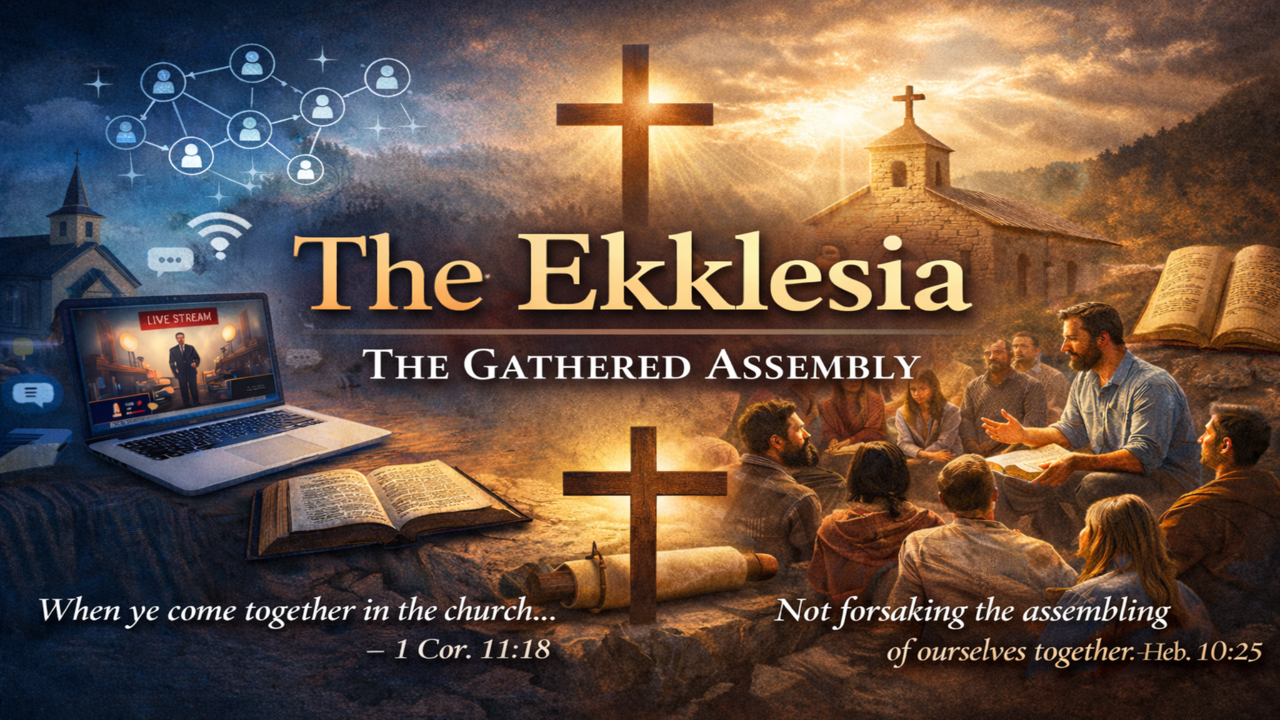
~ A Note to the Reader ~
The purpose of this material is not to create division, provoke debate, or diminish the sincerity of any believer. It is written with the desire to examine Scripture honestly, carefully, and exegetically. Many of us inherited assumptions about what a “church” is—assumptions shaped by tradition, translation history, and culture rather than by the biblical text itself. This study simply invites the reader to look afresh at Scripture, not through the lens of modern terminology, but through the plain meaning of the Greek word ekklesia as the Holy Spirit gave it.
The study that follows is grounded in the objective meaning of the Greek word ekklesia and the plain usage of Scripture. These are not conclusions drawn from a personal interpretive system, but from what the text itself consistently says.
The meaning of ekklesia is clear, consistent, and well-attested across the Greek New Testament and the Greek Old Testament (Septuagint). When the inspired text uses the word ekklesia, it describes something precise and concrete—an assembled people. The aim is to honor what Scripture says, even when it challenges long-held assumptions or familiar language.
Please receive this study in the spirit in which it is offered: a call to return to the biblical definition of Christ’s assembly, grounded not in tradition but in the Word of God itself.
Introduction
Few subjects in modern Christianity carry as much confusion—and yet as much importance—as the meaning of the word church. For most believers today, the term seems self-evident: a ministry, a building, a livestream, a fellowship group, or any gathering of Christians is routinely described as a “church.” But the Greek NT text uses a different word, ekklesia (assembly), and with it comes a different reality—one rooted not in English tradition, but the New Testament writers who were led in the Spirit-wrote the scripture in the Greek language.
Understanding the difference between church as a cultural term and ekklesia as a biblical term is not an exercise in semantics. It is essential for recovering how Christ Himself defined His assembly, how the apostles understood it, and how the early believers lived it out.
This study examines the historical development of the English word church, the unchanging meaning of the Greek word ekklesia, and the biblical pattern that has always characterized the gathered people of God. My desire is simply to allow Scripture to speak for itself so that Christ’s design for His assembly may be seen with clarity, reverence, and conviction.
The English Term “Church” and the Biblical Reality of the Ekklesia
One of the most persistent misunderstandings in Christianity today centers on the use of the English word “church.” In modern speech, nearly anything can be called a church—an online meeting, a livestream, a loosely connected group of believers, a building, an institution, or a ministry. Yet none of these reflect the biblical meaning of the word ekklesia. This confusion is not accidental; it is part of a long linguistic and historical development that obscured the original intent of Scripture.
The English word church is not a translation of ekklesia but a holdover from terms such as kirke, kirch, and cirice, which referred to religious institutions or buildings. King James I cemented this confusion by mandating that the KJV translators retain English ecclesiastical terms—particularly “church”—in order to preserve the authority structure of the Anglican state-church (KJV Translation Rule #3). Because of this, Christians today speak in institutional language without realizing that Scripture speaks in assembly language. A person may freely call something a church in modern English, but the New Testament does not use the English definition; it uses the Greek term ekklesia, which has a stable meaning from Genesis to Revelation.
The Scriptural Meaning of Ekklesia as a Gathered Assembly
Unlike the flexible English term church, the biblical word ekklesia carries a precise, unchanging meaning. In the Septuagint—the Greek Old Testament used by Jesus and the apostles—ekklesia consistently refers to the physically gathered people of God. For example, Moses was commanded: “Gather the people together unto me, and I will make them hear my words” (Deut. 4:10). The LXX uses synagō (to gather together physically) and immediately identifies the gathered people as the ekklesia. Likewise, “all the children of Israel… gathered… in the congregation (ekklesia) of the people of God” (Judg. 20:2). Throughout the Old Testament, ekklesia is always defined by physical gathering.
The New Testament continues this pattern without deviation. Paul writes to the Corinthian believers, “when ye come together in the church” (1 Cor. 11:18), which in Greek reads “when you assemble together in ekklesia.” He later adds, “If therefore the whole church be come together into one place…” (1 Cor. 14:23). Scripture itself defines the ekklesia as the assembly of believers who have come together into one place. When they gather, they are the ekklesia. When they disperse, they are brethren, saints, or disciples—but not the ekklesia. This is not theological opinion; it is the plain wording of the Holy Spirit.
The Biblical Imperative to Assemble: Gathering as a Foundational Command
The relationship between gathering and the ekklesia is not optional—it is commanded. Hebrews 10:25 exhorts believers, “Not forsaking the assembling of ourselves together,” using the strongest Greek noun for gathering: episynagōgē, which always denotes physical assembly. This word family—synagō, episynagō, episynagōgē—is consistently used of real, tangible, bodily gathering. Jesus Himself said, “Where two or three are gathered together in my name, there am I in the midst of them” (Matt. 18:20). Gathering, throughout Scripture, is temporal, spatial, and physical.
There is no biblical category for a virtual ekklesia, nor for a disembodied assembly. A livestream may encourage, and an online meeting may edify, but neither can replace the essence of what God calls the assembly. The Lord’s Supper especially requires a gathered body: “When ye come together therefore into one place…” (1 Cor. 11:20). These ordinances require presence. And the ekklesia is, by definition, the people who have obeyed God by assembling.
Why Modern Usage Cannot Override Biblical Definition
This brings us to the central issue. Modern English usage allows enormous freedom with the word church. A person may describe a livestream service as “going to church,” or a virtual Bible study as “church fellowship.” In colloquial English, this is understandable. Yet calling something a “church” in modern English does not make it a biblical ekklesia. Scripture, not culture, defines Christ’s assembly. Even sincere believers often operate on inherited assumptions rather than biblical conviction, thinking that any Christian activity can be a “church.” But sincerity does not create a biblical category.
A person may accurately call an online meeting a “church” only in the English institutional sense. But he cannot—without contradicting Scripture—call such a meeting an ekklesia. And because biblical authority is tied to the ekklesia, not to the English word church, no one may claim biblical authority for a body that is not gathered.
Ekklesia and Authority: Why the Distinction Matters
Authority in the New Testament belongs not to the word church, but to the ekklesia Jesus builds (Matt. 16:18). Elders are ordained1 “in every church (ekklesia)” where there is a gathered, identifiable body of believers (Acts 14:23; Titus 1:5). Discipline is carried out in the gathered ekklesia (Matt. 18:17). The Lord’s Supper is observed when believers “come together” (1 Cor. 11:20). Even church decisions are made by “the whole church” when gathered (Acts 15:22). Therefore:
- Calling something a church does not give it biblical authority.
- Only a gathered ekklesia can exercise the authority Christ gives.
- Without gathering, there is no biblical assembly, and thus no biblical authority.
This is why the distinction between church and ekklesia is not academic—it is theological, doctrinal, and intensely practical.
A Clarifying Observation About Modern Misuse
Many sincere believers—including those who are genuinely intelligent and earnest students of Scripture—sometimes allow tradition or pride to shape their understanding more than Scripture. A person may insist that their online group is “the church,” while being unaware that Scripture never defines the assembly apart from physical gathering. They may acknowledge that ekklesia means “a gathering of people,” yet still cling to the English word church as justification for claiming authority that Scripture does not confer. This is not intentional deception but inherited thinking. The clarity of Scripture exposes the confusion: the authority Christ grants belongs to the ekklesia, not to the modern English redefinition of the word church.
A believer is free to use the word “church” in its modern, everyday sense. But if he invokes the authority of Scripture, he must use Scripture’s definitions. And Scripture knows nothing of a disembodied assembly, a virtual ekklesia, or a church that never gathers physically.
Three Foundational Truths That Resolve the Confusion
To summarize the biblical and linguistic evidence:
- Calling something a “church” does not make it an ekklesia.
The New Testament grants authority to the ekklesia, not to English terminology. - No one can claim biblical authority without demonstrating a biblical ekklesia.
Without physically gathering, there is no ekklesia; without an ekklesia, there is no authority. - Scripture—not tradition, not modern usage, not preference—defines Christ’s assembly.
Faithful believers must submit to Scripture even when it challenges familiar assumptions.
Conclusion
The difference between church and ekklesia is not minor. It represents the difference between an English institutional term and the Spirit-inspired word God chose to describe His assembly. The ekklesia is the physically gathered body of believers who covenant together, sit under biblical leadership, observe the ordinances, and carry out the will of Christ as His visible people. When we reclaim the biblical meaning of ekklesia, we recover the original clarity, authority, and beauty of Christ’s design for His assembly—something no online meeting or institutional redefinition can ever replace
Footnotes:
- Note on the term “ordained”:
In the New Testament, the word translated ordain (Acts 14:23 NASB —”When they had appointed elders for them in every church, having prayed with fasting, they entrusted them to the Lord…”, Titus 1:5 NASB —“…that you would set in order what remains, and appoint elders in every city as I directed you—”), comes from the Greek cheirotoneō, meaning to appoint or formally recognize. It does not refer to a clerical or sacramental act, but to the public recognition of men who already meet the biblical qualifications for eldership (1 Timothy 3; Titus 1). ↩︎

