
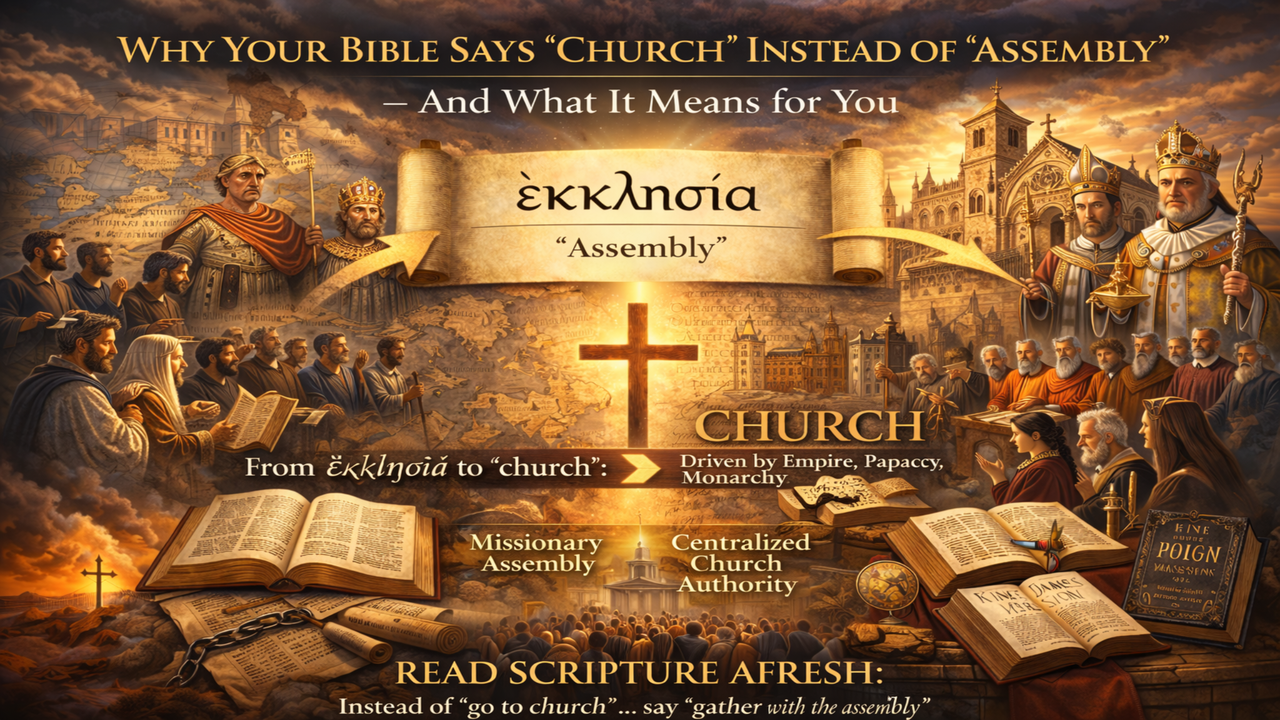
Translating Greek New Testament word Ekklesia: A Full Deep-Dive Answer
Layman-Friendly Summary – And What It Means for You
Why Your Bible Says “Church” Instead of “Assembly”
Imagine you’re reading the Bible and hit words like “church” in verses about Jesus’ followers. It sounds normal, right? But dig a little, and you’ll see it’s not what the original writers meant. The Greek word they used—ekklesia—simply meant a group of people called out from everyday life to gather for a purpose, like a town meeting or a family reunion with a mission. In the New Testament, it was about believers coming together locally to live out God’s plan: sharing, teaching, and proclaiming salvation through Christ. Not a big organization or a building, just God’s people on the move in the world.
So why do we read “church” today? It started way back when Christianity mixed with the Roman Empire’s power games. Around 300 AD, Emperor Constantine made Christianity legal and official. Leaders wanted to make it a big, organized system to control crowds and fight enemies. They took the pure Greek ekklesia and tweaked it in Latin to “ecclesia,” keeping the sound but adding a fancy, official vibe. It was like turning a backyard barbecue into a royal banquet—still people gathering, but now with kings and rules on top.
Fast forward: The Bible got translated into Latin (the Vulgate, around 400 AD), then into Old English around 700–800 AD. Missionaries to places like England borrowed a word for “Lord’s house” (from Greek kyriakon)1, which became “cirice” or “church.” It started meaning a physical building or a top-down group led by bishops, not just everyday believers. By medieval times, the Roman Catholic Church used this to build empires—popes allying with kings, controlling land and wars, all under the banner of “the Church” as the ultimate authority.
| Greek NT Word | Meaning | English Result |
|---|---|---|
| ἐκκλησία (ekklesia) | Assembly | (should be assembly/congregation) |
| κυριακόν (kuriakon) | Lord’s (house) | church this English word derives from a different Greek word entirely. |
When English Bibles came along (like Wycliffe in 1382 or the King James in 1611), they stuck with “church” because it fit the power structure. Kings like James I of England wanted a strong national “church” to unify people against rivals (like Catholic Spain or rebellious Puritans). A neutral word like “assembly” might have encouraged folks to break off and form their own groups, threatening the status quo. So, they borrowed from the old Latin and medieval habits, hiding the original idea of God’s people as a lively, called-out family.
Why does this matter today? It sneaks in wrong ideas: that “church” is a club you join on Sundays, or a building you go to, or a hierarchy you obey. But ekklesia shows the real church is you and other believers, called out by Jesus to transform the world with His truth—no middlemen needed beyond Scripture and the Holy Spirit. It’s God’s plan for mankind: a global family proclaiming Christ as King, fulfilling Old Testament promises (we’re the true Israel in Him). Next time you read “church,” swap it mentally for “assembly,” and see the Bible light up. It’s freedom from man-made systems back to God’s simple design.
If you want the full backstory continuing reading with sources and dates, check out the deeper research below or [your webpage link here]. It’s eye-opening how words shape what we believe.
A Full Deep-Dive Answer: Translating Greek New Testament word Ekklesia
Introduction
In the pages of the New Testament, the Greek word ἐκκλησία (ekklesia)—meaning a “called-out assembly” or dynamic gathering of believers—paints a vivid picture of God’s people united for His redemptive mission in the world. This term, used over 100 times by the apostles, evokes not a rigid institution or physical building, but a living community summoned to proclaim Christ’s lordship and fulfill ancient promises to Abraham’s seed. Yet, when English Bibles like the King James Version (1611) render ekklesia as “church,” a subtle but profound shift occurs: the emphasis moves from participatory believers to a hierarchical organization, altering how generations understand the church’s role in God’s plan.
The compiled research that follows will delve into the historical records tracing why and when “church” supplanted the original Greek, uncovering a story intertwined with linguistics, power dynamics, and geopolitics. From the Roman Empire’s embrace of Christianity to the Vulgate’s papal standardization and English monarchs’ translations, we explore primary sources, manuscripts, and key figures to reveal how institutional agendas reshaped a biblical ideal. By examining this evolution, we not only unearth the evidence but also reclaim the truth that the ekklesia is Christ’s body—a called-out assembly advancing His salvation narrative, unencumbered by man-made structures.
The substitution of “church” for the Greek New Testament term ἐκκλησία (ekklesia) in English Bibles is not a neutral linguistic accident but a product of geopolitical maneuvering, institutional consolidation, and translation politics spanning centuries. This deep dive traces the evidence from the 1st century AD Greek originals through Latin transliteration, Germanic borrowings, and English Bibles, highlighting how ekklesia—a term for a “called-out assembly” of believers—evolved into a symbol of hierarchical power. The Roman Empire’s absorption of Christianity, the Vulgate’s papal standardization, and monarchical pressures in England entrenched “church,” obscuring the biblical emphasis on God’s people as a dynamic, missional gathering proclaiming salvation through Christ.
I. The Original Greek: ἐκκλησία (Ekklesia) as “Called-Out Assembly” (1st Century AD)
Composed between 50–100 AD, the New Testament employs ekklesia 114 times to describe physical gatherings of believers fulfilling God’s redemptive plan. Derived from ek-kaleō (“called out”), it carried classical connotations of a civic assembly (e.g., Aristotle’s Politics, 4th century BC, for citizen meetings). In Scripture, it denotes people summoned locally for divine purposes, not a building or institution.
- Biblical Context: In secular usage, Acts 19:32–41 describes a riotous “assembly” in Ephesus protesting Paul. Christianly, it appears in 1 Corinthians 11:18 (“when you come together as an ekklesia”) and Matthew 16:18 (“I will build my ekklesia”), emphasizing believers called out in a physical meeting to assemble and proclaim Christ’s lordship (echoing the Septuagint’s translation of Hebrew qahal as assembly, e.g., Deuteronomy 4:10). This aligns with the fulfillment of Israel’s congregation (Hebrews 12:23), a universal body superseding the old covenant.
- Early Evidence: 4th-century manuscripts like Codex Sinaiticus confirm ekklesia unchanged.2 Ignatius of Antioch (Epistle to the Smyrnaeans 8:2, c. 107 AD) uses it for local believer groups, without institutional overtones. Ekklēsia’s neutrality allowed Christians to repurpose a common term, distinguishing their gatherings from pagan temples or synagogues.3
No “church” existed; the focus was on God’s called-out people advancing His mission amid Roman persecution.
II. Latin Transliteration: Ecclesia as Imperial and Papal Consolidation (3rd–5th Centuries AD)
The pivotal geopolitical shift begins as Christianity integrates with the Roman Empire, transliterating the Greek term ekklesia to a Latin word ecclesia to forge a parallel power structure.
- Constantine’s Geopolitical Synthesis (313–337 AD): Pre-Constantine, ekklesia evoked house-based assemblies (Pliny the Younger, Epistles 10.96, c. 112 AD). The Edict of Milan (313 AD) and Nicaea Council (325 AD) centralized Christianity to stabilize the empire against internal heresies and external threats (e.g., Sassanids). Acts from Nicaea (preserved in Eusebius’s Life of Constantine, Book 3) use ecclesia for an organized body under imperial bishops, mirroring Roman governance. Constantine’s basilica-building (e.g., Old St. Peter’s, 326 AD) tied it to physical sites, shifting from people to institution.
- Jerome’s Vulgate and Papal Mandate (382–405 AD): Commissioned by Pope Damasus I amid barbarian invasions (Visigoths, 410 AD), Jerome’s Vulgate (c. 405 AD) transliterates ekklesia as ecclesia over 100 times. Jerome’s Preface to the Four Gospels (c. 383 AD) and Epistle 57 (c. 395 AD) justify this to preserve apostolic authority while binding the West under Latin. Earlier Old Latin texts (e.g., Codex Bobbiensis, 4th century) and Tertullian (Apology 39, c. 200 AD) already used ecclesia for assemblies.
Geopolitical Overtones: Transliteration wasn’t casual; it embedded ecclesia in imperial law (Theodosian Code, 380 AD, Book 16, enforcing “catholic” faith via ecclesia). As the Western Empire collapsed (476 AD), popes like Leo I (Tome, 449 AD) wielded it for primacy over Constantinople’s Greeks. Augustine’s City of God (426 AD, Book 19) contrasts the “ecclesia” (earthly church-Rome) with heaven, justifying papal sovereignty. This claimed ekklesia’s biblical prestige for a supranational entity, sidelining “assembly” (contio) to avoid republican chaos or heresy. The Roman see, as imperial heir, exported this to feudal Europe.
Why transliterate? Power: It evoked mystery, continuity, and control, aligning the church with Rome’s geopolitical reach and superseding Jewish qahal as the true Israel in Christ.
III. Germanic and Pre-English Borrowings: From Lord’s House to Institutional Edifice (6th–8th Centuries AD)
As Christianity spread north post-Empire fall, ecclesia influenced Germanic languages, where “church” emerged amid missionary geopolitics.
- Etymology and Origins: English “church” derives from Old English cirice (8th century, Corpus Glossary, c. 700–800 AD, glossing ecclesia). It stems from Proto-West Germanic kirikā, borrowed from Late Greek kyriakón (“Lord’s house,” from kýrios, “lord”; cf. Eusebius, Ecclesiastical History 10.4, c. 325 AD, for post-Constantine buildings). 4th-century Egyptian papyri (Oxyrhynchus) use kyriakè for worship spaces. Ulfilas’s Gothic Bible (c. 350 AD, Codex Argenteus fragments) employs kirkō for ecclesia, spreading to German Kirche.
Geopolitical Spread: Missionaries like Augustine of Canterbury (597 AD) brought Vulgate texts amid Anglo-Saxon wars. Bede’s Ecclesiastical History (731 AD, Book 1.25) uses cirice for Canterbury’s structures, reflecting Carolingian alliances (Charlemagne’s 800 AD coronation by Leo III). Alcuin’s Vulgate revisions (Admonitio Generalis, c. 796 AD) tied ecclesia to dioceses controlling lands against Vikings. The forged Donation of Constantine (8th century) bolstered papal-imperial fusion, making “church” denote territorial power.
Why “church” over assembly? Institutional needs: Germanic converts grasped physical “Lord’s houses” better than abstract gatherings, aligning with feudal hierarchies.
IV. English Translations: Entrenching “Church” Under Monarchical and Ecclesiastical Pressures (14th–17th Centuries)
Medieval papal dominance via the Vulgate spring-boarded “church” into English, adapted for national geopolitics.
- Wycliffe Bible (1382 AD): From the Vulgate, it uses “chirche” (e.g., Matthew 16:18, Bodleian MS Bodley 959). Wycliffe’s On the Church (c. 1378) critiques Roman corruption during the Hundred Years’ War, but ecclesia’s institutional legacy stuck amid English bids for papal independence (Edward III era).
- Tyndale New Testament (1526 AD): From Greek (Erasmus, 1516), Tyndale renders ekklesia as “congregacion” (e.g., Acts 19:32), reclaiming assembly roots. Tyndale’s Obedience (1528) attacks hierarchies, fleeing Roman inquisitors under Henry VIII’s 1534 schism.
- Geneva Bible (1560 AD) to KJV (1611 AD): Geneva mixes terms amid French religious wars, prioritizing “church” for Protestant unity. The KJV, authorized by James I at Hampton Court (1604), uses “church” 108 times (Rule 3, 1604 edicts; British Library Add MS 31040). James’s letters (to Bancroft, 1604) and quip (“No bishop, no king”) show intent to mirror Roman ecclesia under Anglican monarchy, countering Catholic/Spanish threats (post-1588 Armada) and Puritan autonomy. The preface (Translators to the Reader) avoids “innovation,” inheriting Vulgate via Wycliffe.
Geopolitical Lock-In: High Medieval councils (Lateran IV, 1215; Toulouse, 1229) monopolized the Vulgate, entrenching ecclesia as hierarchy (Gregory VII’s Dictatus Papae, 1075; Aquinas, Summa 1274). English kings adapted this for nationalism, using “church” to unify against rivals and suppress “congregation”-style independence.
V. Reasons, Evidence, and Implications
The shift prioritized power: Constantine’s empire-building, papal feudalism, and monarchical control transformed ekklesia from missional assembly to institutional “church.” Sources include patristics (Tertullian, Origen), manuscripts (vulsearch.sourceforge.net; codexsinaiticus.org), etymologies (Etymologicum Magnum, 12th century), and histories (F.F. Bruce, The English Bible, 1961; David Daniell, The Bible in English, 2003). For deeper excavation: Ulfilas fragments (uppsalauniversitylibrary.se), James I’s Basilikon Doron (1599), or Dura-Europos archaeology (Journal of Roman Archaeology).
This obscures the New Testament’s truth: the ekklesia is Christ’s body, called out to declare His kingship (no separate paths; John 14:6). It fulfills Abraham’s promises in the church alone, rejecting distortions like dual covenants or Zionism. Restoring “assembly” reveals God’s design for believers as world-transforming witnesses.
Conclusion
The journey from the New Testament’s ekklesia to the English “church” reveals a layered tapestry of translation choices driven by the geopolitical imperatives of empire, papacy, and monarchy. What began as a simple Greek term for God’s called-out people—echoing Israel’s qahal and fulfilling covenant promises through Christ—evolved through Constantine’s imperial synthesis, Jerome’s Latin transliteration to ecclesia, Germanic borrowings rooted in kyriakón, and the Vulgate’s medieval dominance into a symbol of centralized authority. By the Reformation and the 1611 KJV, “church” was firmly entrenched to serve the needs of national ecclesiocracies, obscuring the original’s emphasis on believers as a missional assembly proclaiming God’s singular path to salvation (John 14:6).
This historical reckoning matters profoundly today: it challenges us to strip away accretions of building-centric or hierarchy-bound religion, rediscovering the ekklesia as the true church—ordinary people called out for extraordinary purpose, the spiritual Israel inheriting eternal promises apart from ethnic or dual-covenant illusions. As we read Scripture, let the evidence here inspire a return to this biblical vision: not attendance at “churches,” but active participation in Christ’s global assembly, transforming the world with His truth. For those seeking to apply this, replacing “church” with “assembly” in personal study unveils fresh insights; for scholars, the cited sources offer gateways to further excavation. In reclaiming ekklesia’s essence, we honor God’s inspired word and empower His people anew.
Footnotes:
- The English word “church” does not come from the Greek ekklesia but from kyriakon, meaning “belonging to the Lord.” Though both words relate to Christian identity, they are not linguistically the same. When English translators rendered ekklesia as “church,” they imported a term shaped by centuries of institutional Christianity. The New Testament emphasis on a called-out assembly was therefore filtered through a word that had already acquired structural and hierarchical connotations. ↩︎
- The 4th-century Codex Sinaiticus preserves the New Testament text in the original Greek, including terms such as ἐκκλησία (ekklēsia), providing early manuscript evidence for the New Testament wording prior to later Latin and vernacular translations. ↩︎
- In classical Greek, ἐκκλησία referred to a civic assembly rather than a religious building (see Liddell-Scott-Jones Greek-English Lexicon, Perseus Digital Library). In the Septuagint it translates Israel’s covenant assembly (Deut. 9:10), and in the New Testament it denotes the gathered people of Christ rather than a temple structure (see Bauer-Danker-Arndt-Gingrich Greek-English Lexicon; Theological Dictionary of the New Testament, vol. 3). ↩︎

