
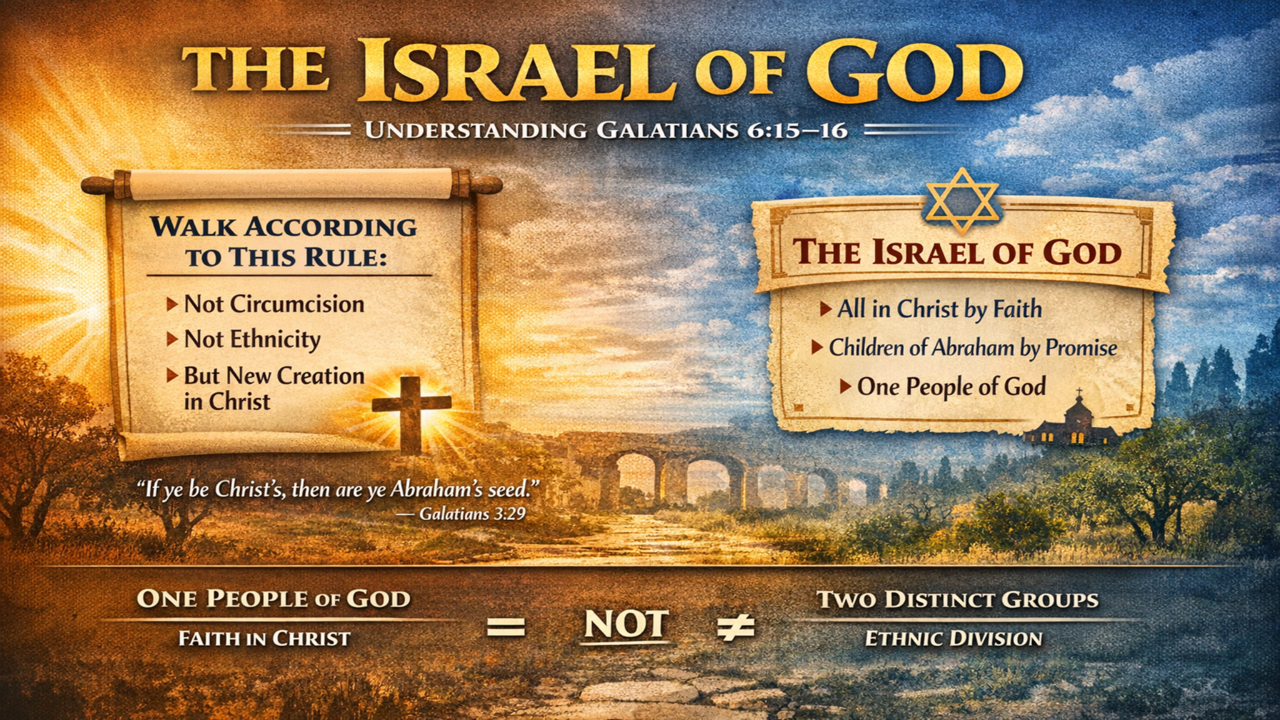
Introduction: Galatians 6:15–16 in Its Proper Context
Few verses in Paul’s writings have generated as much theological discussion as Galatians 6:15–16. At the heart of the debate lies a critical question: Who is “the Israel of God”? Is Paul referring to a separate group—ethnic Israel—or is he describing the same people already identified as those who walk according to the gospel? This question is not isolated. It touches the broader issue of how Scripture defines the people of God under the New Covenant. In a letter written specifically to confront confusion about law, identity, and justification, Paul’s closing words are not incidental—they are the summary of his entire argument.
To understand this passage rightly, we must examine what Paul means by the walk, who “them” refers to, and how the phrase “Israel of God” functions in the sentence.
Galatians 6:15–16
“For in Christ Jesus neither circumcision availeth any thing, nor uncircumcision, but a new creature1. And as many as walk according to this rule2, peace be on them, and mercy, and upon the Israel of God3.”
The Rule and the Walk: A Life Defined by New Creation
Paul says that in Christ Jesus neither circumcision nor uncircumcision4 avails anything, but only a new creature. The “rule” here is the governing standard Paul has just stated. The Greek word behind “rule” is kanōn5, meaning a measuring line or standard. So, to walk according to this rule is to live in accordance with the truth that external distinctions such as ritual identity, ethnic label, and fleshly confidence cannot justify or define the people of God.
In other words, Paul is describing a life governed by the gospel itself. It is a walk that rejects confidence in the flesh and rests instead in union with Christ, inward transformation, and new-creation reality. This is entirely consistent with the broader argument of Galatians, where Paul says, “For ye are all the children of God by faith in Christ Jesus,” and again, “There is neither Jew nor Greek… for ye are all one in Christ Jesus.” The walk, then, is not merely a moral lifestyle in the abstract, but a life consciously ordered by the truth that faith in Christ—not law, ritual, or ethnicity—defines covenant identity.
Peace and Mercy Upon “Them”
When Paul says, “And as many as walk according to this rule, peace be on them, and mercy,” the identity of “them” is grammatically straightforward. “Them” refers to all those who walk according to the rule just described. These are believers in Christ who have embraced the gospel and who no longer ground their standing before God in outward distinctions. Upon these Paul pronounces peace and mercy—peace as reconciliation with God, and mercy as His compassionate favor toward those who are His.
Nothing in the immediate sentence suggests that Paul has shifted to a different category of people. Rather, the blessing is spoken upon one identifiable group: those who live in accord with the truth of the gospel.
“And Upon the Israel of God”: One Group or Two?
The crucial question is whether the words “and upon the Israel of God” refer to a second group distinct from “them,” or whether Paul is restating the identity of “them” in covenantal terms. Much turns on the function of the word and (kai)6. While kai often serves as a simple connector, it can also function in an explanatory sense—“even,” “that is,” or “namely.”
In this context, that explanatory sense fits naturally. Paul is not introducing a second people after spending the whole letter dismantling flesh-based distinctions. Rather, he is identifying the same people in a fuller way. The sense is: peace be on them, even upon the Israel of God. That reading makes “them” and “the Israel of God” synonymous, with the second phrase explaining the true identity of the first.
In plain terms: those who walk according to Paul’s gospel rule are the very people he calls “the Israel of God.”
Why Context Demands This Reading
Paul’s entire argument throughout Galatians points in this direction. Earlier he states, “They which are of faith, the same are the children of Abraham7.” He also says, “If ye be Christ’s, then are ye Abraham’s seed, and heirs according to the promise.” Later he says, “Now we, brethren, as Isaac was, are the children of promise.” These are not side comments. They form the backbone of the letter’s argument.
If Paul has already taught that the children of Abraham are those of faith, and that those in Christ are Abraham’s seed, then it would be highly out of place for him to conclude the letter by suddenly reintroducing a separate covenant identity based on ethnicity. That would undo the very case he has spent the epistle establishing. The natural reading is that Paul is reaffirming that God’s covenant people are defined by faith in Christ and by the new creation, not by fleshly descent.
Comparison Chart: Two Major Interpretive Approaches
| Category | Covenantal / Contextual View | Dispensational View |
|---|---|---|
| “Them” | All believers walking by the gospel rule | Primarily Gentile believers |
| “Israel of God” | Same group, described covenantally | A second group, usually ethnic Israel or believing Jews |
| Meaning of “and” (kai) | Explanatory: “even,” “that is” | Additive: separates two groups |
| Fit with Galatians | Consistent with Paul’s argument removing fleshly distinctions | Reintroduces a distinction Paul has already dismantled |
| Identity of God’s people | One people defined by faith in Christ | Two distinguishable covenant categories |
| Theological implication | Unity of God’s people in Christ | Continuing distinction between Israel and the church |
Parallel Passages That Support the Same Pattern
Paul says in Romans 2:28–29 that one is not a Jew merely outwardly, but inwardly, in the heart and in the spirit. In Philippians 3:3 he writes, “For we are the circumcision8, which worship God in the spirit.” In Romans 9:6 he says, “They are not all Israel, which are of Israel.” Taken together, these passages reinforce the same principle found in Galatians 6: God’s people are not finally identified by outward markers or natural descent, but by the inward reality of faith and the work of God.
A Brief Note on Early Christian Witness
Early Christian writers often understood the matter in this same general direction. Justin Martyr, for example, referred to believers in Christ as the true spiritual Israel. While the fathers should never replace Scripture, their witness is worth noting because it shows that reading Galatians 6:16 covenantally is not an invention of recent theology. It has deep historical roots in Christian interpretation.
Conclusion
Galatians 6:15–16 brings Paul’s argument to a fitting close. The walk he speaks of is a life governed by the gospel truth that neither circumcision nor uncircumcision avails anything, but only a new creature. Those who walk according to this rule are the recipients of peace and mercy. And in the final phrase, Paul identifies them as the Israel of God.
This means that the phrase is best understood not as introducing a second category of people, but as describing the same people already in view. The Israel of God, in this context, is the community of those who are in Christ, who live by faith, and who belong to the new creation. The emphasis falls not on ethnicity, ritual, or lineage, but on Christ, promise, and spiritual transformation. Thus Paul’s closing words reaffirm a central theme of the epistle: God has one covenant people, and they are defined not by the flesh, but by faith.
Popup Index: 1 = new creature, 2 = walk according to this rule, 3 = Israel of God, 4 = circumcision nor uncircumcision, 5 = kanōn, 6 = and (kai), 7 = children of Abraham, 8 = circumcision in Philippians 3:3.

