
~ NOTE TO THOSE CONSUMING THIS CONTENT ~
Before you begin, a brief statement that’s given with grace and clarity.
Nothing in this post is offered in a harsh or argumentative spirit. The points presented here are rooted in the actual Greek text of the New Testament and in the consistent way the inspired writers used the word ekklesia. If you believe any part of this study is incorrect, I kindly ask that you evaluate it with Scripture itself — not personal opinion, tradition, or what seems right to us. The Old Testament warns us that “every man did that which was right in his own eyes” (Judges 21:25), and this caution applies whenever our preferences or customs override what God’s Word actually says. The sincere desire is that we all allow Scripture — not modern practice or technological convenience — to define what Christ’s assembly is and how it functions.
Introduction: Why the Biblical Assembly Cannot Be Virtual
Across the English-speaking world, Christians routinely speak of “going to church” or “attending church online.” Yet these phrases are rooted not in biblical language but in later translation decisions and cultural habits. To understand what Christ established and what the apostles taught, one must return to the New Testament word ekklesia, for this term defines the nature, structure, and essence of the Christian gathering.
What follows is a clear, historically verifiable, biblically grounded explanation of what ekklesia really means, why the English word “church” has caused centuries of misunderstanding, and why online meetings can never fulfill the biblical definition of the assembly.
I. The Meaning of Ekklesia in Scripture and History
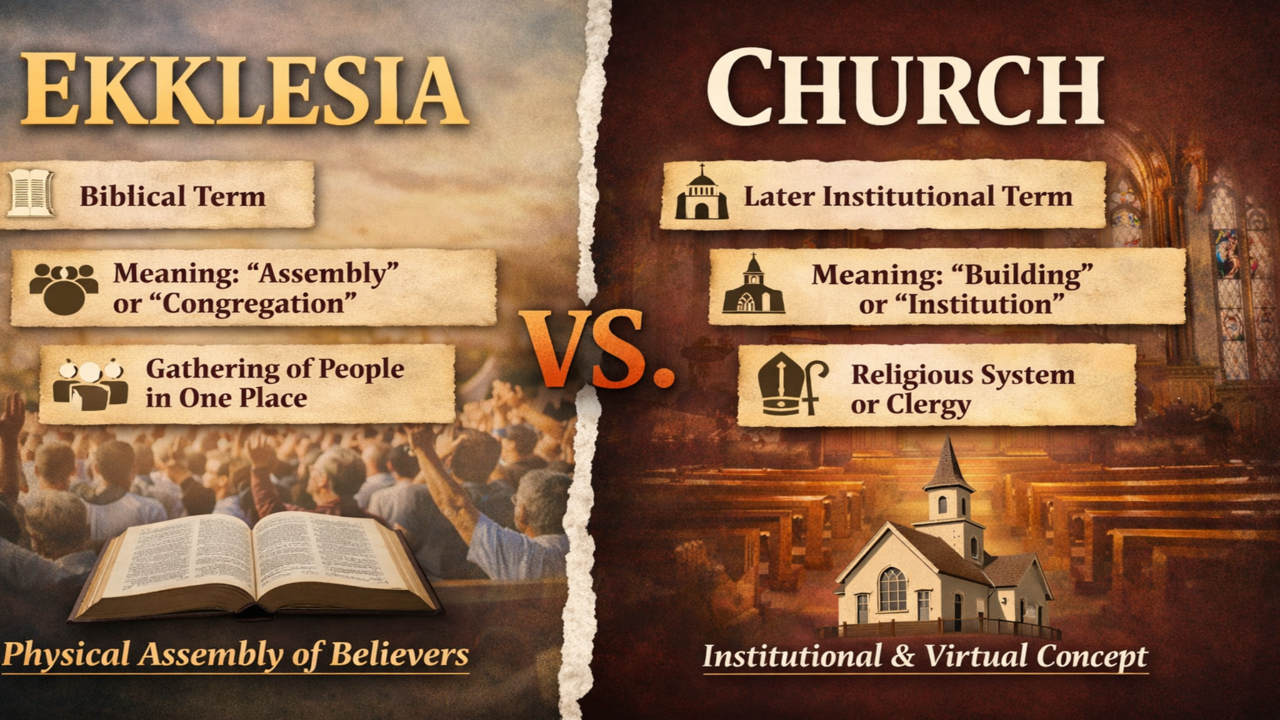
The word used by Jesus and the apostles for the gathered people of God is ἐκκλησία (ekklesia). This Greek term was not invented by Christians; it was already widely understood in the Greek-speaking world. In every natural usage—classical Greek, the Septuagint, and common civic life—ekklesia meant an assembly of people physically gathered together in one place.
A. Etymology and Basic Meaning
Ekklesia is composed of:
- ek (“out of”) and
- kaleō (“to call”).
The literal sense is “a called-out gathering,” but by the first century, the meaning was fixed as simply an assembled group. When people were summoned for a civic meeting, they physically came together. The word always involved:
- people
- gathering
- in a specific location
- for a shared purpose
It was never used for individuals separated from one another in their homes.
B. Scriptural Usage Confirms Physical Gathering
This meaning is demonstrated clearly in the New Testament itself.
In Acts 19, the same word ekklesia describes:
- a confused crowd assembled in the theater (v. 32),
- a lawful civic assembly (v. 39), and
- the dismissed assembly after the town clerk quiets the crowd (v. 41).
These are not spiritual gatherings but secular, civic assemblies. Yet Luke uses the identical Greek term that he—and the rest of the NT—uses for the gatherings of Christians.
This proves that ekklesia means exactly what it always meant:
a physical assembly of people in one place.
C. Translations: Tyndale vs. the KJV
When William Tyndale translated the New Testament into English (1520s), he correctly rendered ekklesia as “congregation.” This preserved the meaning of a gathered people and avoided the institutional connotations of the medieval church.
However, when the King James Bible was commissioned in 1604, King James imposed specific rules on the translators. One rule explicitly prevented them from translating ekklesia as “congregation” and forced them to use the institutional word “church.”
This decision was political, not linguistic.
It preserved the authority structure of the Church of England and prevented readers from seeing the local congregation—not the institution—as the true biblical assembly.
As a result, for four hundred years, English speakers have inherited a term—church—that does not convey the biblical meaning of ekklesia.
II. What Hebrew or Aramaic Term Would Correspond to Ekklesia?
The closest Hebrew Old Testament term is:
קָהָל (qahal) — “assembly, congregation, gathered people”
This word occurs over 120 times in the Hebrew Bible.
Examples:
- Deut. 9:10 — “the day of the assembly” (qahal)
- Psalm 22:22 — “in the midst of the congregation (qahal) will I praise thee.”
- 1 Kings 8:14 — “all the congregation of Israel”
There is also another related term:
עֵדָה (edah) — “community, gathering, group”
But the primary concept closest to ekklesia is qahal.
III. Why Did New Testament Writers Choose Greek Instead of Hebrew?
Many assume the NT should have been written in Hebrew, since Jesus was Jewish. But there are three decisive reasons why the Holy Spirit directed the apostles to write in Greek:
1. Greek was the universal language of the Roman world.
Writing in Greek ensured the gospel spread to:
- Judea
- Samaria
- the Diaspora
- Asia Minor
- Greece
- Rome
- North Africa
God chose the language that would reach the world, not just one ethnic people.
This aligns with Christ’s command:
“Go ye therefore, and teach all nations.” (Matt. 28:19)
Greek made that possible.
2. Most Jews outside Judea did not read Hebrew anymore.
By the first-century:
- 70–90% of world Jewry lived outside the land
- The Septuagint (Greek OT) was their Bible
- Greek synagogues existed across the Mediterranean
- Paul and the apostles preached in Greek-speaking cities
If the NT were written in Hebrew, most Jews themselves could not read it.
3. Greek provided the most precise vocabulary for theology.
Greek is unmatched in clarity for:
- tenses
- voices
- moods
- syntax
- richness of vocabulary
Terms like:
- agape
- logos
- ekklesia
- charis
- pneuma
- diatheke (covenant)
…are extraordinarily clear in Greek.
God chose Greek because it was the sharpest tool for doctrinal precision.
IV. The Biblical Assembly Is Physical, Not Virtual
Having established what ekklesia means, we now evaluate whether an online meeting—through Zoom, Google Meets, livestream, or conference phone call—can be considered an ekklesia in the New Testament sense. Scripture gives a resounding answer.
A. Ekklesia Requires Physical Gathering
“Ekklesia is the noun that arises from the verb ‘to assemble.’ You cannot have an ‘assembly’ without assembling. Some may argue that you can have a ‘church’ without physically gathering — and that may be true only because the English word church has taken on institutional and abstract meanings that the Bible never intended. But church is not the word the Holy Spirit chose. It is not an accurate representation of ekklesia. In the New Testament, whether referring to a civic gathering or a congregation of believers in Christ, ekklesia always described a body of people assembled physically in one place. Therefore, we must either stop using the word ‘church’ as though it were synonymous with ekklesia, or we must consciously correct ourselves and use ‘church’ only in the sense Scripture gives it — as an actual physical assembling together in one place.”
In every case where the NT speaks of the church gathering:
- the members come together,
- in one location,
- to pray, worship, and practice the ordinances.
Believers scattered in different homes, connected technologically, may be communicating—but they are not assembling.
B. The Lord’s Supper Requires One Place
Nowhere is the nature of the assembly clearer than in Paul’s discussion of the Lord’s Supper (1 Cor. 10–11).
Paul repeatedly writes:
- “when ye come together in the church” (11:18)
- “when ye come together into one place” (11:20)
- “when ye come together” (11:33)
The Greek phrase epi to auto (“into one place”) removes all ambiguity. Paul rebukes the Corinthians because they were dividing and eating in separate groups—and that was not the Lord’s Supper (11:20).
If Christians in the same city but in different houses were not considered “together,” how much more those spread out across different homes, cities, or states?
The Supper requires:
- one assembled body
- one shared loaf
- one shared cup
- one local gathering in one location
This cannot be done through a screen.
C. Unity Is Embodied, Not Virtual
Paul’s theology of unity is grounded in physical symbols:
“We being many are one bread, and one body: for we are all partakers of that one bread.”
—1 Corinthians 10:17
The “one bread” symbolizes embodied unity.
There is no shared loaf in virtual communion, no visible unity, no physical participation in one act.
The very act that represents unity shows that virtual connection is not the biblical assembly.
D. Shepherding Requires Presence
Elders shepherd “those among them” (1 Pet. 5:1–3) and “watch for souls” (Heb. 13:17). This is not possible through screens. Elders must know, observe, counsel, visit, and protect the flock. Such shepherding is incarnational.
A virtual meeting cannot have biblical shepherds, and without shepherds, there is no biblical church.
E. Church Discipline Requires a Local Body
Jesus’ instructions in Matthew 18 conclude with “tell it unto the church,” and 1 Corinthians 5 requires the gathered church to act.
Discipline assumes:
- known membership
- shared life
- gathered presence
None of this can be accomplished through a virtual meeting.
F. Baptism Is an Embodied Ordinance
Baptism requires physical water, a baptizer, and witnesses. It is inherently bodily. Virtual baptism is impossible.
G. The “One Another” Commands Assume Embodied Community
Commands such as:
- love one another
- bear one another’s burdens
- exhort one another
- confess faults
- care for widows
- comfort one another
- be hospitable
are relational, physical, and life-sharing. They are not possible in their biblical fullness online.
V. Why Calling an Online Gathering “Ekklesia” Is Incorrect
To summarize the theological and linguistic evidence:
- Ekklesia means assembly, and assemblies require physical presence.
- The Lord’s Supper mandates believers be in one place.
- Shepherding, discipline, baptism, and mutual ministry require embodied community.
- The English word “church” misleads people into thinking institutional or virtual structures qualify.
- No virtual gathering can perform the functions of the biblical assembly.
Therefore:
A group of Christians meeting online may enjoy fellowship and teaching—but it is not an ekklesia.
Using the word “church” to describe an online event confuses modern assumptions with biblical reality.
The New Testament assembly is a community of believers who physically gather, share life, practice the ordinances, submit to recognized shepherds, and mutually minister to one another.
No amount of technology—no matter how advanced—can substitute for the embodied assembly Christ ordained.
Conclusion
Ekklesia, as used by Jesus and the apostles, refers to a gathered community. Far from being a vague spiritual concept or an institution one attends, it means an assembly of believers in one place. Tyndale rendered this correctly as “congregation,” but later translators—under political pressure—retained the institutional word “church,” shaping centuries of misunderstanding.
When this biblical definition is taken seriously, it becomes clear that online gatherings cannot replace or be called the church. They may support, supplement, encourage, and teach, but they cannot embody the life, ordinances, structure, or unity that define the ekklesia of Christ.
The NT assembly is a physically gathered people.
It always has been.
It always will be.
Technology cannot alter what Scripture established.

