
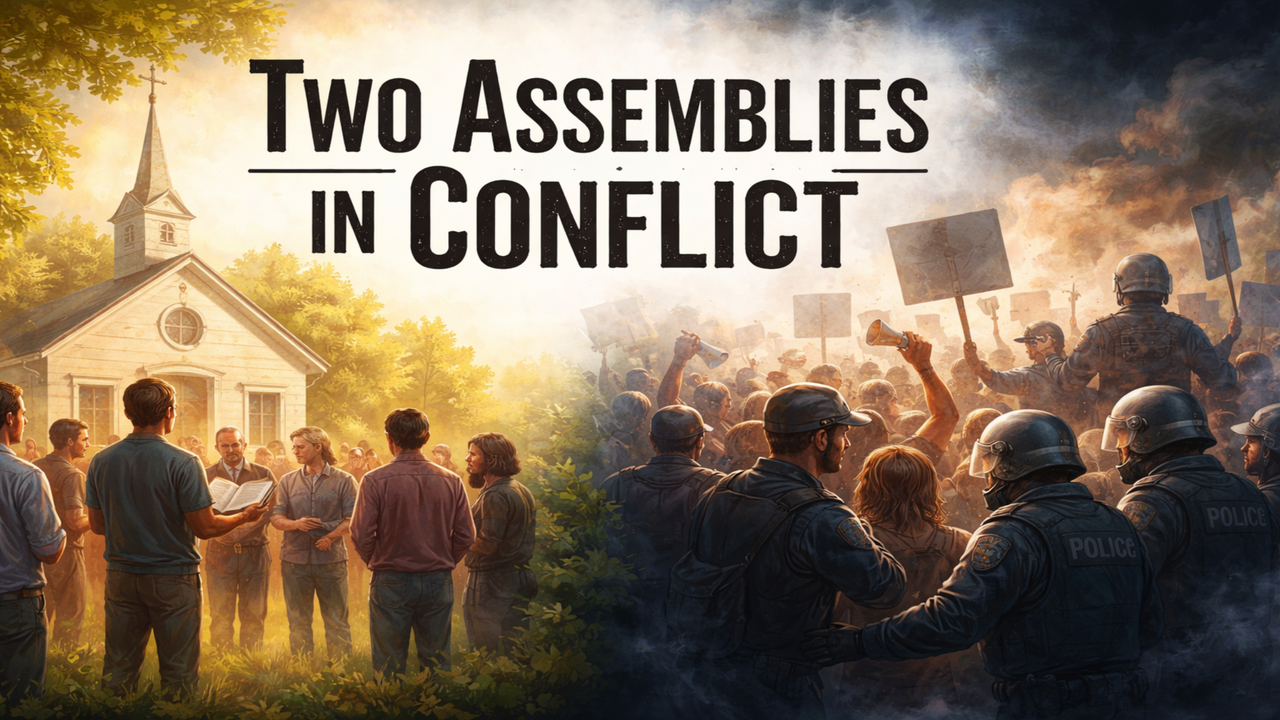
A Modern Reflection of Acts 19 and the Meaning of Ekklesia
Introduction
The New Testament word commonly translated “church” is the Greek term ekklesia, which means assembly—a gathering of people called together for a purpose. Scripture does not define ekklesia as an institution, a building, or a virtual organization, but as a physical gathering of persons in one place.
Acts 19:23–41 provides a rare narrative illustration of what an ekklesia is and when it exists. A recent event in Minnesota, where one gathered group disrupted another, unintentionally mirrors that same biblical pattern. Together, these two scenes—ancient and modern—demonstrate that ekklesia is defined by physical assembly, not by the later concept of “church” as an institutional or virtual entity.
Acts 19: Two Assemblies in Ephesus
In Acts 19, Demetrius the silversmith called together craftsmen whose livelihoods were threatened by the spread of the gospel. Their anger grew, and confusion filled the city. Soon, a large crowd rushed into the amphitheater.
Scripture describes this crowd using the word ekklesia:
- Acts 19:32 — “For the assembly was confused…”
- Acts 19:39 — “…it shall be determined in a lawful assembly.”
- Acts 19:41 — “And when he had thus spoken, he dismissed the assembly.”
This gathering was:
- not Christian
- not holy
- not doctrinally correct
Yet it was still called an ekklesia because it was a real, physical gathering of people.
The most decisive moment comes in verse 41:
When the official dismissed the assembly, the ekklesia ceased to exist. The people remained, but the assembly did not.
This establishes a clear biblical principle:
An ekklesia exists only while people are physically assembled and ends when they disperse.
The Minnesota Incident: A Modern Echo of Acts 19
In Minnesota, a group of believers had gathered physically for worship. They formed an assembly in the biblical sense—people present together in one place for a shared purpose. Into that gathering came another assembled group, organized for a different purpose, and the peaceful meeting was disrupted.
This scene parallels Acts 19:23-41 in striking ways:
- In Ephesus, one assembly gathered to defend its interests.
- In Minnesota, another assembly gathered to express protest.
- In both cases, two assemblies collided.
- In both cases, confusion and disruption followed.
- In both cases, civil authority intervened to restore order.
The Minnesota incident unintentionally reenacted the biblical meaning of ekklesia. It showed that an assembly is not defined by theology or morality, but by the act of people being gathered together.
Just as in Acts 19, once the gathering dispersed, the assembly no longer existed.
Seeing Ekklesia in Motion
Up to this point, the meaning of ekklesia has been established through Scripture and careful reasoning. Acts 19 shows us, in narrative form, that an ekklesia is not defined by belief, morality, or institutional status, but by the simple and concrete reality of people being physically gathered together—and that the assembly ceases when they disperse.
However, this concept is often difficult to grasp because modern Christianity has been trained to think of “church” as an abstract identity rather than an observable event. For this reason, it is helpful to see the principle at work rather than only read about it.
The following short visual presentation places the biblical pattern of Acts 19 side-by-side with a modern real-world example. It shows how assemblies form, collide, and dissolve—making visible what Scripture has already defined. This visual is not intended to add to Scripture, but to help remove modern assumptions so the biblical meaning of ekklesia can be clearly recognized.

What Scripture describes in words, real life confirms in practice: an ekklesia exists only while people are physically assembled—and disappears the moment they disperse.
Why This Matters for the Meaning of “Church”
If the word ekklesia meant “church” as an institution, Acts 19 would make little sense. The riotous crowd could not be called a “church.” But it can rightly be called an assembly.
This reveals the problem with equating ekklesia with the modern concept of “church”:
- an organization
- a denomination
- a permanent structure
- or a virtual meeting
The New Testament concept is simpler and more concrete:
- people gathered
- in one place
- for a purpose
The Minnesota event makes this visible in modern form. One assembly disrupted another. The reality of assembly—not institution—was on display.
Ekklesia and Kyriakós: Related, But Not the Same
An important clarification must be made before proceeding further. In the New Testament, the word commonly translated church overwhelmingly comes from the Greek noun ekklesia1, meaning an assembly—a gathering of people in one place. However, there are only two passages where what is associated with “church” language does not come from ekklesia at all.
These passages are:
- 1 Corinthians 11:20 — “the Lord’s supper”
- Revelation 1:10 — “the Lord’s day”
In both cases, the word translated Lord’s comes from the Greek adjective kyriakós2 . This word does not describe an assembly. It modifies ownership or association—not gathering.
This distinction is crucial.
- Ekklesia answers the question: Who is gathered?
- Kyriakós answers the question: To whom does something belong?
They are not interchangeable.
Historically, the English word church developed from the kyriakós word family, not from ekklesia. Over time, this caused an unintended shift: the concrete idea of assembly was replaced with an abstract idea of institution, place, or religious identity. That later concept was then read back into passages where Scripture was speaking only of people being gathered.
Acts 19 makes this distinction unmistakable. Riotous, pagan crowds are repeatedly called an ekklesia—not because they belonged to the Lord, but because they were physically assembled. Kyriakós is never used that way.
Recognizing this distinction restores clarity. Scripture defines ekklesia by presence and gathering, not by ownership, structure, or permanence. When ownership language is mistaken for assembly language, the physical nature of ekklesia disappears—and with it, the biblical definition of gathering itself.
Physical Assembly, Not Virtual Identity
The Minnesota scene also highlights what ekklesia is not. It is not:
- a label adopted by a group
- a virtual meeting at a scheduled time
- an abstract identity
It is a physical gathering that can be seen, heard, disrupted, dismissed, and dispersed.
In Acts 19, the assembly could be:
- confused
- warned
- dismissed
So too in Minnesota, the assembly could be:
- disrupted
- restrained
- dispersed
Both scenes confirm the same truth:
ekklesia is defined by presence, not by platform.
Common Objection: “But Doesn’t Church Mean God’s People?”
It is true that believers belong to the Lord. Scripture affirms this clearly. However, belonging to the Lord (kyriakós) is not the same as being assembled (ekklesia). The New Testament never defines ekklesia by ownership or identity alone, but by people physically gathered together. Confusing these categories does not elevate theology—it obscures the language Scripture itself uses. Scripture is not diminished when its terms are distinguished; it is clarified.
Conclusion
Acts 19:23–41 provides Scripture’s clearest narrative demonstration of what ekklesia means: a physical assembly that exists only while people are gathered and ceases when they disperse. The Minnesota incident unintentionally echoed this same reality in modern form. Two assemblies gathered for opposing purposes, collided, and were eventually dispersed.
Together, these events expose a misunderstanding that has developed over time. The word “church” has come to mean an institution or a virtual body, but this is not how the New Testament defines ekklesia. Scripture defines it by gathering, not by organizational identity.
The lesson is simple but profound:
The act of physically assembling is what defines ekklesia.
The term “church” as used in modern society does not preserve that meaning.
When Scripture is allowed to speak for itself, both ancient Ephesus and modern Minnesota testify to the same truth:
An assembly exists only when people are assembled—and when they are dismissed, the assembly ends.

