
A Linguistic and Biblical Examination
Examining whether the concept of a “universal church” aligns with the inspired Greek word ekklesia used by the apostles.
Introduction
The New Testament was written in Greek by apostles who were guided by the Holy Spirit in their choice of words and expressions. One of the most important and repeated terms they used to describe the community of believers is the Greek word ἐκκλησία (ekklesia). This word appears throughout the Gospels, Acts, and the Epistles and is commonly translated into English as “church.”
However, a serious tension arises when the biblical meaning of ekklesia is compared with the modern theological concept of the “universal church.” If ekklesia means an assembly of people who are called together physically for a specific purpose, how can it describe a body made up of believers who are not alive at the same time, not in the same place, and incapable of gathering together? This question exposes a linguistic and theological contradiction that deserves careful examination.
This paper argues that the idea of a “universal church” cannot properly function as ekklesia according to the meaning of the word used by the inspired New Testament authors. While Scripture teaches a spiritual unity of believers in Christ, it consistently presents ekklesia as a local, physical assembly of living believers who gather together in obedience, fellowship, and order.
The Meaning of Ekklesia in Scripture
In both Classical Greek and the New Testament, the word ekklesia refers to an assembly of people who are summoned together. It assumes living participants who can meet, deliberate, worship, and act as a body. This is evident in Acts 19, where the same word ekklesia is used to describe a confused crowd (Acts 19:32), a lawful civic assembly (Acts 19:39), and a dismissed gathering (Acts 19:41). In each case, ekklesia refers to a real, physical gathering of people.
When the apostles used this word to describe followers of Christ, they did so under the guidance of the Holy Spirit. This means the choice of ekklesia was not accidental or merely cultural. It was intentional and divinely directed. The word already carried the meaning of an ordered assembly with purpose, and God invested it with spiritual significance to describe His gathered people.
Scripture confirms this understanding:
“Not forsaking the assembling of ourselves together…” (Hebrews 10:25)
This command only applies to believers who are alive and capable of gathering. An ekklesia is something believers do, not merely something they are in theory.
Where the Idea of the “Universal Church” Comes From
The doctrine of the “universal church” is derived from passages that speak of spiritual unity in Christ:
“For by one Spirit are we all baptized into one body…” (1 Corinthians 12:13)
“And gave him to be the head over all things to the church, which is his body…” (Ephesians 1:22–23)
These passages describe the body of Christ—the spiritual reality that all believers are united in Christ by faith and by the Spirit. This unity is true and biblical. However, these passages do not describe an ekklesia that assembles. They describe identity, not activity.
Over time, English theology merged these two ideas—spiritual unity and physical assembly—into the single word “church.” As a result, the term “church” came to mean both:
- a local gathering of believers, and
- an invisible, universal body of believers across all time.
This linguistic merging is not found in the Greek word ekklesia itself. It is a later theological development that stretches the word beyond its normal meaning.
The Linguistic Contradiction
An ekklesia requires:
- living people
- physical presence
- identifiable membership
- the ability to gather
- order and leadership
A so-called “universal church” includes:
- the dead
- the unborn
- believers across centuries
- believers across continents
- people who cannot gather
Thus, when the term ekklesia is applied to a timeless, invisible body, the linguistic meaning breaks down. The concept of a “universal ekklesia” cannot function as an assembly in any practical or literal sense.
This contradiction becomes more serious when Christians use the idea of the universal church to justify virtual or non-physical forms of church. If ekklesia is redefined as merely a spiritual association, then physical gathering becomes optional rather than essential. This undermines the New Testament pattern of embodied community, pastoral oversight, discipline, and shared life.
The Role of Translation and Tradition
William Tyndale translated ekklesia as “congregation,” preserving the meaning of a gathered people. Later English translations, including the King James Version, standardized the word “church,” a term already shaped by institutional and ecclesiastical traditions. Over time, “church” came to mean an abstract entity rather than a gathered assembly.
While the KJV faithfully translated Scripture, this inherited word carried meanings not inherent in ekklesia itself. The result is that modern Christians often accept the idea of “church” as a universal invisible body without questioning whether this fits the original Greek term chosen by the Holy Spirit.
Thus, the contradiction is not created by Scripture but by linguistic tradition and theological habit.
Visual Study: Exploring
Why Two Visual Videos May Help
These visual resource guides the viewer through:
- The historical meaning of the Greek word ekklesia
- How ekklesia was used by the biblical authors under the inspiration of the Holy Spirit
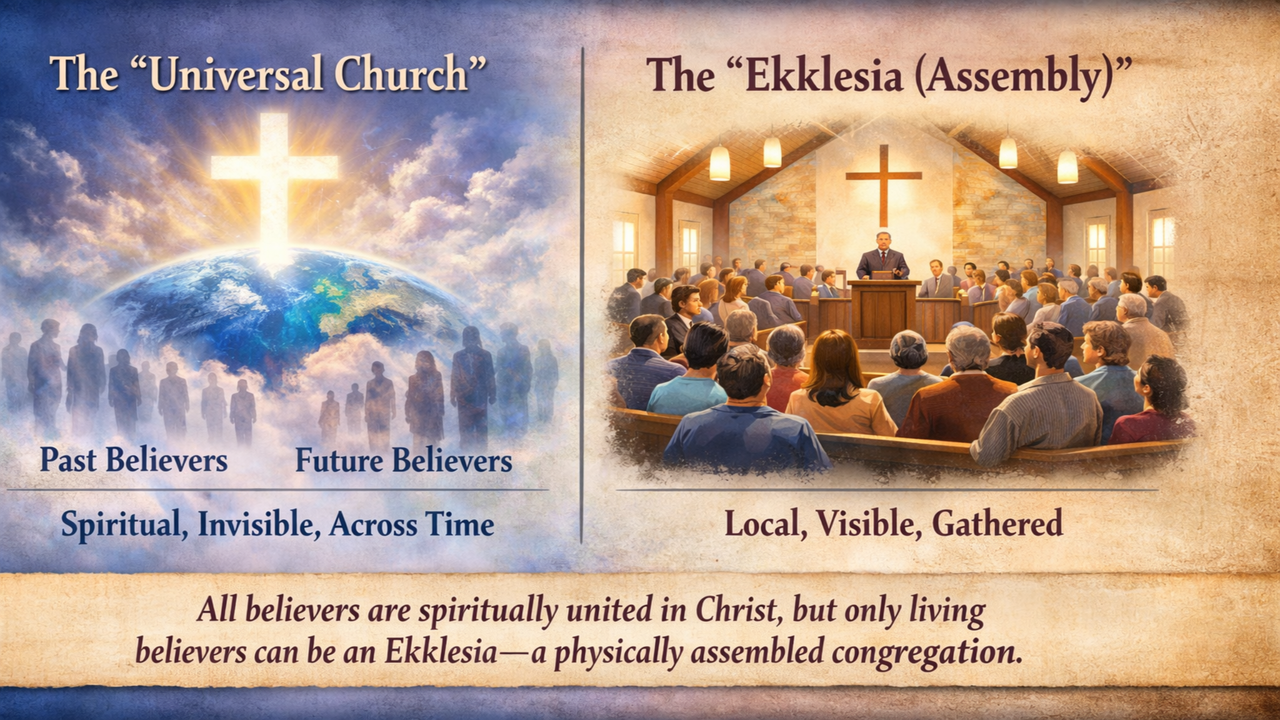
- The difference between a physically gathered assembly and the theological idea of universal unity
- How misunderstanding the meaning has led to modern confusion over the word “church”
- Clear examples and visuals that make the linguistic distinction easier to grasp
By watching the videos, 1st plays & followed by 2nd video, reader can see a graphic and spoken explanation of the same themes examined textually in this paper, making the concepts more accessible and memorable.

A Biblically Coherent Distinction
Scripture itself maintains two complementary truths:
- The Body of Christ — all believers are spiritually united in Christ.
- The Ekklesia — believers assembling locally and physically to live out that unity.
These are not the same concept. Confusing them produces the illusion that a universal, non-gathered body can be called an ekklesia.
A more precise biblical way to speak is:
- There is one spiritual body in Christ.
- There are many local assemblies (ekklesiai) where that body is expressed.
Teaching Q&A Section
Q: Isn’t the universal church biblical?
A: Scripture teaches universal spiritual unity in Christ, but it does not describe that unity as an ekklesia that gathers. Ekklesia refers to assembly, not abstract membership.
Q: Why does this matter?
A: Because redefining ekklesia as a universal or virtual entity weakens the command to assemble physically (Hebrews 10:25) and blurs accountability and shepherding.
Q: Does this mean virtual Bible studies are wrong?
A: No. Virtual meetings can supplement teaching and encouragement, but they cannot replace the biblical ekklesia as a physical gathering of believers.
Q: Why do so many Christians accept the term “universal church”?
A: Because the English word “church” has been used for centuries to mean both spiritual unity and local assembly, even though ekklesia itself does not naturally carry both meanings.
Comparison Chart: Body of Christ vs. Ekklesia
| Feature | Body of Christ (Spiritual Unity) | Ekklesia (Assembly) |
|---|---|---|
| Scope | All believers across time | Local believers |
| Nature | Spiritual identity | Physical gathering |
| Can assemble? | No | Yes |
| Membership | Invisible | Visible |
| Leadership | Not directly exercised | Elders and shepherds |
| Discipline | Abstract | Practiced (Matt 18:17) |
| Commanded | Believed | Assembled (Heb 10:25) |
| Linguistic fit with ekklesia | Weak | Strong |
Conclusion
The New Testament authors, writing in Greek under the inspiration of the Holy Spirit, deliberately chose the word ekklesia to describe the gathered people of God. This word carries with it the idea of assembly, order, and physical presence. When the concept of a “universal church” is equated with ekklesia, the linguistic and practical meaning of the term collapses.
While all believers are spiritually united in Christ as one body, only living believers who gather together can form an ekklesia. Scripture preserves this distinction, but later theological tradition blurred it by allowing the English word “church” to absorb meanings not inherent in ekklesia itself.
Therefore, the idea that “church” can exist purely as a virtual or universal entity apart from physical gathering is not grounded in the language of the New Testament. It is grounded in linguistic drift and theological habit. A biblically faithful understanding restores ekklesia to its original meaning: a people called by God who assemble together in one place, under Christ’s authority, for worship, teaching, fellowship, and mutual care.
“Not forsaking the assembling of ourselves together…” (Hebrews 10:25)
This command remains intelligible only if ekklesia is understood as what Scripture presents it to be—a gathered assembly of God’s people.

