
Introduction
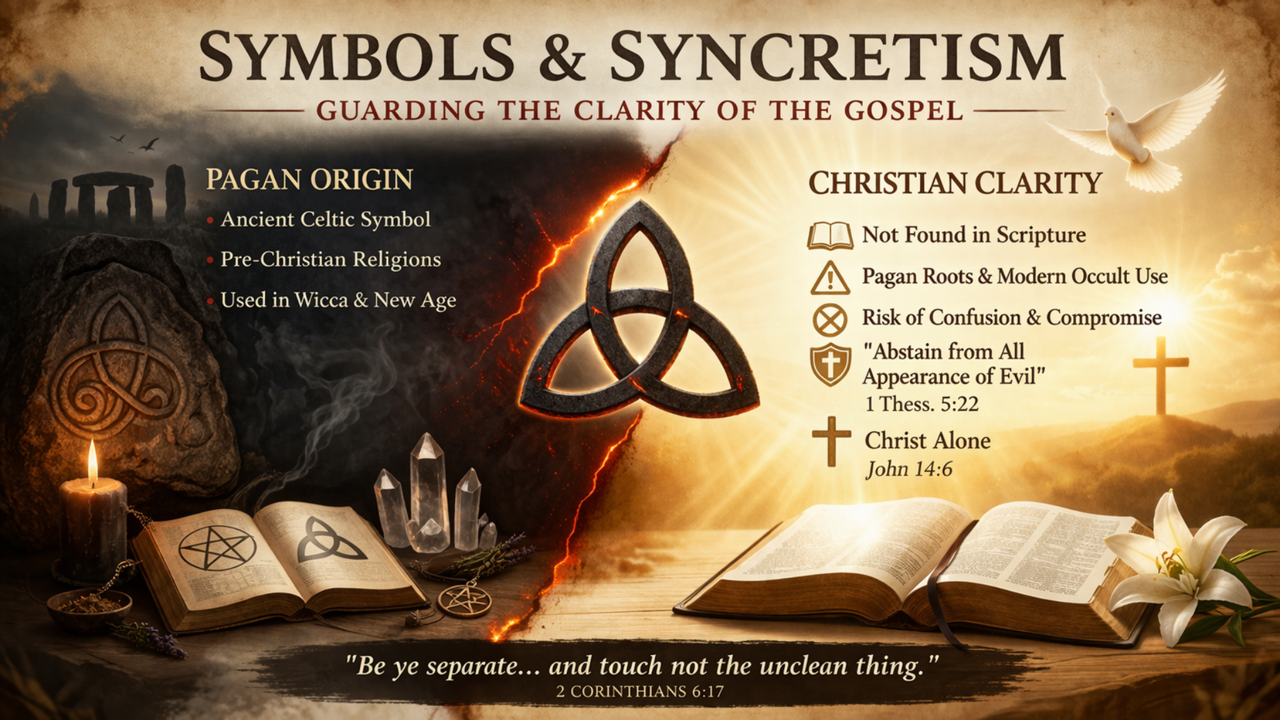
The modern church often attempts to facilitate cultural engagement by adopting aesthetic symbols and motifs from the surrounding world, under the erroneous pretense that these forms are neutral. Among these, the triquetra, or “trinity knot,” is frequently presented as an emblem of the Christian faith. However, a rigorous examination of the historical record and a strict application of biblical separation principles reveal that the triquetra is not a product of Christian revelation; rather, it is a borrowed artifact of pagan origin. This paper examines the necessity for the ekklesia—the called-out assembly—to maintain visual and theological purity by rejecting symbols that bear the appearance of the world, rather than the substance of the Gospel.
The Historical Reality of the Triquetra
The assertion that the triquetra is an inherently Christian symbol is historically untenable. Archaeological evidence confirms that the form existed in Anatolian, Germanic, and Norse pagan cultures as early as the 4th century BC. Long before these cultures encountered the Gospel, the triquetra served as a motif within polytheistic cosmologies. The adoption of this symbol by the medieval church was a deliberate act of syncretism, where missionaries and scribes integrated existing, culturally familiar geometric patterns into their own manuscripts. It was not a symbol born from Scripture, but a pre-existing form repurposed to fit a Christian theological framework. By borrowing from the aesthetic vocabulary of the ethnos—the pagan nations—the Church surrendered its visual boundary.
The Biblical Mandate for Separation
The utilization of such symbols by the ekklesia stands in direct tension with the command in 1 Thessalonians 5:22 (KJV): “Abstain from all appearance of evil.” This passage serves as a divine mandate for believers to maintain distance not just from actual sin, but from anything that could be interpreted by the world as an endorsement of darkness. When the Church takes a symbol of the ethnos—the pagan nations—and attempts to rename it, it often creates confusion. By using a symbol that is currently being used in Wiccan and New Age rituals, the Church effectively obscures its own distinct testimony. If the world sees the same symbol in a New Age shop and on a church bulletin, the Church has surrendered its visual boundary, creating an “appearance of compromise” that contradicts the exclusivity of the Gospel. The Scripture demands that the people of God be set apart, specifically warning against touching the “unclean thing” (2 Corinthians 6:17).
The Failure of “Christianizing” Pagan Forms
The strategy of “reclaiming” or “baptizing” pagan symbols is a flawed hermeneutical approach. It assumes that the Word of God is insufficient in its own revelation and requires the aesthetic support of worldly forms to be understood. However, true faithfulness requires not the rehabilitation of pagan forms, but the total abandonment of them in favor of a distinct, biblical identity. The Cross of Christ, a symbol of historical execution and divine substitution, provides the only necessary visual anchor for the Christian faith. Unlike the triquetra, which remains inextricably linked to its pagan, New Age, and occult usage, the Cross is uniquely founded upon the historical event of Christ’s atonement. Borrowing from the aesthetic language of the adversary suggests that the Church’s own witness is somehow lacking, thereby weakening the testimony of the ekklesia in the sight of men.
Conclusion
The historical origin of the triquetra is indisputably pagan, and its continued use by the ekklesia represents a failure to maintain the standards of separation mandated by the New Covenant. Popularity and tradition do not equate to biblical soundness. As the ekklesia seeks to reclaim its identity as the temple of the Holy Spirit, it must purge itself of all appearances of worldly syncretism. To be a beacon of uncompromising truth, the Church must rely solely on the symbols provided by Scripture, rejecting the artistic leftovers of the nations. To “abstain from all appearance of evil” is not an invitation to rehabilitate; it is a command to separate. True witness is found in distinctiveness, not in the imitation of the world. The modern church often attempts to facilitate cultural engagement by adopting aesthetic symbols and motifs from the surrounding world, under the pretense that these forms are neutral. Among these, the triquetra, or “trinity knot,” is frequently presented as an emblem of the Christian faith. However, a rigorous examination of the historical record and a strict application of biblical separation principles reveal that the triquetra is not a product of Christian revelation. Instead, it is a borrowed artifact of pagan origin. This paper examines the necessity for the ekklesia to maintain visual and theological purity by rejecting symbols that bear the appearance of the world, rather than the substance of the Gospel.

