
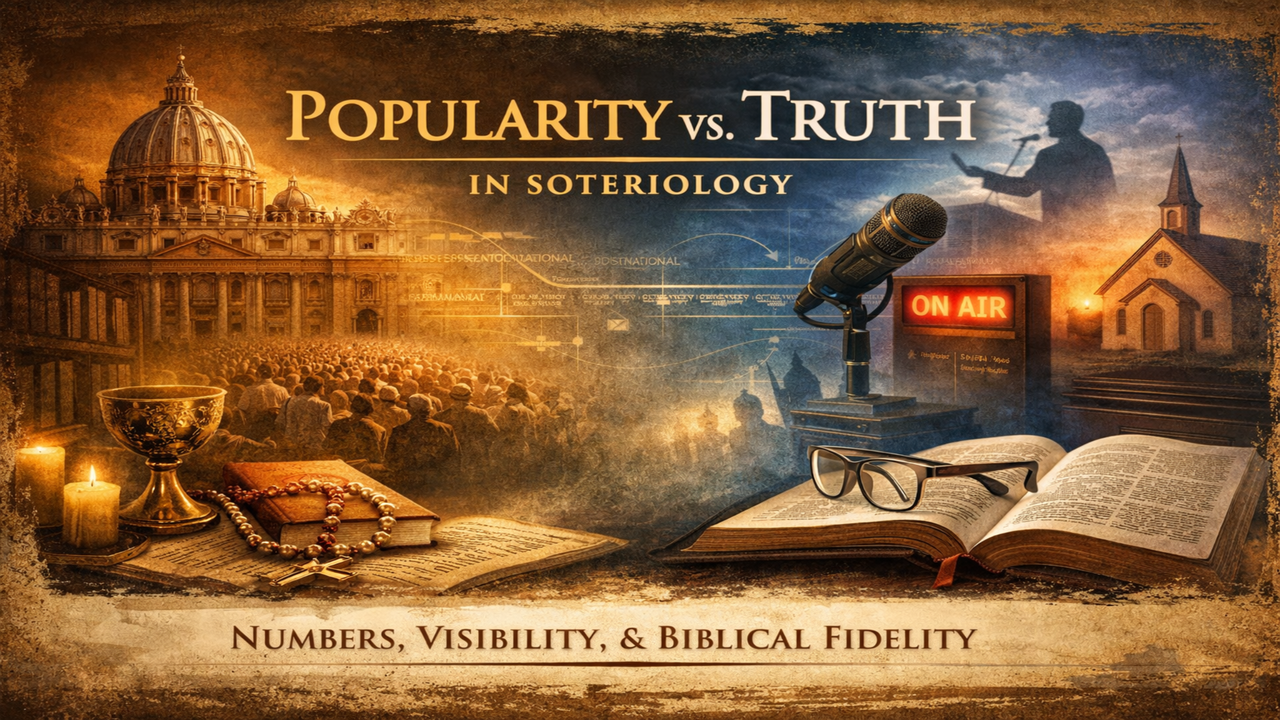
Why Numbers, Visibility, and Biblical Fidelity Are Not the Same
Introduction
When Christians talk about salvation—how a sinner is made right with God—most assume that the answer is clear, settled, and widely agreed upon. Yet the reality is that soteriology, the doctrine of salvation, is taught through different theological frameworks, each shaped by history, tradition, and interpretive assumptions.
One of the most common mistakes believers make is assuming that the most popular view of salvation must also be the most biblical. Popularity, however, depends entirely on how it is measured—and Scripture never treats numbers as a reliable indicator of truth.
In this short video, we’ll examine how popularity is often confused with biblical soundness, why certain soteriological systems feel dominant, and why truth must always be measured by Scripture, not statistics.
How Popularity Shapes Perception—But Not Truth
Before examining how different soteriological frameworks compare by popularity and influence, it is important to clarify what “popular” actually means. This short video explains why visibility, numbers, and biblical faithfulness are often confused—and why Scripture, not consensus, must remain the final measure of truth.

Popularity can shape perception—but only Scripture determines truth.
Major Soteriological Frameworks
(Global Adherents vs. Influence)
| Framework | Approx. Adherents | Why It’s “Popular” | Soteriology | Hermeneutics |
|---|---|---|---|---|
| Roman Catholic | 1.3+ billion | Institutional continuity, cultural inheritance | Sacramental, synergistic, process-based | Scripture + Tradition + Magisterium |
| Eastern Orthodox | 220–260 million | National churches, ethnic identity | Theosis, participatory | Patristic, mystical |
| Arminian / Semi-Arminian Evangelical | ~500–600 million* | Revivalism, global missions | Synergistic, resistible grace | Verse-driven, experiential |
| Reformed / Calvinist | ~75–100 million | Confessional churches, seminaries | Monergistic, covenantal | Grammatical-historical |
| Dispensational Evangelical | ~30–70 million | Media, prophecy teaching, Bible colleges | Fragmented across dispensations | Selective literalism |
| Covenantal / Biblical-Theological | Unquantified | Pastoral & academic study | Unified in Christ | Redemptive-historical |
*Arminian estimates overlap denominational lines and reflect theological alignment, not formal labels.
What Do We Mean by “Popularity”?
The word popular is often used without definition. In theology, popularity can mean several different things:
- The number of people who adhere to a system worldwide
- The historical reach of an institution
- Media visibility and cultural influence
- Or regional dominance, especially in the West
These are not the same, and confusing them leads to serious theological misunderstandings.
Popularity by Sheer Numbers
Measured by global adherents, Roman Catholicism is the most popular soteriological framework in the world, with more than 1.3 billion followers.
This numerical dominance did not arise from superior hermeneutics or consistent exegesis. Rather, it developed through:
- Institutional continuity
- State-church alignment
- Colonial expansion
- Cultural inheritance across generations
Large numbers, therefore, tell us nothing about whether a system is faithful to Scripture. They tell us only that it has been historically successful at retaining adherents.
Eastern Orthodoxy follows behind, largely through national and ethnic churches, again reflecting historical continuity rather than widespread biblical examination.
Popularity by Evangelical Influence
Within modern evangelicalism, Arminian or semi-Arminian theology is the most widespread, particularly through revivalism, missions, and decision-focused preaching. Its emphasis on human responsibility and choice resonates strongly in modern culture.
Reformed or Calvinist theology, while smaller numerically, has significant influence through confessional churches, seminaries, and theological literature. It tends to emphasize God’s sovereignty, covenant theology, and systematic coherence.
These systems dominate evangelical discussions—but still represent only a portion of global Christianity.
Why Dispensationalism Feels So Dominant
Many Christians assume that Dispensational Evangelicalism is the most popular soteriological framework. This assumption is understandable—but incorrect.
Dispensationalism feels dominant because of visibility, not volume.
Its influence has been amplified by:
- Prophecy conferences
- Radio, television, and internet ministries
- The legacy of the Scofield Reference Bible
- American evangelical publishing
Numerically, Dispensationalism represents a relatively small segment of global Christianity. It is high-impact but low-density—widely heard, but not widely held.
Why Popularity Is a Poor Measure of Truth
Scripture consistently warns against equating numbers with truth.
Throughout biblical history:
- The majority was often wrong
- The faithful remnant was often small
- Truth was tested by God’s Word, not consensus
Soteriology must never be evaluated by:
- How many people believe it
- How influential its institutions are
- How emotionally compelling it feels
Instead, it must be examined by:
- Careful hermeneutics
- Contextual, grammatical-historical exegesis
- Covenant continuity across Scripture
- Faithful submission to Christ as the interpretive center
A Better Way to Evaluate Soteriology
Rather than asking, “Which view is most popular?”, a better question is:
“Which view arises from the careful handling of Scripture?”
Any theological system—whether Catholic, Arminian, Reformed, Dispensational, or otherwise—must remain subject to correction by the Word of God.
Systems are tools.
Scripture is the authority.
When systems govern interpretation, error follows.
When Scripture governs systems, clarity emerges.
Conclusion
Popularity and truth are not the same thing.
Roman Catholicism is the most popular soteriological framework by sheer numbers.
Dispensationalism is among the most visible by media influence.
Neither popularity nor visibility determines biblical accuracy.
Sound soteriology is not inherited, assumed, or marketed. It is tested, examined, and proved by Scripture.
The call remains the same for every believer:
“Prove all things; hold fast that which is good.”

