
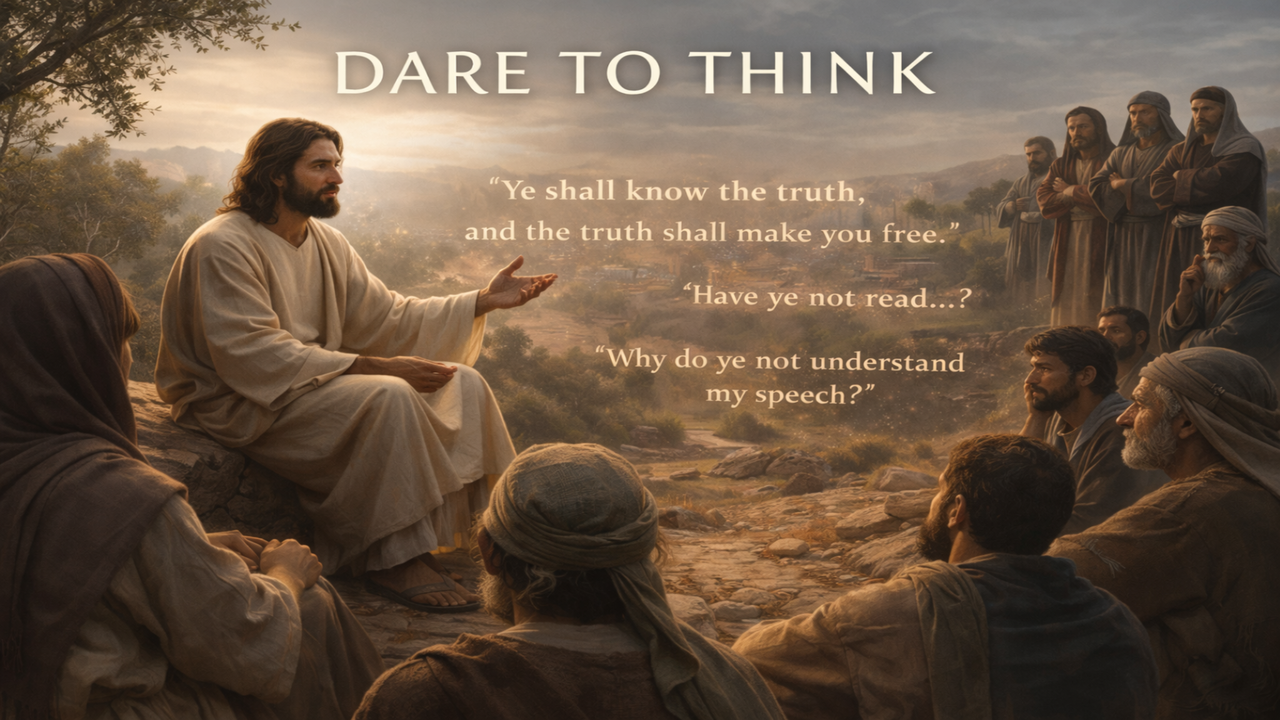
Re-Examining Popular End-Times Teaching in the Light of Scripture
Introduction: Why “Dare To Think” Matters
The call to think biblically is not a modern idea—it is woven throughout Scripture. God repeatedly invites His people to reason, to test, and to examine what they believe rather than inherit assumptions unchallenged.
“Prove all things; hold fast that which is good.” (1 Thessalonians 5:21)
“Come now, and let us reason together, saith the LORD.” (Isaiah 1:18)
Yet in many churches today, certain end-times teachings are accepted not because they are clearly taught in Scripture, but because they are familiar, popular, and widely repeated. The doctrines of a secret rapture, a future seven-year tribulation, and a postponed fulfillment of prophecy—especially in Matthew 24 and Daniel 9—often go unquestioned. To dare to think is not rebellion; it is obedience to God’s Word.
The Root of Theological Error: Assumption Over Exegesis
A primary cause of theological error is eisegesis—reading ideas into Scripture—rather than exegesis, drawing meaning from the text itself. Jesus warned the religious leaders of His day:
“Ye do err, not knowing the scriptures, nor the power of God.” (Matthew 22:29)
Many modern prophetic systems begin not with the text, but with a framework already assumed to be true. Verses are then arranged to support that framework. This is precisely the opposite of how Scripture is meant to be handled.
“Why do ye not understand my speech? even because ye cannot hear my word.” (John 8:43)
The Rapture: A Doctrine Without a Text
The popular idea of a secret, pre-tribulation rapture—where believers are removed from the earth before a future seven-year tribulation—is notably absent from Scripture. The passages often cited (1 Thessalonians 4, 1 Corinthians 15) speak plainly of the visible return of Christ, the resurrection of the dead, and the final gathering of the saints—not a secret escape.
“For the Lord himself shall descend from heaven with a shout, with the voice of the archangel, and with the trump of God…” (1 Thessalonians 4:16)
There is no mention of secrecy, two stages of Christ’s return, or a seven-year interval. Instead, Scripture consistently presents one return, one resurrection, one judgment.
The “Seven-Year Tribulation”: Imported, Not Taught
The idea of a future, global seven-year tribulation is derived almost entirely from a particular interpretation of Daniel 9:24–27, combined with assumptions brought into Matthew 24 and Revelation. Yet Scripture itself never uses the phrase “seven-year tribulation.”
Jesus spoke of tribulation as something His disciples would experience in their own generation:
“Then shall they deliver you up to be afflicted… and ye shall be hated of all nations for my name’s sake.” (Matthew 24:9)
“Verily I say unto you, This generation shall not pass, till all these things be fulfilled.” (Matthew 24:34)
To push these words thousands of years into the future is not demanded by the text—it is required only by the system.
Matthew 24: Context Is King
Matthew 24 begins with a direct question from the disciples concerning the destruction of the temple:
“Tell us, when shall these things be? and what shall be the sign of thy coming, and of the end of the world?” (Matthew 24:3)
Jesus’ answer repeatedly references events tied to Jerusalem, Judea, the temple, and that generation. He warns those in Judea to flee, speaks of the abomination of desolation spoken of by Daniel, and describes unparalleled tribulation connected to the city and the covenant people.
To reinterpret Matthew 24 as a global, end-of-time scenario divorced from its first-century context is to ignore Jesus’ own time markers.
Daniel 9:24–27: A Completed Prophecy
Daniel 9 is one of the most misused passages in prophetic interpretation. The text clearly states that seventy weeks are determined:
“Seventy weeks are determined upon thy people and upon thy holy city…” (Daniel 9:24)
The purpose of these weeks is explicit:
- To finish the transgression
- To make an end of sins
- To make reconciliation for iniquity
- To bring in everlasting righteousness
These are Messianic accomplishments, fulfilled in Christ—not events waiting thousands of years for completion.
The idea of a gap between the sixty-ninth and seventieth week is never stated in the text. It is an assumption imposed to make room for a future tribulation narrative. Scripture itself presents the seventy weeks as a unified, continuous prophecy culminating in Christ and the end of the old covenant order.
The Destruction of Jerusalem: God’s Covenant Judgment
Jesus’ warnings in Matthew 24, Luke 21, and Mark 13 align with the historical destruction of Jerusalem in A.D. 70—a cataclysmic event that marked the definitive end of the Mosaic system.
“These be the days of vengeance, that all things which are written may be fulfilled.” (Luke 21:22)
This was not the end of the physical world, but the end of an age—the age of temple sacrifice and covenant administration under the Law.
Why These Errors Persist
These interpretations persist because:
- They are deeply ingrained in modern evangelical tradition
- They are reinforced by study Bibles, charts, and popular teachers
- They appeal to escapism rather than endurance
Yet Scripture calls believers not to escape tribulation, but to remain faithful through it.
“In the world ye shall have tribulation: but be of good cheer; I have overcome the world.” (John 16:33)
Dare To Think: A Call Back to Scripture
To question popular doctrine is not arrogance—it is obedience. The Bereans were commended because they examined Scripture daily to see whether what they were taught was true.
“These were more noble… in that they received the word with all readiness of mind, and searched the scriptures daily, whether those things were so.” (Acts 17:11)
Jesus never asked His followers to suspend their minds. He asked them to hear, to understand, and to follow truth—even when it challenged tradition.
Conclusion: Holding Fast to What Is Good
The call of Scripture is not to fear questioning, but to fear believing error. False certainty built on tradition is more dangerous than humble examination guided by the Word of God.
To dare to think is to:
- Let Scripture interpret Scripture
- Respect historical and textual context
- Reject systems that require adding to God’s Word
- Follow Christ, not charts
“Buy the truth, and sell it not.” (Proverbs 23:23)
The truth does not need defending by tradition—it only needs to be believed.

