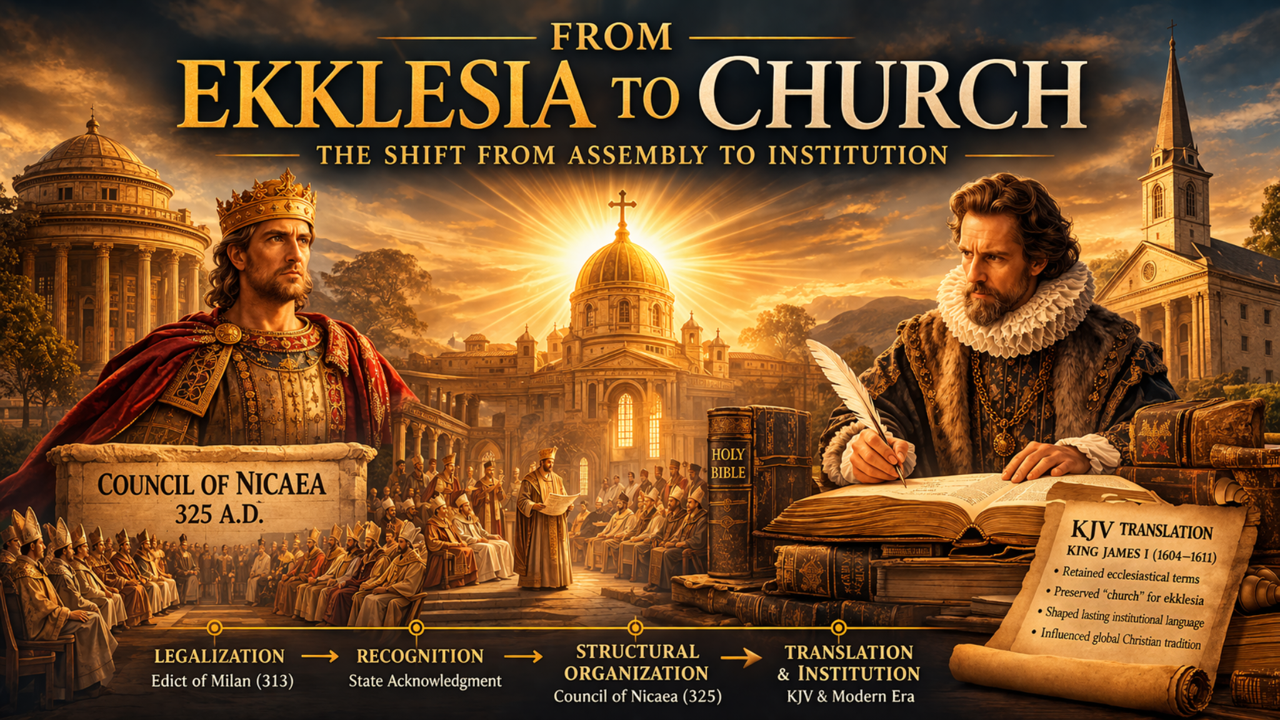
The Political & Structural Shift of Ekklesia
Under Constantine
Part of Ekklesia — A Closer Look series. Return to Table of Contents
Preface
We begin by digging into the topic of Ekklesia to Church, to peel back the first "layer of a deep-rooted tradition." This is the beginning of a series of inquiries into how the Greek term ekklesia was transformed into the modern institutional word "church." This investigation intentionally peels back the historical, linguistic, and political threads that have obscured the original identity of Christ's assembly for centuries. The roadmap for our exploration is outlined in the graphic at the top of this page. You are invited to follow this progression as we move beyond traditional narratives to uncover the reality that has been hidden in plain sight.
In this series, we are going to refuse to rely on "received wisdom" or the simplified narratives that have been repeated in Sunday School lessons for generations. Each installation of this series applies a critical lens to established traditions. We will examine the evidence, trace the historical timeline, and draw conclusions based on the facts of how this institution was built, regardless of how uncomfortable those facts may be to modern institutional sensibilities.
Introduction: The Linguistic and Structural Metamorphosis
The catalyst for the drift away from the biblical ekklesia and toward the modern institutional definition of "church" found its primary momentum in the 4th century, specifically through the political and structural upheavals of the Edict of Milan and the First Council of Nicaea. What began as a decentralized, spiritually governed assembly of Christ's people underwent a profound metamorphosis under the influence of imperial favor and the requirements of a Roman-modeled state-religion. This shift was not merely a change in nomenclature; it was a fundamental reorientation of the nature and purpose of the gathered believers.
The transition from the Greek term ekklesia—which denotes an assembly of called-out citizens(cf. Acts 19:39)—to the later conceptualization of the "church" marks the entry of the community into a system of legal recognition, geographic fixation, and hierarchical control. By analyzing this historical fork in the road, we begin to see how the early assembly was increasingly subordinated to state authority and redefined by the structures of the Roman legal system. This movement from the people as the assembly to the institution as a place of worship and a regulatory body reflects a multi-century project of institutionalization that continues to color our contemporary understanding of Christian life and practice.
This series of pages serves as a guide through this development, tracing the linguistic, cultural, and political threads that have woven our modern vocabulary. As we peel back the layers of tradition and translation, the objective is to recover the original, radical identity of Christ's assembly and challenge the institutional assumptions that have, for too long, obscured that identity. By questioning why and how our terminology has shifted, we prepare the ground to re-examine what it actually means to be the ekklesia in a world that equates it with a building, an organization, or a denomination.
I. The Imperial Capture: From Sovereign Assembly to State Asset
The transformation of the ekklesia into the modern "church" was not a natural evolution; it was a captured transition. When Constantine issued the Edict of Milan in 313 AD, the primary objective of the Empire shifted from outward persecution to inward subversion.1 By granting legal status, the state did not merely offer "freedom"; it offered a seat at the table of imperial administration. The movement of the ekklesia from the private sphere of the home into the public, state-sanctioned arena required a new set of rules, creating a dependency on the state that would define the next sixteen centuries(cf. 1 Sam. 8:6-7).
II. Nicaea and the Consolidation of Power
If Milan opened the door, the First Council of Nicaea (325 AD) bolted it shut. By summoning the bishops under imperial authority, Constantine transformed the ekklesia from a decentralized, independent gathering of sovereign believers into a centralized, hierarchical department of the state.2 The establishment of a unified creed and clerical jurisdiction meant that "unity" was no longer defined by the Holy Spirit within the assembly(cf. 1 Cor. 12:13), but by adherence to an imperial framework. This was the birth of the bureaucratic institution—an entity organized not for the life of the people, but for the stability of the Empire.
III. The Linguistic Engineering: From Kyriakos to "Church"
The evolution from the Greek word kyriakos to the modern English word "church" is a masterful example of linguistic displacement—a migration where the original meaning is stripped away, leaving only a shell of the original intent.
Kyriakos means "belonging to the Lord." In the New Testament, it is never used to define the people of God(cf. 1 Cor. 11:20; Rev. 1:10). Yet, as the institutional focus shifted from the "called-out" assembly (ekklesia) to the "Lord's house" (the physical structure), kyriakos became the shorthand for the place of worship.
The linguistic trajectory is erratic and deliberate:
- The Greek Root: Kyriakos carries the sound of the hard "K".
- The Germanic Transition: As the concept moved into Germanic lands, the term evolved into kirika or kyrka. Note the persistence of the hard "K" sound.
- The Softening Shift: Over centuries of vernacular development, the spelling underwent a radical phonetic transformation. The guttural, strong "K" softened into the "Ch" sound found in the English word "church."3
By the time the word arrived in modern English, it had been transformed into an entirely different concept. The word "church" is completely severed from the Greek New Testament text ekklesia; therefore, the roots for the word "church" have no connection to a valid translation of ekklesia as a congregation or assembly. It was utterly never married to the concept of a living, breathing, called-out people. It has become a term that functions solely to describe a topographical location or an institutional hierarchy, leaving the true identity of the ekklesia buried beneath layers of linguistic artifice.
IV. The Tyndale Intervention: A Return to the Qahal
Amidst an era of heavy-handed ecclesiastical control, William Tyndale performed a radical act of linguistic liberation. While the official state-approved translations of his day enforced the word "church" to maintain the hierarchy of the established order, Tyndale recognized that the Greek ekklesia was an exact conceptual match for the Hebrew qahal found in the Old Testament(cf. Deut. 18:16; Acts 7:38).
Qahal—like ekklesia—is the definitive term for a gathered host, an assembly of the covenant people. Tyndale understood that the New Testament was not introducing a new, imperial institution, but rather the fulfillment of the old covenant assembly. By refusing to use the term "church," Tyndale cut through centuries of Roman-mandated distortion. He viewed the people of God as the people in assembly, not as subjects within a temple-institution.
Tyndale's refusal to adopt the state's preferred vocabulary was seen as a grave threat because it redirected the authority away from the institution and back to the people themselves. He correctly saw that if you restore the language, you restore the reality. When we read the texts as they were intended, we find no "church" in the original manuscripts—we find only the qahal of the Old Testament and the ekklesia of the New, both unified in their identity as the sovereign, gathered people of God.
V. The King James Paradigm: Standardizing Control
Centuries later, the shift reached its apex in the cultural and legal domain of the British Crown. The translators of the King James Bible were neither objective nor neutral; they operated under explicit instructions to preserve the ecclesiastical terminology that validated the monarchy's control over the faith.4 By enforcing the word "church" upon the text of the New Testament, they systematically stripped the ekklesia of its identity as an autonomous, self-governing people, forcing the English-speaking world to read the Scriptures through the lens of a state-aligned institution(cf. 2 Cor. 2:17).
VI. The Modern 501c(3) Model: The Cycle Completes
The trajectory that began in the 4th century reaches its final, practical conclusion in the modern non-profit and 501c(3) status of today's religious organizations. By voluntarily entering into legal contracts with the state, modern churches have essentially re-enacted the Constantinian arrangement.5 The assembly has become a tax-exempt entity, subject to federal regulation, oversight, and policy alignment. We are no longer living in the era of the apostolic ekklesia; we are living in the era of the state-integrated institution(cf. John 18:36). The question for the modern believer is not how to preserve the current system, but how to reclaim the sovereignty of the gathered assembly from the machine that has claimed it for so long.
VII. Theological Impact of the Shift to Church
The theological fallout of replacing ekklesia with "church" is not merely cosmetic; it is a fundamental subversion of how the believer relates to God, their brothers and sisters, and the world at large. By recasting a living, governing assembly as a static, institutional "church," the following theological distortions have taken root:
1. The Displacement of the Temple
In the Old Testament, the presence of God was localized in the Temple. In the New Covenant, the Temple is superseded; as the Scriptures affirm, the Spirit of God now dwells within the born-again believer, and by extension, within the ekklesia as a collective body of people(cf. 1 Cor. 3:16; 1 Cor. 6:19).
“For where two or three are gathered together in my name, there am I in the midst of them” (Matthew 18:20) and “Do you not know that you are the temple of God, and that the Spirit of God dwells in you?” (1 Corinthians 3:16).
When we label our gatherings "church," we subconsciously re-sacralize the building. The theology of the "house of God" returns us to the shadows of the Old Covenant(cf. Heb. 9:11-12). We begin to believe we are "going to a holy place" to meet God, rather than understanding that we are the holy place because His Spirit resides in us. This creates a dependency on a physical location that is nowhere to be found in the apostolic writings.
“For where two or three are gathered together in my name, there am I in the midst of them” (Matthew 18:20) and “Do you not know that you are the temple of God, and that the Spirit of God dwells in you?” (1 Corinthians 3:16).
2. The Professionalization of the Priesthood
The ekklesia of the New Testament was a body where every member functioned according to the Spirit's leading(cf. 1 Cor. 12:12-27). By moving toward an institutional "church," we necessitated a professionalized caste of leaders to manage the "facility" and the "institution." This created a bifurcated reality: the "clergy" who perform the duties, and the "laity" who attend as passive consumers. This hierarchy effectively silences the gifts of the body, as the structure requires a manager to oversee the organization, rather than a living organism requiring the participation of all its members(cf. 1 Pet. 2:9; Rev. 1:6).
“But you are a chosen generation, a royal priesthood, a holy nation, His own special people” (1 Peter 2:9) and “And has made us kings and priests to His God and Father” (Revelation 1:6).
3. The Decoupling of Authority from the Assembly
The ekklesia was a governing body. When Christ spoke of his ekklesia he spoke of kingdom authority—the power to bind and loose (Matt. 16:18-19; Matt. 18:18). By redefining the ekklesia as "church," we strip the assembly of its governing mandate. A "church" is managed; an ekklesia is governed by its King. Modern Christians often act as if they have no authority to resolve issues within their own communities, deferring instead to regional denominational offices, legal boards, or secular statutes. The loss of the ekklesia concept is the loss of the delegated authority of the Kingdom of God on earth.
“And I also say to you that you are Peter, and on this rock I will build My ekklesia, and the gates of Hades shall not prevail against it” (Matthew 16:18).
4. The Erosion of the Nation and the Body
Historically, the ekklesia was a distinct identity that stood counter to the polis (the city/state). It was a called-out people whose primary allegiance was to Christ the King(cf. Phil. 3:20). By folding the "church" into the legal and tax-exempt frameworks of the state (like the 501c(3) model mentioned earlier), the institution becomes an extension of the state's influence rather than a prophetic voice against it. The "church" becomes a domesticated version of the faith, concerned with maintaining its legal status and tax benefits rather than acting as a sovereign, peculiar people(cf. 1 Pet. 2:9).
5. The False Universalism of the Institution
Perhaps the most damaging impact is the improper coupling of "church" with the word "universal." In common parlance, the "universal church" is treated as a vast, invisible network of organizations. This obscures the biblical requirement of physical presence(cf. Heb. 10:25). You cannot have an ekklesia via a Zoom call or a digital broadcast. Ekklesia requires the assembly of living, breathing human beings in a specific place(cf. 1 Cor. 11:20). By moving toward an amorphous, "universal" institutional concept, we abandon the hard work of gathering together, bearing one another's burdens face-to-face, and exercising the local, tangible nature of the Body of Christ.
The video player provided below features a distinct visual representation of ekklesia to church. This concise visual summary of the concepts discussed may assist in solidifying the main ideas before the final closing statements. Horizontal viewing is recommended on mobile phone devices.
~ V i s u a l - S u m m a r y ~

The Road Back to the Ekklesia
To grasp the full weight of this transition, one must recognize that we are not merely dealing with a simple linguistic preference or a difference in denominational vocabulary. We are confronting a structural and psychological conditioning that has been woven into the fabric of Western civilization for over sixteen hundred years. The idea of "the church" has become so deeply embedded in our social, legal, and theological consciousness that it is often invisible, much like the air we breathe. It functions as the unquestioned default of modern religious life, making it profoundly difficult to see past the curtain of tradition to the original, radical reality of the ekklesia.
The following pages will peel back these layers from several distinct angles, designed to help you see the complete picture of how this transformation occurred and why it persists. We will examine the historical mandates that cemented these changes, the subtle linguistic subversions that redefined the identity of the believer, and the modern institutional traps that continue to reinforce these patterns today.
Do not expect this to be a comfortable inquiry. Unraveling an assumption that has been reinforced by centuries of state-aligned influence requires a willingness to challenge the very foundations of how we assemble, how we govern ourselves, and how we understand our allegiance to Christ the King. Our goal is not to present a new theory, but to recover the apostolic standard of the ekklesia—a governing, called-out assembly that operates independently of the political and institutional frameworks that have sought to domesticate it for so long. As you read through these subsequent sections, I invite you to set aside the "church-going" lens and prepare to view the fellowship of believers through the eyes of those who understood what it meant to be simply, radically, and exclusively Christ's assembly.
What you have accomplished by reading thus far is a preliminary compilation of this research that commenced in the 4th century. We must now embark on a journey to examine historical transformations from all perspectives, necessitating a discussion of the apostolic era to understand how the biblical authors wrote the scriptures under the guidance of the Holy Spirit. By clicking HERE, you can continue and reveal the complete, unfiltered view of the ekklesia.
Footnotes
- Lactantius, De Mortibus Persecutorum, ch. 48. The text of the edict, preserved by Lactantius, granted “to the Christians and others full authority to follow whatever worship each person has desired,” thereby transitioning the assembly from an illicit, persecuted status to a legally recognized, state-managed entity under imperial administrative oversight ↩︎
- Eusebius of Caesarea, Vita Constantini (Life of Constantine), Book III, ch. 6–10. Eusebius records the emperor’s personal involvement in the assembly of the bishops, marking the shift from internal spiritual governance to reliance upon imperial convocation and the imposition of a unified creed to ensure political stability. ↩︎
- Middle English Dictionary (University of Michigan). The etymological lineage from the Greek kyriakos (the Lord’s) moved through the Germanic kirika and Old English cirice, illustrating the linguistic migration from a descriptor of ownership to a topographical designation, distinct from the Greek ekklesia (the called-out assembly). The shift from ekklesia to kyriakon denotes a pivot from the people to the architecture, a shift explicitly documented in the OED’s analysis of late-antique Germanic adoption. ↩︎
- The Rules for the Translation of the Bible,” Rule 3, issued by King James I (1604). The royal mandate explicitly required that “The old ecclesiastical words to be kept, viz. the word Church not to be translated Congregation,” ensuring the preservation of the institutional hierarchy against the egalitarian implications of the original Greek text. ↩︎
- Internal Revenue Code, 26 U.S.C. § 501©(3); Bob Jones University v. United States, 461 U.S. 574 (1983). The legal framework for tax-exempt status mandates that religious organizations operate within state-defined parameters, effectively conditioning the assembly’s legal recognition upon adherence to federal administrative guidelines, mirroring the subversion inherent in the Constantinian model. ↩︎