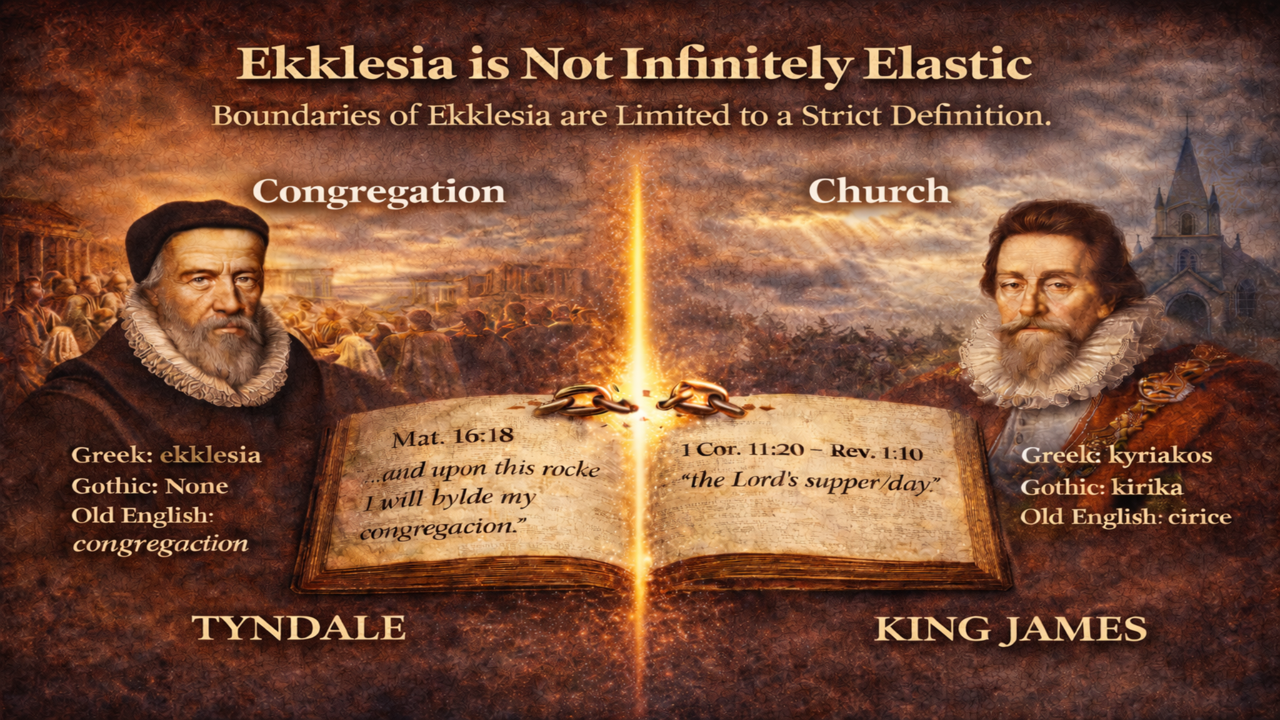
A Linguistic & Translational Examination
Assembly to Church
Part of Ekklesia — A Closer Look series. Return to Table of Contents
Introduction: Why Words—and Their Limits—Matter
It is easy to assume that commonly used biblical terms carry the same meaning today as they did in their original context. Yet Scripture calls for careful examination of all things. Language is not infinitely flexible; words possess defined semantic ranges shaped by usage, context, and historical setting. When a term is stretched beyond those boundaries—or replaced with another carrying different associations—the result can be a shift not only in wording, but in understanding.
Among the most significant examples is the Greek term ekklesia. Widely translated as “church,” this word has come to carry meanings that extend far beyond its original linguistic scope. The question, therefore, is not merely about translation preference, but about whether the meaning presented to the reader reflects the intent of the original text—or the weight of later tradition.
This study proceeds in two parts. First, it examines the principle that words are “not infinitely elastic” and how this applies to ekklesia. Second, it analyzes the distinction between kyriakos and kyriakon, and how the latter contributed to the development of the English word “church.”
Part I — “Not Infinitely Elastic”: The Boundaries of Ekklesia
1. The Principle of Limited Semantic Range
Greek terms such as logos (word), charis (grace), diathēkē (covenant), and pneuma (spirit) demonstrate a consistent linguistic reality: each word operates within a definable range of meaning. While nuances exist depending on context, those meanings are not limitless.
This principle applies equally to ekklesia. Its meaning is not subject to indefinite expansion but is anchored in its historical and linguistic usage.
2. The Meaning of Ekklesia in Context
In both classical Greek and biblical usage, ekklesia refers to:
- A gathering of people
- An assembly called together
- A congregation assembled for a purpose
This understanding is consistent across:
- Classical Greek literature
- The Septuagint (Greek Old Testament)
- The New Testament (e.g., Acts 7:38)
The emphasis is consistently on people assembled, not a building, institution, or abstract religious system.
3. Where the Perception of “Elasticity” Emerges
The claim that a word is “not infinitely elastic” is linguistically sound. However, the modern reader often encounters ekklesia through the English word “church,” which carries a far broader range of meanings.
These include:
- A physical building
- A denominational structure
- A religious institution
- A clergy-led organization
Such meanings extend beyond the lexical boundaries of ekklesia. This creates the impression that the original word itself is flexible or “elastic,” when in reality the expansion occurs elsewhere.
4. Clarifying the Source of the Expansion
The perceived elasticity does not originate within ekklesia itself. Rather, it arises from:
- Translation choices
- Historical development
- Doctrinal and institutional layering over time
A more precise statement would be:
The Greek word ekklesia maintains a defined semantic range; however, the English rendering “church” introduces expanded meanings that exceed that range, creating the appearance of elasticity not in the original word, but in its later interpretation.
This point becomes even clearer when considering usage frequency in the New Testament. The word ekklesia appears well over one hundred times, consistently referring to an assembly of people. By contrast, forms of kyriakos—from which the English word “church” ultimately derives—appear only twice, and never as a replacement for ekklesia. This distinction underscores that the expanded meaning associated with “church” does not arise from the New Testament usage of ekklesia, but from later linguistic and historical developments.
Part II — Kyriakos and Kyriakon: The Linguistic Path to “Church”
1. Distinguishing the Terms
A careful distinction must be made between two closely related Greek forms: κυριακός (kyriakos) and κυριακόν (kyriakon).
The term kyriakos is an adjective meaning “belonging to the Lord.” It functions as a descriptor rather than a standalone noun. For example, in 1 Corinthians 11:20, the phrase “the Lord’s supper” (kyriakon deipnon) uses the term to describe something that belongs to the Lord.
The form kyriakon is the neuter form of this same adjective. In Greek, adjectives often take on a noun-like function depending on their grammatical usage. In this case, kyriakon can be understood as “that which belongs to the Lord,” and through historical usage came to be associated with a place—commonly understood as “the Lord’s house.”
It is worth noting that kyriakos and kyriakon differ only in their final letter—“s” and “n.” This difference reflects standard Greek grammatical endings, not a change in meaning. Greek adjectives adjust their form based on gender and function within a sentence. Thus, kyriakos (masculine), kyriakon (neuter), and related forms such as kyriakē (feminine) all derive from the same root and carry the same essential meaning: “belonging to the Lord.” This distinction is grammatical rather than conceptual and does not introduce a new or expanded definition.
2. Frequency and Usage in the New Testament
A critical observation often overlooked in this discussion is the actual frequency of these terms in the New Testament. The Greek term κυριακός (kyriakos) and its related forms appear only two times in the entire New Testament:
- 1 Corinthians 11:20 — “the Lord’s supper” (kyriakon deipnon)
- Revelation 1:10 — “the Lord’s day” (kyriakē hēmera, a related adjectival form)
In both cases, the term functions as an adjectival descriptor, meaning “belonging to the Lord.” It does not denote a people, an assembly, or a structured religious body.
By contrast, the Greek word ἐκκλησία (ekklesia) appears approximately:
- 112–115 times in the Greek New Testament
(depending on textual tradition and how singular/plural forms are counted)
Across these occurrences, ekklesia consistently refers to:
- A gathering of people
- An assembly or congregation
- A body called together
This contrast is highly significant:
- Kyriakos / kyriakon → 2 occurrences
- Ekklesia → over 100 occurrences
Yet in English translation, the term “church” is overwhelmingly used to render ekklesia, despite the fact that its linguistic origin traces back to kyriakon, a word almost entirely absent from the New Testament in this context.
3. Why This Matters
This disparity highlights a critical point:
The dominant English term “church” is derived from a word that is virtually absent from the New Testament, while the actual New Testament term (ekklesia)—used over a hundred times—carries a different and more specific meaning.
This reinforces the conclusion that the issue is not merely one of translation preference, but of conceptual substitution—where a term with limited New Testament usage has influenced the understanding of a term that is central to the text.
4. The Historical Development of “Church”
The English word “church” does not derive from ekklesia. Its linguistic lineage traces back to kyriakon:
- Greek: kyriakon (“the Lord’s [house/place]”)
- Gothic: kirika
- Old English: cirice
- Modern English: church
Over time, kyriakon came to refer specifically to a place associated with the Lord, eventually becoming identified with a building used for worship.
5. The Translational Shift
The Greek New Testament consistently uses ekklesia—a term centered on people. However, the English translation “church” introduces a term rooted in kyriakon, which emphasizes possession and place.
This results in a conceptual shift:
- From: assembly of people
- To: institution or location associated with the Lord
6. The Resulting Conceptual Expansion
When ekklesia is translated as “church,” meanings associated with kyriakon are effectively imported into the text. Over time, this has led to an expanded understanding that includes:
- Sacred buildings
- Institutional authority structures
- Organized religious systems
These elements are not inherent in ekklesia but arise from the historical development of the term “church.”
7. A More Precise Framing
Rather than stating that ekklesia became elastic, a more accurate conclusion is:
The expansion in meaning results from the substitution of a different linguistic tradition (kyriakon) in place of ekklesia, thereby introducing concepts not present in the original term.
Conclusion: Recovering Linguistic Clarity
Words are not infinitely elastic. They carry meaning within definable boundaries shaped by usage and context. The Greek term ekklesia consistently refers to an assembly of people—a gathering called together. This meaning remains stable across its historical usage.
The divergence arises not from the word itself, but from the translation and development of the English term “church,” which traces back to kyriakon. Through this shift, meanings associated with buildings, institutions, and religious systems have been layered onto a word that originally described a people.
Recognizing this distinction does not diminish the authority of Scripture; rather, it clarifies it. Careful attention to language helps ensure that understanding is rooted in the text itself rather than in later developments. In doing so, the reader is brought closer to the original intent of the biblical authors—where meaning is not infinitely elastic, but faithfully defined.