
Introduction
The modern Christian landscape is characterized by a standardized architecture and liturgy. Believers drive to a dedicated building, sit in rows of pews or chairs facing a stage, listen to a professional speaker deliver a monologue, and receive a miniaturized token of the Lord’s Supper—typically a tiny cracker and a plastic thimble of juice administered by clergy.
This format is accepted as normative Christianity. Yet a rigorous examination of the New Testament alongside the historical record reveals that this structure bears almost no resemblance to the practice of the first-century ekklesia.
Section 1: The Historical Inversion of the Assembly and the Supper
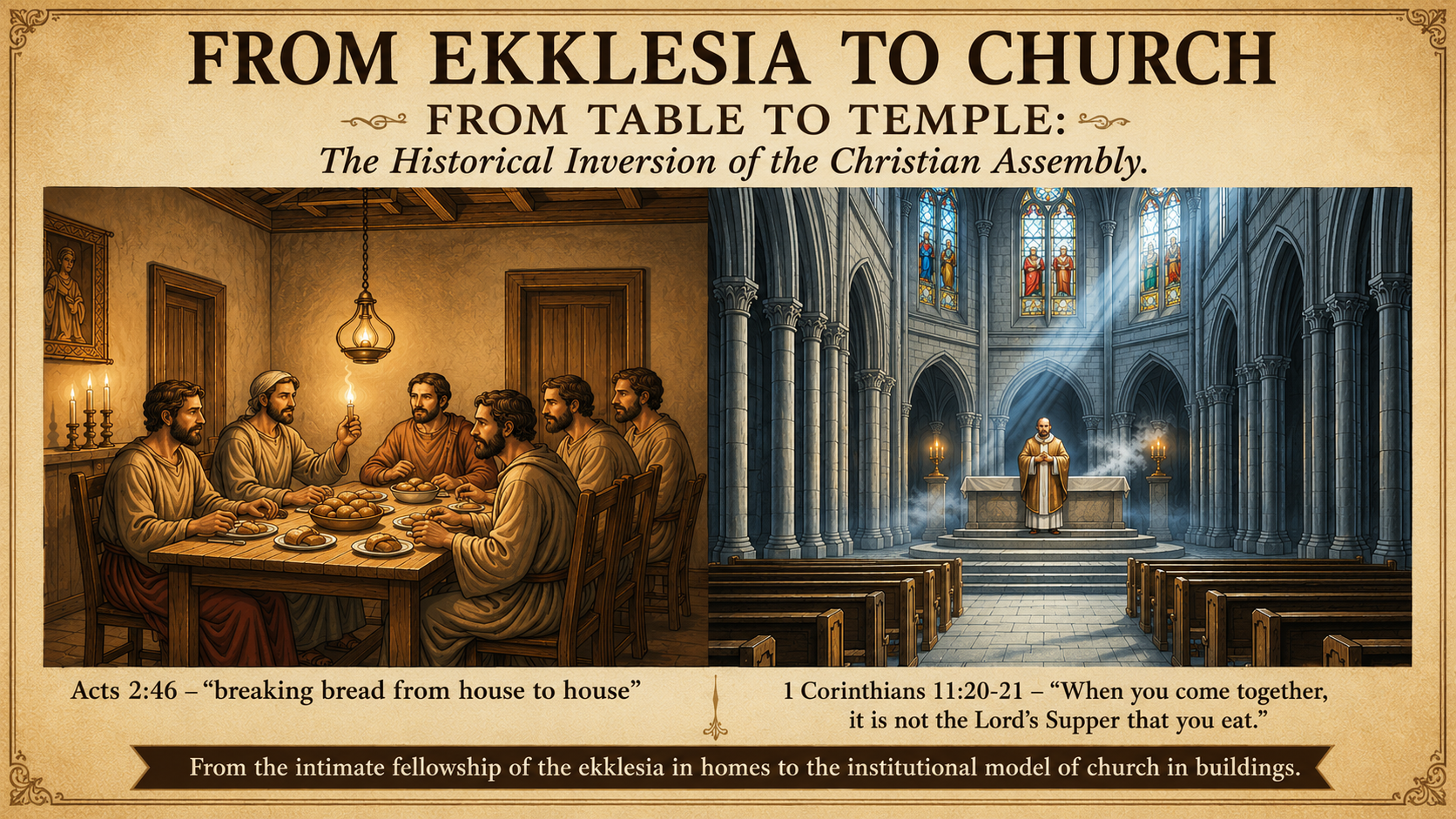
The transformation from a participatory, meal-centered gathering in domestic spaces to a hierarchical, temple-oriented religious service did not happen overnight. It was the result of a gradual historical and theological shift that accelerated during the second and third centuries and culminated in the fourth century under the reign of Constantine. By importing Old Testament and pagan categories—specifically sacrifices, altars, priests, and temples—into the Christian framework, the historic practice of the assembly was fundamentally inverted.
1. The First-Century Reality: Houses, Meals, and Mutual Participation
In the apostolic era, the followers of Jesus did not possess sacred real estate, nor did they utilize specialized religious vocabulary to describe their gatherings. As researcher Tom Wadsworth notes, the New Testament remarkably avoids using traditional worship (latreia or thusia) terminology to describe what Christians did when they convened.
The early assemblies met primarily in homes (kat’ oikon). Passages such as Romans 16:5 demonstrate that the domestic space was the natural locus of the community. The central focal point was the Lord’s Supper (kyriakon deipnon), which was not a brief symbolic ritual, but a full, shared community meal (1 Corinthians 11:20–34). Furthermore, the gathering was inherently interactive. As Paul outlines in 1 Corinthians 14:26, every member brought a psalm, teaching, or revelation. There was no professional clergy class acting as intermediaries; all believers shared in the royal priesthood (1 Peter 2:9).
2. The Four-Step Historical Inversion
The transition from this dynamic model to the institutional cathedral unfolded in four distinct steps:
- Step 1: The Lord’s Supper Becomes a Sacrifice. Beginning in the early second century (seen in the Didache and Justin Martyr), post-apostolic writers began applying sacrificial language to the elements, viewing the Eucharist as an offering given to God rather than a meal given by God.
- Step 2: The Table Becomes an Altar. Once the Supper was viewed as a sacrifice, the physical furniture required an upgrade. By the third century, the wooden community table was transformed into a sacred “altar” (thysiasterion).
- Step 3: The Presider Becomes a Priest. With the altar in place, the person presiding over the ritual was reframed as a sacrificing priest (hiereus), mirroring Jewish and pagan systems and effectively abolishing the universal priesthood of believers.
- Step 4: The Building Becomes a Temple. Following the Edict of Milan (AD 313), Constantine lavished imperial funds on Christian architecture. In AD 320, Eusebius dedicated the cathedral at Tyre and explicitly hailed it as a “holy temple of God,” completing the architectural and theological slide back into Old Testament shadows.
Section 2: Recovering the First-Century Pattern
Moving from critique to restoration requires examining what a functional, New Testament-aligned recovery actually looks like. Rebuilding the ekklesia according to its original blueprint demands a structural and theological realignment across four key areas.
1. Reclaiming the Household as the Center of Gravity
The primary locus of the early Christian assembly was the home. When Paul greets “the church that is in their house,” he is identifying the natural cellular unit of the kingdom of God. Households provided an environment where radical hospitality, mutual accountability, and genuine koinonia were unavoidable. Recovering this model means restoring the scale and intimacy of the assembly, breaking the clerical monopoly on ministry.
2. Restoring the Full Meal and Biblical Context to the Lord’s Supper
The sanitization of the Lord’s Supper into a tiny wafer and a thimble of juice is a casualty of post-apostolic ritualism. As the 2nd and 3rd-century patristic writers reinterpreted the table as an altar, the atmosphere shifted from a joyful family feast to a terrifying, high-stakes ritual requiring scrupulous individual purification.
This post-apostolic anxiety warped Paul’s warning in 1 Corinthians 11:27 and 29 regarding partaking “unworthily” (anaxiōs). Because anaxiōs is an adverb of manner (describing how an action is done) rather than an adjective of personal moral status, Paul was never demanding absolute spiritual perfection before eating. Instead, Paul rebuked the Corinthians’ horizontal behavior: they were forming cliques, getting drunk, and humiliating poor believers (1 Corinthians 11:21–22). To “not discern the body” (v. 29) meant failing to recognize the unity of the local church assembly. Reclaiming the Lord’s Supper means returning it to a shared meal where the body breaks bread together in unity.
3. Activating the Priesthood of All Believers
The professionalization of the ministry—where one man is paid to do the heavy lifting while the rest of the body watches—is foreign to the New Testament. A true New Testament assembly operates on mutual edification (1 Corinthians 14:26). Every believer is endowed with the Spirit and has something to contribute. Elders exist to shepherd and equip, not to run a weekly religious production for passive consumers.
4. Redefining the Assembly as a People, Not a Place (From Ekklesia to Real Estate)
Perhaps the most difficult shift for modern Christians is breaking the mental conditioning that equates “church” with a geographical destination.
Following the 4th-century Constantinian shift and Eusebius’s temple rhetoric, the Greek term ekklesia—which originally meant the summoned, gathered assembly of citizens—began to lose its true meaning, becoming synonymous with sacred real estate. This institutional corruption was perpetuated centuries later in the 17th century when the translators of the King James Version deliberately translated ekklesia (and even qahal in Acts 7:38) as “church,” cementing the structural myth that the house of God is a physical building.
When believers break this conditioning and stop viewing the assembly as an event they attend in a designated “church” building, the posture of the Christian life changes. The gathering on the first day of the week is the fueling station, not the destination. The early Christians gathered to worship and break bread so they could scatter back into the world as ambassadors of an alternative king.
Conclusion
The goal of returning to the first-century pattern is not a form of historicist legalism. The goal is fidelity to the text and reality of the kingdom.
When we strip away the Constantinian cathedrals, the clerical castes, the sacrificial altars, and the consumer-driven programming, we are left with something far more resilient: a brotherhood of believers, redeemed by Christ, meeting in homes, sharing meals, exercising their spiritual gifts, and declaring that Jesus—and not Caesar, and not the state, and not the institutional machine—is Lord. That is the ekklesia the gates of hell cannot prevail against.

