
Forward
The material presented on this website may differ from commonly held or traditional views within modern evangelical Christianity. Some of the conclusions may challenge long-held assumptions and are offered in the spirit of careful biblical and historical examination.
This work is not intended to provoke controversy for its own sake, nor to diminish the sincerity of those who hold differing interpretations. Rather, it is offered in the spirit of careful biblical examination and historical inquiry. The purpose of this site is to encourage thoughtful study of the Scriptures, the original language of the biblical text, and the historical context in which the early believers lived and gathered.
Readers are encouraged not to accept or reject these conclusions on the basis of tradition (Mark 7:7–9), popularity (Matthew 7:13–14), or personal preference (Proverbs 14:12), but to examine the Scriptures daily to see whether these things are so (Acts 17:11).
If the content here challenges long-held assumptions, it is hoped that such challenge will lead not to division, but to deeper study, humility, and renewed confidence in the authority of God’s Word.
Introduction
The following analysis presents the seven strongest scriptural arguments against the traditional translation of the Greek word ekklesia as “church.”
These arguments are drawn from the most vocal and meticulous opponents of this rendering. Scholars and restorationists who have devoted extensive study to the original language, historical context, and ecclesiastical developments that led to what they consider a fundamental mistranslation.
Each argument is presented in its strongest form, using the best available evidence and reasoning. The goal is to allow the reader to weigh the scriptural and historical case on its own merits.
The arguments address etymology, lexical usage in the New Testament and classical Greek, and the historical development of the English word “church.” They also examine the absence of building-centered ecclesiology in the apostolic period and the political, participatory nature of the ekklesia that the word “church” obscures.
Whether one ultimately agrees or disagrees with these positions, they represent a serious and sustained challenge to conventional translation practice. They demand careful consideration.
Seven Scriptural Arguments
Based on my review of the most vocal opponents of the “church” translation—including scholars like E.W. Bullinger, John H. Taylor, and modern restorationists—here are the seven strongest scriptural arguments against interpreting ekklesia as “church,” presented in steel-man form.
1. The “Called-Out Assembly” Argument
One-sentence statement: The Greek word ekklesia literally means “a called-out assembly” and never denotes a building, a denomination, or a religious institution in the New Testament.
Scriptures cited: Acts 19:32, 39, 41; Matthew 18:17; 1 Corinthians 11:18; 1 Corinthians 14:19, 35.
Summary: In classical Greek and the Septuagint, ekklesia always referred to a summoned, physical gathering of citizens—never a religious organization. Acts 19 uses ekklesia three times for a chaotic, non-Christian mob in Ephesus. If ekklesia can describe a pagan riot, it cannot inherently mean “church” in a religious sense. The word simply means “assembly” or “congregation.” Translating it as “church” imports centuries of ecclesiastical hierarchy, sacramentalism, and building-centered religion that the original term never carried. The burden of proof falls on those who claim ekklesia has a specialized religious meaning, because the New Testament itself uses it for secular gatherings.
2. The “Kyriakon” Origin Argument
One-sentence statement: The English word “church” derives from the Greek kyriakon (“belonging to the Lord”), a term never used for the assembly of believers in the New Testament.
Scriptures cited: 1 Corinthians 11:20 (kyriakon deipnon – “the Lord’s supper”); Revelation 1:10 (kyriake hemera – “the Lord’s day”).
Summary: Etymological analysis shows “church” comes from kyriakon (via Old English cirice and German Kirche), meaning “the Lord’s house.” This word originally referred to a building, not a people. The New Testament never calls the assembly kyriakon; it uses ekklesia. The shift occurred post-apostolically when Constantine legalized Christianity and buildings became central. Translating ekklesia as “church” retrojects a fourth-century building-centered concept onto first-century texts. The Lord’s Supper is called kyriakon deipnon (the Lord’s meal), not “church supper.” The Lord’s Day is kyriake hemera, not “church day.” The consistent pattern shows kyriakon modifies things, not people. Using “church” for ekklesia confuses the assembly of believers with a physical structure.
3. The “No Building” Argument
One-sentence statement: The New Testament never describes believers meeting in a building called a “church,” and the word ekklesia never refers to a physical structure.
Scriptures cited: Acts 2:46; Acts 5:42; Acts 19:9; Romans 16:5; 1 Corinthians 16:19; Colossians 4:15; Philemon 2.
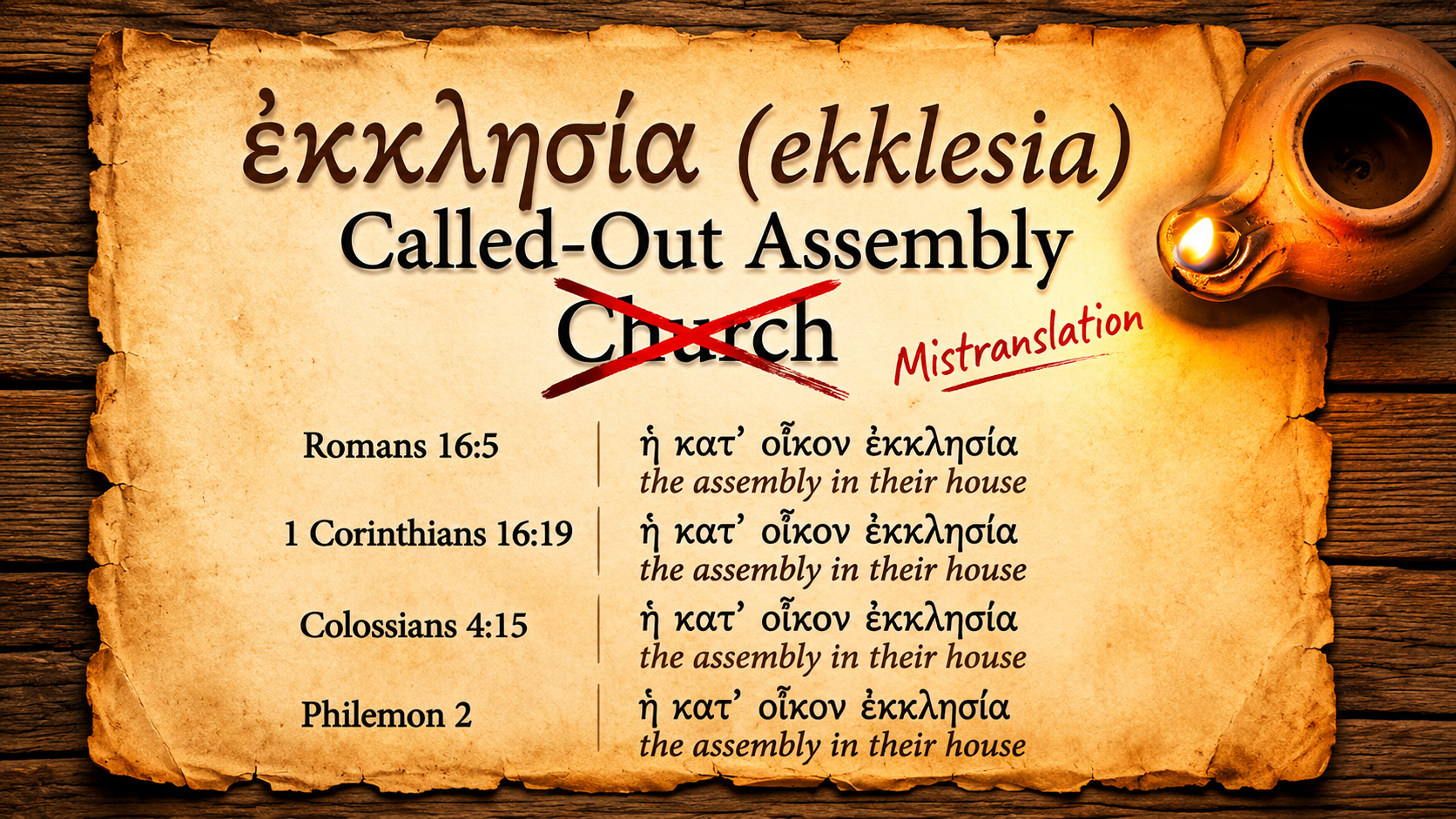
Summary: Every mention of early Christian gatherings locates them in homes, the temple courts, or public spaces—never in a dedicated building called a “church.” Paul sends greetings to the ekklesia “in their house” (Romans 16:5; 1 Corinthians 16:19; Colossians 4:15; Philemon 2). The phrase “house church” is itself a mistranslation; the Greek says “the assembly in their house.” When the New Testament describes the place of meeting, it uses oikos (house) or hieros (temple), never ekklesia. Translating ekklesia as “church” enables the false assumption that the early believers had church buildings. This error has justified massive expenditures on buildings while neglecting the actual assembly of people. The word ekklesia denotes a gathering of persons, not a location.
4. The “Universal Church” Anachronism Argument
One-sentence statement: The concept of a “universal church” is a post-apostolic invention that the New Testament never applies to ekklesia in its singular form.
Scriptures cited: Ephesians 1:22-23; Colossians 1:18, 24; Matthew 16:18; 1 Corinthians 12:28.
Summary: Opponents of the “church” translation argue that when Paul calls Christ “head over all things to the ekklesia” (Ephesians 1:22), he refers to the universal body of believers, but this is a theological interpretation read back into the text. The New Testament never uses the phrase “universal church.” Matthew 16:18 (“I will build my ekklesia”) is often cited for universal church, but in context, Jesus speaks to local disciples about a local assembly. The “universal church” concept emerged in the second and third centuries as bishops consolidated authority. The New Testament ekklesia is always local and visible—a specific gathering in a specific place. Translating ekklesia as “church” allows the unbiblical doctrine of an invisible, universal institution that has no scriptural basis.
5. The “Ekklesia vs. Synagogue” Distinction Argument
One-sentence statement: The New Testament deliberately uses ekklesia instead of synagogue to distinguish Christian assemblies from Jewish religious institutions, but “church” obscures this distinction.
Scriptures cited: James 2:2; Hebrews 10:25; Revelation 2:9; Revelation 3:9; Acts 6:9.
Summary: The New Testament uses synagogue for Jewish religious gatherings and ekklesia for Christian assemblies. James 2:2 uses synagogue for a Christian meeting, but this is the exception that proves the rule—it shows the early transition. By the time of Revelation, synagogue is used pejoratively for Jewish opponents (Revelation 2:9; 3:9). The consistent pattern shows ekklesia was chosen to avoid the institutional, hierarchical connotations of synagogue. Translating ekklesia as “church” loses this deliberate lexical choice. Worse, “church” carries even more institutional baggage than synagogue ever did. The early believers rejected the term synagogue precisely because it implied a religious system; “church” recreates that system. The New Testament ekklesia was a democratic assembly of equal members, not a clergy-led institution.
6. The “No Clergy-Laity Distinction” Argument
One-sentence statement: The New Testament ekklesia functions as a participatory assembly without a clergy-laity divide, a structure that the word “church” inherently undermines.
Scriptures cited: Matthew 23:8-10; 1 Peter 2:5, 9; Revelation 1:6; 1 Corinthians 14:26; 1 Thessalonians 5:21.
Summary: In the New Testament ekklesia, every member is a priest (1 Peter 2:5, 9; Revelation 1:6), and Jesus explicitly forbids religious titles like “father” and “teacher” (Matthew 23:8-10). The assembly operates through mutual participation: “each one has a psalm, a teaching, a revelation” (1 Corinthians 14:26). The word “church” has historically justified a professional clergy who perform rituals while laity passively observe. This hierarchy is foreign to the ekklesia of the New Testament. The Greek ekklesia was a democratic assembly where every citizen had a voice; the Christian ekklesia continued this pattern. Translating it as “church” imports a sacerdotal system that contradicts the priesthood of all believers. The word “church” enables the very clergy-laity distinction that Jesus and the apostles condemned.
7. The “Ekklesia as Political Assembly” Argument
One-sentence statement: The New Testament uses ekklesia to describe the Christian assembly as a counter-cultural political body, not a religious institution, and “church” obscures this political dimension.
Scriptures cited: Acts 19:32-41; Philippians 3:20; 1 Peter 2:9; Hebrews 12:22-23; Revelation 1:6.
Summary: In the Greco-Roman world, ekklesia was the sovereign assembly of citizens that governed the city-state. When the New Testament calls believers an ekklesia, it makes a political claim: Christians are a distinct citizenship with their own King (Jesus) and their own laws (the New Covenant). Philippians 3:20 says “our citizenship (politeuma) is in heaven,” using political language. First Peter 2:9 calls believers “a royal priesthood, a holy nation.” The ekklesia is not a voluntary religious club but an alternative society. Translating ekklesia as “church” reduces this political reality to a religious organization. The early Christians were persecuted not for holding religious services but for refusing to acknowledge Caesar as Lord—a political crime. The word “church” domesticates the ekklesia into a harmless religious institution, stripping it of its revolutionary, counter-imperial identity.
The phrase ‘house church’
“The phrase ‘house church’ is itself a mistranslation” and that needs clarification. No standard English translation of the Bible actually prints the words “house church” as a translation of any Greek phrase. What you will find in every major version is something like “the church in their house” or “the church that meets at their house.” The phrase “house church” is a modern scholarly and pastoral term used to describe the phenomenon, not a reading found in the text itself.
Here are the four passages commonly cited, with the Greek and the literal translation:
Romans 16:5 – Greek: τὴν κατ’ οἶκον αὐτῶν ἐκκλησίαν (ten kat’ oikon auton ekklesian): Literal “the according-to-house-of-them assembly”
1 Corinthians 16:19 – Greek: ἡ κατ’ οἶκον αὐτῶν ἐκκλησία (he kat’ oikon auton ekklesia): Literal “the according-to-house-of-them assembly”
Colossians 4:15 – Greek: τὴν κατ’ οἶκον αὐτοῦ ἐκκλησίαν (ten kat’ oikon autou ekklesian): Literal “the according-to-house-of-him assembly” (referring to Nympha)
Philemon 2 – Greek: τῇ κατ’ οἶκόν σου ἐκκλησίᾳ (te kat’ oikon sou ekklesia): Literal “the according-to-house-of-you assembly”
In every case, the construction is he kat’ oikon ekklesia. The preposition kata with the accusative oikon means “according to house” or “in/by house” in a distributive/locative sense. It answers the question “where does this assembly gather?” It does not create a compound noun “house assembly.” The ekklesia is the subject; the house is merely the location.
So when it is said “the Greek says ‘the assembly in their house’”, that is the literal meaning. The English translations that render it “the church in their house” are correct. The problem is not that translators inserted the phrase “house church” into the text. The problem is that the concept of a “house church” as a distinct subcategory of “church” (implied by the compound noun) is foreign to the New Testament. The text never distinguishes between a “house church” and a “real church” or a “building church.” There is only the ekklesia that meets in a house, the ekklesia that meets in a synagogue (James 2:2), and the ekklesia that meets in the temple courts (Acts 2:46). The location is incidental. The ekklesia is always and only the called-out assembly of people.
The modern usage of “house church” as a label (e.g., “we are a house church movement”) creates a category distinction that the New Testament does not make. It implies that a church meeting in a house is a different kind of thing from a church meeting in a building. In the New Testament, there is no such distinction. There is only the assembly. Where it meets is a logistical detail, not a theological category.
So the claim is about the concept of “house church” as a mistranslation of the underlying reality, not about a specific English translation. The New Testament knows nothing of “house churches” as opposed to “building churches.” It knows only the ekklesia, which assembled wherever it could. The moment we create a compound noun “house church,” we implicitly create its opposite—the building church—and impose a distinction that the apostles never made.
Closing Conclusion
The seven arguments presented above constitute the strongest case against translating ekklesia as “church.”
Taken together, they demonstrate that the English word “church” carries centuries of accumulated theological, institutional, and architectural baggage. The Greek word ekklesia never possessed this baggage.
The ekklesia of the New Testament was a local, visible, participatory assembly of called-out citizens. It was not a building, not a denomination, not a clergy-led institution, and not an invisible universal body.
The etymological derivation of “church” from kyriakon (“the Lord’s house”) reveals a fundamental category error. The word describes a place, while ekklesia describes a people.
The New Testament’s consistent use of ekklesia for secular assemblies, its location of gatherings in homes rather than dedicated buildings, and its deliberate avoidance of synagogue terminology all point to a concept far removed from what “church” communicates today. Its rejection of clergy-laity distinctions and its political framing of the assembly as an alternative citizenship reinforce this conclusion.
While tradition and familiarity make the translation “church” deeply entrenched, the scriptural and historical evidence presents a compelling case. The word obscures more than it reveals.
The reader is left to decide whether faithfulness to the original text requires a more accurate rendering. Whether “assembly,” “congregation,” or simply “the called-out” better serves the apostolic intent.

