
Forward
The material presented on this website may differ from commonly held or traditional views within modern evangelical Christianity. Some of the conclusions may challenge long-held assumptions and are offered in the spirit of careful biblical and historical examination.
This work is not intended to provoke controversy for its own sake, nor to diminish the sincerity of those who hold differing interpretations. Rather, it is offered in the spirit of careful biblical examination and historical inquiry. The purpose of this site is to encourage thoughtful study of the Scriptures, the original language of the biblical text, and the historical context in which the early believers lived and gathered.
Readers are encouraged not to accept or reject these conclusions on the basis of tradition (Mark 7:7–9), popularity (Matthew 7:13–14), or personal preference (Proverbs 14:12), but to examine the Scriptures daily to see whether these things are so (Acts 17:11).
If the content here challenges long-held assumptions, it is hoped that such challenge will lead not to division, but to deeper study, humility, and renewed confidence in the authority of God’s Word.
Introduction
When modern Christians open their Bibles, they naturally read through the lens of their own century. They see words like “church,” visualize a brick-and-mortar building or a global religious institution, and assume those concepts existed in the minds of the first-century authors. I anticipate that for some readers, the etymological and linguistic points raised here may seem trivial or overly academic—a mere disagreement over semantics.
However, to dismiss these issues as “just terminology” is to remain trapped in the very anachronism that distorts our view of Scripture. If you are grounded in the “house church” movement, or sympathetic to this practice of a Christian assembly, these arguments may feel like an unnecessary challenge to your paradigm. I understand this pushback; it is natural to feel defensive when the vocabulary we have been taught is questioned. But I ask you to look past the comfort of tradition and stick with the historical facts.
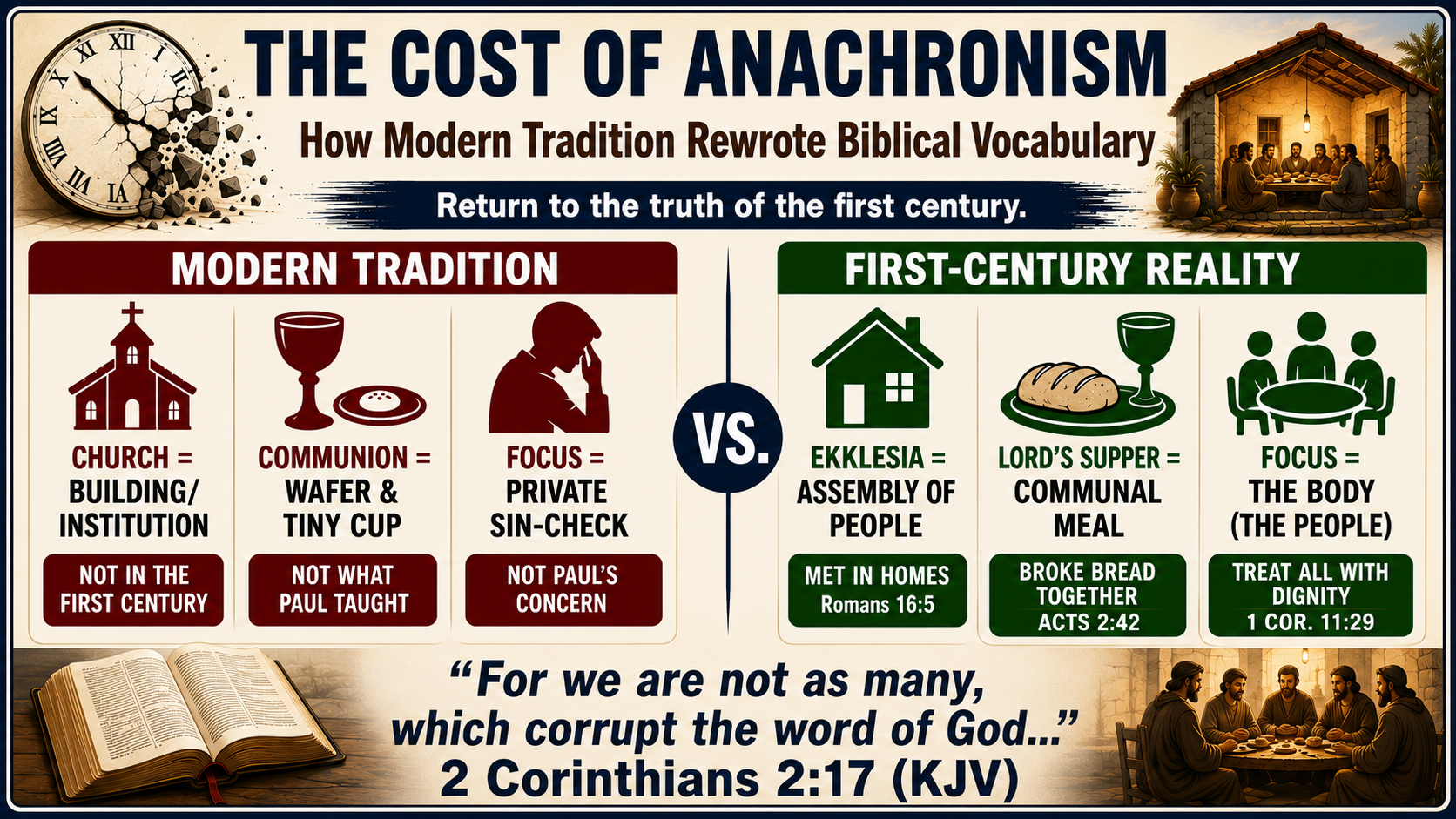
To strip away centuries of linguistic drift and institutional baggage, we will examine two key areas where modern traditions have warped the text: the pervasive mistranslation of ekklesia and the profound misapplication of the Lord’s Supper.
As devoted learners of God’s Word, it is natural to question points that seem to conflict with the biblical worldview we have been taught. If you find these claims challenging or unconventional, I encourage you to search the scriptures to see whether these things are so (Acts 17:11). The intent here is not to convince you to accept what’s said here, but to highlight the vital significance of the language the inspired authors intentionally chose. We must consider their first-century vernacular—rather than our modern assumptions—to determine the true meaning they intended to communicate.
What is Anachronism? In the context of biblical hermeneutics (the study of interpretation), anachronism occurs when we project the definitions, cultural concepts, or institutions of a later time—our own—back onto a historical text from the past.
An anachronism is essentially “chronologically out of place.” When we read a first-century Greek document but define its words using a twenty-first-century dictionary or with contemporary ideas, we create a false narrative. We become guilty of “fallacious exegesis,” because the original authors had no knowledge of our modern religious institutions, steeple-topped buildings, or corporate denominations. By treating the New Testament as if it were written yesterday, we strip the text of its original, grounded meaning and replace it with our own modern assumptions.
I. The Term “House Church”—A First-Century Linguistic and Biblical Anachronism
If we as Christians became convinced that the English word church, with its accumulated institutional and architectural meanings, no longer communicates what ekklesia denoted in the first century—an assembled people—our understanding of many familiar expressions would naturally be reexamined.
Being unaware that the expression “house church” represented a departure from the terminology of the New Testament is experienced by many dedicated Christians. Like many today, I simply accepted the phrase without considering whether it accurately reflected the language and conceptual framework of the first-century writers. It was only after studying the historical meaning and usage of the Greek word ekklesia within its first-century context that I recognized the distinction.
The New Testament never speaks of a “house church,” but rather of the ekklesia in a house (Rom. 16:5; 1 Cor. 16:19; Col. 4:15; Philem. 2). Once that first-century perspective became clear, one can appreciate and realize that this modern expression has unintentionally blended later ecclesiastical terminology with apostolic language. The issue is not merely one of vocabulary, but of allowing the inspired writers to define their own terminology and preserving the distinction they consistently maintained between the place of meeting and the assembled people.
The purpose of this study is not to criticize modern Christians for using familiar terminology, but to ask whether our terminology faithfully reflects the language, concepts, and distinctions employed by the inspired writers themselves.
II. Digging Deeper for Answers
The expression “house church” is a modern linguistic misnomer. More significantly, it is a first-century linguistic and biblical anachronism, because it combines concepts that the inspired writers of the New Testament never combined. Since the New Testament is a first-century document, its language must be understood according to the vocabulary, grammar, and conceptual framework of its original authors and audience—not according to later English ecclesiastical terminology. The apostles did not write in modern English, nor did they employ the later religious vocabulary that eventually developed around the word church. Therefore, the question is; not how the word church is commonly used today, but how the inspired writers themselves described these gatherings.
1. The Biblical Standard
The New Testament consistently speaks of the ekklesia in a house, never of a “house church” (Rom. 16:5; 1 Cor. 16:19; Col. 4:15; Philem. 2). In every instance, the house identifies the location of the assembly, while ekklesia identifies the assembled people. The inspired writers consistently distinguished between the place where believers gathered and the gathering itself.
2. The Conceptual Error
The expression “house church” uses house as a noun adjunct modifying church, thereby creating the impression that the house itself defines or qualifies the church. This reverses the New Testament pattern. Biblically, the house is merely the location of the gathering; it never becomes the identity of the ekklesia assembly. The apostles did not describe a “house church”; they described an assembly meeting in a house.
3. The Etymological Shift
The English word church is not derived from ekklesia, but from the Greek adjective kyriakos (“belonging to the Lord”), from which the substantivized neuter form kyriakon eventually entered the Germanic languages. In its original Greek usage, kyriakos expressed possession or relationship, not an assembled people. Through centuries of linguistic development, the word gradually acquired meanings associated with Christian institutions and places of worship—concepts that are distinct from the New Testament meaning of ekklesia.
4. The Resulting Contradiction
When the expression “house church” is examined in light of its first-century linguistic setting, the contradiction becomes apparent. The New Testament consistently distinguishes between the house (oikos) as the place of meeting and the ekklesia as the assembled people. The modern expression collapses these distinct concepts into a single term that the inspired writers themselves never used. Consequently, “house church” is a first-century linguistic and biblical anachronism, importing later ecclesiastical terminology into a text that consistently maintains the distinction between the meeting place and the assembly.
III. The Apostolic Terminology
Rather than relying upon modern religious terminology, we should allow the New Testament writers to speak in their own words. Every passage describing believers meeting in a home follows the same pattern: the assembly is identified as the ekklesia, while the house is identified only as the place where the assembly met. Nowhere does the inspired text describe a “house church.”
Romans 16:5
- Greek: τὴν κατ᾽ οἶκον αὐτῶν ἐκκλησίαν
- Literal: the assembly according to (or in) their house
- KJV: “Likewise greet the church that is in their house.”
Observation: Paul does not identify the house as the ekklesia. Rather, he identifies the ekklesia as gathering in their house. The house designates the location; the ekklesia designates the assembled people.
1 Corinthians 16:19
- Greek: τὴν κατ᾽ οἶκον αὐτῶν ἐκκλησίαν
- Literal: the assembly in their house
- KJV: “Aquila and Priscilla salute you much in the Lord, with the church that is in their house.”
Observation: The wording is identical to Romans 16:5. Once again, Scripture distinguishes the meeting place from the assembly.
Colossians 4:15
- Greek: τὴν κατ᾽ οἶκον αὐτῆς ἐκκλησίαν
- Literal: the assembly in her house
- KJV: “Salute the brethren which are in Laodicea, and Nymphas, and the church which is in his house.”
Observation: The inspired text again locates the assembly within the house rather than identifying the house as the assembly.
Philemon 2 –
- Greek: τῇ κατ᾽ οἶκόν σου ἐκκλησίᾳ
- Literal: to the assembly in your house
- KJV: “…and to the church in thy house.”
Observation: The same construction appears for the fourth time. The pattern is consistent throughout the New Testament. The house is the place of meeting; the ekklesia is the assembled people.
Summary / Review
The biblical evidence is remarkably consistent. In every passage, the inspired writers speak of the ekklesia in a house, never of a “house church.” The grammatical relationship remains unchanged:
- The house (oikos) identifies the location.
- The ekklesia identifies the assembled people.
The New Testament therefore preserves a distinction that later ecclesiastical terminology often obscures. Rather than describing a “house church,” the apostles consistently described an assembly meeting in a house. This is not merely a difference in wording but a reflection of the first-century vocabulary and conceptual framework employed by the inspired writers themselves.
Because ekklesia never denotes a building but an assembled people, the expression “house church” does not reproduce the language or conceptual framework of the New Testament. While many Christians today use the phrase simply as a convenient description for believers gathering in a home, it is not the terminology employed by the apostles. The first-century writers consistently described the ekklesia in a house—an assembly meeting in a home—not a “house church.”
The issue, therefore, is not whether modern Christians understand what the expression “house church” is intended to mean. The issue is whether the expression faithfully represents the language, concepts, and distinctions employed by the inspired writers of the New Testament. If our desire is to understand Scripture as its original authors intended, then we should allow the apostolic vocabulary—not later ecclesiastical terminology—to define our understanding of the assemblies described in the New Testament.
IV. Biblical Anachronism in Practice
Anachronism wrecks the interpretation of 1 Corinthians 11:27–34 just as severely as it wrecks the word ekklesia.
Modern pulpit tradition has turned these verses into an individualistic, introspective guilt-trip. Believers are told to sit quietly, mentally scanning their past week for any unconfessed sin, terrified that if they miss something, they will eat and drink judgment on themselves using a tiny plastic cup and a dry wafer. That is entirely foreign to what Paul wrote.
The Context of 1 Corinthians 11:17–22
You cannot rip verses 27–34 out of their paragraph and treat them as a timeless rule for private, personal sin inspection. The entire passage is a single, cohesive correction of a specific communal abuse:
- The Abuse: Wealthy believers were showing up early to the assembly, gorging themselves on their own food, and getting drunk, while the poor believers—who had to work or had nothing to bring—were humiliated and left hungry.
- Paul’s Rebuke (v. 22): “What! Do you not have houses to eat and drink in? Or do you despise the church (assembly) of God and shame those who have nothing?”
What “Unworthy Manner” and “Discerning the Body” Actually Mean
- Anaksiōs (“Unworthily”): This adverb does not describe the moral perfection or sinless status of the individual participant. It describes the behavioral manner during the meal. To act unworthily is to treat poorer brothers and sisters with contempt, creating social divisions.
- “Discerning the Body” (v. 29): Modern tradition teaches this means mentally visualizing Jesus on a cross or confessing hidden sins. In the immediate context, it refers to recognizing the local assembly—the actual brothers and sisters sitting right across the table from them. They were failing to recognize that the people they were shaming were part of the body of Christ.
Centuries of institutionalized, ritualistic tradition stripped away the actual meal, replaced it with a microscopic token (a wafer and a thimble of juice), and transformed a rebuke about social cruelty into a mystical, private ritual of personal sin introspection.
For a complete historical record of the Lord’s Supper the below video explains in depth how the 1st century assembly partook of what’s was a meal.

Conclusion
When we allow modern linguistic evolution, institutional traditions, and anachronistic readings to dictate our understanding of Scripture, we obscure the reality of the apostolic era.
The first-century ekklesia was not a global, invisible institution meeting in a sacred architectural plant, nor did it operate through corporate denominations. It was a local, bodily assembly of believers utilizing domestic infrastructure. Likewise, the warning of 1 Corinthians 11 was never a call for isolated, introspective sin-inspection using a modern thimble of juice and a cracker; it was a severe apostolic rebuke against the social mistreatment and marginalization of the poor within the body of Christ.
To return to the true intent of the text, we must lay aside later traditions and hold fast to the historical, linguistic reality of the first century.

