
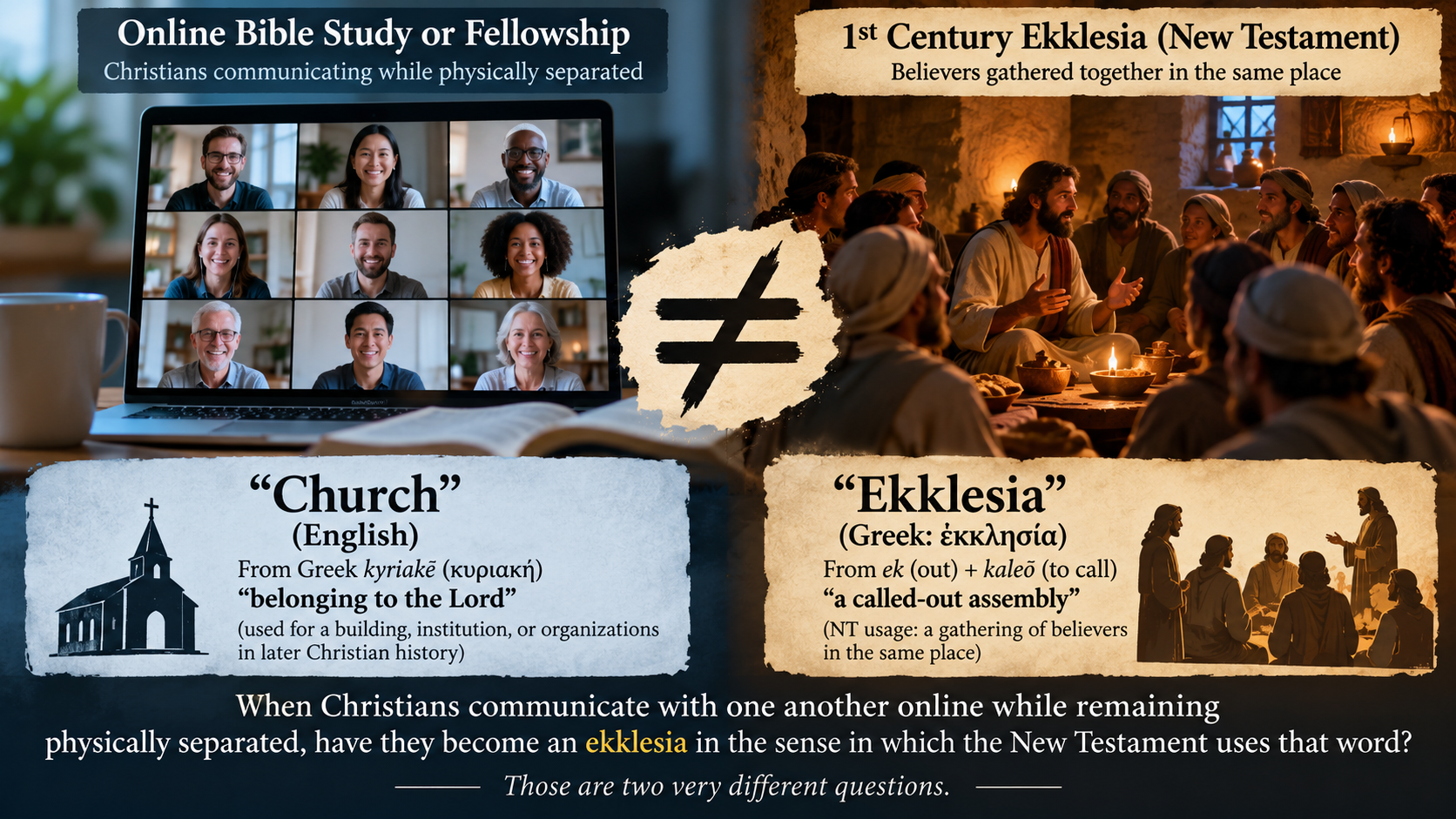
When “Virtual Church” Meets the Language of the New Testament
“He that answereth a matter before he heareth it, it is folly and shame unto him.”
— Proverbs 18:13, KJV
There may be no better biblical principle with which to approach the question of ekklesia and the modern expression “online church.”
Proverbs 18:13 is not offered as proof of what ekklesia means. Rather, it establishes an important principle for examining the question. Before defending an inherited religious term or practice, the matter should first be heard. What word did the New Testament writers actually use? What did that word communicate to their first-century readers? How was it used outside explicitly Christian contexts? And does a modern practice correspond to what those writers described?
The question, therefore, should not begin with:
Can Christians have meaningful fellowship online?
Certainly they can.
The more precise question is:
When Christians communicate with one another online while remaining physically separated, have they become an ekklesia in the sense in which the New Testament uses that word?
Those are two very different questions.
1. “Church” and Ekklesia Are Not the Same Word
A major obstacle appears before the question of virtual gatherings is even considered.
The English reader encounters the word church throughout most English New Testaments and naturally assumes that “church” is the English equivalent of the Greek word used by Jesus and the apostles.
Historically, however, the matter is more complicated.
The English word church does not descend etymologically from Greek ekklesia (ἐκκλησία). Its historical ancestry is associated instead with the Greek adjective kyriakos (κυριακός), meaning “of the Lord” or “belonging to the Lord.”
The transcript supplied for this study emphasizes this important distinction. It notes that kyriakos occurs only twice in the Greek New Testament.
In 1 Corinthians 11:20:
“When ye come together therefore into one place, this is not to eat the Lord’s supper.”
“Lord’s” represents kyriakon — something belonging or pertaining to the Lord.
And Revelation 1:10 reads:
“I was in the Spirit on the Lord’s day…”
Again, “Lord’s” represents the same Greek word-family.
Significantly, neither occurrence uses kyriakos as the name of the Christian assembly. The New Testament does not call the gathered believers kyriakon. It calls them an ekklesia.
This distinction becomes obscured in English because church eventually acquired an extensive range of religious meanings — a building, institution, denomination, clergy, religious organization, and also a congregation of Christians. The transcript itself recognizes this expanded semantic range and observes that several common meanings attached to church bear little resemblance to the underlying ekklesia found in the Greek New Testament.
Thus an important distinction must be maintained:
- The history of the English word church is one question.
- The meaning of the Greek word ekklesia is another.
They should not be treated as though they were historically the same word.
2. What Was an Ekklesia?
The safest way to determine the meaning of ekklesia is not merely to dissect the word into possible component parts. It is to examine how Greek speakers actually used it.
That distinction matters.
It is sometimes said that ekklesia literally means “called-out ones,” based upon its etymological components. The supplied transcript makes considerable use of this explanation and connects it with citizens being called from their homes to assemble for civic business.
There is a useful historical observation behind this, but the stronger lexical argument comes from usage.
An ekklesia was an assembly. This is demonstrated dramatically within the New Testament itself because ekklesia was not exclusively a Christian word. Acts 19 uses ekklesia for the civic assembly at Ephesus.
After the disturbance involving Demetrius and the craftsmen, the town clerk says:
“But if ye enquire any thing concerning other matters, it shall be determined in a lawful assembly.”
— Acts 19:39, KJV
Then Luke concludes:
“And when he had thus spoken, he dismissed the assembly.”
— Acts 19:41, KJV
The word translated assembly is ekklesia. No Christian institution is meant, no denomination is meant, no religious building is meant. People had assembled.
This provides an important control upon theological definitions of the word. Before ekklesia becomes a theological term in someone’s systematic theology, it is already an intelligible Greek word describing an assembly.
3. The Old Testament Background Points in the Same Direction
The Greek Old Testament provides another important background.
The transcript correctly draws attention to Hebrew qahal and its frequent representation in the Septuagint by Greek ekklesia. It describes qahal in contexts involving the congregation or assembly of Israel and notes the connection between this language and ekklesia.
This background becomes especially significant in Acts 7:38:
“This is he, that was in the church in the wilderness with the angel which spake to him in the mount Sina…”
— Acts 7:38, KJV
The expression “church in the wilderness” can easily cause an English reader to imagine something resembling the later Christian concept of “church.” But the underlying word is ekklesia. Israel was the assembly in the wilderness. Once ekklesia is allowed to retain this ordinary sense, many passages become remarkably straightforward.
The question then becomes whether our inherited English terminology has sometimes caused us to read later religious concepts backward into a first-century word.
4. The New Testament Repeatedly Describes an Actual Coming Together
This becomes especially important when considering what is now called virtual church.
Paul does not describe the Corinthians merely as Christians who maintained communication with one another. His language repeatedly emphasizes their coming together.
Consider the progression in 1 Corinthians 11:
“For first of all, when ye come together in the church…”
— 1 Corinthians 11:18, KJV
And then:
“When ye come together therefore into one place…”
— 1 Corinthians 11:20, KJV
And later:
“Wherefore, my brethren, when ye come together to eat, tarry one for another.”
— 1 Corinthians 11:33, KJV
Finally:
“And if any man hunger, let him eat at home; that ye come not together unto condemnation.”
— 1 Corinthians 11:34, KJV
Notice something easily missed when church is treated primarily as an institution.
Paul distinguishes being at home from coming together. That distinction is extraordinarily relevant to the modern virtual-meeting question. A believer sitting in his home in Texas and another believer sitting in his home in California may see and hear one another through a computer. They can speak together. They can study Scripture together. They can pray simultaneously. They can encourage one another.
But neither has left his respective place and come together into one place with the other. Technology has connected their communication. It has not removed their physical separation.
5. Technology Can Transmit What an Assembly Does Without Creating the Assembly
This distinction deserves careful consideration.
- A sermon can be transmitted electronically.
- Teaching can be transmitted electronically.
- Prayer can occur through electronic communication.
- Conversation can occur electronically.
- Christians can encourage, exhort, counsel, and instruct one another electronically.
None of those things should be disparaged merely because technology is involved. But transmitting activities ordinarily performed by an assembly does not necessarily create the assembly itself.
Consider a simple analogy.
A person watching a livestream of a courtroom can hear everything occurring in the courtroom. He may see the judge, attorneys, witnesses, and proceedings in real time. But watching the courtroom does not place him in the courtroom assembly.
Likewise, watching a family meal through a video connection does not place someone at the table. Communication across distance can be genuine without eliminating distance.
That is the issue with ekklesia. The question is not whether communication occurred. The question is whether an assembly occurred.
6. “When Ye Come Together Into One Place”
First Corinthians 11:20 deserves particular attention:
“When ye come together therefore into one place…”
The expression presents considerable difficulty for the concept of a virtual ekklesia.
Suppose ten Christians live in ten houses and connect through ten computer screens. Where is the place into which they have come together?
- House number one?
- House number five?
- The Internet?
- A computer server?
- A Zoom meeting room?
The digital connection provides a medium through which communication occurs, but it does not turn ten geographically separated locations into one physical gathering. This does not make the online meeting worthless. It simply means that something can be good without being an ekklesia.
The New Testament does not require every beneficial interaction among Christians to be called an ekklesia.
7. The Lord’s Supper Makes the Difference Even More Visible
Paul’s discussion of the Lord’s Supper makes physical assembly particularly difficult to remove from the passage.
First Corinthians 10:16–17 says:
“The cup of blessing which we bless, is it not the communion of the blood of Christ? The bread which we break, is it not the communion of the body of Christ? For we being many are one bread, and one body: for we are all partakers of that one bread.”
Paul does not describe numerous isolated meals symbolically synchronized across separate locations. The believers were participating together.
Then 1 Corinthians 11 repeatedly describes them coming together, eating, waiting for one another, and correcting abuses occurring during that gathering. The physicality of the event is built into the narrative. This does not mean Christians separated by distance cannot remember Christ’s death at the same time. Of course they can.
It means something narrower:
Doing the same thing simultaneously is not necessarily the same thing as doing it together as an assembled body.
8. What About “Online Church”?
At this point another linguistic problem appears. Someone may respond:
“We don’t claim to be an ekklesia. We simply call ourselves an online church.”
But that answer creates its own difficulty. If church is simply being used as the conventional English translation of ekklesia, then the original question immediately returns:
Where is the assembly? If the participants have not assembled, calling their electronic connection “church” does not transform it into an ekklesia.
But suppose church is instead defended according to the historical development of the English word itself. That does not solve the problem either.
The kyriakos/kyriakon word-family from which the English word historically developed came to be associated in later usage with that which belonged to the Lord, including the Lord’s house and eventually the religious building itself. From there church accumulated still more meanings — institution, denomination, organization, clergy, congregation, and building.
The transcript specifically recognizes this historical accumulation of meanings, including building and denomination, and contrasts them with the underlying New Testament ekklesia.
So which meaning is intended by online church? It cannot literally be the religious building, because there is no common building. If it means denomination or religious organization, that tells us something about institutional affiliation but does not establish an ekklesia. And if it means the New Testament ekklesia, we return once again to the fundamental question:
Where did the people assemble?
The terminology begins chasing itself in a circle.
9. Christians Scattered and Christians Assembled
A simple distinction can clear away much of the confusion:
Believers remain believers when scattered.
The ekklesia exists as an assembly when assembled.
This does not diminish Christian identity outside the gathering. A believer does not cease belonging to Christ when he goes home. Neither does spiritual unity disappear when believers are geographically separated.
But ekklesia identifies something more specific than the mere existence of Christians. It describes their assembly. This explains naturally why Paul can write:
“Salute Priscilla and Aquila my helpers in Christ Jesus…”
and shortly afterward:
“Likewise greet the church that is in their house.”
— Romans 16:3, 5, KJV
The house did not become a “church building.” Nor did ekklesia mean the house. The people assembled there.
The transcript similarly recognizes assemblies meeting in homes and mentions Aquila and Priscilla, Nymphas, and other gatherings associated with houses. The biblical concept is therefore not fundamentally a sacred place to which Christians go. It is people assembling.
10. This Is Why Vocabulary Matters
Some may regard this discussion as merely semantic. But words shape concepts, and concepts eventually shape practices.
If ekklesia becomes “church,” and church can mean a building, denomination, institution, organization, worldwide abstraction, television ministry, website, or virtual meeting room, something remarkable has occurred.
One English word has accumulated meanings far beyond what the underlying Greek word itself necessarily communicates. Eventually the English word begins interpreting the Greek rather than the Greek correcting our understanding of the English word.
That is precisely where caution is necessary.
The transcript’s central concern is that church became an established religious term carrying meanings derived from centuries of religious development, while the underlying New Testament word is actually ekklesia. Whether every historical judgment made in that presentation is accepted or not, this central linguistic distinction deserves serious consideration:
Ekklesia and church do not share the same etymological history.
Therefore, one should not automatically pour every modern meaning of church back into ekklesia.
11. This Is Not an Argument Against Technology
The argument should not be misunderstood.
An online Bible study can be valuable. An elderly or homebound believer may receive tremendous encouragement through a livestream. Christians separated by hundreds or thousands of miles can pray together, discuss Scripture, counsel one another, and maintain relationships that previous generations could have maintained only through correspondence.
Technology is a tool. The question is not whether Christians may use it. The question is whether technology changes the meaning of ekklesia.
A telephone allows two people separated by a thousand miles to converse, but it does not place them in the same room. A livestream permits thousands to watch an event, but it does not physically place those viewers at the event. A videoconference allows faces and voices to interact in real time, but the participants remain geographically separated.
Technology overcomes certain limitations of communication. It does not make distance cease to exist. Consequently, Christians may have meaningful online fellowship without needing to rename that fellowship an ekklesia.
12. Why Insist Upon Calling It an Ekklesia?
This leads to a revealing question. Why must every Christian activity be called “church”?
If several believers meet online to study Scripture, why not simply call it an online Bible study?
If they pray together, why not call it an online prayer meeting?
If they encourage one another, why not call it Christian fellowship?
If teaching is broadcast, why not call it an online teaching ministry?
None of those descriptions diminishes what is taking place. The difficulty arises only when the modern religious category church is assumed to encompass virtually every form of Christian interaction and is then projected backward upon the New Testament word ekklesia.
Perhaps the better course is not to expand ekklesia until it accommodates modern practice. Perhaps modern practice should instead be measured by the language and pattern of Scripture.
13. “Hear the Matter” Before Answering It
This returns us to Proverbs:
“He that answereth a matter before he heareth it, it is folly and shame unto him.”
— Proverbs 18:13, KJV
That principle should govern both sides of this discussion.
The purpose is not to ridicule Christians who speak of “going to church,” “having church,” “online church,” or “virtual church.” Most Christians inherited this vocabulary long before they ever encountered the Greek word ekklesia, and neither should tradition automatically settle the question.
Before answering the matter, hear it.
- Hear what ekklesia meant.
- Hear what ekklesia meant.
- Examine how the Septuagint used it.
- Observe its ordinary civic use in Acts 19.
- Examine how Jesus and the apostles employed it.
Notice Paul’s repeated language — “when ye come together.” Consider carefully his even more explicit statement — “when ye come together therefore into one place.”
Then investigate separately where the English word church came from and what meanings it accumulated through subsequent centuries. Only after hearing that evidence should the conclusion be drawn. The challenge of Proverbs 18:13 therefore cuts deeper than simply asking whether someone agrees with a particular interpretation.
It asks:
Have we heard the matter before defending what we inherited?
Conclusion — An Assembly Must Assemble
Christians meeting virtually may be doing something worthwhile, edifying, and genuinely Christian. But those qualities alone do not establish that they constitute an ekklesia. The fundamental issue is remarkably simple:
Ekklesia denotes an assembly, and an assembly assembles.
The New Testament describes believers coming together, coming together into one place, eating together, waiting for one another, teaching one another, speaking to one another, and participating together.
A virtual connection can reproduce portions of that communication. It cannot reproduce the physical fact upon which the language itself rests — the people have come together. This is why the distinction between ekklesia and church matters so much.
If church is intended to mean ekklesia, then an “online church” must answer the question of how geographically separated people constitute an actual assembly.
If church instead carries its later building, institutional, or denominational meanings, those meanings cannot simply be imported backward and assigned to the New Testament ekklesia.
Neither route establishes that an online gathering is an ekklesia.
There is no need to disparage online fellowship in order to recognize this distinction. There is only a need to let biblical language speak within its own historical and grammatical setting. And before inherited terminology is defended merely because it has become familiar, Proverbs offers a fitting admonition:
“He that answereth a matter before he heareth it, it is folly and shame unto him.”
First hear the matter.
Then examine the words.
Then examine the apostolic practice.
And only then answer the question:
Can an assembly remain unassembled and still properly be called an ekklesia?

