
Introduction
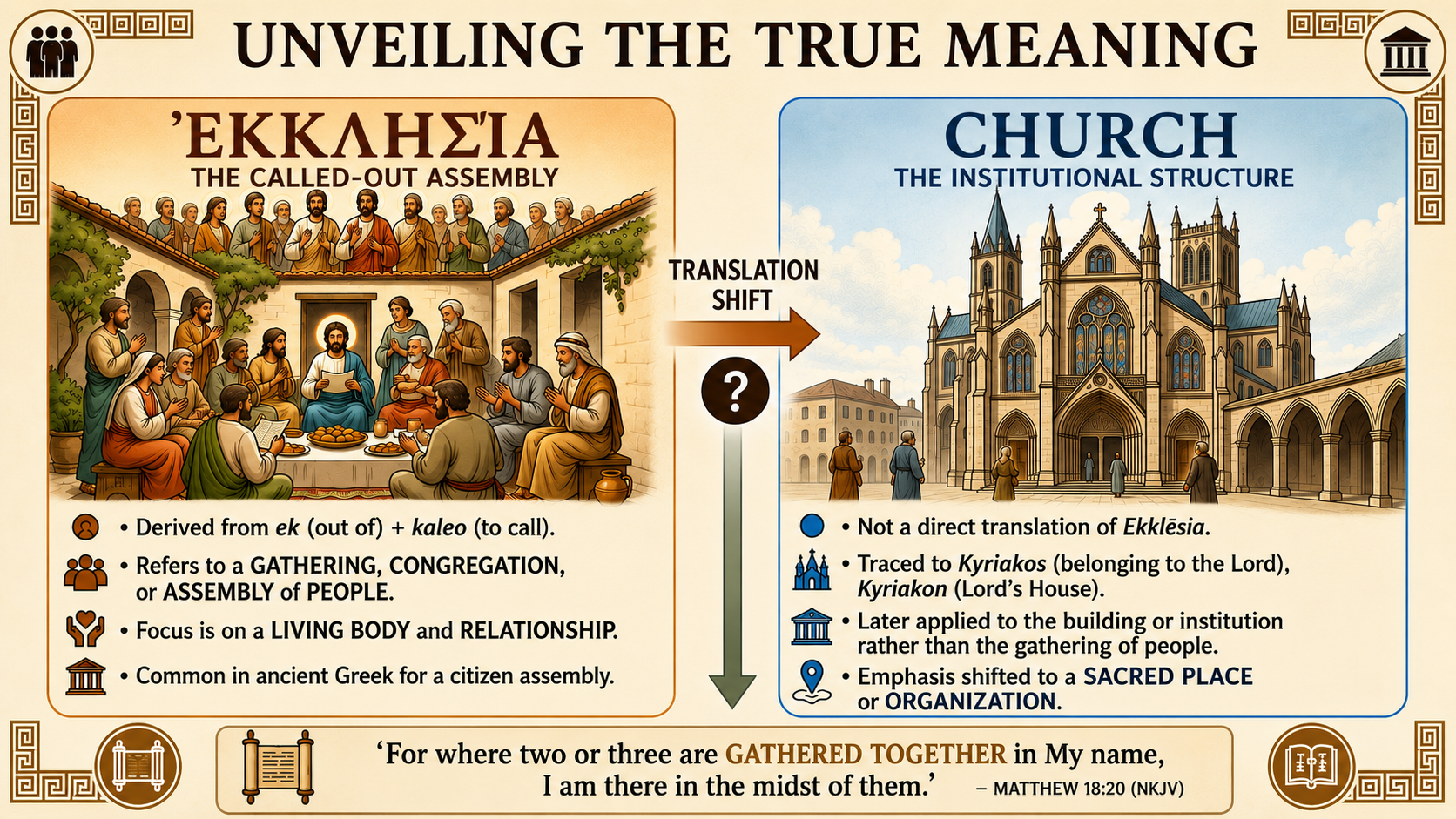
The following webpost is offered as a respectful clarification of an important subject: the meaning of the Greek word ekklesia and the way it differs from the English word church. The video presented below raises several valuable points that deserve careful consideration. It correctly challenges the widespread assumption that Christ’s ekklesia is fundamentally a religious building, a denomination, an institutional organization, or merely a scheduled Sunday service. It also calls attention to the active, participatory, and relational character of the gatherings described in the New Testament.
The purpose of this article is not to put down, belittle, or degrade the video or its author. On the contrary, the presentation brings attention to a subject that has often been neglected and makes several observations that are both helpful and worthy of further study. Because the subject matters so deeply, however, certain statements deserve additional clarification so that viewers do not exchange one misunderstanding for another.
The video will follow this introduction so that readers may first consider its argument in its original form. After the video, the article titled “Clarifying Ekklesia, ‘Church,’ and the Christian Gathering” will examine the major claims more closely. Particular attention will be given to the meaning of ekklesia, the distinction between Christ’s people and their assembled condition, Paul’s repeated language of “coming together,” the communal character of the Lord’s Supper, the Old Testament background of the Hebrew word qāhāl, the use of ekklesia in Acts 7:38, the difference between ekklesia and the adjective kyriakos, and Justin Martyr’s description of the Christian gathering in First Apology, Chapter 67.
At the conclusion, the bottom of this post, the full transcript of the video will be displayed for readers who would like to examine the presentation more carefully and compare its statements with Scripture. The transcript contains many worthwhile observations even where some conclusions require qualification.
The goal is therefore not to tear down a useful presentation, but to sharpen it. With a fuller and more precise explanation of ekklesia, kyriakos, kyriakon, the assembled congregation, and the biblical pattern of Christian fellowship, the central message of the video can become even clearer and more accurate.
Video Transcript
Jesus Never Said Go to Church
Transcript
00:00 – There is a word that appears in the Gospels more than a hundred times, a word that Jesus himself used repea00:00 – There is a word that appears in the Gospels more than a hundred times, a word that Jesus himself used repeatedly, and yet almost every English translation has chosen to render it in a way that completely changes what he was actually saying.
00:15 – The word is ekklesia, and for 2,000 years Christians have been told that when Jesus said, I will build my church, he was talking about a building, an institution, a weekly gathering inside four walls.
00:29 – But the Greek word ekklesia never meant any of those things. It meant something far more specific, far more political, and far more dangerous than anything we now call a church service. And Jesus never once told anyone to go to it.
00:45 – The problem is not that the word is difficult to translate. The problem is that the translation we have inherited has already made a decision for us about what the Christian life is supposed to look like.
00:56 – When you hear church, you almost certainly think of a place you go to, a service you attend, a building with a steeple or a stage. But the word Jesus chose does not carry any of that weight. It carries the weight of a civic assembly, a summoned gathering of citizens who have been called out of their homes to conduct the business of the city.
01:16 – It is the same word used in the Greek city-states for the lawful gathering of free men to make decisions about taxes, war, and justice. It is not a religious word, it is a political word, and Jesus took it and applied it to the community he was forming, which means he was not inviting people to a weekly religious event, he was calling them into a new kind of citizenship.
01:40 – That is the first thing that has to settle into your mind before anything else in this script makes sense. Jesus never said, “Go to church”; he said, “I will build my ekklesia.” And the difference between those two statements is not a matter of vocabulary.
01:56 – It is a matter of what you think God is actually doing on this earth. The word you choose determines the life you live. This is where we have to do something uncomfortable. We have to set aside everything we think we know about the word “church.”
02:11 – We have to let the Greek text be what it is, and we have to follow where it leads, even if it leads to a conclusion that makes Sunday morning feel different, because there is a detail in the Gospel of Matthew that almost no one notices, and it has been sitting there for 2,000 years waiting for someone to finally ask the obvious question.
02:30 – Jesus uses the word ekklesia only twice in the Gospels. Both times are in Matthew, and both times he is not talking about a building, a service, a denomination, or a geographic location. He is talking about a community that has the authority to bind and loose, to include and exclude, to represent the reality of heaven on earth.
02:53 – The word is not a place. It is a people, and the people are not defined by where they gather, but by the fact that they have been called out. The Greek word ekklesia is a compound of two words: ek, meaning “out of,” and kaleo, meaning “to call.”
03:10 – It means literally “the called out.” In the secular Greek world, it referred to the assembly of citizens who had been summoned from their homes to the public square to participate in the governance of the city.
03:22 – When the herald went through the streets calling the citizens to assemble, the ones who responded were the ekklesia. They were not a passive audience; they were the governing body. They had been called out of their private lives into a public responsibility.
03:36 – And when Jesus uses this word, he is drawing on that entire cultural background. He is not inventing a new religious term. He is taking a term that every person in the first century Mediterranean world would have recognised as the language of political identity and citizenship, and he is applying it to his followers.
03:56 – The implication is staggering. The people who follow Jesus are not a religious club. They are a counter-society, an alternative city, a new kind of public assembly that answers to a different king. But if we are honest, most of us do not live like that.
04:12 – Most of us have been shaped by a version of Christianity that treats the assembly as something we attend rather than something we are. We talk about “going to church” as if the church were a destination, a place on a map, an event on a calendar.
04:27 – We measure our spiritual health by whether we showed up on Sunday. We evaluate churches by the quality of their music, the length of their sermons, the friendliness of their greeters, and none of those things are bad in themselves, but they have absolutely nothing to do with what the word ekklesia meant when Jesus said it.
04:46 – The gap between what we think church is and what Jesus said it is not a small gap. It is a chasm, and most Christians have never been told that the chasm exists. So let me ask the question that this entire script is built around.
05:01 – If Jesus never said “go to church,” and if the word he used instead meant a summoned assembly of called-out citizens, then what did he actually intend for his followers to do? And how did we end up with a version of Christianity that is so focused on weekly attendance that we have almost completely lost the reality of being a distinct people called out of the world to represent the governance of God?
05:26 – The answer requires us to go back further than Matthew. It requires us to understand that the word ekklesia did not originate with Jesus. It was the Greek translation of a Hebrew word that appears throughout the Old Testament, and that Hebrew word carries its own set of meanings that will change how you read everything from Exodus to Revelation.
05:47 – The Hebrew word is Qāhēl. It means the same thing: a congregation, an assembly, a gathering of people who have been called together. But in the Old Testament, the Qāhēl is almost always the assembly of Israel before God.
06:01 – It is not a voluntary gathering. It is a commanded assembly. When God calls his people together at Mount Sinai, that is a Qāhēl. When they gather for covenant renewal, that is a Qāhēl. When they assemble for worship at the tabernacle, that is a Qāhēl.
06:17 – And every single time, the emphasis is not on the building or the ritual. The emphasis is on the people who have been summoned into the presence of God. This is the shadow. The Old Testament Qāhēl was the assembly of Israel, gathered at the foot of Sinai, gathered at the door of the tent of meeting, gathered in the courts of the temple.
06:37 – They were called out of Egypt, called out of the nations, called out of their ordinary lives to stand before God as a people, and the entire Old Testament system of priesthood, sacrifice, and law was designed to make that assembly possible.
06:52 – But the assembly had a problem. It was temporary. It depended on location. It depended on a building that could be destroyed. It depended on a priesthood that could fail. It depended on sacrifices that had to be repeated.
07:05 – The assembly could be called together, but it could not be sustained. The people could be summoned, but they could not remain. The Qāhēl was a shadow, a pattern, a preview of something that was coming.
07:18 – And when Jesus says, “I will build my ekklesia,” he is not starting something new. He is fulfilling something old. He is saying that the assembly that was called together at Sinai, the assembly that gathered at the temple, the assembly that had been scattered by exile and dispersed among the nations, was now being reconstituted around a single person—not a mountain, not a building, not a law, but a person.
07:44 – And that person is the one who is building the assembly. The assembly is not building itself; the assembly is not a human organization; it is a divine construction, and the material he is using is not stone or wood or brick.
08:00 – The material is people—people who have been called out of the old assembly of the world and into the new assembly of the kingdom. There is a figure in the early church who understood this better than almost anyone.
08:12 – His name is Justin Martyr, and he wrote his first apology around 155 AD, addressing it to the Roman Emperor Antoninus Pius. Justin is not writing from a comfortable study. He is writing from a city where Christians are being executed for refusing to worship the emperor.
08:30 – He is writing knowing that his own death may come at any moment, and in the middle of this apology, he describes what happens when the Christians gather. He does not call it a “church service”; he calls it “the assembly,” and he describes it in language that would have been immediately recognizable to any Roman reading it.
08:49 – The Christians gather on the day called Sunday, they read the memoirs of the apostles and the writings of the prophets, and then the president gives a discourse. But notice what Justin does not say. He does not describe a building.
09:02 – He does not describe a hierarchy. He does not describe a ritual that separates them from the world. He describes an assembly of people who have been called out of the worship of idols and into the worship of the one true God.
09:16 – And for Justin, that assembly is not an event. It is an identity. The application lands on us with its full weight. If you have ever walked into a church building on a Sunday morning and felt like something was missing, you were right.
09:30 – The building is not the problem. The problem is that we have been trained to think of the assembly as a place we go to instead of a people we are. We have been told that church is something you attend, and if you attend faithfully, you are a good Christian.
09:46 – But Jesus never said that. Paul never said that. None of the New Testament writers ever said that. What they said was that you are the assembly. You are the called-out ones. And the moment you think of the assembly as a destination, you have already missed the point.
10:02 – The assembly is not where you go; the assembly is who you are. But there is a deeper tension here, and we cannot avoid it. If the assembly is the people, then what happens when the people are not gathered?
10:14 – What happens on Monday morning, Tuesday afternoon, Wednesday evening? Are they still the Ekklesia? The New Testament answer is yes. The assembly does not cease to exist when the people are scattered.
10:27 – The assembly is not defined by the gathering. The assembly is defined by the calling. You have been called out; you are always called out. You do not stop being a citizen of the kingdom when you leave the building.
10:40 – You carry the assembly with you into the marketplace, into the workplace, into the living room. And that means the question is not whether you went to church today. The question is whether you are living today as a member of the called-out assembly.
10:55 – There is a detail in the book of Acts that has been sitting there for 2,000 years, waiting for someone to notice its implication. When Luke describes the early believers, he does not say they went to church.
11:06 – He says they devoted themselves to the teaching and fellowship, to the breaking of bread and the prayers. He says they were together in the temple and broke bread from house to house. He does not use the word ekklesia to describe a location.
11:21 – He uses it to describe the people. And when persecution scatters them, they do not stop being the ekklesia. They carry the assembly with them wherever they go. The word follows the people, not the place.
11:35 – That is not a minor grammatical detail. That is the entire structure of the New Testament understanding of what it means to be the people of God, which means we have a decision to make. We can continue thinking of church as a service we attend, a building we enter, a weekly obligation we fulfil, or we can let the text rewire our imagination.
11:57 – We can let the word ekklesia do its work and realize that we have been called out of the world not to attend an event, but to be a people. And that change in thinking will affect everything. It will affect how you gather.
12:12 – It will affect how you scatter. It will affect what you think you are doing when you walk into a room with other believers. It will affect what you think you are doing when you walk out. But here is the tension that we have to carry into the second half of this script.
12:28 – If the assembly is the people, and if the gathering is not the goal, then what was the gathering actually for? The early church gathered. They gathered on the first day of the week, they gathered in homes, they gathered in the temple courts, they gathered even when it was dangerous to do so.
12:47 – If the assembly is not defined by the gathering, then why did they gather at all? And why did they treat the gathering as so essential that they were willing to die for it? The answer is not what you think.
12:59 – It has nothing to do with obligation; it has everything to do with embodiment. The gathering was not the point, but it was the place where the point became visible. And if we get that distinction wrong, we will either abandon the gathering entirely or we will make it into an idol.
13:16 – Both errors are deadly, and both errors are possible only because we have not understood what Jesus actually meant when he said the word we have been mistranslating for two thousand years. The second half of this script will show you what the gathering was for and what it meant for the people who carried the assembly into the arena, because the tension is not going to resolve itself.
13:38 – It is going to demand an answer. The answer is that the gathering was never the point, but it was the only place where the point could be made visible. The early Christians gathered on the first day of the week not because they were required to, not because the law demanded it, not because a building was waiting for them, but because the resurrection had redefined what time itself meant.
14:01 – The first day of the week was the day the tomb was empty; it was the day the new creation began, and when they gathered on that day, they were not merely meeting for a religious service; they were publicly declaring that the old world had passed away and a new world had begun.
14:19 – The gathering was the visible evidence that the assembly was real. But that raises a tension we cannot ignore. If the assembly is the people and the gathering is only a moment, then what happens when the gathering ends?
14:31 – Does the assembly cease to exist? Does the calling expire? The New Testament answer is unequivocal. The assembly does not cease. You do not stop being the called-out people when you walk out the door, and yet the early Christians treated the gathering as absolutely essential.
14:48 – They arranged their lives around it. They travelled distances to be at it. They risked imprisonment and death to participate in it. If the gathering was not the point, why did it matter so much? The Greek word that explains this is Kyriakos, which appears only twice in the New Testament, both times in contexts that are easy to overlook.
15:09 – The first is in Revelation, where John says he was in the Spirit on the Kiriak day. The second is in 1 Corinthians, where Paul refers to the Kiriak Supper. The word means “belonging to the Lord.” It is not the Greek word for Sabbath.
15:25 – It is not the word for the seventh day. It is a word that ties a specific time to a specific person. “The Lord’s Day” does not mean Sunday in the way we use the word. It means the day that belongs to the Lord.
15:39 – And that distinction is everything. The early Christians did not gather on Sunday because it was the first day of the week. They gathered on Sunday because it was the day the Lord rose, and that resurrection had claimed the day as his own.
15:53 – The gathering was not about keeping a commandment; it was about celebrating a person. This is where the shadow-and-substance pattern completes itself. The Old Testament Sabbath was a shadow. It was the seventh day, the day of rest, the day God ceased from his work, and it was given to Israel as a sign of the covenant, a reminder that they were a people set apart.
16:15 – But the Sabbath was always pointing forward. It was a promise that there would be a rest that no amount of human effort could achieve, a rest that would come only when God completed a work of redemption that matched the work of creation.
16:29 – Every week Israel paused; every week they laid down their tools; every week they trusted that God would provide; and every week they were rehearsing a hope that had not yet been fulfilled. The Sabbath said, “Rest is coming,” but the rest did not arrive until a man hung on a cross and said, “It is finished,” and then lay down in a tomb on the seventh day, and then rose on the first day.
16:54 – The substance of the Sabbath is not a day of the week; the substance is a person who finished the work, and when he rose he did not merely restore the seventh day; he inaugurated an eighth day, a first day, a day that had never existed before.
17:11 – The Lord’s Day is not a new Sabbath. It is the day the Sabbath was always pointing toward. The Greek word Leitourgia is the one the early Christians used for what they did when they gathered, and it is almost never translated correctly in our modern Bibles.
17:27 – Leitourgia means “public work” or “service on behalf of the people.” In the ancient Greek world it referred to a wealthy citizen who funded a public festival or outfitted a warship for the city. It was not a private devotion.
17:42 – It was a public act that served the common good. And when the New Testament uses this word for the gathering of the Ekklesia, it is saying something that completely subverts our modern understanding of worship.
17:56 – The gathering is not about what you get; it is about what you do for the assembly. The singing, the teaching, the breaking of bread, the prayers—these are not consumer activities. They are acts of citizenship.
18:10 – They are the work you do for the city of God. Every person who enters the gathering as a passive consumer has missed the entire point. You do not go to church to be served. You go to the assembly to serve the assembly, to build it, to strengthen it, to make it visible.
18:28 – There is a letter written by a Roman governor named Pliny the Younger around 112 AD, and it is one of the most revealing documents we have about early Christian gatherings. Pliny is writing to the Emperor Trajan because he does not know what to do with these Christians.
18:44 – They refuse to worship the Emperor’s statue. They refuse to burn incense to the gods. They are stubborn, and they are multiplying. And in his letter, Pliny describes what he has learned from interrogating them.
18:58 – He says they meet on a fixed day before dawn, they sing a hymn to Christ as to a god, and they bind themselves by an oath not to commit theft, robbery, or adultery, not to break their word, not to deny a trust.
19:12 – Pliny is not a theologian; he is a bureaucrat, but he has noticed something that most modern Christians have forgotten. The gathering was not the end of their obedience. The gathering was the place where they renewed their oath to live a certain way.
19:27 – The gathering was the moment they reminded themselves who they were, so that when they scattered they would live like it. That is the application that lands directly on every person who has ever walked into a church building and felt that something was missing.
19:42 – The problem is not that you are not getting enough out of the service. The problem is that you have been trained to think of the service as something you consume rather than something you become part of.
19:54 – The early Christians did not ask whether the sermon was good enough, or whether the music moved them. They asked whether the assembly was being built. They asked whether the body of Christ was being strengthened.
20:06 – They asked whether the Ekklesia was living as a called-out people, and if you have ever left a church service feeling empty, it may be because you were waiting to receive something that you were actually supposed to give.
20:19 – But now we have to face the deepest tension of all, the one that the first half of this script left unresolved. The early Christians gathered even when it was fatal to do so. They gathered in secret, they gathered in catacombs, they gathered in upper rooms with the doors locked, they gathered knowing that a knock on the door could mean arrest, torture, and death.
20:40 – If the gathering was not the point, why did they risk their lives for it? The answer is that the gathering was the only place where the assembly could publicly declare its allegiance. In a world that demanded loyalty to Caesar, the Ekklesia gathered to proclaim that Jesus is Lord.
20:57 – That was not a private devotional sentiment; that was an act of treason, and the gathering was the moment when that treason became visible. They did not gather to hear a sermon; they gathered to confess a king.
21:09 – This is the moment when the shadow becomes substance, and we have to see it in the specific details. The Old Testament assembly at Sinai was a theophany. The mountain shook, the trumpets sounded, the people trembled; they were gathered to hear the voice of God and to swear allegiance to his covenant.
21:27 – That assembly was terrifying, glorious, and temporary. It could not last. The people could not remain on the mountain. They had to go back to the camp. They had to live out the covenant in the ordinary days.
21:40 – But the New Testament assembly is not called to a mountain that can be touched. It is called to the heavenly Jerusalem, to the assembly of the firstborn whose names are written in heaven. The writer of Hebrews makes this explicit.
21:54 – “You have not come to a mountain that can be touched,” he says. “You have come to Mount Zion, to the city of the living God.” The gathering of the Ekklesia on earth is not a distant echo of that heavenly assembly; it is the earthly manifestation of it.
22:09 – When the Ekklesia gathers, the heavenly assembly breaks into the present moment. The veil between the ages is thin, the king is present, and the gathering is the place where that reality becomes so real that people were willing to die for it.
22:25 – There is a story from the early church that has been preserved in the writings of Eusebius. A man named Polycarp was bishop of Smyrna in the second century. He was old, probably in his eighties, when the authorities came for him.
22:38 – They arrested him in the countryside, brought him to the stadium, and gave him a choice: swear by Caesar, curse Christ, and live. Polycarp refused. He said, “Eighty-six years I have served him, and he has done me no wrong.”
22:53 – “How can I blaspheme my king who saved me?” They burned him alive. But what is often missed in that story is what Polycarp said just before his arrest. When the soldiers arrived, he asked for an hour to pray.
23:05 – He prayed aloud for two hours, and the soldiers were so moved that they regretted coming to take him. Polycarp was not afraid of the gathering that was about to happen in the arena. He was already gathered with the assembly of heaven.
23:18 – The earthly gathering was about to cost him his life, but the heavenly gathering was about to receive him into eternal rest. The application for us is uncomfortable. Most of us will never face the choice Polycarp faced.
23:30 – We live in places where the gathering is safe, comfortable, and convenient. And that safety has allowed us to forget what the gathering actually is. We have reduced it to a cultural habit, a weekly ritual, a social obligation.
23:45 – We have forgotten that the gathering is the moment when the Ekklesia declares that Jesus is Lord and no one else is. We have forgotten that the gathering is an act of war against the principalities and powers.
23:58 – We have forgotten that when we gather, we are not just meeting each other. We are meeting the ascended king, and if we have not felt the weight of that, it is not because the gathering has lost its power; it is because we have lost our vision.
24:13 – The final tension resolves itself in a single sentence. The ekklesia is not a building you enter; it is a people you become. The gathering is not the goal. It is the moment when the goal becomes visible.
24:26 – And the call is not to go to church. The call is to be the called-out assembly of the risen king, a living testimony that the world’s allegiances are passing away, and that the only true citizenship is in the kingdom that cannot be shaken.
24:41 – Every Sunday morning, you have a choice. You can walk into a building and sit in a seat and leave the same person you were when you arrived. Or you can enter the assembly of the called-out ones, confess that Jesus is Lord, renew your oath to live as his people, and walk out carrying the assembly with you into every room you enter.
25:00 – The building will not save you, the gathering will not save you, but the one who called you out of darkness and into his marvellous light—he is the one who builds his ekklesia, and the gates of hell will not prevail against it.tedly, and yet almost every English translation has chosen to render it in a way that completely changes what he was actually saying.
Appreciating the Video While Sharpening Its Argument
The video “Jesus Never Said Go to Church” raises an important concern. Its strongest contribution is that it challenges Christians to distinguish the New Testament word ekklesia from the many ideas now carried by the English word church. The video rightly observes that ekklesia does not inherently mean a sacred building, a denomination, a clerical institution, or a weekly program conducted inside four walls. It also correctly calls attention to the active and participatory character of the earliest Christian gatherings.
From the Video (00:15–00:56)
“…for 2,000 years Christians have been told that when Jesus said, ‘I will build my church,’ he was talking about a building, an institution, a weekly gathering inside four walls… But the Greek word ekklesia never meant any of those things… When you hear ‘church,’ you almost certainly think of a place you go to… But the word Jesus chose does not carry any of that weight.”
Editorial Clarification
The transcript correctly identifies one of the greatest sources of confusion in modern Christian vocabulary. Over the centuries, the English word church has acquired numerous meanings beyond the lexical meaning of the Greek noun ekklesia. Today it may refer to a building, a worship service, a denomination, an institution, or the people themselves. Because of this expanded usage, many readers naturally picture a building or religious service long before they think of an assembled congregation. Recognizing this distinction is essential to understanding the New Testament’s use of ekklesia.
Those are significant strengths. The purpose of this clarification is therefore not to discredit the video, but to preserve its best insights while refining several statements that could leave viewers with an inaccurate understanding of the Greek language, the New Testament pattern, and the testimony of Justin Martyr.
With several careful corrections, the presentation could become one of the more useful introductions to this subject. The topic matters too much either to dismiss the video’s valid concerns or to accept every statement in it without examining the biblical and historical evidence.
An Important Correction at the Beginning
The transcript begins by saying that ekklesia appears in the Gospels more than one hundred times and that Jesus used it repeatedly. Later, however, the transcript correctly states that Jesus uses the word only in two passages in Matthew.
From the Video (00:00–00:15)
“There is a word that appears in the Gospels more than a hundred times, a word that Jesus himself used repeatedly…”
Editorial Clarification
This opening statement is factually inaccurate. The Greek word ekklesia occurs well over one hundred times in the New Testament, but not in the four Gospels. Within the Gospels, Jesus uses ekklesia only in Matthew 16:18 and Matthew 18:17 (where it appears twice), for a total of three occurrences in two teachings. Interestingly, the transcript itself later acknowledges this correctly, making the opening statement an internal inconsistency rather than a disagreement over interpretation.
From the Video (02:30–02:53)
“Jesus uses the word ekklesia only twice in the Gospels. Both times are in Matthew, and both times he is not talking about a building, a service, a denomination, or a geographic location. He is talking about a community that has the authority to bind and loose, to include and exclude, to represent the reality of heaven on earth.”
The opening statement should therefore be revised. The word occurs more than one hundred times in the New Testament as a whole, but in the four Gospels it appears only in Matthew 16:18 and Matthew 18:17. In Matthew 18:17 it appears twice, giving three occurrences in the Gospel text within two teachings of Jesus.
This may seem like a small correction, but accuracy at the beginning is especially important in a presentation intended to correct a long-established translation tradition. A presentation inviting readers to reconsider inherited assumptions should itself be careful to present precise historical and textual facts from the outset.
What Ekklesia Actually Communicates
The central meaning of ekklesia is an assembly, congregation, or gathering of people. Its historical usage included civic assemblies, but it should not be reduced exclusively to a political governing body.
From the Video (00:56–01:40)
“…It carries the weight of a civic assembly, a summoned gathering of citizens who have been called out of their homes to conduct the business of the city. It is the same word used in the Greek city-states for the lawful gathering of free men to make decisions about taxes, war, and justice… Jesus took it and applied it to the community he was forming…”
Editorial Clarification
The civic background of ekklesia is an important part of its history and helps explain why the word never denoted a sacred building. Nevertheless, the New Testament inherits another equally significant background through the Greek Septuagint, where ekklesia frequently translates the Hebrew qāhāl (“assembly” or “congregation”). First-century Jewish hearers would therefore have recognized both the civic and the biblical associations of the word. Preserving both backgrounds provides a fuller understanding than emphasizing either one in isolation.
Acts 19 provides a useful example. The same Greek word is used for the confused gathering in Ephesus, for a lawful assembly, and for the assembly that was finally dismissed. The immediate meaning is determined by the fact that people were gathered, not necessarily by their possessing governmental authority.
The video repeatedly derives ekklesia from ek, meaning “out of,” and kaleō, meaning “to call,” and then treats “the called-out ones” as its controlling definition. That word history may be mentioned, but it should not replace the meaning established by actual usage. The meaning of a word is determined primarily by how speakers and writers use it, not merely by separating it into earlier word components.
From the Video (02:53–03:22)
“The Greek word ekklesia is a compound of two words, ek, meaning ‘out of,’ and kaleō, meaning ‘to call.’ It means literally the called out…”
Editorial Clarification
The etymology of ekklesia is often cited because it provides a memorable illustration of God’s calling of His people. Modern lexical scholarship, however, generally recognizes that a word’s established meaning is determined by its actual usage rather than by the meanings of its individual components. In the New Testament and in contemporary Greek literature, ekklesia consistently denotes an assembly, congregation, or gathered body. While believers are unquestionably “called” by God, that theological truth should not replace the lexical meaning of the noun itself.
In New Testament usage, ekklesia means an assembly or congregation. “Called out” may provide a memorable association, especially because believers truly are called by God, but it should not be treated as the complete lexical definition.
A more precise statement would be:
An ekklesia is an assembly or congregation of people. Christ’s people are called by God, and when they come together they constitute His assembly.
That wording preserves the truth of divine calling without redefining an assembly as a permanent condition existing independently of assembling.
Are Believers Still “the Assembly” When They Return Home?
The principal difficulty in the transcript appears when it asks what happens after the believers return home on Monday. It answers that they remain the ekklesia and declares that “the assembly is not defined by the gathering” but by the calling.
From the Video (10:02–10:40)
“But there is a deeper tension here… If the assembly is the people, then what happens when the people are not gathered?… Are they still the Ekklesia? The New Testament answer is yes. The assembly does not cease to exist when the people are scattered. The assembly is not defined by the gathering. The assembly is defined by the calling… You carry the assembly with you into the marketplace, into the workplace, into the living room.”
Editorial Clarification
This is the central thesis of the presentation and therefore deserves especially careful consideration. There is much in the statement that is true. Believers do not cease to belong to Christ when they leave a meeting. They remain redeemed people, disciples, saints, members of Christ’s body, and citizens of His kingdom wherever they go. Their relationship with Christ is continuous.
The question, however, is not whether believers remain Christ’s people after dispersing. The question is whether the Greek noun ekklesia itself denotes that scattered condition. Throughout Scripture, ekklesia consistently refers to an assembly or congregation. Consequently, it is more precise to say that believers remain Christ’s people between gatherings, while the ekklesia is manifested in its defining activity when those believers assemble.
That statement combines two related but distinguishable realities. Believers do not cease to belong to Christ when they leave a meeting. They remain saints, disciples, brethren, servants of Christ, members of His body, citizens of His kingdom, and people belonging to God. Their relationship with Christ does not begin when a meeting opens or end when the meeting closes.
Nevertheless, it does not follow that an assembly remains assembled after its members have dispersed.
A simple civic comparison illustrates the distinction. Members of a town council remain council members after they return home, but the council is not then sitting in assembly. Citizens eligible to participate in an assembly remain citizens when scattered, but the assembly itself exists in its active and visible form when those citizens convene.
From the Video (03:10–03:36)
“In the secular Greek world, it referred to the assembly of citizens who had been summoned from their homes to the public square to participate in the governance of the city. When the herald went through the streets calling the citizens to assemble, the ones who responded were the ekklesia.”
Editorial Clarification
Ironically, the civic illustration used by the transcript itself reinforces this distinction. Citizens did not cease to be citizens after returning home, yet no Greek writer would have described them as remaining “in assembly” once the meeting had ended. Their civic identity continued; the assembly did not. The same distinction helps explain the New Testament usage of ekklesia. Christ’s people remain His people at all times, while the assembly is expressed whenever those people come together.
Their identity continues. Their assembled condition does not.
A clearer statement would therefore be:
When believers return home, they remain Christ’s people and remain related to the local congregation of which they are members. Yet they are not presently assembled. The ekklesia becomes visible and functional as an assembly when those believers come together.
This distinction does not weaken Christian identity during the week. It gives proper meaning both to the scattered life of believers and to the importance of their gathering. The saints continue living faithfully while scattered, but an assembly, by the ordinary meaning of the word, is manifested through assembling.
From the Video (11:06–11:35)
“He says they devoted themselves to the teaching and fellowship, to the breaking of bread and the prayers… He does not use the word ekklesia to describe a location. He uses it to describe the people. And when persecution scatters them, they do not stop being the ekklesia. They carry the assembly with them wherever they go.”
Editorial Clarification
The Book of Acts certainly demonstrates that persecution did not end the believers’ relationship with Christ or with one another. Yet Acts also repeatedly records those same believers assembling again whenever circumstances permitted (Acts 2:42–47; 5:12; 20:7; 1 Corinthians 11:17–34; 14:23). The New Testament therefore presents no contradiction between believers living faithfully while scattered and those same believers gathering as the ekklesia. One reality complements the other. The scattered life of the saints and the assembled life of the congregation together form the normal rhythm of New Testament Christianity.
The Continuing Identity of a Local Congregation
It is also important not to overstate the matter in the opposite direction. Paul could write to “the church of God which is at Corinth,” even though the members were not continuously gathered every hour of every day. A local congregation could therefore be spoken of as an identifiable body between its meetings.
This is similar to the way we may speak of a council, court, or assembly by name even when it is not presently in session. The recognized body continues to exist relationally and organizationally, although its members are not actively assembled at every moment.
The balanced conclusion is therefore:
A local ekklesia may be recognized and named as a continuing congregation between meetings, but its defining activity and visible expression are found in the people’s actual coming together.
This avoids two extremes. It does not reduce ekklesia to nothing more than a brief event, but it also does not treat a scattered collection of individuals as presently assembled in exactly the same sense as when they are gathered in one place.
Paul’s “Coming Together” Language
Paul’s language in 1 Corinthians is especially important. He repeatedly describes the believers as coming together:
“For first of all, when ye come together in the church…”
—1 Corinthians 11:18 (KJV)
“When ye come together therefore into one place…”
—1 Corinthians 11:20 (KJV)
“Wherefore, my brethren, when ye come together to eat, tarry one for another.”
—1 Corinthians 11:33 (KJV)
Paul is describing an actual event. The believers came together into the same place, waited for one another, ate together, and acted corporately as a congregation.
From the Video (12:28–13:16)
“The early church gathered. They gathered on the first day of the week, they gathered in homes, they gathered in the temple courts, they gathered even when it was dangerous to do so… If the assembly is not defined by the gathering, then why did they gather at all?… The gathering was not the point, but it was the place where the point became visible.”
Editorial Clarification
This is one of the strongest observations in the presentation. The transcript rightly emphasizes that the early Christians deliberately assembled and regarded those gatherings as essential. The question is whether the gathering was merely the visible expression of an assembly that already existed in exactly the same sense while scattered, or whether the gathering itself constituted the assembly in its active, biblical expression.
Paul’s repeated language strongly favors the latter. Rather than speaking abstractly about an assembly existing apart from gathering, he continually directs attention to the believers coming together, into one place, and waiting for one another. The inspired vocabulary repeatedly emphasizes the act of assembling.
He uses similar language in 1 Corinthians 14:23:
“If therefore the whole church be come together into one place…”
—1 Corinthians 14:23 (KJV)
That sentence is particularly instructive. Paul can refer to “the whole ekklesia” as a recognized congregation, but he also speaks of that congregation coming together into one place.
This shows both sides of the distinction. The congregation possesses a continuing identity, but it functions visibly as an assembly when its members gather.
From the Video (11:57–12:47)
“It will affect how you gather… If the assembly is the people, and if the gathering is not the goal, then what was the gathering actually for? The early church gathered…”
Editorial Clarification
The transcript asks an excellent question, and the New Testament itself supplies the answer. Christians gathered because many of the central activities Christ gave His people can only be practiced corporately. Teaching, exhortation, prayer, the Lord’s Supper, discipline, mutual edification, the exercise of spiritual gifts, and congregational decision-making all presuppose believers assembled together. Gathering was therefore not incidental to the life of the ekklesia; it was one of the principal ways the ekklesia fulfilled its God-given purpose.
The Lord’s Supper as an Example of the Gathered Assembly
The Lord’s Supper provides one of the clearest examples of why the physical gathering mattered.
Paul was not describing believers privately eating in separate homes while being spiritually connected at a distance. They were coming together into one place, waiting for one another, eating together, and failing to recognize the communal nature of the meal.
The abuses Paul corrects show that real food was involved. Some were eating before others arrived. One person was hungry while another was drunken. Paul told those whose main purpose was satisfying ordinary hunger that they had houses in which to eat.
These details make far more sense in the setting of a communal supper than in the later custom of distributing a small wafer and a thimble-sized cup of grape juice.
Paul writes:
“For in eating every one taketh before other his own supper: and one is hungry, and another is drunken.”
—1 Corinthians 11:21 (KJV)
He then asks:
“What? have ye not houses to eat and to drink in?”
—1 Corinthians 11:22 (KJV)
The problem was not that they were eating a meal. Paul had just called it the Lord’s Supper. The problem was the selfish and disorderly way they were eating it. Some went ahead without waiting. The poor were humiliated. The shared meal that should have expressed unity was instead exposing division.
Paul therefore concludes:
“Wherefore, my brethren, when ye come together to eat, tarry one for another.”
—1 Corinthians 11:33 (KJV)
From the Video (17:56–18:10)
“The gathering is not about what you get, it is about what you do for the assembly. The singing, the teaching, the breaking of bread, the prayers… These are acts of citizenship.”
Editorial Clarification
Although the transcript later overstates the role of leitourgia, it rightly recognizes that the gathering was participatory rather than spectator-oriented. Paul’s discussion of the Lord’s Supper confirms this. The meal was not an individual religious exercise performed in isolation. It was a communal act requiring believers to gather, wait for one another, eat together, remember Christ together, and visibly express their unity as one body.
The Lord’s Supper was corporate, participatory, and connected with believers physically coming together. It was not originally a private act performed separately by isolated individuals, nor does the passage resemble the later reduction of the supper to a token wafer and a thimble of juice.
Paul had already explained the communal meaning of the meal:
“For we being many are one bread, and one body: for we are all partakers of that one bread.”
—1 Corinthians 10:17 (KJV)
The Supper visibly expressed their shared participation in Christ and their unity with one another. They remained Christ’s people while at home, but the common meal took place when they assembled, waited for one another, ate together, remembered Christ, and manifested themselves as one body.
The Lord’s Supper therefore gives concrete meaning to the word ekklesia. The gathered body was not merely an invisible identity. It was a people acting together.
From the Video (18:10–19:12)
“You do not go to church to be served. You go to the assembly to serve the assembly, to build it, to strengthen it, to make it visible… The gathering was the moment they reminded themselves who they were, so that when they scattered they would live like it.”
The emphasis on mutual edification is a valuable reminder. The New Testament presents the gathering as the place where believers strengthened one another before returning to their daily lives of discipleship. Rather than competing with the scattered life of the Christian, the assembly equipped and prepared believers to live faithfully once they dispersed. In this way, the assembled congregation and the scattered witness of believers complement one another rather than stand in opposition.
“The Gathering Was Not the Point”
The transcript repeatedly says that “the gathering was not the point,” although it also acknowledges that the first Christians treated gathering as essential. This wording creates an unnecessary tension.
From the Video (12:59–13:38)
“The gathering was not the point, but it was the place where the point became visible… The gathering was never the point, but it was the only place where the point could be made visible.”
Editorial Clarification
This is perhaps the most repeated phrase in the presentation, yet it is also one of its least precise. If by “the point” the author means that gathering is not the entirety of Christian life, then the statement is certainly true. Believers are called to live faithfully every day of the week. However, the wording unintentionally diminishes the importance that the New Testament itself places upon assembling. Scripture never presents the gathering as merely incidental or illustrative. Rather, it is one of the primary expressions through which Christ’s people worship, remember Him, edify one another, exercise discipline, and manifest their unity before the world.
Certainly, gathering was not the entirety of Christian life. Believers were expected to live faithfully, serve others, care for their households, proclaim Christ, practice holiness, help the needy, and bear witness throughout the week.
Nevertheless, the gathering was not merely a visual aid showing that some deeper invisible reality existed. It was itself a meaningful and necessary expression of obedience and shared life.
When Christians assembled, they heard the apostles’ teaching, prayed together, broke bread, partook of the Lord’s Supper, exercised spiritual gifts, encouraged one another, gave for the needy, practiced discipline, and built up the body. These activities required actual interaction among gathered believers.
From the Video (14:01–14:48)
“The gathering was the visible evidence that the assembly was real… Yet the early Christians treated the gathering as absolutely essential. They arranged their lives around it. They travelled distances to be at it. They risked imprisonment and death to participate in it.”
Editorial Clarification
Here the transcript itself demonstrates why its earlier wording deserves refinement. If the gathering was so central that believers ordered their lives around it and willingly faced persecution to participate in it, then the gathering was more than a convenient illustration of Christian identity. It was one of the principal ways that identity found obedient expression. The New Testament consistently joins these two realities together rather than separating them.
A better statement would be:
The gathering was not the whole of Christian discipleship, but it was an essential expression of the life Christ gave His people. The believers gathered so that the body could function together in teaching, fellowship, prayer, the shared meal, mutual edification, discipline, and care for one another.
Acts 7:38 and “The Church in the Wilderness”
Acts 7:38 provides an especially revealing example of how the English word church can obscure the underlying meaning of ekklesia. Stephen, speaking about Moses and Israel at Sinai, says in the KJV:
“This is he, that was in the church in the wilderness with the angel which spake to him in the mount Sina…”
—Acts 7:38 (KJV)
A modern reader may easily imagine that Stephen is saying there was a “church” in the wilderness in the later institutional or denominational sense. But the Greek word is ekklesia, and the context concerns the assembled congregation of Israel at Mount Sinai.
Other English translations use “congregation” or “assembly,” making the sense more immediately apparent. The Greek text has not changed. Only the English rendering differs.
From the Video (05:26–06:17)
“The word ekklesia did not originate with Jesus. It was the Greek translation of a Hebrew word that appears throughout the Old Testament… The Hebrew word is Qāhēl… a congregation, an assembly… When God calls His people together at Mount Sinai, that is a Qāhēl.”
Editorial Clarification
This is one of the strongest historical observations made in the presentation. The Septuagint frequently translates the Hebrew qāhāl with ekklesia, providing an important Old Testament background for the New Testament. Acts 7:38 becomes especially significant because Stephen himself uses ekklesia of Israel gathered before God at Sinai. The passage demonstrates that the word already possessed a rich biblical history long before Jesus spoke of building His ekklesia.
Stephen was not describing a Christian institution existing under Moses. He was describing Israel gathered before God. There was no cathedral, denomination, ecclesiastical corporation, or weekly Christian service in the wilderness. There was a people summoned and assembled before the Lord.
Acts 7:38 therefore demonstrates that ekklesia was not invented as a uniquely Christian religious title. The word could be used of Israel at Sinai because it meant an assembly or congregation.
The identity of the people and the covenantal setting differed from the assemblies established under Christ, but the fundamental concept of a gathered body remained.
From the Video (06:17–07:18)
“The emphasis is not on the building or the ritual. The emphasis is on the people who have been summoned into the presence of God… The Old Testament Qāhēl was the assembly of Israel…”
The transcript rightly recognizes that God’s covenant people were defined by their relationship with Him rather than by sacred architecture. The assembly at Sinai illustrates precisely that truth. Yet the people were not merely related to one another conceptually—they were actually gathered before the Lord. Thus, the Old Testament pattern reinforces rather than diminishes the assembled character of qāhāl and ekklesia.
The Old Testament Background of Qāhāl
The New Testament use of ekklesia should be understood not only against the background of Greek civic assemblies, but also against the Greek Old Testament’s use of the word for the Hebrew qāhāl (קָהָל).
The Hebrew term commonly refers to an assembly, congregation, or convoked gathering. Its related verb carries the idea of assembling or summoning people together. In the Septuagint, qāhāl is frequently translated with ekklesia, although not in every occurrence and not exclusively.
This Old Testament background would have been familiar to Greek-speaking Jews and early Christians. When they heard ekklesia, they would not have thought only of civic assemblies in Greek cities. They also had the scriptural pattern of Israel being summoned and gathered before God.
At Sinai, Israel assembled to hear the words of the covenant. Moses later referred to “the day of the assembly,” the day on which Israel stood before the Lord. The defining picture was not merely that Israel had been called out of Egypt, although that was certainly true. The picture was that the people redeemed from Egypt were brought together before God as His congregation.
Israel remained God’s covenant people when families returned to their tents, but the qāhāl language especially describes the people in their assembled capacity. Their covenant identity continued when dispersed; their corporate assembly occurred when they were summoned together.
Acts 7:38 carries this Old Testament background into the New Testament. Stephen speaks of the ekklesia in the wilderness because Israel was the gathered congregation at Sinai.
This reinforces the distinction between the continuing identity of the people and their functioning as an assembled congregation.
The Modern Flexibility and Confusion of “Church”
The video is on firm ground when it observes that the English word church has accumulated meanings that ekklesia itself does not contain.
From the Video (00:45–01:16)
“When you hear church, you almost certainly think of a place you go to, a service you attend, a building with a steeple or a stage. But the word Jesus chose does not carry any of that weight.”
Editorial Clarification
This observation captures one of the central concerns of this article. The difficulty is not that the English word church is an illegitimate word; it is a perfectly valid English noun. Rather, over many centuries it has accumulated a wide range of meanings that extend beyond the lexical meaning of ekklesia. As a result, modern readers often import ideas into the biblical text that the Greek word itself does not convey.
Modern Christians commonly say:
“Our church is the best one in this area.”
“Can you think of a better church for us to attend?”
“What time does church start?”
“Church was really good today.”
“We missed church last Sunday.”
“We are going to church.”
“The church is located on Main Street.”
“The church burned down.”
“The church needs a new roof.”
“The church seats five hundred people.”
“He left the church.”
Listeners usually understand these expressions because centuries of English usage have made church an unusually flexible noun. Depending upon the sentence, it may mean a congregation, a meeting, a worship program, a building, a denomination, an institution, its leadership, or Christianity generally.
Yet that very flexibility can conceal the New Testament picture.
An assembly does not have a roof that can leak, doors that can be locked, pews that can seat five hundred people, or an address on Main Street. A building may have those things, but the congregation does not.
The expressions can be made more precise:
“The congregation with which we assemble is the soundest one in this area.”
“Can you recommend a sound Christian assembly with which we could meet?”
“What time does the congregation meet?”
“Our gathering was especially encouraging today.”
“We were unable to assemble with the congregation last Sunday.”
“The congregation meets in a building on Main Street.”
“The meetinghouse burned down.”
These alternatives may sound less familiar because modern Christian speech is deeply accustomed to the word church, but they expose distinctions that customary usage often hides.
From the Video (04:12–05:01)
“We talk about going to church as if the church were a destination, a place on a map, an event on a calendar… The gap between what we think church is and what Jesus said it is… is a chasm.”
The transcript correctly challenges readers to reconsider habitual religious language. At the same time, Christians should recognize that language develops over time. Today, many believers use the word church intending nothing more than the local congregation with which they assemble. The concern, therefore, is not merely vocabulary but precision. Whenever possible, language should illuminate rather than obscure the biblical picture presented by ekklesia.
Kyriakos and Kyriakon Require Fuller Explanation
The video gives extensive attention to ekklesia but only a brief explanation of kyriakos. It correctly says that the word means “belonging to the Lord” and connects it with the Lord’s Day and the Lord’s Supper.
From the Video (14:48–15:39)
“The Greek word… appears only twice in the New Testament… The word means belonging to the Lord… The Lord’s Day… means the day that belongs to the Lord.”
Editorial Clarification
Here the presentation identifies an important truth but leaves much of the linguistic picture unexplained. Understanding the distinction between ekklesia and kyriakos is essential because the two words belong to entirely different grammatical categories and communicate different ideas.
That basic definition is correct, but considerably more explanation is needed if the presentation intends to address the origin and meaning of the English word church.
The Greek word κυριακός (kyriakos) is an adjective meaning “belonging to the Lord,” “pertaining to the Lord,” or “the Lord’s.”
It appears only twice in the New Testament.
In 1 Corinthians 11:20, Paul writes:
κυριακὸν δεῖπνον (kyriakon deipnon)
“the Lord’s Supper.”
Here kyriakon is the neuter form of the adjective and modifies the noun deipnon, meaning “supper.”
In Revelation 1:10, John writes:
κυριακῇ ἡμέρᾳ (kyriakē hēmera)
“the Lord’s Day.”
Here kyriakē is the feminine form and modifies hēmera, meaning “day.”
In both New Testament occurrences, the word describes something as belonging or pertaining to the Lord. It does not mean assembly, congregation, people, or gathering.
The New Testament never uses kyriakos as another name for ekklesia, and it never uses kyriakon as the noun by which Christ’s assembled people are identified.
The distinction can be expressed simply:
Kyriakos describes relationship or possession—something belonging to the Lord. Ekklesia identifies an assembly or congregation.
The Lord’s Supper is kyriakon, but the Supper is not an ekklesia. The Lord’s Day is kyriakē, but the day is not an ekklesia. Christ’s assembly certainly belongs to Him, but that theological fact does not make the two Greek words synonymous.
From the Video (15:09–15:53)
“The word means belonging to the Lord… The gathering was not about keeping a commandment; it was about celebrating a person.”
The transcript rightly emphasizes the possessive force of kyriakos. Where additional precision is needed is in recognizing that an adjective describing something that belongs to the Lord cannot simply be substituted for a noun meaning an assembled congregation. Appreciating this grammatical distinction helps explain why the New Testament writers consistently preserved both words rather than treating them as interchangeable.
How an Adjective Became a Noun
It is grammatically possible for an adjective to become substantivized. This means that an adjective begins functioning as a noun when another noun is understood from the context.
Thus, to kyriakon could convey the general idea of “the Lord’s thing,” “that which belongs to the Lord,” or, in later usage, a place associated with the Lord. Through post-apostolic linguistic development, forms related to kyriakon became associated with a place belonging to the Lord and eventually entered Germanic languages, producing words related to the English word church.
Editorial Clarification:
This later linguistic development is historically significant because it explains why the English word church ultimately derives from a family of words associated with kyriakos rather than from ekklesia. That historical pathway, however, belongs to the development of language after the apostolic period. It should not be read back into the New Testament itself. The inspired writers consistently maintained the distinction between the adjective kyriakos (“belonging to the Lord”) and the noun ekklesia (“assembly” or “congregation”).
The important New Testament point remains straightforward:
The inspired writers did not use kyriakos or kyriakon to translate, define, or replace ekklesia.
The connection between a later word descended from kyriakon and the Christian congregation developed through later language history. It was not an equivalence established by Christ or the apostles.
It would therefore be unfair to say that church is not a real English noun. It unquestionably is, and modern speakers generally understand it.
The more exact criticism is this:
“Church” became an established English religious noun, but it does not transparently reproduce the lexical meaning of the Greek noun ekklesia. Its historical association with kyriakos represents a different Greek idea: belonging to the Lord.
Conclusion
The purpose of this study has not been to diminish the importance of Christian gathering, nor to criticize sincere believers who have long used the English word church. Rather, its purpose has been to encourage a fresh reading of Scripture by carefully distinguishing between the biblical vocabulary and the layers of meaning that later history attached to it.
Throughout the New Testament, the inspired writers consistently use ekklesia to describe the assembled congregation of God’s people. They likewise use kyriakos only to describe that which belongs to the Lord, such as the Lord’s Supper and the Lord’s Day. Those words are related only in the sense that Christ’s assembly belongs to the Lord. They are not interchangeable terms, nor does the New Testament ever use kyriakos as another name for the ekklesia.
The evidence presented throughout this article points toward several important conclusions.
First, the New Testament consistently portrays believers assembling together. Whether in homes, upper rooms, public places, or other suitable locations, the congregation is repeatedly described as coming together, assembling, and meeting in one place. The activities central to congregational life—teaching, prayer, fellowship, the Lord’s Supper, mutual edification, discipline, and the exercise of spiritual gifts—all assume believers gathered together.
Second, believers remain Christ’s people when they disperse. They remain saints, disciples, members of Christ’s body, and citizens of His kingdom wherever they go. Their relationship with Christ does not depend upon occupying the same room. Yet the New Testament carefully distinguishes that continuing identity from the corporate activity of assembling. The congregation continues to exist as a recognizable local body between meetings, but its defining activity is realized when its members actually come together.
Third, the English word church has become a remarkably broad religious term. It may refer to a congregation, a building, a denomination, an institution, a worship service, or Christianity in general. Because of that flexibility, readers can easily import meanings into biblical passages that are not supplied by the Greek word ekklesia itself. This does not make the English word illegitimate; it simply calls for greater care whenever Scripture is being interpreted.
From the Video (Closing Remarks)
“The church is not somewhere you go. The church is who you are. The gathering makes that identity visible, but the gathering itself is not the point.”
Editorial Clarification:
The closing message captures an important pastoral concern: Christians should not reduce their faith to attendance at a weekly meeting. That reminder deserves to be heard. Yet the language may be strengthened by preserving the New Testament’s own categories. Scripture consistently identifies believers as saints, disciples, brethren, members of Christ’s body, and children of God wherever they live. It then describes those same believers assembling as the ekklesia. Preserving both truths avoids diminishing either the believer’s daily walk or the significance of the gathered congregation.
A formulation that more closely reflects the New Testament evidence may therefore be stated as follows:
Believers do not become Christians because they assemble, nor do they cease being Christians when they depart. Yet when those believers gather together in obedience to Christ, they constitute the local ekklesia in its visible and functional expression.
This understanding honors both the lexical meaning of ekklesia and the practical pattern demonstrated throughout the New Testament. It neither confines Christianity to a meeting nor dissolves the meaning of an assembly into a merely invisible concept. Instead, it recognizes that Christ calls a people to Himself, and those people repeatedly gather before Him as His congregation.
Final Reflection
One of the enduring strengths of the presentation Jesus Never Said “Go to Church” is that it encourages readers to reconsider assumptions that have often gone unquestioned. It reminds Christians that following Christ extends far beyond attendance at a weekly meeting and that the people of God are called to live faithfully every day of the week. Those are valuable and necessary emphases.
Where the presentation can be strengthened is in maintaining the distinction between the continuing identity of believers and the lexical meaning of ekklesia. Throughout Scripture, the assembly is not presented merely as an illustration of Christian life but as one of its essential expressions. The New Testament does not force us to choose between believers living faithfully while scattered and believers assembling together as Christ’s congregation. It consistently presents both realities as complementary aspects of the same covenant life.
If the English word church is to remain in use—and history suggests that it will—it serves readers best when it is consciously understood in the biblical sense intended by the New Testament writers: not primarily as a building, denomination, institution, or religious event, but as the gathered congregation of those who belong to Jesus Christ.
Only then can the modern reader appreciate both the richness of the apostolic language and the practical reality that animated the earliest Christian communities.
“And let us consider one another to provoke unto love and to good works: Not forsaking the assembling of ourselves together, as the manner of some is…”
—Hebrews 10:24–25 (KJV)
That closing exhortation summarizes the New Testament pattern well. Christ’s people belong to Him every day, but they are repeatedly called to assemble, encourage one another, remember Him together, and visibly manifest the life of the congregation. In that rhythm of scattering and gathering, the biblical picture of the ekklesia finds its fullest expression.
Editorial Assessment
This publication has sought to strengthen, rather than replace, the video’s central thesis. The presentation rightly challenges common misconceptions associated with the English word church and effectively draws attention to the rich biblical meaning of ekklesia. Where refinement has been offered, it has aimed to increase historical precision, lexical accuracy, and theological balance without diminishing the video’s pastoral appeal.
The central conclusion is therefore not that the presentation is fundamentally mistaken, but that its strongest insights become even more persuasive when anchored consistently in the ordinary lexical meaning of ekklesia, the Old Testament background of qāhāl, and the repeated New Testament pattern of believers coming together as the visible congregation of Christ. By preserving those distinctions, the discussion moves beyond a critique of terminology and becomes a positive exposition of the gathered life envisioned by Christ and His apostles.

