
The Necessity of Hermeneutical Integrity
Introduction
Everything proceeds from doctrine. That proposition is simple, but its implications reach into virtually every area of Christian belief and practice. Doctrine is not merely the material of theological books, seminaries, creeds, or denominational statements. What Christians believe determines how they understand Scripture, how they worship, how they relate to one another, and how they put their faith into practice.
The message from which the title of this study is drawn makes precisely this argument. Doctrine affects “our thoughts, our actions, our conduct, our dispositions,” and Christian life will inevitably be regulated either by biblical doctrine or by something substituted for it.
Paul establishes the biblical foundation:
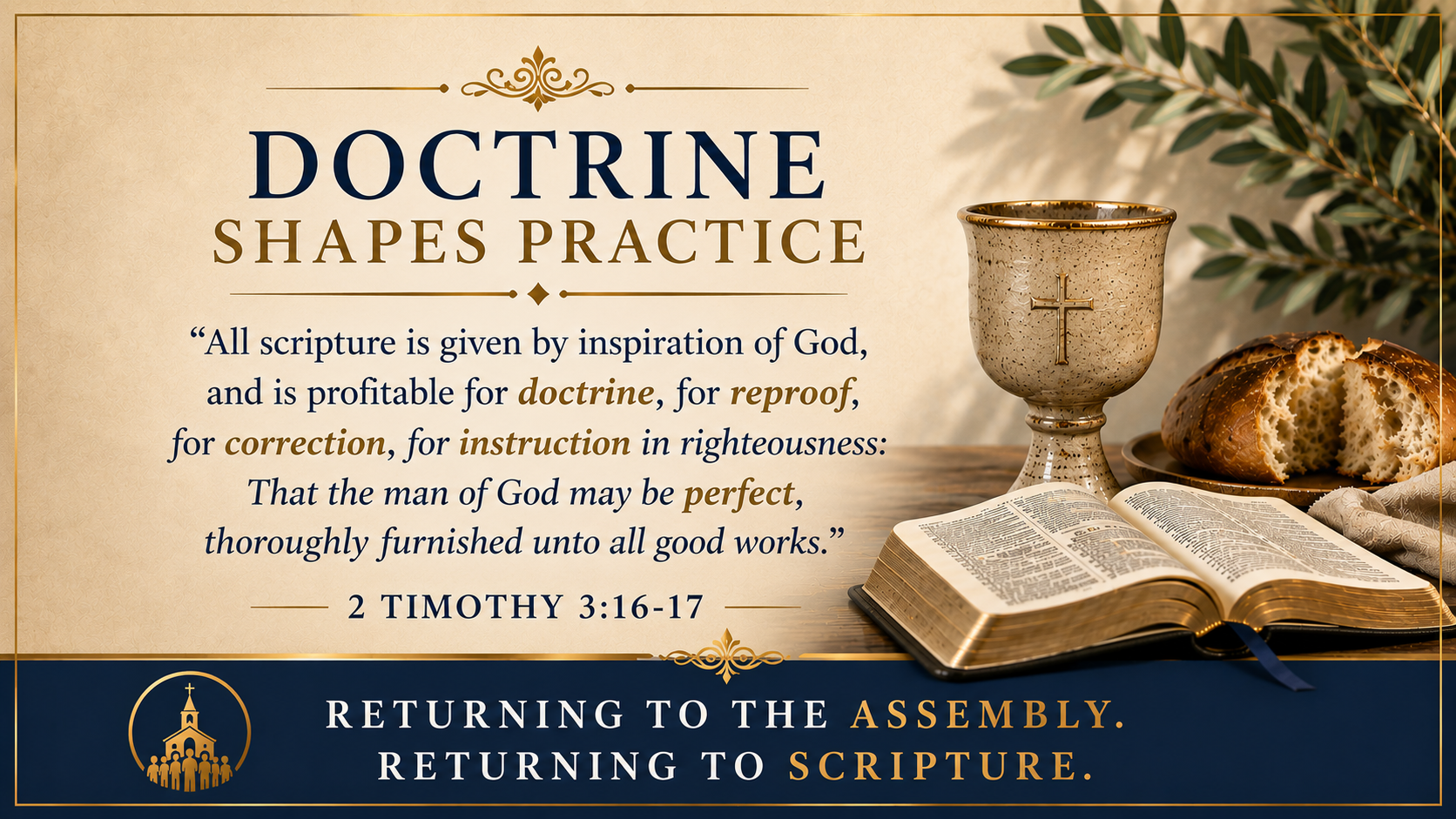
“All scripture is given by inspiration of God, and is profitable for doctrine, for reproof, for correction, for instruction in righteousness: That the man of God may be perfect, throughly furnished unto all good works.”
— 2 Timothy 3:16–17, KJV
There is an important progression here. Scripture establishes doctrine. Doctrine provides the standard by which error may be reproved. Reproof identifies what requires correction. Correction restores what has become misaligned. Instruction in righteousness then directs how truth is to be lived.
This means that Christian practice cannot properly be separated from Christian doctrine.
What we believe eventually determines what we practice.
This raises an important question concerning several practices and concepts that have become deeply established within Christianity: our understanding of ekklesia and the English word church; the doctrine commonly described as the Universal Church; the nature of Christian assembly and participation; and the transformation of the Lord’s Supper from the communal setting described in the New Testament into the small wafer or cracker and thimble-sized cup familiar to much of Christianity today—and, more recently, into “communion” practiced virtually by geographically separated participants.
Are these merely matters of terminology, historical development, or preference? Or are they doctrinal matters? If doctrine means biblical teaching that governs faith and practice, then they necessarily involve doctrine. The question is not whether every later development must therefore be wrong. The question is whether those developments remain consistent with the teaching and practice documented in Scripture. The objective is not: “Here is everything Christianity has gotten wrong.”
The more responsible question is: If these conclusions are supported by Scripture, should they not cause us to reconsider doctrines and practices inherited through tradition?
That is the question this study seeks to examine.
I. Everything Proceeds From Doctrine
The message underlying this study repeatedly emphasizes that Christians cannot separate belief from conduct. At one point the principle is expressed plainly:
“You cannot act correctly unless you believe correctly. You cannot have biblical conduct unless you believe biblically.”
That statement provides the bridge into the present study. If Christians hold a particular doctrine concerning the nature of the church [ekklesia], that doctrine will affect how they understand the gathering of believers.
Their understanding of the gathering will influence its structure. Its structure will influence participation. Its understanding of participation will influence fellowship. And its understanding of fellowship will influence practices such as the Lord’s Supper. There is therefore a natural progression:
Biblical Text → Interpretation → Doctrine → Practice
But another progression is possible. Once a practice has existed for generations, it can become tradition. The tradition becomes familiar, and eventually that familiarity can influence how the biblical text itself is read:
Tradition → Assumed Meaning → Interpretation of Scripture → Continued Practice
The danger is subtle. Christians may believe they are deriving their practice from Scripture when they are actually interpreting Scripture through a practice inherited from previous generations.
This is why the sermon emphasizes comparing Scripture with Scripture. Its argument is that doctrine cannot legitimately rest upon what an individual thinks, hopes, or prefers; teaching must remain accountable to the broader witness of God’s Word.
This principle becomes particularly important when examining the doctrine of the ekklesia.
II. Ekklesia, “Church,” and the Doctrine of the Assembly
If everything proceeds from doctrine, then the meaning assigned to ekklesia is not a peripheral question. The definition adopted at this point affects how Christians understand the body of Christ, the gathering of believers, leadership, discipline, the Lord’s Supper, and even the larger question of what is commonly called the “universal church.”
The Greek noun ἐκκλησία (ekklesia) should first be understood from its usage in the language and setting in which the New Testament was written. It is not necessary—and is linguistically unsafe—to construct its meaning from its component parts and define it as “the called-out ones.” Etymology tells us where a word came from; usage tells us what the word meant to its speakers. Roger Williams Maslin makes this distinction in his 1951 Baylor University thesis, A Critique of the Universal Church Theory, observing that the derivation of ekklesia must not be confused with its established lexical meaning. His discussion follows F. J. A. Hort, who likewise rejected the popular notion that ekklesia meant a number of persons “called out” from mankind merely because of its etymological components.¹
The relevant question, therefore, is not, What can be constructed from the parts of the word? but rather, What did ekklesia ordinarily communicate to Greek-speaking hearers and readers?
Its established sense was that of an assembly, gathering, or congregation. The New Testament itself supplies unusually clear evidence in Acts 19:32, 39, and 41, where ekklesia describes the civic gathering at Ephesus. The assembly was confused; a lawful assembly was contemplated; and finally the assembly was dismissed. Nothing Christian or ecclesiastical in the later theological sense is inherent in the word. The people constituted an ekklesia because they had assembled.
This provides an important control upon interpretation. Christian usage gives the assembly a Christian identity, purpose, order, and relationship to Christ, but those theological characteristics need not require the lexical meaning of ekklesia itself to be transformed into something fundamentally different.
The First-Century Meaning Must Govern the Inquiry
The New Testament was written in Koine Greek, the common Greek of its period. Maslin draws attention to the importance of this fact: the language of the New Testament was not an isolated sacred dialect whose ordinary words could silently receive entirely new meanings unknown to contemporary readers. He therefore argues that a materially different meaning should not be assigned to ekklesia unless the New Testament context itself requires such a change.²
A writer may certainly use a familiar word figuratively, generically, collectively, or in a specialized setting. Context determines those uses. But the existence of theological ideas associated with a word does not automatically alter the word’s lexical identity. Before ekklesia is made to signify a new entity—such as an invisible aggregate composed of every believer everywhere—the text should provide sufficient reason for that conclusion.
Maslin expresses the interpretive principle by appealing to the ordinary meaning of a word until a context requires something different. His central question is essentially whether any disputed passage must carry the proposed universal sense, or whether the recognized assembly sense can still account for the language.³
This provides a useful methodological safeguard:
A new theological meaning should not be assigned to ekklesia merely because a passage has a broader reference than one named congregation. The interpreter should first ask whether the assembly may be spoken of generically, representatively, collectively, or institutionally without changing the essential idea expressed by the word.
That distinction becomes especially important in considering what is commonly called the “universal church.”
“Church” and the Associations of Later Centuries
A further difficulty arises because the English word church now carries meanings that ekklesia did not inherently carry in first-century Greek.
Modern English may use church for a building, a denomination, a religious institution, a worship service, the clergy, a local congregation, all professing Christians, or all believers throughout the world.
Consequently, when an English reader sees the word church in a Bible, these later associations can enter the passage before the Greek term itself has been considered.
Maslin identified this problem more than seventy years ago. In his discussion entitled “The Fundamental Idea of ‘Ecclesia’ Misrepresented by ‘Church,’” he notes that the English word had accumulated numerous meanings that make it considerably broader and more ambiguous than ekklesia. He also distinguishes the historical origin of English church from ekklesia, connecting it instead with Greek κυριακόν (kyriakon).⁴
The lexical point should be stated precisely. Kyriakon is the neuter form of the adjective kyriakos, meaning “belonging to” or “pertaining to the Lord.” In later usage it could function substantivally with reference to something belonging to the Lord and became associated particularly with the Lord’s house or place. That historical development is different from the semantic history of ekklesia, which denotes an assembly.
Maslin also calls attention to the fact that early English versions—including Tyndale’s—used congregation rather than church in many New Testament passages. He cites the translation instructions issued for the King James Version, one of which required traditional ecclesiastical terminology to be retained, specifically directing that church not be replaced by congregation.⁵
This historical fact does not prove a theological position by itself. It does, however, demonstrate why an English reader must distinguish between the Greek word being interpreted and the centuries of ecclesiastical associations carried by its traditional English rendering.
The question must therefore remain:
What does the inspired Greek text communicate before later meanings of the English word church are allowed to govern the interpretation?
Particular Assembly and Generic Assembly Are Not Opposites
One of the most important distinctions in this discussion is the difference between a particular use of a noun and a generic use of that noun.
When Scripture speaks of “the labourer,” “the husband,” “the wife,” “the fig tree,” or similar singular expressions, the reference does not necessarily identify one numerically singular object encompassing every member of the class. A singular noun can describe a kind, institution, or class by speaking of it generically.
Maslin applies this grammatical principle to ekklesia. He distinguishes the concrete use of the word for a particular assembly from an abstract or generic use in which the assembly is considered as an institution or kind. The reference becomes broader, but the underlying kind of thing being described need not change.⁶
This distinction prevents a false choice.
The alternatives are not limited to:
(1) one specifically named local assembly
or
(2) one universal invisible assembly composed of every believer.
There is another legitimate possibility:
(3) the assembly spoken of generically—the institution or class represented concretely by individual assemblies.
This distinction becomes critical when examining passages commonly offered as proof of a universal ekklesia.
The Universal Church — Does Ekklesia Require This Meaning?
The purpose of this inquiry is not to deny the spiritual unity of believers.
Scripture clearly teaches that those who belong to Christ share salvation, one Lord, one faith, one Spirit, one hope, and a common relationship to God through Christ. Believers are called brethren, saints, children of God, members of the household or family of God, heirs, citizens of the kingdom, and those who are “in Christ.”
The question is narrower:
Does the New Testament call the totality of all believers everywhere an ekklesia in such a way that the word itself must be understood as “the universal invisible church”?
Those are not identical propositions.
It is entirely possible for all believers to possess a spiritual unity in Christ without assuming beforehand that ekklesia is the technical designation for that worldwide totality.
Maslin makes this distinction when discussing Ephesians. He notes that Scripture possesses broader descriptions for the saints in the aggregate and therefore argues that theologians need not place every saved person into a universal ekklesia merely to account for their common salvation and relationship to God.⁷
This is an important safeguard against circular reasoning.
If church is first defined theologically as “all believers,” and church is then automatically substituted for ekklesia, passages containing ekklesia will naturally appear to teach the universal church. But the conclusion has already been inserted into the definition.
The proper inquiry runs in the opposite direction:
First determine what ekklesia is doing in the passage; then derive the theological conclusion from the text.
Matthew 16:18 — “I Will Build My Ekklesia”
One of the most frequently cited texts is Matthew 16:18:
“And I say also unto thee, That thou art Peter, and upon this rock I will build my church; and the gates of hell shall not prevail against it.” — Matthew 16:18, KJV
It is often assumed that because Jesus speaks of “my ekklesia” in the singular, He must be describing one universal body consisting of every believer.
But the singular form does not establish that conclusion.
The statement is readily intelligible as a generic or institutional use: Christ will build His assembly—His own divinely established institution or kind of assembly. Maslin adopts precisely this explanation, comparing the usage with other institutional expressions that may be spoken of in the singular without referring to one gigantic universal manifestation.⁸
Matthew itself supplies an important control only two chapters later:
“And if he shall neglect to hear them, tell it unto the church…” — Matthew 18:17, KJV
Here the ekklesia is capable of being told a matter. It can hear and become involved in discipline. These are functions of an identifiable assembly.
Therefore, the question that Matthew 16:18 presents is not:
Can the verse be made consistent with universal-church theology?
It can.
The stronger exegetical question is:
What in Matthew 16:18 requires ekklesia to acquire the new meaning “universal invisible body of all believers,” especially when Matthew 18:17 uses the same word of an assembly capable of hearing and acting?
The universal interpretation must be demonstrated; it cannot merely be assumed from the English phrase “my church.”
Galatians 1:13 — “I Persecuted the Ekklesia of God”
Paul writes:
“For ye have heard of my conversation in time past in the Jews’ religion, how that beyond measure I persecuted the church of God, and wasted it.” — Galatians 1:13, KJV
This verse is sometimes taken to mean that Paul persecuted the entire universal church.
Maslin argues more narrowly that Paul’s persecution centered upon the Jerusalem assembly and those scattered from it, appealing to Acts 8 and related passages.⁹
That interpretation is possible, although the verse need not be pressed so narrowly to answer the universal-church argument.
Even if Paul speaks collectively of Christian assemblies or of the persecuted people identified with them, the language still does not require the later systematic category of an invisible worldwide organization. A collective or generic reference is not equivalent to a new lexical meaning.
Thus Galatians 1:13 may have broad reference without establishing the proposition that ekklesia now means all believers everywhere whether assembled or unassembled.
1 Timothy 3:15 — An Ekklesia That Can Be Ordered
Paul tells Timothy:
“But if I tarry long, that thou mayest know how thou oughtest to behave thyself in the house of God, which is the church of the living God, the pillar and ground of the truth.” — 1 Timothy 3:15, KJV
The context concerns conduct, overseers, deacons, qualifications, household order, and the practical life of believers together.
Maslin therefore argues that the passage naturally describes an actual Christian assembly rather than an invisible worldwide entity.¹⁰
This contextual observation is significant.
One may certainly say that the truth upheld by Christ’s assemblies is universally true. But a universal truth does not require a universally constituted organization to express it. An individual assembly can be “the pillar and ground of the truth” because it visibly confesses, guards, teaches, and embodies that truth where it exists.
Ephesians and Colossians — The Strongest Universal-Church Passages
The most serious case for the universal-ekklesia interpretation arises not in Acts but principally in Ephesians and Colossians.
Even F. J. A. Hort, whose The Christian Ecclesia has been highly influential, acknowledged the overwhelmingly concrete character of ekklesia elsewhere while locating what he regarded as the clearest universal usage particularly in these epistles. Maslin accordingly gives these passages sustained attention.¹¹
The principal texts include Ephesians 1:22–23; 3:10, 21; 4:4; 5:23–32; and Colossians 1:18, 24.
These passages undeniably broaden the theological discussion. Christ’s headship, His relationship to the body, His love for the ekklesia, and His redemptive purpose are described in elevated language.
But broad theological significance does not automatically establish a new lexical meaning.
Ephesians 3:10 — “By the Ekklesia”
Paul writes:
“To the intent that now unto the principalities and powers in heavenly places might be known by the church the manifold wisdom of God.” — Ephesians 3:10, KJV
The ekklesia here functions as an agency through which God’s wisdom becomes manifest.
Maslin argues that the singular can naturally be generic: what is true of the assembly as Christ’s institution is manifested through actual assemblies in which that institution takes visible form.¹²
The grammar does not require one enormous invisible ekklesia any more than saying that some truth is demonstrated “through the family,” “through marriage,” or “through the school” requires one universal family, marriage, or school encompassing every instance of the institution.
Ephesians 5 — “Christ Is the Head of the Ekklesia”
Paul’s comparison between marriage and Christ’s relationship to the ekklesia is among the strongest examples of the generic singular:
“For the husband is the head of the wife, even as Christ is the head of the church…” — Ephesians 5:23, KJV
Paul speaks of the husband, the wife, and the ekklesia.
No reader imagines that “the husband” means one universal husband consisting mystically of every husband in existence, or that “the wife” signifies one universal wife composed of all wives.
The nouns state what is characteristically true of the relationship.
Maslin makes precisely this observation: the generic singular allows Paul to describe what is true of husband and wife as classes and likewise what is true of Christ and His assembly.¹³
The same principle can therefore be considered when Paul says:
“Christ also loved the church, and gave himself for it.” — Ephesians 5:25, KJV
That statement unquestionably magnifies Christ’s love and redemptive work. But it does not follow merely from the singular noun that ekklesia has now become a second kind of entity.
Acts 20:28 is particularly relevant:
“…feed the church of God, which he hath purchased with his own blood.” — Acts 20:28, KJV
The immediate context identifies the elders of Ephesus. The redemptive language of Christ purchasing the ekklesia with His blood is therefore capable of application to a particular assembly. Maslin consequently argues that Ephesians 5 can speak generically of the same relationship without requiring a universal-invisible referent.¹⁴
The Body of Christ — Does “Body” Require a Universal Church?
A second major line of argument identifies the universal church with the body of Christ.
Here again the question should not be decided by later theological terminology but by examining how Paul actually uses the body metaphor.
In 1 Corinthians 12 Paul tells the believers at Corinth:
“Now ye are the body of Christ, and members in particular.” — 1 Corinthians 12:27, KJV
The pronoun ye addresses the Corinthian recipients. The body described in the chapter is therefore not merely theoretical.
Its members possess differing gifts, need one another, interact with one another, can experience schism, honor weaker members, suffer together, rejoice together, and function through mutual participation.
Maslin emphasizes these concrete features, observing that the body capable of experiencing division and mutual suffering corresponds naturally to the interacting Corinthian assembly.¹⁵
This point can be strengthened further by the language of the text itself:
“And whether one member suffer, all the members suffer with it…” — 1 Corinthians 12:26, KJV
That statement describes relational life.
It corresponds closely to the many New Testament “one another” commands. Believers exhort one another, bear one another’s burdens, serve one another, comfort one another, forgive one another, receive one another, and wait for one another.
The body is therefore not presented merely as a theological list of persons sharing the same salvation status. It is an operative, relational body.
This does not by itself settle every use of “body” in Ephesians and Colossians, but it establishes something important:
Paul can call a particular assembly “the body of Christ.”
Therefore, when “body” appears elsewhere, it cannot simply be assumed that the phrase automatically means “the universal invisible church.” Context must decide the scope.
“One Body” — Ephesians 4
Ephesians 4:4 states:
“There is one body, and one Spirit, even as ye are called in one hope of your calling.” — KJV
This is understandably offered as evidence of one universal church.
The passage deserves careful treatment rather than dismissal.
Yet the surrounding description of the body later in the chapter is highly functional:
“From whom the whole body fitly joined together and compacted by that which every joint supplieth… maketh increase of the body unto the edifying of itself in love.” — Ephesians 4:16, KJV
The body is joined, supplied through its parts, working, increasing, and edifying itself.
Maslin argues that this language naturally describes the functioning life of an assembly rather than an invisible aggregate whose members may never encounter one another.¹⁶
At minimum, therefore, Ephesians 4 should not be treated as though the expression “one body” by itself settles the universal-church question. The entire argument of the passage—including the actual functioning of the body—must be taken into account.
1 Corinthians 12:13 — “By One Spirit…Into One Body”
Perhaps no passage is cited more frequently for entrance into the universal church than 1 Corinthians 12:13:
“For by one Spirit are we all baptized into one body…” — KJV
Maslin challenges the standard universal-church interpretation, although portions of his alternative explanation—particularly his attempt to connect the passage directly with water baptism—are less persuasive than some of his other arguments and should not be made foundational.¹⁷
The stronger observation comes directly from the context.
Whatever precise relationship between Spirit and baptism is expressed in verse 13, Paul does not subsequently define the resulting “body” as an invisible worldwide entity. He proceeds immediately to describe the body in terms of interacting members and concludes:
“Now ye are the body of Christ, and members in particular.” — 1 Corinthians 12:27, KJV
Consequently, acknowledging the Holy Spirit in verse 13 does not compel the conclusion that “one body” must mean the later theological category of the universal invisible church.
That conclusion still has to be demonstrated from the passage.
Hebrews 12:23 — “The Ekklesia of the Firstborn”
Hebrews 12:22–23 is one of the more difficult passages:
“But ye are come unto mount Sion, and unto the city of the living God, the heavenly Jerusalem… To the general assembly and church of the firstborn, which are written in heaven…” — KJV
The passage clearly uses heavenly and eschatological imagery and therefore should not be forced into an ordinary local-congregation formula merely to preserve a system.
Maslin himself acknowledges the difficulty and surveys several interpretations, including a heavenly assembly, a prospective gathering, and generic or institutional readings.¹⁸
For the present question, however, a more modest conclusion is sufficient.
Hebrews 12:23 may broaden the imagery of assembly beyond an ordinary earthly meeting, but it does not automatically establish the Protestant systematic doctrine of a presently functioning universal invisible church. The passage describes heavenly Jerusalem, innumerable angels, festal gathering, firstborn ones enrolled in heaven, God the Judge, and the spirits of just men made perfect.
Whatever conclusions are drawn must arise from that eschatological context.
It is therefore better to acknowledge Hebrews 12:23 as a difficult and elevated assembly text than to make it carry more theological weight than its wording requires.
Spiritual Unity Does Not Require a Universal Ekklesia
The rejection of an assumed universal meaning for ekklesia must never be misunderstood as the rejection of the unity of God’s people.
Christians throughout the world are united in Christ.
They possess the same Lord, are children of the same Father, share the same salvation, participate in the same covenant promises through Christ, belong to the household of God, are fellowcitizens with the saints, and possess the same Spirit.
Nothing in the assembly meaning of ekklesia diminishes those truths.
The error occurs only when those truths are used to redefine the Greek noun without demonstrating that the inspired writers themselves used it in that new sense.
Scripture possesses broader categories by which the people of God may be described. Maslin makes essentially this point when distinguishing the ekklesia from such descriptions as the family or household of God.¹⁹ There is no theological necessity to make ekklesia carry every truth associated with salvation, union with Christ, the kingdom, the family of God, or the redeemed.
This distinction allows two biblical truths to stand together:
Believers everywhere possess genuine spiritual unity in Christ.
and
An ekklesia is an assembly whose character and function must be determined from New Testament usage.
One proposition does not cancel the other.
From Ekklesia to “Catholic” and “Invisible Church” — The Historical Development of the Concept
The preceding examination has asked whether the New Testament itself requires ekklesia to mean a universal invisible body of all believers. History cannot answer that lexical question for the apostles, but history can help identify when terminology later used to interpret them entered Christian thought.
Maslin himself recognized the importance of this distinction. He begins his historical discussion by observing that expressions such as “universal church,” “invisible church,” and “mystical body of Christ” had become so familiar that readers could easily suppose that the terminology itself came from Scripture.²⁰
Three historical categories therefore need to remain distinct:
the apostolic ekklesia,
the post-apostolic katholikē ekklēsia,
and the later visible/invisible church distinction.
They are historically related, but they are not identical.
The First Surviving “Catholic Church” Terminology
The New Testament repeatedly uses ekklesia, but nowhere uses the expression καθολικὴ ἐκκλησία (katholikē ekklēsia) — “catholic church.”
The earliest surviving occurrence generally identified in Christian literature is in Ignatius of Antioch, Epistle to the Smyrnaeans 8.2, from the early second century. This means Maslin’s claim—derived from E. J. Fish—that the first occurrence was associated with the Martyrdom of Polycarp around A.D. 169 is too late.²¹ Maslin nevertheless correctly directs attention to the fact that the terminology is post-apostolic.
Ignatius of Antioch — Epistle to the Smyrnaeans
At this early date, catholic should not simply be equated with the later institutional meaning of Roman Catholic. The important point for this study is more limited: the expression katholikē ekklēsia represents post-apostolic terminology, not a phrase found in the New Testament.
That fact does not make the terminology false. Extra-biblical terms can accurately summarize biblical doctrine. The term Trinity, for example, demonstrates that a doctrine is not disproved merely because its later technical designation does not occur verbatim in Scripture.
The proper question is therefore more exacting:
Does the later expression accurately summarize what the New Testament teaches, or does it introduce a conceptual category that subsequently becomes read back into the word ekklesia itself?
From Catholic Consciousness to Institutional Consolidation
The development of a broader catholic consciousness did not occur at a single moment. It was already underway long before Constantine.
The fourth century, however, represents another significant stage. The Council of Nicaea in A.D. 325 was convened under Emperor Constantine and brought bishops together to resolve a controversy affecting Christianity across the empire. Eusebius preserves Constantine’s own letter following the council, in which the emperor says that a large gathering of bishops had been convened for the purpose of reaching unity and concord.²²
Eusebius, Life of Constantine, Book III
Constantine therefore should not be described as having invented catholic ecclesiology. That would place too much historical development at one moment.
What changed under Constantine was the scale and relationship between ecclesiastical deliberation and imperial power. An emperor could now summon bishops across the empire to address an ecclesiastical controversy in an imperial setting.
The Constantinian period is therefore better described as a decisive stage of imperial and institutional consolidation, not the beginning of catholic ecclesiology.
This distinction avoids anachronism in both directions.
It would be inaccurate to say: Constantine invented the universal church. But it would be equally problematic to assume: the developed fourth-century conception of “the Church” was already contained in the first-century lexical meaning of ekklesia.
Historical continuity must be demonstrated rather than presumed.
The Apostles’ Creed Is Not a First-Century Document
The expression “holy catholic church” also appears in the received form of the Apostles’ Creed. Its title, however, should not be mistaken for first-century apostolic composition.
The historical evidence points instead to development from earlier baptismal and confessional formulas. The older Roman form differs from the later received form. Schaff’s comparison of the Old Roman Creed with the received Apostles’ Creed explicitly identifies additions in the later text, and his historical treatment rejects the traditional story that the Twelve composed the creed article by article.²³
Schaff — Old Roman and Apostles’ Creed comparison
Even the modern Roman Catholic Catechism does not describe the creed as a document physically written by the Twelve. It calls the Apostles’ Creed the ancient baptismal symbol of the Roman Church and regards it as a summary of apostolic faith.
That distinction is important. To say that a later creed expresses apostolic doctrine is not the same as demonstrating that its particular terminology was apostolic vocabulary.
Consequently, the phrase “holy catholic church” in the creed may be evidence for later Christian confession, but it is not first-century lexical evidence for what Matthew, Luke, Paul, or John meant when they wrote ekklesia.
The proper order remains:
Scripture judges later creeds; later creeds do not determine the lexical meaning of Scripture.
From Catholic Church to Visible and Invisible Church
The later Protestant concept of the invisible church represents another historical development and should not simply be equated with earlier catholic terminology.
Here Maslin’s basic historical argument requires qualification rather than rejection. The distinction did not suddenly appear without precedent at the Reformation. Wycliffe and Hus had already developed conceptions of the true church that influenced later Reformers. Schaff traces this line through Wycliffe and Hus to Luther, Zwingli, and Calvin.²⁴
The terminology became considerably more explicit in Reformation ecclesiology. Schaff credits Luther with early use of the term “invisible” and Zwingli with explicitly distinguishing the church as visible and invisible. Calvin subsequently developed a mature distinction between the church known perfectly to God and the church visibly manifested among professing Christians. Scholarship on Luther and Calvin likewise recognizes development within their respective formulations rather than a single instantaneous invention of the concept.
The distinction eventually received especially explicit confessional expression in the Westminster Confession of Faith, which speaks of the “catholic or universal Church, which is invisible,” defining it in relation to the whole number of the elect.²⁵
This is historically significant.
By the post-Reformation period, concepts of universal church, invisible church, the elect, the body of Christ, and the spouse of Christ could be brought together within a developed systematic ecclesiology.
The question for this study is not whether the theologians who developed that system were sincere, nor does its later formulation by itself prove that the doctrine is false. The question is whether that mature theological framework should be carried backward and placed inside the first-century noun ekklesia.
Why the Historical Development Matters
History does not disprove the universal-church doctrine merely by demonstrating that some of its terminology developed later. Such an argument would be too simplistic. What history does demonstrate is that the modern expression “universal invisible church” is not itself apostolic terminology. It is a theological formulation with a traceable history of development. That changes the burden of proof.
One cannot reason:
- Paul used ekklesia.
- Ekklesia means church.
- The Church is the universal invisible body of all believers.
- herefore Paul was speaking of the universal invisible Church.
The second and third premises have already imported later theological development into the apostolic vocabulary. Instead, the question must remain:
Does the New Testament itself establish that ekklesia carries this meaning? If the doctrine is biblical, it should be demonstrable exegetically without first inserting its later theological terminology into the lexical definition.
This is precisely why the historical evidence belongs after the principal biblical passages have been examined. The history does not establish the doctrine. It reveals the danger of allowing later doctrinal categories to determine beforehand what first-century language must mean.
When a Theological Conclusion Becomes a Lexical Definition
This brings the discussion to an important methodological danger. A lexicon or theological reference work may appropriately explain that certain interpreters understand ekklesia in particular passages as referring to “the universal body of believers.” The problem arises when that theological interpretation is presented in such a way that the reader assumes “universal body of believers” is simply what the Greek word itself means.
Maslin encountered the same problem in earlier ecclesiological literature. He cites George Dana Boardman, who acknowledged the ordinary assembly meaning but then proposed a theological “transfiguration” by which the word came to signify a universal celestial society.
Maslin’s objection is instructive: such a conclusion is theological and must therefore be demonstrated exegetically; it cannot simply be inserted into the lexical definition.
This distinction is indispensable:
- Lexical evidence asks: What does the word mean?
- Contextual exegesis asks: What does the writer mean by using that word here?
- Theology asks: What larger doctrinal conclusions properly follow from the passage and from Scripture as a whole?
Those three questions are related, but they are not identical.
When theology is silently placed inside the lexical definition, the reasoning becomes circular. The interpreter finds “universal church” in the passage because “universal church” was already placed into the definition of ekklesia before the passage was examined.
This is particularly important when consulting lexicons or study resources that write something resembling:
ekklesia — “church,” the mystical body of Christ, the universal company of believers.
Such a statement may summarize the resource’s theological interpretation of certain texts, but the reader should not mistake that theological category for the basic lexical content of the noun. The distinction between lexicon and theology must remain visible.
The Necessary Burden of Proof
The issue may therefore be reduced to a straightforward question: Where does the New Testament require ekklesia to mean a presently existing, universal, invisible aggregate of all believers?
It is not sufficient merely to show that Christ has one people, believers are one in Him, Christians share one Spirit, Christ is Head, the saints are described corporately, or the word ekklesia sometimes appears in the singular without a geographical designation. All of those propositions may be affirmed while the lexical question remains unanswered.
To establish a separate universal meaning for ekklesia, it must be demonstrated that the relevant passages cannot reasonably be understood as referring to:
- a particular assembly,
- assemblies considered collectively,
- the assembly considered generically or institutionally,
- or, where the context requires it, an anticipated or heavenly assembly.
Only after those possibilities are examined should an additional lexical category be asserted.
Maslin’s 1951 thesis is valuable precisely because he applied this question systematically. His work is not final authority, and several of his individual arguments require qualification—as the historical investigation above itself demonstrates. Nevertheless, his fundamental challenge remains worthy of serious consideration:
If the recognized assembly sense accounts for the New Testament passages without contradiction, what textual necessity requires the interpreter to create another meaning? That is the question the doctrine of the universal church must answer.
From Doctrine to Practice
This is not merely a dispute about vocabulary. If ekklesia is understood primarily as an invisible worldwide entity, the concrete assembly can easily become secondary—a local manifestation of what is thought to be the “real” or “true” Church.
But the New Testament places extraordinary weight upon actual assembled life. It is in the gathered body that believers hear teaching, exercise gifts, submit to recognized leadership, practice discipline, edify one another, bear one another’s burdens, break bread, pray together, and observe the Lord’s Supper.
Paul’s description of the body in 1 Corinthians 12 is inseparable from mutual participation, and his instructions concerning the Supper repeatedly presuppose believers coming together. The assembly is therefore not merely an incidental visible expression of a more important invisible institution. It is the concrete arena in which much of apostolic Christian doctrine becomes practice.
And this returns the discussion to the controlling principle of the article: Everything proceeds from doctrine. If the doctrine of ekklesia begins with a later meaning imported through the English word church, subsequent Christian practice will naturally develop from that definition. But if the inquiry begins with the Greek text, its first-century usage, its immediate contexts, and the actual functions assigned to assembled believers, then the question must be reconsidered from the ground up.
The task is not to deny the unity of Christ’s people. It is to allow Scripture to define the terms by which that unity and the assembly of His people are described.
References — Section II
1. Roger Williams Maslin, A Critique of the Universal Church Theory, M.A. thesis, Baylor University, 1951, PDF pp. 27–29, discussion of etymology and lexical meaning; Maslin also appeals to F. J. A. Hort, The Christian Ecclesia, p. 5.
2. Maslin, Critique, PDF pp. 33–35 / thesis pp. 50–54, on Koine Greek and interpreting ekklesia according to first-century usage rather than presuming an apostolic redefinition.
3. Maslin, Critique, PDF pp. 45–46 / thesis pp. 72–74, on the principle that a new meaning should not be introduced where the recognized meaning adequately accounts for the passage.
4. Maslin, Critique, PDF pp. 35–36 / thesis pp. 54–56, “The Fundamental Idea of ‘Ecclesia’ Misrepresented by ‘Church,’” including his discussion of ekklesia, church, and kyriakon.
5. Maslin, Critique, PDF pp. 36–37 / thesis pp. 56–57, on early English use of congregation and the King James translation instruction retaining traditional ecclesiastical terminology.
6. Maslin, Critique, PDF pp. 45–47 / thesis pp. 72–75, discussion of concrete, abstract, generic, and institutional uses.
7. Maslin, Critique, PDF pp. 53–54 / thesis pp. 87–88, distinguishing ekklesia from broader descriptions such as the family of God.
8. Maslin, Critique, PDF pp. 38–39 / thesis pp. 59–61, Matthew 16:18 considered generically/institutionally and in relation to Matthew 18:17.
9. Maslin, Critique, PDF pp. 39–40 / thesis pp. 61–62, Galatians 1:13 and Paul’s persecution of the Jerusalem assembly and those scattered from it.
10. Maslin, Critique, PDF pp. 40–41 / thesis pp. 62–63, treatment of 1 Timothy 3:15.
11. Maslin, Critique, PDF pp. 44–47 / thesis pp. 70–75, introduction to his treatment of ekklesia in Ephesians and Colossians and his interaction with Hort.
12. Maslin, Critique, PDF pp. 48–50 / thesis pp. 78–80, Ephesians 3:10 and the generic/institutional understanding of “by the church.”
13. Maslin, Critique, PDF pp. 51–52 / thesis pp. 81–83, Ephesians 5:23–24 and the generic husband/wife comparison.
14. Maslin, Critique, PDF pp. 52–53 / thesis pp. 83–85, Ephesians 5:25–27 considered in relation to Acts 20:28.
15. Maslin, Critique, PDF pp. 59–61 / thesis pp. 96–100, 1 Corinthians 12 and the Corinthian assembly as a body whose members interact, suffer together, and can experience schism.
16. Maslin, Critique, PDF pp. 60–61 / thesis pp. 100–101, Ephesians 4:11–16 and the functioning and edification of the body.
17. Maslin, Critique, PDF pp. 66–69 / thesis pp. 110–115, treatment of 1 Corinthians 12:13. Maslin’s objections to simply assuming a universal body are useful; his proposed water-baptism explanation should be evaluated independently.
18. Maslin, Critique, PDF pp. 41–43 / thesis pp. 63–69, competing interpretations of Hebrews 12:23 and acknowledgment of the difficulty of the passage.
19. Maslin, Critique, PDF pp. 53–54 / thesis pp. 87–88, on the family or household of God as a broader category than his understanding of ekklesia.
20. Maslin, A Critique of the Universal Church Theory, Part I, Chapter III, thesis pp. 30–31, on the terminology “universal,” “invisible,” “true,” and “mystical body of Christ.” The online transcription supplied for this study preserves the original thesis pagination.
21. Ignatius of Antioch, Epistle to the Smyrnaeans 8.2. This provides earlier surviving evidence for katholikē ekklēsia than Maslin’s proposed A.D. 169 occurrence. Maslin’s older chronology therefore requires correction.
Read Ignatius, Smyrnaeans 8
22. Eusebius, Life of Constantine, III.17, preserving Constantine’s letter concerning the Council of Nicaea and his stated purpose of bringing a large number of bishops together for unity and deliberation. This supports describing the Constantinian period as a stage of imperial/institutional consolidation rather than the origin of catholic ecclesiology.
Read Eusebius, Life of Constantine, Book III
23. Philip Schaff, Creeds of Christendom, on the Old Roman Creed and the received Apostles’ Creed. The older Roman form and later received form are distinguishable, and the traditional story that the Twelve individually composed the articles is not historically sustainable.
Old Roman and Apostles’ Creed comparison
24. Philip Schaff, History of the Christian Church, Vol. VII, on Wycliffe and Hus as antecedents of the Reformation ecclesiological distinction and its subsequent development in Luther, Zwingli, and Calvin. Schaff specifically associates Luther with the term “invisible” and Zwingli with the explicit visible/invisible pairing.
Schaff — development of the visible/invisible distinction
25. The later Reformed formulation is expressed particularly clearly in the Westminster Confession, chapter 25, which speaks of the “catholic or universal Church, which is invisible.” Schaff identifies this as one of the clearest confessional statements of the Protestant distinction.
III. When Doctrine Changes, Practice Changes
If the ekklesia is fundamentally understood as assembled people, its activities naturally possess an embodied and relational character. This is readily visible in the New Testament.
Acts 2:42 states: “And they continued stedfastly in the apostles’ doctrine and fellowship, and in breaking of bread, and in prayers.”
Doctrine was not isolated from the shared life of the believers. Doctrine, fellowship, breaking bread, and prayers appear together.
Acts 2:46 continues: “And they, continuing daily with one accord in the temple, and breaking bread from house to house, did eat their meat with gladness and singleness of heart.”
Acts 20:7 likewise records: “And upon the first day of the week, when the disciples came together to break bread, Paul preached unto them…”
Notice the repeated connection between people, gathering, fellowship, and eating. This is also where the numerous New Testament “one another” passages become significant. Believers are commanded to:
- “love one another” (John 13:34),
- “receive ye one another” (Romans 15:7),
- “by love serve one another” (Galatians 5:13),
- “bear ye one another’s burdens” (Galatians 6:2),
- “forgiving one another” (Colossians 3:13),
- “teach and admonish one another” (Colossians 3:16),
- “comfort one another” (1 Thessalonians 4:18),
- and “exhort one another” (Hebrews 3:13).
These are not descriptions of spectatorship. They describe reciprocal relationships. Paul’s body analogy reinforces the same point:
“For as the body is one, and hath many members… so also is Christ.”
— 1 Corinthians 12:12, KJV
The body consists of members functioning in relation to other members. This does not eliminate leadership, teaching, authority, or order. All are present in the New Testament. But leadership serves and equips the body; it does not transform the body into an audience. Therefore the doctrinal question is larger than where Christians meet.
What kind of people does our doctrine of the ekklesia teach Christians to be when they assemble?
That question leads directly to one of the clearest practical examples.
The Lord’s Supper — From a Shared Table to a Token Portion
The Lord’s Supper is especially important because the New Testament gives us considerable information concerning the setting in which it occurred.
Paul writes: “When ye come together therefore into one place, this is not to eat the Lord’s supper.”
— 1 Corinthians 11:20, KJV
Notice all three elements: come together — into one place — eat.
Paul continues: “For in eating every one taketh before other his own supper: and one is hungry, and another is drunken.”
— 1 Corinthians 11:21, KJV
Whatever conclusions are ultimately drawn concerning every detail of the meal, this was plainly more substantial than the modern practice of distributing a wafer or small cracker accompanied by a thimble-sized cup of juice.
One person could remain hungry. Another could become drunken. Some were being shamed because they had little (1 Corinthians 11:22).
Paul concludes his correction: “Wherefore, my brethren, when ye come together to eat, tarry one for another.”
— 1 Corinthians 11:33, KJV
Again: come together — eat — wait for one another.
Some discussions identify this communal setting with what later Christians called an agape, or love feast. Jude 12 does use the expression “feasts of charity” (agapais). Whether every occurrence of the Lord’s Supper should technically be labeled an “agape feast” is a secondary historical question. We do not need that identification to establish the more immediate point from 1 Corinthians:
The apostolic Lord’s Supper occurred in the context of believers actually gathered and eating together. Paul had already established its corporate significance in the preceding chapter:
“The cup of blessing which we bless, is it not the communion of the blood of Christ? The bread which we break, is it not the communion of the body of Christ?”
— 1 Corinthians 10:16, KJV
Then: “For we being many are one bread, and one body: for we are all partakers of that one bread.”
— 1 Corinthians 10:17, KJV
The bread, the many participants, and the one body belong together. Therefore Paul’s concern in chapter 11 is not merely whether individuals have properly contemplated the symbolism of bread and wine. Their conduct toward one another was contradicting the very unity their participation proclaimed.
This raises an unavoidable doctrinal question about the later development of communion. How did a shared eating occasion involving an assembled body become the abbreviated ritual familiar to much of Christianity—a small wafer or cracker and a small quantity of wine or juice?
The question is not intended rhetorically to settle the entire historical development by itself. It is an invitation to examine it. If doctrine determines practice, what doctrinal developments permitted the practice to change?
And conversely: If the apostolic practice changed substantially, should we examine whether the underlying doctrine changed with it?
Virtual Communion — A Modern Test of the Same Doctrine
The more recent practice of virtual or online communion makes the underlying doctrinal question even clearer. The internet did not exist in the first century. Therefore, we should not pretend there is a direct biblical prohibition saying, “The Lord’s Supper shall not be observed online.” There isn’t. That is precisely why hermeneutics is necessary.
The question is not whether Scripture mentions the technology. The question is whether the practice enabled by the technology adheres to the doctrine and pattern Scripture does reveal. What does Scripture document?
Paul says: “when ye come together in the church” (1 Corinthians 11:18).
He says: “when ye come together therefore into one place” (1 Corinthians 11:20).
He describes them eating (1 Corinthians 11:21).
He rebukes their treatment of one another.
And finally: “when ye come together to eat, tarry one for another” (1 Corinthians 11:33).
This produces a remarkably consistent picture: an assembled people, in one place, eating together, sharing with one another, and expressing through the bread their identity as one body.
Virtual communion therefore presents a serious doctrinal question. Participants may see one another through a screen. They may hear the same teaching. They may simultaneously possess bread and drink in separate homes. Technology can provide communication across distance.
But have they assembled in the sense documented in these passages? Are they eating with one another, or are geographically separated individuals eating simultaneously?
Can “tarry one for another” retain Paul’s practical meaning when the participants are not sharing the same table or even the same location? These questions should not be dismissed merely because technology is new. Nor should technology automatically be condemned merely because it is new.
The question remains: Does the new practice preserve what Scripture establishes, or does it require us first to redefine what constitutes the assembly and the Lord’s Supper?
This demonstrates why ekklesia is not merely a vocabulary debate. If an ekklesia can exist as an assembly while no one is physically assembled, then virtual communion becomes easier to defend. But if ekklesia denotes an actual assembly, and if Paul’s Lord’s Supper repeatedly involves believers coming together into one place, eating, waiting for one another, and functioning as one body, then virtual communion is not merely a technological variation.
It represents a significant departure from the documented apostolic pattern and therefore requires a doctrinal justification, and that brings us directly back to the central proposition:
Everything proceeds from doctrine.
IV. Reproof, Correction, and Restoration
At this point 2 Timothy 3:16 becomes especially important. Scripture is profitable not only for doctrine but: “for reproof, for correction…”
The original message emphasizes that reproof and correction cannot legitimately rest upon personal preference. Doctrine must supply their foundation. Without that foundation we are left largely with personal opinions. That distinction should govern this entire discussion.
The argument is not: “I dislike institutional Christianity.”
Nor: “I prefer meeting in homes.”
Nor: “I prefer a full meal to a wafer and cup.”
Nor: “I dislike online meetings.”
Personal preferences prove very little. The question is: What does Scripture teach, and does our practice correspond to that teaching? This is where Paul’s word correction becomes particularly appropriate.
The Greek noun in 2 Timothy 3:16 is epanorthōsis (ἐπανόρθωσις), carrying the sense of correction or restoration toward an upright state. The original sermon message illustrates the concept with a bone that has healed improperly; correction requires restoring what has become misaligned. The illustration gives us an important principle:
Restoration Is Not Innovation
Something does not become apostolic merely because Christians have practiced it for centuries. Neither does its antiquity prove that it is wrong. Age settles neither question. Scripture must settle the doctrinal question.
This is also why correction should be approached with humility. Galatians 6:1 commands those restoring another to do so: “in the spirit of meekness; considering thyself, lest thou also be tempted.”
Many Christians have never considered the linguistic history of ekklesia and church. They opened an English Bible, read church, and naturally understood the word according to the Christian environment in which they were taught.
Many have never questioned why the Lord’s Supper consists of a tiny portion rather than the communal eating described in 1 Corinthians. Many Christians participating in online communion undoubtedly do so sincerely, intending to remember Christ.
Sincerity, however, cannot determine biblical doctrine. Neither can tradition. The appropriate response is not condemnation but examination. If these conclusions are supported by Scripture, should they not cause us to reconsider doctrines and practices inherited through tradition?
That is precisely what biblical reproof and correction are intended to accomplish.
Conclusion — Doctrine Must Ultimately Become Practice
The questions surrounding ekklesia, church, the Universal Church, Christian assembly, the Lord’s Supper, and even modern practices such as virtual communion are not merely questions of vocabulary, history, or personal preference. They are doctrinal questions because they concern what Scripture teaches about the identity, gathering, fellowship, and practice of Christ’s people.
This does not mean that every historical development within Christianity is automatically wrong. Nor does it mean that recovering first-century doctrine requires Christians to reproduce every cultural circumstance of first-century life. The question is more disciplined:
What has Scripture established as doctrine, and what has subsequently developed as tradition?
Where tradition agrees with Scripture, there is no conflict. Where Scripture permits liberty, we should be careful not to create commandments where God has not. But where tradition has changed the meaning of a biblical concept or produced a practice substantially different from the apostolic pattern, Scripture gives us both the authority and responsibility to examine it.
That is why the linguistic question surrounding ekklesia matters. That is why the doctrine of a Universal Church deserves examination rather than merely being assumed from the English word church. That is why the repeated New Testament commands concerning one another matter. And that is why the Lord’s Supper provides such an important test case.
Paul did not describe isolated individuals privately remembering Christ while happening to consume the same symbols at approximately the same time. He described believers coming together, coming together into one place, eating, waiting for one another, and recognizing that:
“we being many are one bread, and one body.”
— 1 Corinthians 10:17, KJV
When the apostolic gathering becomes an institution, when participation becomes spectatorship, when the shared table becomes a token portion, or when physically assembling becomes simultaneous participation through individual screens, we should at least be willing to ask whether we are witnessing merely harmless changes in form—or the downstream consequences of changes in doctrine.
The original message concludes with essentially the same warning: if our lives are not governed by biblical doctrine, they will nevertheless be governed by some doctrine.
Therefore the objective is not to compile a catalogue of everything Christianity has gotten wrong. The objective is to return continually to Scripture and ask whether what we believe and practice can withstand examination by the apostolic record.
Paul wrote: “But speak thou the things which become sound doctrine.”
— Titus 2:1, KJV
And Titus 2:10 takes the matter beyond correct belief by calling believers to: “adorn the doctrine of God our Saviour in all things.”
Sound doctrine is therefore not merely something to possess. It is something to practice. If doctrine is found to be sound, hold it fast. If tradition is found to agree with Scripture, retain it. But if Scripture exposes a misalignment between apostolic doctrine and inherited practice, then correction should not be feared. It should be welcomed as part of Scripture’s God-given purpose:
“for doctrine, for reproof, for correction, for instruction in righteousness.”
This study ends with were it started: Everything proceeds from doctrine.

