Mouse Over Image to Enlarge
The Telltale Bible Verse
How Acts 19:37 Exposes the Error of Translating Ekklēsia as “Church”
Part of Ekklesia — A Closer Look series. Return to Table of Contents
Dare-To-Think · Read and listen
The video can be played using its own controls. Transcript controls have not started yet. If this message remains on the saved page, the block’s JavaScript may be blocked or removed.
Introduction
Bible translation is not a neutral, mechanical process of swapping one word for another across languages. Every translation decision carries with it centuries of theological assumption, institutional pressure, and linguistic drift — and few words illustrate this more clearly than the English word “church.” For most English-speaking Christians, the word feels self-evident: it means a building, a denomination, a worship service, or an institution with clergy, membership rolls, and a governing structure. Yet none of these associations existed in the mind of any New Testament author when he picked up a pen and wrote the Greek word ἐκκλησιˊα (ekklēsia).
This gap between the modern English word and its ancient Greek counterpart is not merely academic. It shapes how millions of readers understand what the “church” actually is, where authority resides within it, and what it means for believers to “assemble.” If the word chosen by translators subtly imports a building, a hierarchy, or an institution into a text that originally described people — a living, breathing, gathered assembly — then centuries of ecclesiology, church polity, and even personal spiritual identity have been shaped by a translational error rather than by the text itself.
Among the hundreds of individual word choices made by the King James translators — and by Tyndale before them, and by nearly every English Bible translator since — one small, easily overlooked verse offers an unusually clear and almost accidental window into the truth of the matter. Tucked into the account of a pagan riot in Ephesus, Acts 19:37 becomes, upon close examination, a kind of confession: a single crack in the translation that reveals what “church” truly meant to the men who chose that word, and by extension, exposes the deeper and far more consequential error of applying that same English word to ekklēsia throughout the rest of the New Testament.
This article examines that verse in detail — its Greek vocabulary, its historical context, and its implications — and uses it as a lens through which to evaluate the broader translation history of ekklēsia, from Wycliffe and Tyndale through the King James Version and into modern translations. The evidence assembled here draws on classical Greek usage, the Septuagint, standard lexical authorities, and the documented historical record of ecclesiastical and political pressures that shaped 16th- and 17th-century English Bible translation. Taken together, it makes the case that “church” — however familiar and beloved the word has become — is not a neutral or historically accurate translation of the word the Apostles actually wrote.
I. The Verse in Question
The King James Version reads:
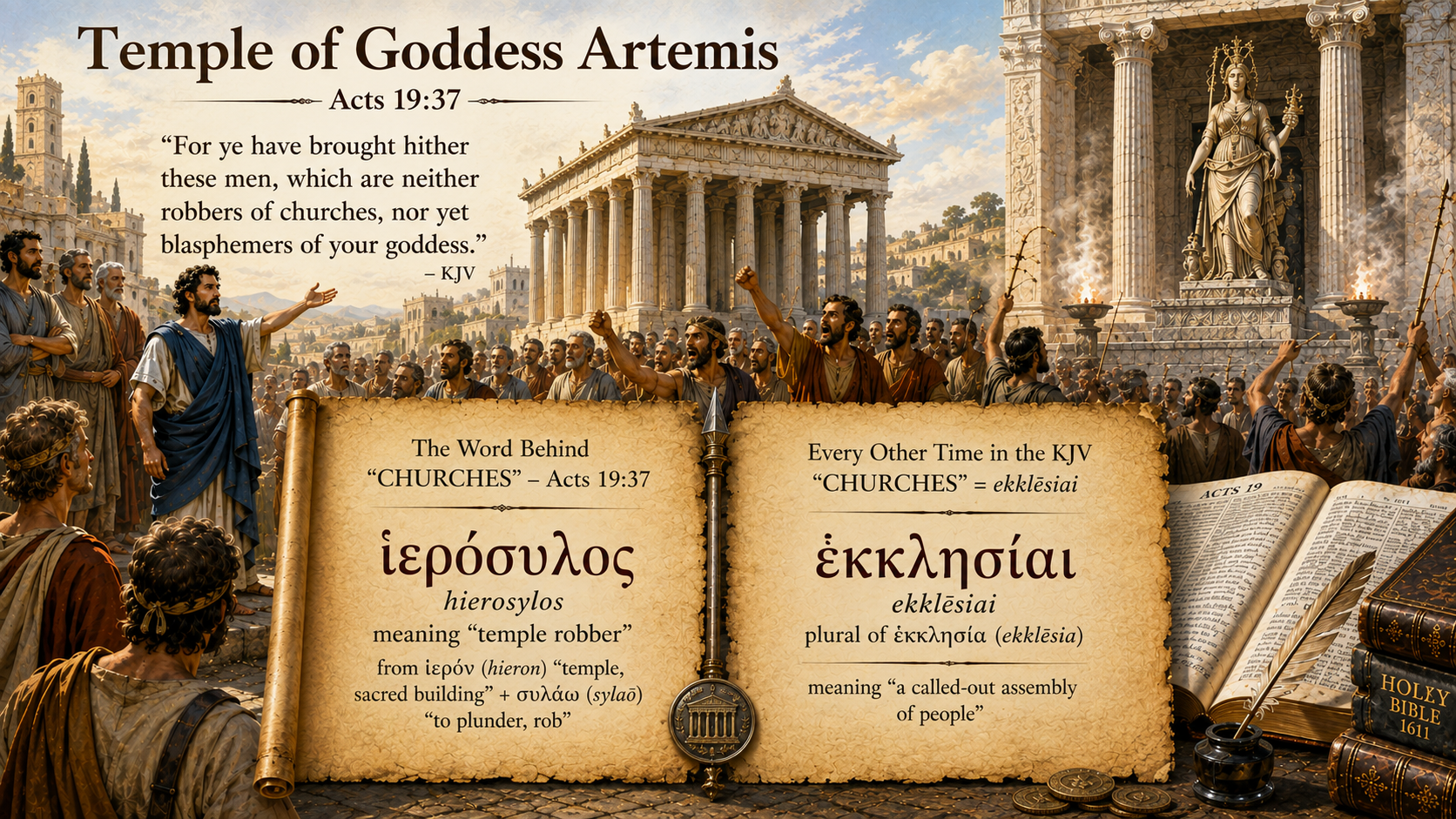
“For ye have brought hither these men, which are neither robbers of churches, nor yet blasphemers of your goddess.” (Acts 19:37)
This is part of the town clerk’s speech during the Ephesian riot, where he defends Paul’s companions before an angry pagan mob incited by Demetrius the silversmith. The clerk points out that the Christians committed no punishable crime — they neither looted temples nor blasphemed the goddess Artemis.
What makes this verse remarkable is a simple textual fact: the Greek word behind “churches” here is not ekklēsia. It is ἱεροˊσυλος (hierosylos), a compound word meaning “temple robber,” built from ἱεροˊν (hieron, a sacred building or shrine) and συλαˊω (sylaō, to plunder or rob).
Out of the thirty-seven occurrences of the plural form “churches” in the King James New Testament, this is the only instance where the underlying Greek word is something other than ekklēsia. Every other time, “churches” translates ἐκκλησιˊαι (ekklēsiai), the plural of the word meaning a called-out assembly of people. Here alone, the translators used “churches” for a word about pagan temple architecture.
II. What This Proves About the Word “Church” in the Translators’ Minds
This single anomaly is a linguistic goldmine, because it reveals exactly what the translators wanted understood for the English word “church” to mean when they were free to choose any rendering they wished for a Greek word that had nothing to do with ekklēsia.
They chose “church” — for a pagan temple.
This demonstrates that in the vernacular of Tyndale (who first rendered it this way in 1526) and the later KJV translators who retained his wording, “church” was fundamentally understood as a physical, consecrated building set apart for religious worship — whether that worship was directed toward Yahweh, Christ, or Artemis. It was not, in their minds, primarily a word for a gathered body of people. It was architectural. It was locative. It described a place, not a people.
This matters immensely for the larger argument about ekklēsia, because the New Testament authors never used the Greek word for “temple” (ἱεροˊν or ναοˊς) to describe the body of believers. They deliberately and consistently used ekklēsia — a word meaning a summoned gathering of people — precisely because the church, biblically, was never a building. Yet the English translators applied a building-word to the people-word, importing architectural and institutional baggage into a term that, in the first century, carried none.
III. The Etymological Layer: Where “Church” Actually Came From
It is worth clarifying the etymology of the English word “church” itself, so as not to conflate two separate historical threads.
The English word “church” descends from the Greek adjective κυριακοˊς (kyriakos), meaning “belonging to the Lord.” In the New Testament, this word appears only twice — in 1 Corinthians 11:20 (“the Lord’s supper”) and Revelation 1:10 (“the Lord’s day”) — and never once to describe the assembly of believers. By the early 4th century, following the Constantinian shift and the construction of dedicated basilicas, the term kyriakon (“belonging to the Lord”) began to be applied as a substantive noun to Christian buildings, particularly in the Greek-speaking East — though it remained less common than ekklēsia or basilikē even in this period. This form migrated into Gothic as kirika, into Old English as cirice or cyrice, and eventually became “church” in Modern English.
Word history — reference table, not included in narration
| Form | Language | Approximate Date | Meaning / Notes |
|---|---|---|---|
| κύριος (kyrios) | Ancient Greek | Classical Greek, attested well before NT era | "Lord, master" — the root noun |
| κυριακός (kyriakos) | Koine Greek | 1st century AD | Adjective, "belonging to the Lord" — used in NT (1 Cor. 11:20; Rev. 1:10) |
| κυριακόν (kyriakon) | Koine / Ecclesiastical Greek | c. 300 AD onward | Substantized neuter form ("the Lord's [house/building]"), applied to Christian meeting places, especially in the Greek-speaking East |
| kurikon / kūrikón | Vulgar Latin / Balkan Latin (hypothesized intermediary) | c. 300–400 AD | Proposed transitional loan form; not directly attested in surviving texts, but widely assumed by philologists as the bridge into Germanic languages |
| *kirikā | Reconstructed Proto-West Germanic | c. 4th–6th century AD | Reconstructed form (not directly attested); borrowed from Greek/Latin kyriakon, likely spreading from Christianized Roman centers such as Trier to Frankish and other West Germanic peoples |
| chirica / kirika | Old High German | c. 8th–9th century AD | Attested in early German glosses and texts |
| cirice / cyrice | Old English | c. 9th–10th century AD | Directly attested in Anglo-Saxon manuscripts (e.g., glosses to Latin texts, and Ælfric's homilies, c. 990s) |
| kirkja | Old Norse | c. 9th–10th century AD | Borrowed from Old English cirice into Norse via Viking-Age contact; source of Scottish "kirk" |
| chirche / kirke | Middle English | c. 12th–14th century AD | Attested in Middle English texts, including Wycliffe's Bible (1382–1395), which uses "chirche" |
| church | Modern English | c. 15th century onward | Standardized spelling; Tyndale (1520s) still used "congregation" for ekklēsia, but by the Geneva Bible (1560) and KJV (1611), "church" was the fixed form |
| Kirche | Modern German | Parallel development from same Germanic root | Modern German cognate, not a descendant of English "church" but a sibling form |
| Note: Forms marked with an asterisk (*) are linguistic reconstructions inferred by comparative philology and are not directly attested in any surviving text. |
Note carefully: The Greek text κυριακός (kyriakós) does not appear in Acts 19:37. The Greek word there is ἱερόσυλος (hierósylos) entirely unrelated to kyriakós. What Acts 19:37 demonstrates is not a direct link between kyriakós and paganism, but something more important: it shows that by the 16th and 17th centuries, the word “church” — which had originated from a term specifically meaning “belonging to the Lord” — had broadened and secularized into a generic English term for any sacred building, Christian or pagan, untethered from the specific deity being worshipped there.
In other words: “church” started as a word tied to Christ (“the Lord’s [building]”), but by Tyndale’s day it had become simply the common word for a temple, shrine, or holy building of any kind. Acts 19:37 is the proof text for that broadening — the translators used “church” for a pagan Artemis shrine with no hesitation, because to them, “church” simply meant “sacred building.”
When the Germanic and Anglo-Saxon peoples were later Christianized, they applied their own word — circe — to the stone buildings and priestly institutions of the Latin Church. So when Bible translators subsequently encountered ekklēsia in the Greek text, they did not translate the Greek word’s actual meaning (assembly/gathering). Instead, they substituted a completely different Germanic word (circe/church) carrying an entirely different etymological pedigree — one rooted in architecture and institution rather than in people summoned together. This is not natural language evolution; it is a semantic substitution that replaced a dynamic, living action (a gathering of disciples) with a static physical object (a building) and, eventually, a hierarchical clerical institution.
IV. The Inconsistency Among the Later Translations
Here the picture becomes even more revealing. Most modern translations — recognizing that ἱεροˊσυλος has nothing to do with ekklēsia and everything to do with ἱεροˊν (temple) — corrected Acts 19:37. The ESV, NASB, NIV, and CSB all render the word as “temple robbers” or “robbers of temples,” abandoning the KJV’s “robbers of churches.”
At first glance, this looks like progress. And in a narrow, technical sense, it is — these translations correctly identified that hierosylos refers to temple plundering, not “church” robbery, and fixed the specific lexical error the KJV inherited from Tyndale.
But here is the critical point that must not be missed: these same translations did not apply this correction consistently. While they fixed the isolated word ἱεροˊσυλος in Acts 19:37, they retained the word “church” everywhere ekklēsia itself appears — over a hundred times throughout the New Testament. They recognized that “church” was the wrong word for a Greek term about temple architecture, yet they continued using that very same word “church” for a Greek term about a gathered assembly of people.
This is a glaring inconsistency. If “church” is inappropriate for ἱεροˊσυλος because that word has nothing to do with buildings called “churches” in the modern institutional sense, then the same translators should have recognized that “church” is equally inappropriate for ekklēsia, which likewise has nothing to do with buildings, institutions, or the architectural and denominational connotations “church” carries in English. Instead, only Tyndale — nearly five centuries earlier — got this right across the board, consistently rendering ekklēsia as “congregation,” precisely because he recognized what these later revisers only recognized in one isolated verse.
Modern translators fixed the symptom in Acts 19:37 while leaving the underlying disease — the mistranslation of ekklēsia as “church” throughout the rest of the New Testament — fully intact.
V. Confirming the Pattern: What Ekklēsia Actually Meant in the First Century
The New Testament authors did not invent the word ekklēsia. They adopted a term that had carried a precise, well-understood meaning in the Greco-Roman and Jewish world for over half a millennium — and that meaning had nothing to do with buildings.
Classical and Hellenistic Greek Usage. In civic Greek life, an ekklēsia was the formal assembly of free citizens called out from their homes to a public space to conduct governance and business. Thucydides (History of the Peloponnesian War, 2.22.1) uses ekklēsia to describe the physical gathering of Athenian citizens debating military policy. Demosthenes (De Corona, 18.169) describes the prytaneis summoning the ekklēsia to the Pnyx — the assembly ceased to be an ekklēsia the moment the people dispersed. Tellingly, Luke himself uses ekklēsia three times in Acts 19 (vv. 32, 39, 41) to describe the pagan civic mob and lawful assembly in the Ephesian theater — proof that the word described a gathering of people, not a sacred place, even in a thoroughly pagan context.
The Septuagint Witness. The Greek Old Testament consistently translates the Hebrew קָהָל (qahal, a gathered assembly) as ekklēsia — as in Deuteronomy 9:10 and Psalm 21:23 (LXX) / Psalm 22:22 (Masoretic), the latter quoted in Hebrews 2:12. By contrast, the Hebrew עֵדָה (‘edah, a community whether gathered or scattered) was rendered synagōgē. This distinction shows that the Greek-speaking Jewish translators of the Septuagint understood ekklēsia specifically as an actual, convened gathering.
Standard Lexical Authorities. Liddell-Scott-Jones defines ekklēsia as “an assembly of citizens regularly summoned… in the NT, an assembly of Christians, a local congregation.” BDAG (3rd ed.) defines it as “a gathering of citizens called out from their homes into some public place, an assembly,” and in the New Testament, “an assembly of Christians gathered for worship, a meeting/congregation.” Kittel and Friedrich’s Theological Dictionary of the New Testament (Vol. III, K.L. Schmidt) notes that ekklēsia is fundamentally an event — “the assembly of people convened for a purpose” — an occurrence in space and time, not a static institution or building.
VI. The Literal Substitution Test
One effective way to demonstrate the semantic failure of “church” as a stand-in for ekklēsia is to substitute the building/institution sense of “church” back into the New Testament text and observe the result:
Acts 8:3 — “Saul made havock of the church, entering into every house…” If ekklēsia meant a building, Saul’s act of entering houses to destroy the ekklēsia becomes incoherent. He was arresting people, not attacking architecture.
1 Corinthians 14:23 — “If therefore the whole church be come together into one place…” If ekklēsia were already a building or institution, this becomes nonsensical — “if the whole building comes together into one place.” Paul’s own grammar requires ekklēsia to mean the gathered people themselves.
Romans 16:5 — “Greet the church that is in their house.” Translating ekklēsia as “church” creates the strange image of an institution or building existing inside another building, when Paul is simply describing the assembly that met at that address.
Acts 19:37 — the anchor text of this article — “robbers of churches” for pagan temple-robbers, showing that the translators’ own working definition of “church” was architectural.
VII. Why “Language Evolution” Does Not Rescue the Translation
A common defense of “church” is that language evolves — that words shift in form and meaning over time, and that “church” is simply what English speakers today (and in the 16th–17th centuries) use, making it “accurate for our time.” This argument does not hold up under scrutiny.
Sound translation is governed by authorial intent: the meaning of a text is fixed by what the original author communicated to his original audience in his own linguistic context — not by whatever a receptor-language word evolves into centuries later. When Paul wrote ekklēsia to the believers in Corinth (1 Corinthians 1:2; 11:18; 14:23), every reader understood it as an actual, localized gathering of people in one place. A translator who substitutes a word evoking “a building with a steeple” or “a global denominational institution” is not evolving with the language — he is importing a much later concept backward into a first-century text. A word that reverses or obscures the semantic core of the original vocabulary cannot be called “accurate” merely because generations of readers have grown accustomed to it. That is the perpetuation of an error, not the natural progress of a living language.
VIII. The Historical Pressures Behind the Word “Church”
It would be a mistake to treat the retention of “church” as a neutral, purely linguistic matter of familiarity. The historical record shows that political and ecclesiastical pressure played a direct role.
In 1604, King James I convened the Hampton Court Conference and issued a specific set of translation rules, administered by Richard Bancroft, Bishop of London. Rule 3 explicitly commanded:
“The Old Ecclesiastical Words to be kept, viz. the Word Church not to be translated Congregation &c.” (Alfred W. Pollard, Records of the English Bible*, 1911, p. 53; David Norton,* A Textual History of the King James Bible*, Cambridge University Press, 2005, p. 7.)*
King James was a committed defender of the Divine Right of Kings and the episcopal hierarchy of the Church of England — famously declaring “No bishop, no king!” Rendering ekklēsia as “congregation” or “assembly” favored the Puritan and Presbyterian model of autonomous local gatherings, which posed a direct threat to the top-down monarchical and diocesan structure he depended on. The mandate to retain “church” was not a neutral stylistic preference — it was an explicit political and ecclesiastical directive.
This same dynamic explains why Tyndale’s own translation choices were treated as dangerous nearly a century earlier. In A Dialogue Concerning Heresies (1529), Sir Thomas More attacked Tyndale specifically for replacing five foundational ecclesiastical terms:
Tyndale’s terminology — reference table, skipped during playback
| Greek Term | Tyndale's Rendering | Traditional Rendering |
|---|---|---|
| ekklēsia | congregation | church |
| presbyteros | elder | priest |
| metanoite | repent | do penance |
| agapē | love | charity |
| episkopos | overseer | bishop |
More argued that these substitutions stripped the institutional hierarchy of its sacerdotal authority. When Tyndale was condemned by imperial authorities at Vilvoorde in 1536, his translation choices — this list chief among them — were central evidence of his “heresy.” While it is accurate to say Tyndale was executed for making Scripture accessible in English, separating that from his specific vocabulary choices is a distinction without a difference — the vocabulary was what made Scripture accessible to lay people — and that accessibility is precisely what authorities feared, because it dismantled the linguistic scaffolding of institutional control.”
IX. A Comparative Timeline of English Translations
The following table traces how ekklēsia was rendered across the major English translations, along with the documented motivation behind each choice. This is useful for seeing that the KJV’s decision was not an isolated stylistic quirk, but part of a traceable historical trajectory — one that Tyndale alone broke from consistently, and that even later “correcting” translations (which fixed Acts 19:37) never fully reversed.
English translation timeline — reference table, not included in narration
| Version | Year | Source Text | Translation of Ekklēsia | Primary Motivation |
|---|---|---|---|---|
| John Wycliffe | 1382–1395 | Latin Vulgate (ecclesia) | chirche / church | Translated from Latin into Middle English vernacular under the Catholic institutional framework. |
| William Tyndale | 1526, 1534 | Erasmus' Greek New Testament | congregation | First English translation from the original Greek. Rejected "church" to restore the local-assembly meaning and reject papal/prelatical control. |
| Coverdale Bible | 1535 | German / Latin / Tyndale | congregation | Followed Tyndale's Greek scholarship. |
| Matthew Bible | 1537 | Tyndale / Coverdale | congregation | Maintained Tyndale's renderings. |
| Great Bible | 1539 | Hebrew / Greek (Cranmer) | congregation | Authorized for English parishes; retained Tyndale's terminology. |
| Geneva Bible | 1560 | Greek (Beza / Stephanus) | church | Marian exiles in Geneva adopted "church" under Presbyterian covenantal theology, retaining the concept of an institutional church system. |
| Bishops' Bible | 1568 | Greek / Great Bible base | church | Commissioned by the Church of England hierarchy to counter the anti-episcopal notes of the Geneva Bible. |
| King James Version | 1611 | Beza / Stephanus Greek base | church | Strictly enforced by Royal Rule 3 to suppress Puritan/separatist local-assembly concepts and uphold Anglican hierarchy. |
| ESV / NASB / NIV / CSB | 20th–21st c. | Nestle-Aland / UBS Greek NT | church (temple robbers at Acts 19:37) | Corrected the isolated hierosylos error in Acts 19:37, but retained "church" for every other occurrence of ekklēsia — leaving the larger mistranslation uncorrected. |
Notice the pattern in the final row. The very translations that had every opportunity — and every piece of lexical evidence — to recognize that “church” was the wrong English word for a building-based Greek term (ἱεροˊσυλος) in Acts 19:37 fixed only that one word. They did not extend the same correction to the far more consequential and far more frequent word ekklēsia. In other words, modern translators proved they were capable of recognizing “church” as an architecturally-loaded, inaccurate rendering — they simply chose not to apply that recognition consistently.
X. Conclusion: One Small Correction, One Enormous Blind Spot
Acts 19:37 functions as a kind of accidental confession. In choosing “church” for a word about pagan temple-robbing, the King James translators revealed that their working definition of “church” was a building — a place dedicated to worship, whether of the true God or a false one. That single word choice unmasks the deeper problem: throughout the rest of the New Testament, this same architecturally-loaded English word was applied to ekklēsia, a Greek term that in the first century meant something entirely different — a living, gathered, called-out assembly of people, with no building, no institution, and no denominational apparatus attached to it.
Modern translations deserve credit for correcting the specific error in Acts 19:37, replacing “churches” with “temples” to reflect what ἱεροˊσυλος actually means. But their failure to apply the same scrutiny to the far more consequential term ekklēsia — retaining “church” over a hundred times elsewhere — reveals that the correction was cosmetic, not principled. They fixed one anomalous verse without reconsidering the far larger and more theologically significant translation choice that Tyndale alone, among all major English translators, got right: ekklēsia means an assembly of people, not a place, and certainly not a building called a “church.”
About this listening test
The three reference tables stay closed by default and can be opened manually. Playback skips the terminology table narration in Section VIII, from approximately 22:42 to 23:02. The other two tables are not narrated. Playback also skips the duplicated passage from approximately 9:51 to 14:36 and continues with “This is a glaring inconsistency.” The displayed timestamps remain those of the original YouTube video. Follow text is optional; leave it unchecked to read and scroll at your own pace.
Timings come from the supplied Movavi project. This test checks playback and synchronization; it does not constitute a factual review of the article.