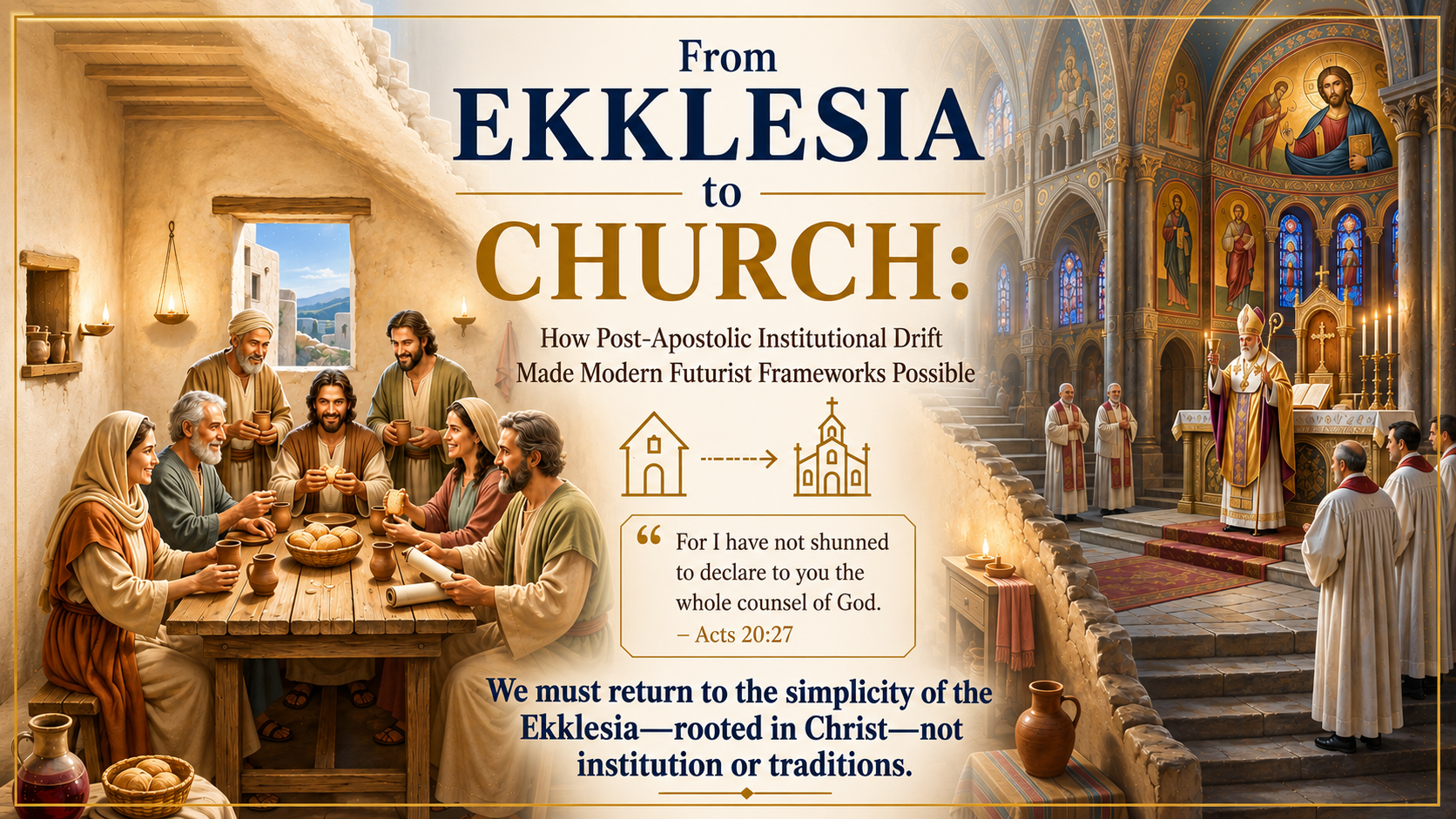
The Drift of 1st Century Apostolic Teaching
That Made Modern Futurist Frameworks Possible
Part of Ekklesia — A Closer Look series. Return to Table of Contents
What began as a simple, vibrant assembly of called-out believers gathered in homes for a shared meal has, over the centuries, become an institution that in many ways resembles the very structures the New Testament sought to transcend. The words translated as church carry DNA from a post-apostolic mutation that began in the second century and was never fully reversed, even by the Reformation. This article traces that drift and shows how it created the theological conditions that made modern futurist premillennial frameworks thinkable.
The argument unfolds in six movements. We begin with the apostolic ekklesia as the New Testament actually describes it, an assembly without sacred buildings, without a sacerdotal priesthood, with Jew and Gentile united as one new man. We then trace the gradual mutation of that assembly through the second to fourth centuries: the rise of the monarchical bishop, the Hellenization of thought, the Constantinian catastrophe, and the resulting institutional church. A brief look at historic premillennialism, the early chiliast view, shows that premillennial belief need not require the radical Israel-Church distinction that later systems imposed.
We then examine the Reformation’s half-finished work: what it recovered in soteriology, and what it failed to recover in ecclesiology. A case study in the Lord’s Supper illustrates how partial reform left the original apostolic pattern largely unrestored. With that foundation laid, we turn to futurist premillennial frameworks: what they teach, where their internal tensions lie, and how the inherited institutional church made their entire architecture possible. The conclusion calls for a recovery of the ekklesia, the called-out assembly that Christ promised to build.
Approaching these writings with an open mind is essential, recognizing that the only final authority is the Word of God. With that foundation established, the following perspectives outline the nature and function of these frameworks as they developed historically.
Return to the Study OverviewTable of Contents
🔍 Click Image to Enlarge | Click Section to Expand Sub-Sections
-
 ›
›Section One
The Apostolic Ekklesia — What the New Testament Actually Describes
The Greek ekklesia meant a called-out assembly, not an institution. We examine the New Testament baseline before any drift occurred.
-
 ›
›Section Two
The Gradual Mutation — Second Through Fourth Century Developments
From Ignatius to Augustine, the ekklesia was transformed into an institution with sacred buildings, a clerical hierarchy, and state entanglement.
-
 ›
›Section Three
Historic Premillennialism — The Early Chiliast View
From Papias to Lactantius, the early chiliasts held a premillennial view that did not require dividing Israel from the Church or rapture the ekklesia.
-
 ›
›Section Four
The Reformation’s Half-Finished Work
Luther and Calvin recovered the gospel. They did not recover the ekklesia. The Lord’s Supper is a case study in incomplete reform.
-
 ›
›Section Five
Futurist Premillennial Frameworks — What They Teach and Where Their Tensions Lie
The classic dispensational scheme: rapture, tribulation, millennium, rebuilt temple. We summarize fairly and identify the internal tensions.
-
 ›
›Section Six
How the Inherited ‘Church’ Made Futurist Frameworks Thinkable
These systems require the ekklesia to be something other than the true Israel. Only a weakened ecclesiology made that thinkable.
-
 ›
›Conclusion
Recovering the Ekklesia
The path forward is not to refine these frameworks but to recover what was lost: the assembly Christ promised to build.
Section One: The Apostolic Ekklesia — What the New Testament Actually Describes
Before tracing the drift, we must establish the baseline. What was the ekklesia in the apostolic period?
The Meaning of the Word
The Greek word ekklesia carries no sacred or institutional freight. In secular usage, it referred to the assembly of citizens in a Greek city-state called together to conduct public business. It is functional and relational, not architectural or sacerdotal. The word means “called-out assembly” and nothing more.
When the New Testament writers adopted this term, they did not invent a new religious institution. They described a gathering. The ekklesia was the people assembled, not a building they entered or an organization they joined. Wherever believers gathered in Christ’s name, there was the ekklesia. When they dispersed, the assembly was not in session, though the people remained members of Christ’s body.
No Sacred Buildings
The apostolic ekklesia owned no temples, no basilicas, and no dedicated worship spaces. Believers met in homes.
“Likewise greet the church that is in their house” (Romans 16:5).
“Salute the brethren which are in Laodicea, and Nymphas, and the church which is in his house” (Colossians 4:15).
“There shall be a church in thy house” (Philemon 1:2).
The New Testament knows nothing of consecrated ground under the new covenant. Stephen’s declaration in Acts 7:48-49 settled the matter: “Howbeit the most High dwelleth not in temples made with hands; as saith the prophet, Heaven is my throne, and earth is my footstool: what house will ye build me? saith the Lord: or what is the place of my rest?” The temple of the new covenant is not a building in Jerusalem or anywhere else. It is the people of God indwelt by the Spirit (1 Corinthians 3:16-17, Ephesians 2:19-22).
No Sacerdotal Priesthood
The apostolic ekklesia had no priests except one: Jesus Christ, the great High Priest after the order of Melchizedek (Hebrews 7). Every believer is a priest.
“Ye also, as lively stones, are built up a spiritual house, an holy priesthood, to offer up spiritual sacrifices, acceptable to God by Jesus Christ” (1 Peter 2:5).
“But ye are a chosen generation, a royal priesthood, an holy nation, a peculiar people” (1 Peter 2:9).
The New Testament knows elders (presbyteroi) and overseers (episkopoi), but these terms are used interchangeably for the same office (Acts 20:17, 28; Titus 1:5-7), and they function as shepherds among the flock, not as mediating priests between God and man. The clerical class as a separate order of being is entirely absent.
Jew and Gentile United as One New Man
The apostolic ekklesia was not a Gentile institution separate from Israel. It was the continuation and fulfillment of God’s covenant people, now opened to all nations through faith in Christ.
“For he is our peace, who hath made both one, and hath broken down the middle wall of partition between us” (Ephesians 2:14).
“There is neither Jew nor Greek, there is neither bond nor free, there is neither male nor female: for ye are all one in Christ Jesus” (Galatians 3:28).
“And if ye be Christ’s, then are ye Abraham’s seed, and heirs according to the promise” (Galatians 3:29).
The ekklesia is the true Israel, the circumcision made without hands (Philippians 3:3), the Israel of God (Galatians 6:16). Gentiles are no longer strangers and foreigners but fellow citizens with the saints and of the household of God (Ephesians 2:19). There is one olive tree, not two, and unbelieving branches were broken off so that believing Gentiles could be grafted in (Romans 11:17-24).
The Lord’s Supper as a Meal
The Lord’s Supper in the apostolic period was not a ritual morsel distributed by a priest at an altar. It was a meal. Paul’s instruction in 1 Corinthians 11 presupposes eating and drinking in the context of gathering together.
“When ye come together therefore into one place, this is not to eat the Lord’s supper. For in eating every one taketh before other his own supper: and one is hungry, and another is drunken” (1 Corinthians 11:20-21).
The problem Paul addresses is not the wrong ritual format but the wrong social conduct at a real meal. Some were gorging themselves while others went hungry. Paul does not respond by reducing the meal to a token wafer and sip. He responds by calling them to wait for one another and to examine themselves. The meal was the context. The body and blood were proclaimed through the breaking of bread and sharing of the cup within that meal.
“This do, as oft as ye drink it, in remembrance of me” (1 Corinthians 11:25). The phrase “as oft as” suggests regular repetition within the life of the assembly, not an annual or quarterly ceremony. The breaking of bread was a defining activity of the gathered ekklesia (Acts 2:42, 46; 20:7).
This is the apostolic baseline. Functional assembly, home gatherings, priesthood of all believers, Jew and Gentile united, and a covenant meal shared by the body. Everything that follows is departure from this norm.