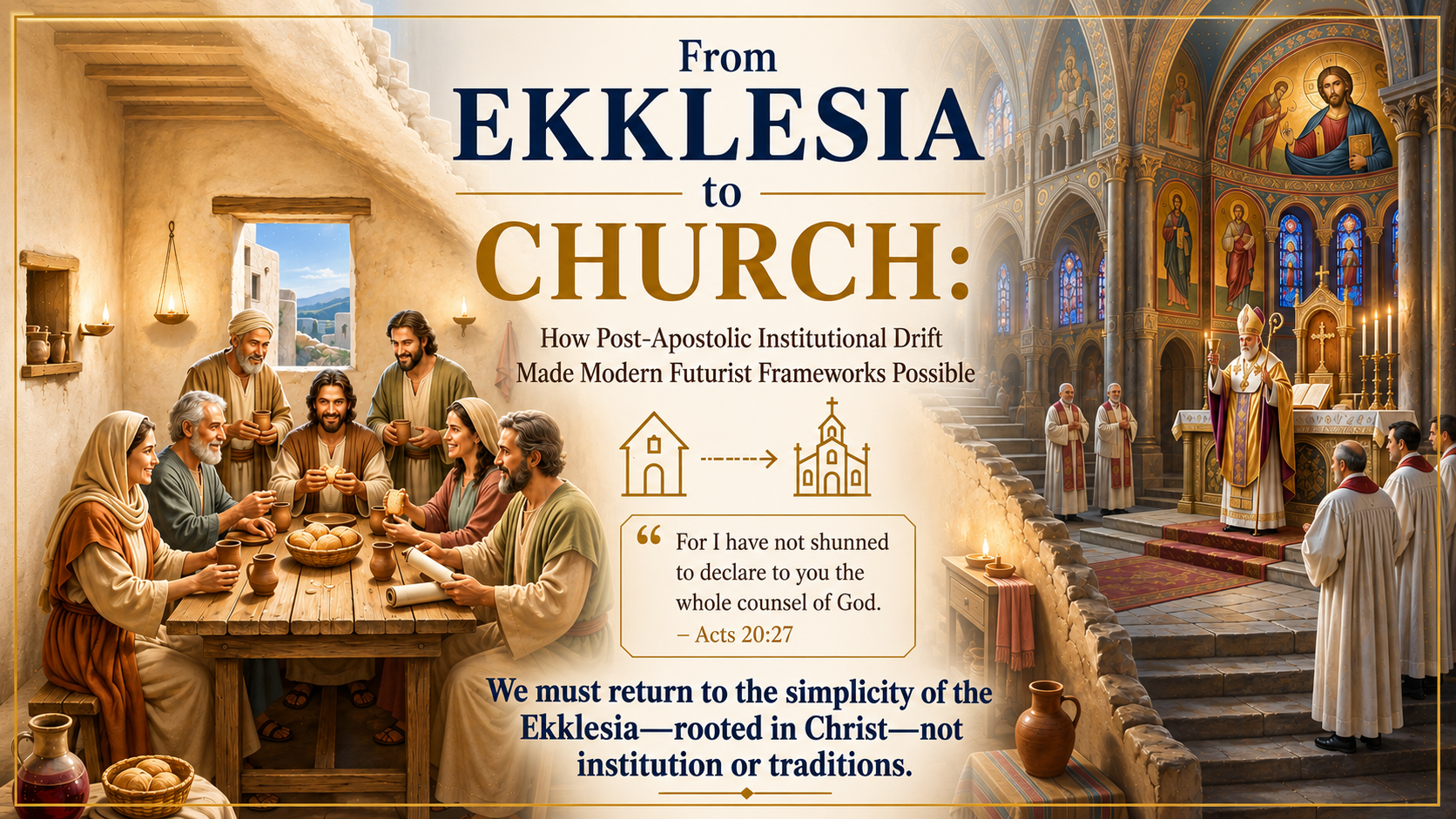
The Drift of 1st Century Apostolic Teaching
Part of Ekklesia — A Closer Look series.
Return to Table of Contents
Introduction
This article traces a single thread running through two millennia of Christian history: how the gradual replacement of the apostolic ekklesia with an institutional church, a shift encoded in the very terminology we use, created the theological conditions that made modern futurist theological frameworks thinkable. The argument is not merely that these frameworks err on certain points of prophetic interpretation. The argument is that these systems rest on an ecclesiological foundation that was already corrupted centuries before their key architects ever articulated them, and that the Reformation, for all its recovery of soteriology, left this foundation largely intact.
To understand how this happened, we must examine four movements: the apostolic ekklesia as the New Testament actually describes it, the gradual mutation of that assembly into an institution during the second through fourth centuries, the incomplete recovery attempted by the Reformation, and finally how the inherited institutional church provided exactly the weakened ecclesiology these futurist systems require. Along the way, we will examine a specific case study in incomplete reformation: the Lord’s Supper, which was reformed enough to reject transubstantiation but never restored to its first-century form as a family meal of the assembled ekklesia.
The stakes are not merely academic. If the ekklesia is the true Israel of God, the inheritor of all the covenant promises, and the one new man in which Jew and Gentile are united without distinction, then futurist premillennial systems entire framework of a separate future for ethnic Israel collapses. But as long as church means something other than what the apostles meant, that framework retains its plausibility.
Use the Table of Contents below to open each section and jump directly to the matching portion of the article.
Table of Contents
Click image to enlarge | Click section to expand sub-sections
-
 ►
►Section One
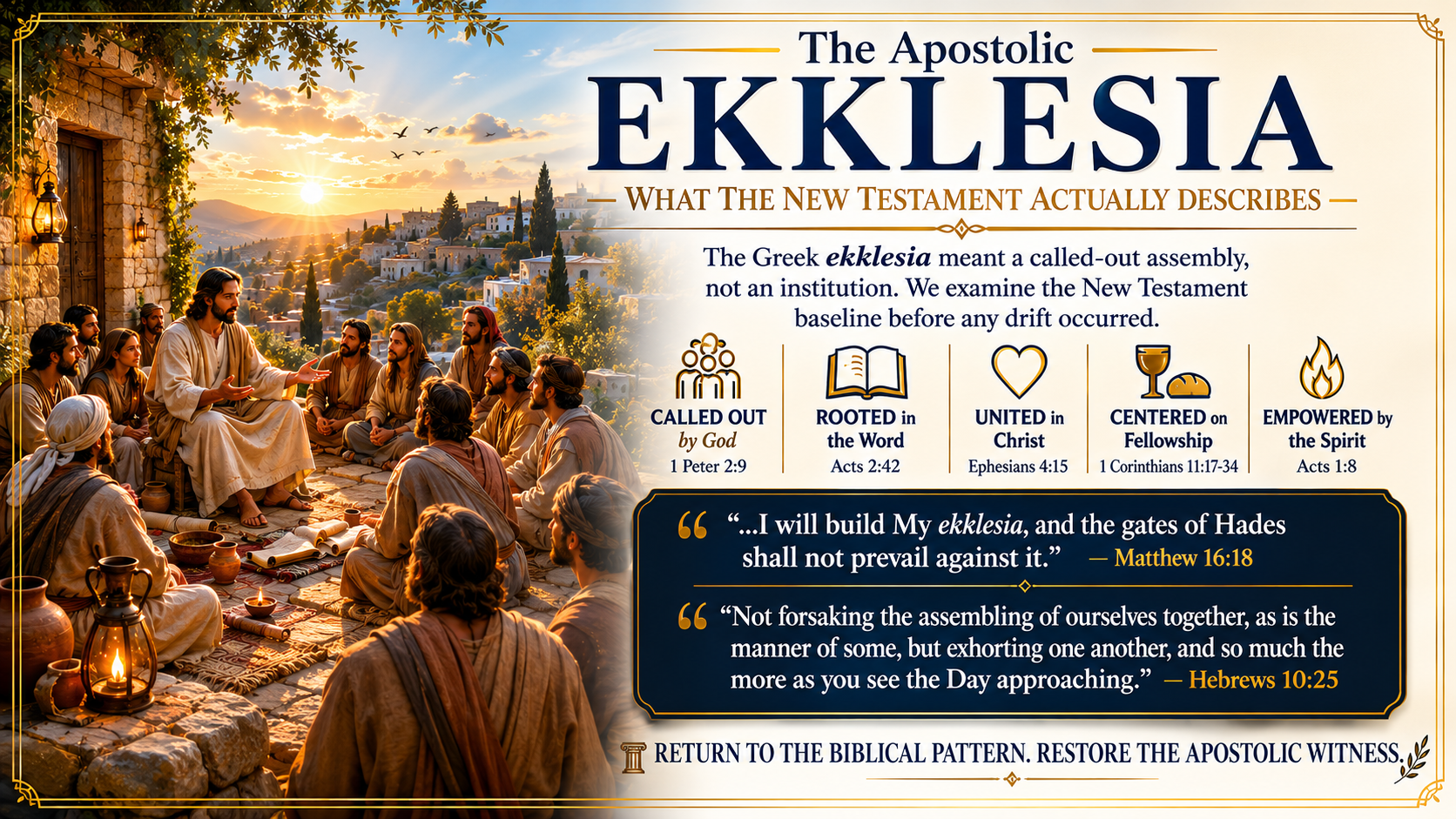
Section One — The Apostolic Ekklesia — What the New Testament Actually Describes
The New Testament baseline: assembly, homes, priesthood of believers, one new man, and the Lord’s Supper as a meal.
-
 ►
►Section Two
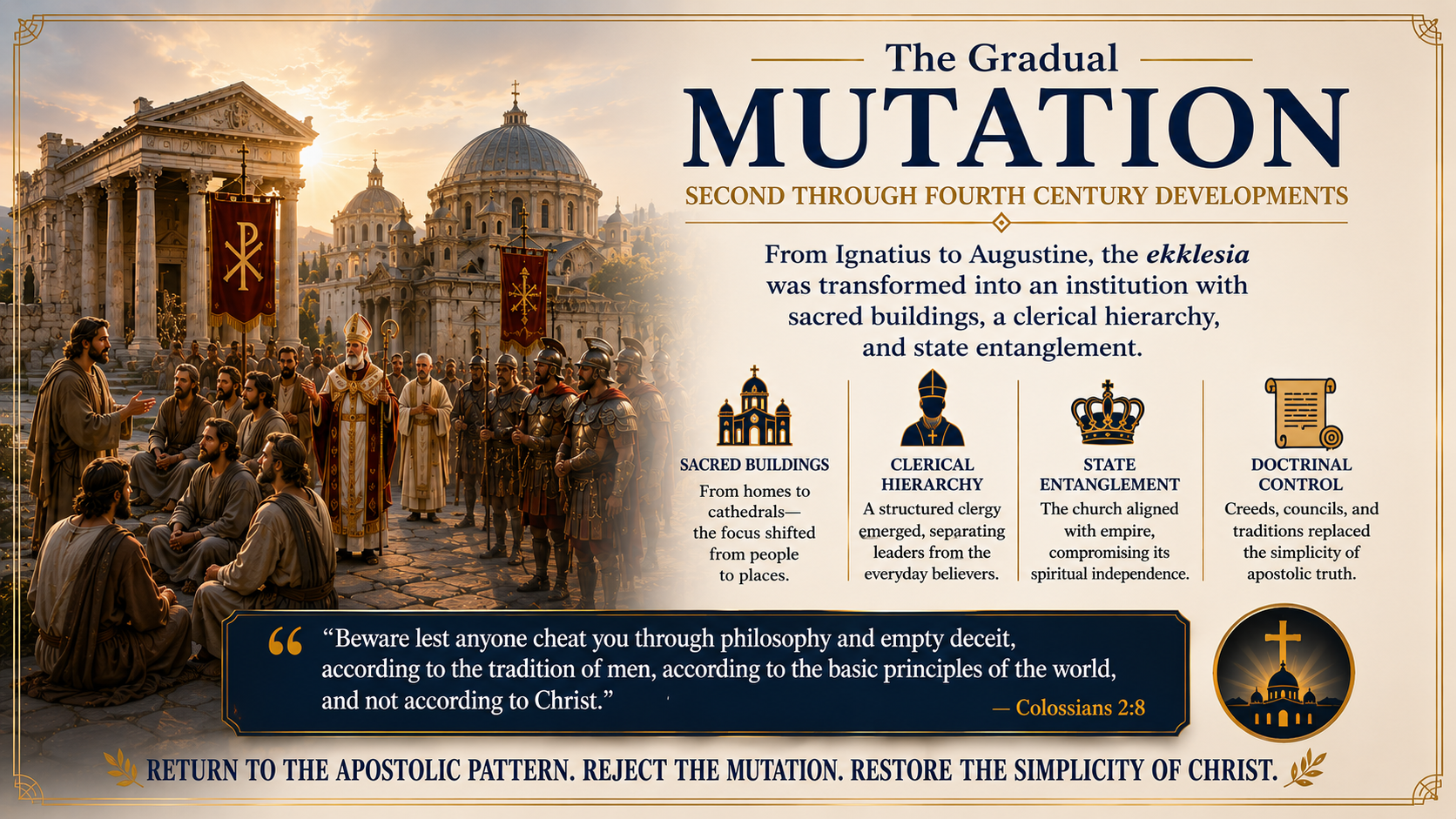
Section Two — The Gradual Mutation — Second Through Fourth Century Developments
The gradual second-to-fourth century transformation from apostolic assembly to institutional church.
-
 ►
►Section Three
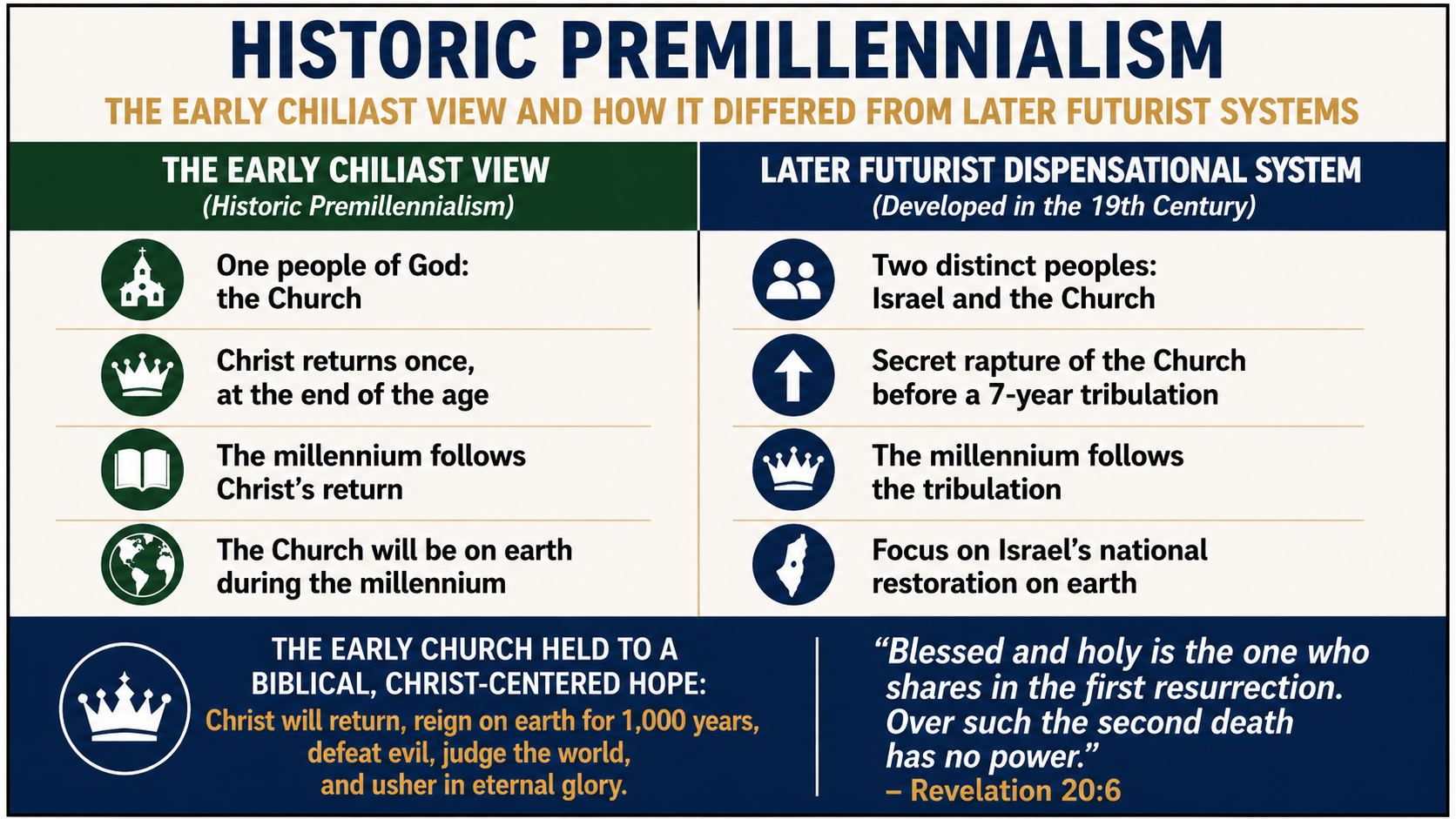
Section Three — Historic Premillennialism — The Early Chiliast View and How It Differed From Later Futurist Systems
The early chiliast view and why it differs from later futurist dispensational systems.
-
 ►
►Section Four
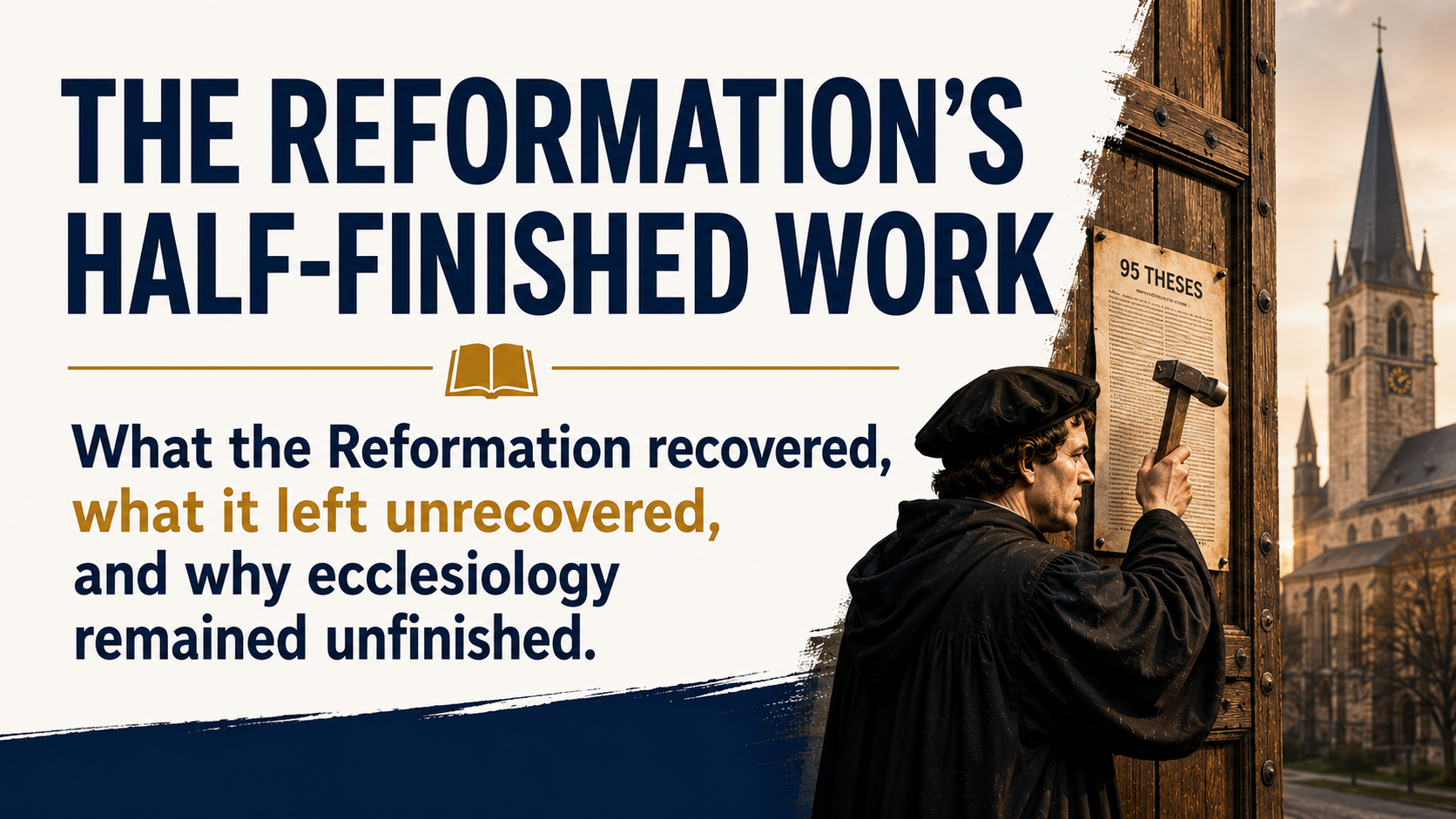
Section Four — The Reformation’s Half-Finished Work
What the Reformation recovered, what it left unrecovered, and why ecclesiology remained unfinished.
-
 ►
►Section Five
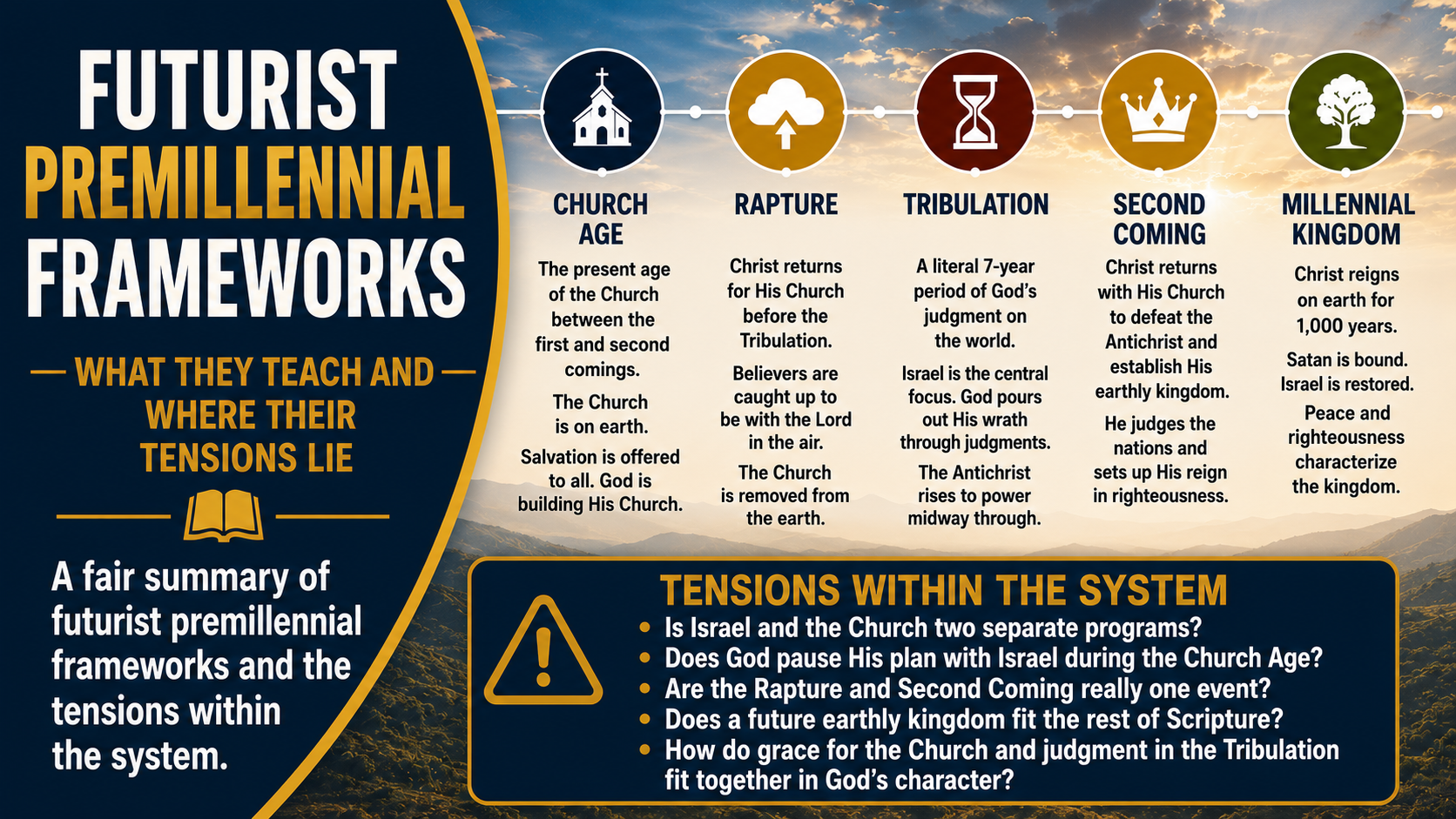
Section Five — Futurist Premillennial Frameworks — What They Teach and Where Their Tensions Lie
A fair summary of futurist premillennial frameworks and the tensions within the system.
-
 ►
►Section Six
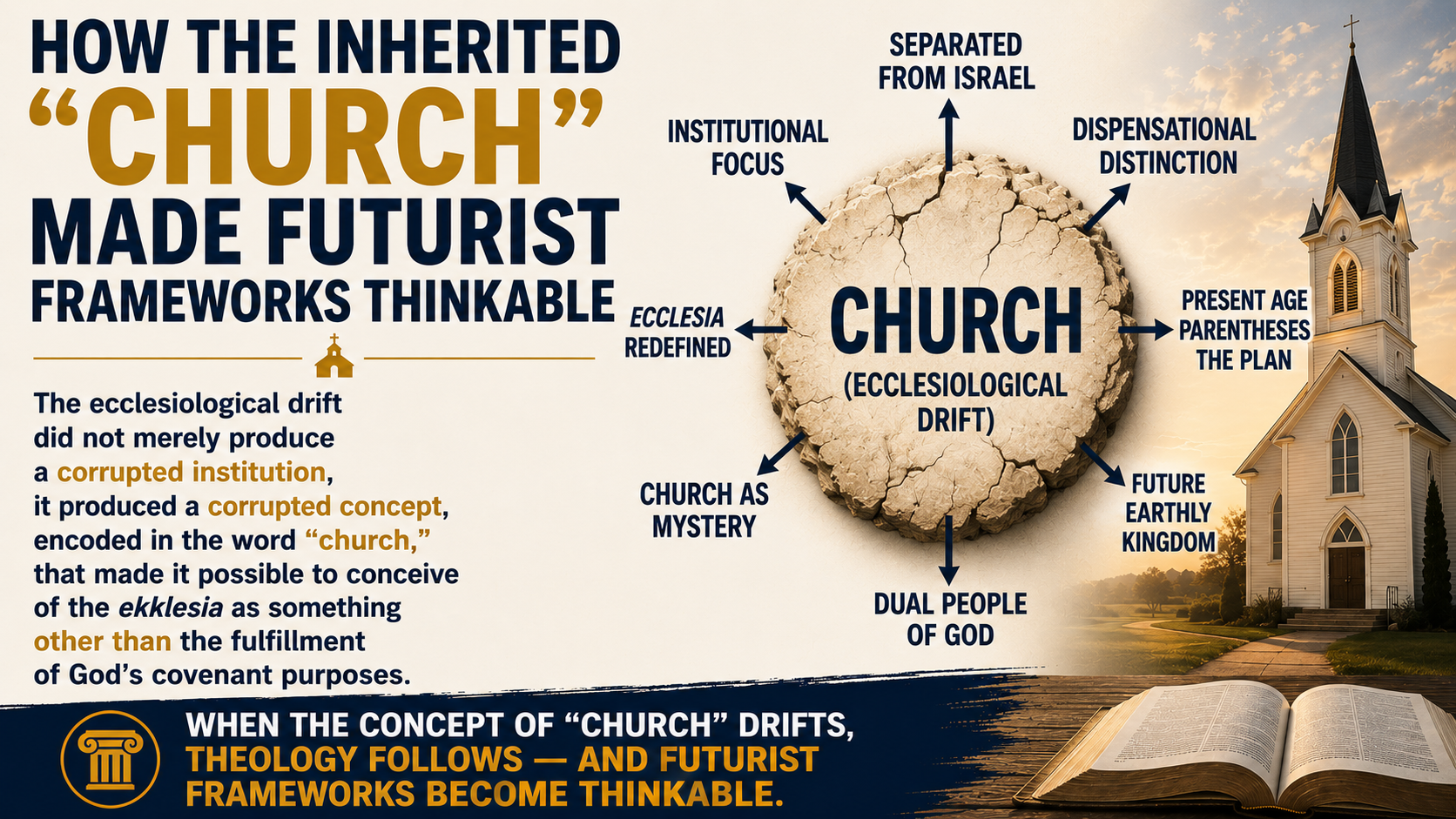
Section Six — How the Inherited “Church” Made Futurist Frameworks Thinkable
How the inherited concept of church made later futurist frameworks thinkable.
-
 ►
►Conclusion
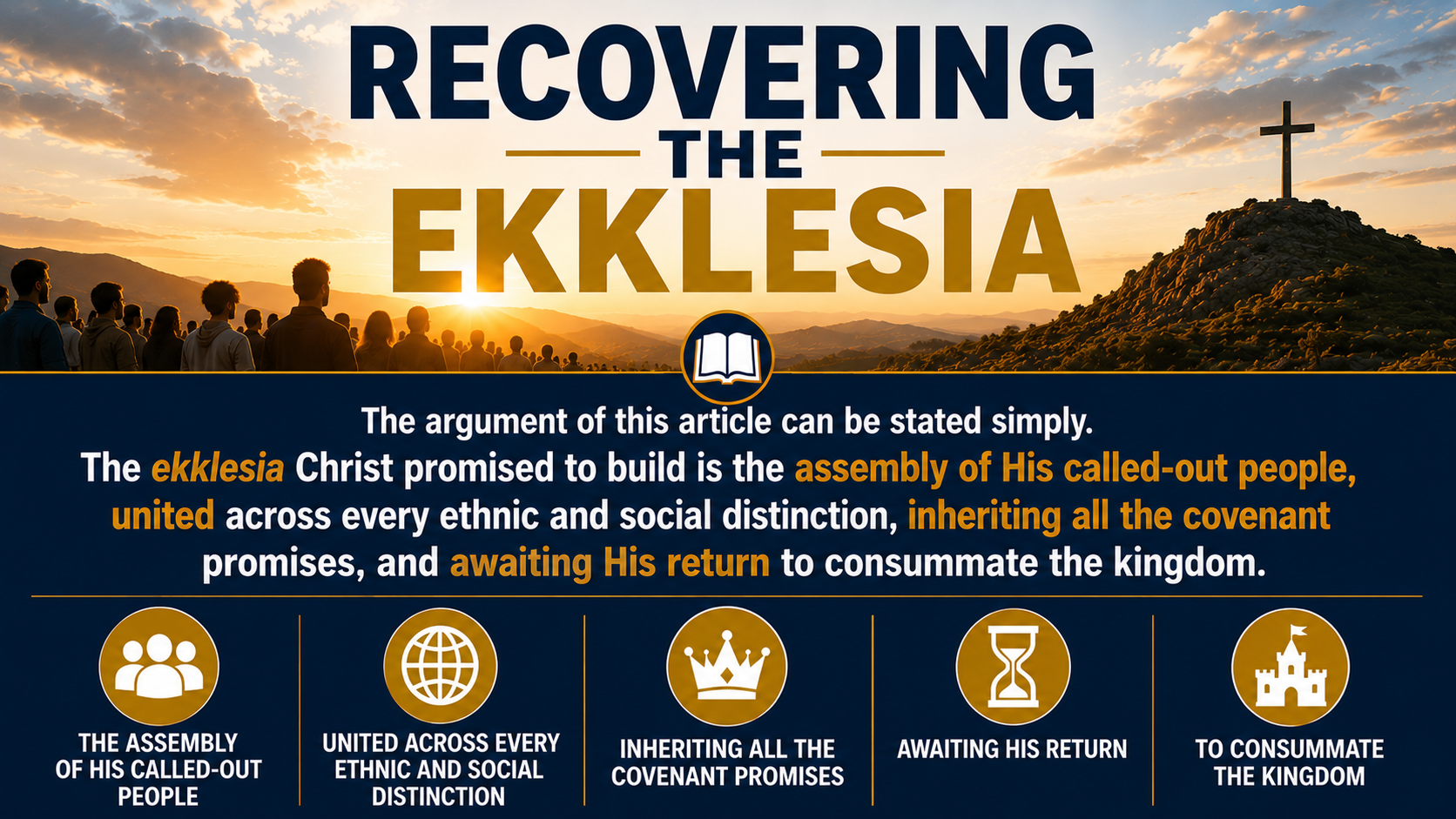
Recovering the Ekklesia
The call to recover the ekklesia as the assembly Christ promised to build.
Section One: The Apostolic Ekklesia — What the New Testament Actually Describes
Before tracing the drift, we must establish the baseline. What was the ekklesia in the apostolic period?
The Meaning of the Word
The Greek word ekklesia carries no sacred or institutional freight. In secular usage, it referred to the assembly of citizens in a Greek city-state called together to conduct public business. It is functional and relational, not architectural or sacerdotal. The word means “called-out assembly” and nothing more.
When the New Testament writers adopted this term, they did not invent a new religious institution. They described a gathering. The ekklesia was the people assembled, not a building they entered or an organization they joined. Wherever believers gathered in Christ’s name, there was the ekklesia. When they dispersed, the assembly was not in session, though the people remained members of Christ’s body.
No Sacred Buildings
The apostolic ekklesia owned no temples, no basilicas, and no dedicated worship spaces. Believers met in homes.
“Likewise greet the church that is in their house” (Romans 16:5).
“Salute the brethren which are in Laodicea, and Nymphas, and the church which is in his house” (Colossians 4:15).
“There shall be a church in thy house” (Philemon 1:2).
The New Testament knows nothing of consecrated ground under the new covenant. Stephen’s declaration in Acts 7:48-49 settled the matter: “Howbeit the most High dwelleth not in temples made with hands; as saith the prophet, Heaven is my throne, and earth is my footstool: what house will ye build me? saith the Lord: or what is the place of my rest?” The temple of the new covenant is not a building in Jerusalem or anywhere else. It is the people of God indwelt by the Spirit (1 Corinthians 3:16-17, Ephesians 2:19-22).
No Sacerdotal Priesthood
The apostolic ekklesia had no priests except one: Jesus Christ, the great High Priest after the order of Melchizedek (Hebrews 7). Every believer is a priest.
“Ye also, as lively stones, are built up a spiritual house, an holy priesthood, to offer up spiritual sacrifices, acceptable to God by Jesus Christ” (1 Peter 2:5).
“But ye are a chosen generation, a royal priesthood, an holy nation, a peculiar people” (1 Peter 2:9).
The New Testament knows elders (presbyteroi) and overseers (episkopoi), but these terms are used interchangeably for the same office (Acts 20:17, 28; Titus 1:5-7), and they function as shepherds among the flock, not as mediating priests between God and man. The clerical class as a separate order of being is entirely absent.
Jew and Gentile United as One New Man
The apostolic ekklesia was not a Gentile institution separate from Israel. It was the continuation and fulfillment of God’s covenant people, now opened to all nations through faith in Christ.
“For he is our peace, who hath made both one, and hath broken down the middle wall of partition between us” (Ephesians 2:14).
“There is neither Jew nor Greek, there is neither bond nor free, there is neither male nor female: for ye are all one in Christ Jesus” (Galatians 3:28).
“And if ye be Christ’s, then are ye Abraham’s seed, and heirs according to the promise” (Galatians 3:29).
The ekklesia is the true Israel, the circumcision made without hands (Philippians 3:3), the Israel of God (Galatians 6:16). Gentiles are no longer strangers and foreigners but fellow citizens with the saints and of the household of God (Ephesians 2:19). There is one olive tree, not two, and unbelieving branches were broken off so that believing Gentiles could be grafted in (Romans 11:17-24).
The Lord’s Supper as a Meal
The Lord’s Supper in the apostolic period was not a ritual morsel distributed by a priest at an altar. It was a meal. Paul’s instruction in 1 Corinthians 11 presupposes eating and drinking in the context of gathering together.
“When ye come together therefore into one place, this is not to eat the Lord’s supper. For in eating every one taketh before other his own supper: and one is hungry, and another is drunken” (1 Corinthians 11:20-21).
The problem Paul addresses is not the wrong ritual format but the wrong social conduct at a real meal. Some were gorging themselves while others went hungry. Paul does not respond by reducing the meal to a token wafer and sip. He responds by calling them to wait for one another and to examine themselves. The meal was the context. The body and blood were proclaimed through the breaking of bread and sharing of the cup within that meal.
“This do, as oft as ye drink it, in remembrance of me” (1 Corinthians 11:25). The phrase “as oft as” suggests regular repetition within the life of the assembly, but not specifically on a set schedule. However, there is historically that the practice of the early ekklesia was doing what’s either breaking of bread or doing what we know as the Lord’s Supper. To suggest that it was done annually or quarterly as a ceremony cannot conclusively be interpreted from the New Testament text, however, the breaking of bread appears to be often. The breaking of bread was a defining activity of the gathered ekklesia (Acts 2:42, 46; 20:7).
This is the apostolic baseline. Functional assembly, home gatherings, priesthood of all believers, Jew and Gentile united, and a covenant meal shared by the body. Everything that follows is departure from this norm.
Section Two: The Gradual Mutation — Second Through Fourth Century Developments
The drift from apostolic ekklesia to institutional church did not happen overnight. It was incremental, often imperceptible to those living through it, and accelerated at key moments. What follows is not an exhaustive history but a tracing of the key deviations that, cumulatively, transformed the nature of Christ’s assembly.
The Rise of the Monarchical Bishop — Early Second Century
The earliest post-apostolic writer whose works survive in significant form is Ignatius of Antioch, writing around 107-110 AD. In his letters, we find a dramatic shift in ecclesiastical structure.
“See that ye all follow the bishop, even as Jesus Christ does the Father, and the presbytery as ye would the apostles; and reverence the deacons, as being the institution of God. Let no man do anything connected with the Church without the bishop” (Ignatius, Letter to the Smyrnaeans, Chapter 8).
“Wherever the bishop shall appear, there let the multitude also be; even as, wherever Jesus Christ is, there is the Catholic Church” (Ignatius, Letter to the Smyrnaeans, Chapter 8).
In the New Testament, bishops and elders are the same office. Ignatius elevates the bishop above the presbytery as a distinct and superior order. The three-tier hierarchy (bishop, presbyter, deacon) is not apostolic. It represents an early accommodation to Roman organizational models and the perceived need for centralized authority to combat heresy.
The motive may have been understandable. The result was the first major step away from the mutual, plural eldership of the apostolic ekklesia toward a hierarchical institution.
Hellenization of Thought — Mid-Second Century
Justin Martyr (c. 100-165 AD) represents a significant shift in how Christianity engaged with Greek philosophy. Justin had been a philosopher before his conversion and continued to wear the philosopher’s cloak afterward. He sought to reconcile Christian faith with Platonic categories, arguing that whatever was true in Greek philosophy belonged to Christ.
This may sound reasonable, but the method introduced a foreign epistemological framework. The Hebraic thought-world of the apostles, with its concrete, covenantal, historical categories, began to be filtered through Greek abstraction. Justin also provides early evidence of changes in worship practice. In his First Apology (c. 155 AD), he describes a baptismal ceremony and a eucharistic service that already bear marks of formalization absent from the New Testament.
Tertullian and the Latin Turn — Late Second to Early Third Century
Tertullian (c. 155-220 AD) was the first major Christian writer to compose in Latin rather than Greek. This linguistic shift was consequential. The New Testament was written in Greek, the language of the Septuagint and the apostolic mission. Translating its concepts into Latin, the language of Roman law and administration, introduced legal and institutional frameworks foreign to the original.
Tertullian gave the Western church the term trinitas and a forensic vocabulary for describing salvation and ecclesial authority. The ekklesia began to be understood in legal and structural terms: an institution with officers, jurisdictions, and powers. The organic, familial assembly of the New Testament receded further.
Origen and Allegorical Hermeneutics — Third Century
Origen (c. 185-253 AD) was a brilliant scholar who systematized an allegorical method of interpretation that cut the text loose from its historical and apostolic meaning. If the plain sense seemed troubling or unphilosophical, it could be spiritualized away. This method would bear bitter fruit in later centuries when passages about Israel, the kingdom, and the assembly were reinterpreted to support institutional claims the apostles never made.
The Constantinian Catastrophe — Early Fourth Century
The Edict of Milan (313 AD) and the subsequent reign of Constantine transformed Christianity from a persecuted sect into a favored and then established religion. This is the pivot point beyond which the apostolic ekklesia becomes nearly unrecognizable.
Church buildings proliferated. Under Constantine, basilicas were constructed across the empire, often on sites associated with martyrs. The architecture reinforced the new hierarchy: the clergy occupied the apse, elevated and separated from the laity. The gathered assembly became an audience watching a performance.
The clergy became a distinct legal class. Constantine granted clergy exemption from taxation and public service. This attracted men of status and ambition to ecclesiastical office. The bishop became a figure of civic authority, not merely a shepherd of souls.
The Lord’s Supper was transformed. In the apostolic period, it was a meal shared by the assembly in homes. By the fourth century, it had become a solemn ritual performed by priests at an altar, increasingly interpreted through the lens of sacrifice rather than communion. The language shifted from the Lord’s table to the altar, from the breaking of bread to the offering of the Eucharist. The distance between clergy and laity was reinforced architecturally (the altar rail), liturgically (prayers in Latin rather than the vernacular), and theologically (the priest as mediator).
The Donatist controversy revealed competing ecclesiologies. The Donatists, concentrated in North Africa, insisted that the church must be a pure assembly of believers and that clergy who had betrayed the faith under persecution could not be restored to office. Augustine opposed them, arguing that the church was a corpus permixtum, a mixed body containing both wheat and tares, and that the validity of sacraments depended on Christ, not the worthiness of the minister. Augustine was correct on the sacramental point but his ecclesiology justified an institutional church in which genuine faith was optional.
Augustine also provided the theological justification for using state power to compel religious conformity. “Compel them to come in” (Luke 14:23) became the proof text for persecution of heretics and schismatics. The ekklesia that had once been persecuted now became the persecutor. This was not merely a political development. It reflected a fundamental change in how the nature of Christ’s assembly was understood.
Summary of the Mutation
By the end of the fourth century, the apostolic ekklesia had become the institutional church. The following elements had been introduced:
- A three-tier clerical hierarchy with a monarchical bishop
- Sacred buildings with altars and separated clergy spaces
- A sacerdotal priesthood distinct from the priesthood of all believers
- A ritualized Eucharist understood as sacrifice rather than meal
- An ecclesiology of the mixed body justified by Augustine
- State entanglement and coercive power
The very term “church,” derived from kyriakon (the Lord’s house), began its journey toward replacing ekklesia in common usage, encoding the architectural and institutional assumptions into the language itself
These mutations would persist for over a thousand years. Some were challenged, but none were fully reversed.
Section Three: Historic Premillennialism — The Early Chiliast View and How It Differed From Later Futurist Systems
Before examining the Reformation’s incomplete recovery, we must address an eschatological position that emerged during the very period of drift traced in Section Two. The view commonly called “historic premillennialism” (or chiliasm, from the Greek chilioi, meaning a thousand) was the dominant end-times expectation among early post-apostolic Christians from roughly the early second century through the third century. It predates modern futurist frameworks by over seventeen hundred years and differs from them in ways that are essential to understand.
Addressing this early chiliasm here serves two purposes. First, it demonstrates that doctrinal development was occurring across multiple fronts simultaneously: ecclesiology was mutating toward institutionalism while eschatology was developing in a premillennial direction. Second, it shows that the early chiliast view, whatever its own departures from apostolic simplicity, did not share the radical Israel-Church distinction or the pre-tribulational rapture that would later define the classic dispensational scheme. The errors of the nineteenth century were not merely a continuation of early chiliasm. They were a novel synthesis that required the prior ecclesiological mutation to become thinkable.
What Historic Premillennialism Actually Taught
Historic premillennialism holds that Christ will return bodily and visibly before a literal thousand-year reign on a renewed earth, as described in Revelation 20:1-6. However, it diverges sharply from the later dispensational system on several defining points.
No pre-tribulational rapture. The early chiliasts were uniformly post-tribulational. The Church was expected to go through the tribulation, and Christ’s return would rescue the saints and initiate the millennium in a single event. There is no secret coming for a separate heavenly people. This concept is entirely absent from the first three centuries. The ekklesia was understood as a pilgrim people destined to suffer under Antichrist before being delivered at the visible appearing of Christ.
No radical Israel-Church distinction. While some early fathers spoke of a future blessedness for believing Israel, they did not divide redemptive history into two separate peoples with two separate destinies. The Church is the continuation of God’s covenant people; Gentile believers are grafted into Israel. Irenaeus, for example, saw the millennium as the fulfillment of God’s promises to Abraham for the whole people of God, not a return to a parenthetical Jewish age. There is one olive tree, one flock, one people of God from the patriarchs through the final consummation.
The millennium as consummation of creation, not return to shadows. The early chiliasts expected a period of earthly peace, fertility, and the renewal of creation, drawing on Isaiah 65, Revelation 20, and related texts. They often described it as the “kingdom of the saints” before the final judgment and the eternal state, a foretaste of the new heavens and new earth, not a time when the Mosaic sacrificial system would be reinstituted. Some, like Irenaeus, did anticipate a rebuilt Jerusalem with a temple, but this was generally understood as a spiritual house or a place of worship for the glorified saints, not a resumption of Levitical sacrifices. The redemptive-historical movement from shadow to substance was generally preserved, even if some elements of literalism pointed in a problematic direction.
The “first resurrection” is the resurrection of the just. This is the martyrs and faithful believers who reign with Christ. The rest of the dead do not live again until the thousand years are finished (Revelation 20:5). The chiliasts took this sequence literally: the resurrection of the righteous at Christ’s return initiates the millennial kingdom; the general resurrection and final judgment follow its close.
When Did This View Appear and Who Held It?
The belief in a future earthly millennium appears in Christian writings by the early second century and flourished through the third century. Its roots are often traced to Jewish apocalyptic expectations that many early Jewish Christians carried forward, filtered through the New Testament’s own use of Revelation 20. The key figures and dates are as follows.
Papias of Hierapolis (c. 60-130 AD)
Eusebius records that Papias, who claimed to have heard the apostle John, taught a literal thousand-year reign of Christ on earth and passed on traditions about the extraordinary fertility of the renewed creation. Papias’s writings are lost, but his chiliasm is well attested and makes him the earliest known post-apostolic premillennialist.
Justin Martyr (c. 100-165 AD)In his Dialogue with Trypho (c. 160 AD)
Justin affirms that he and “many others who are right-minded Christians” believe in a literal resurrection and a thousand-year reign in a rebuilt Jerusalem, after which comes the general resurrection and judgment. Importantly, Justin acknowledges that some devout Christians reject this view, showing that chiliasm was not yet universal even in the mid-second century.
Irenaeus of Lyons (c. 130-202 AD)
Irenaeus’s Against Heresies (Book 5, chapters 32-36) provides the most detailed early exposition of chiliasm. He ties the millennium to the fulfillment of God’s promises to Abraham, interpreting the kingdom as the time when the righteous inherit the earth and enjoy its renewed abundance before entering the uncreated glory of the Father. His system is thoroughly post-tribulational and sees the Antichrist’s defeat as immediately preceding the kingdom.
Tertullian (c. 155-220 AD)
Tertullian, especially in his later Montanist-influenced period, defended chiliasm against its detractors. In Against Marcion (Book 3, chapter 24), he argued for a literal kingdom on earth for the saints, a period of reward before the final judgment. Even in his more orthodox earlier works, a premillennial framework is evident.
Hippolytus of Rome (c. 170-235 AD)
In his commentary on Daniel and in On Christ and Antichrist, Hippolytus set forth a premillennial sequence with a six-thousand-year scheme of world history, each day of creation prefiguring a thousand years, followed by the seventh millennium as the sabbath rest of the kingdom. This week-of-millennia schema became common among chiliasts.
Commodian (3rd century, probably mid-200s)
A Latin poet whose Carmen Apologeticum describes a post-tribulational gathering, a resurrection of the righteous, and a millennium of peace and abundance for the saints.
Victorinus of Pettau (died c. 304 AD)
Victorinus’s commentary on Revelation, the earliest Latin commentary on the Apocalypse, interprets the thousand years literally, though he also applies allegorical meanings. He was one of the last chiliasts before the Constantinian shift.
Lactantius (c. 250-325 AD)
In his Divine Institutes (Book 7), Lactantius provides a vivid premillennial picture: after the destruction of the wicked, the earth will be renewed, the righteous will reign with Christ for a thousand years in a transformed world of peace and fertility, and then the final judgment will come. He writes in the early fourth century, just as the chiliastic consensus was beginning to wane.
The Decline of Historic Premillennialism
By the mid-to-late third century, allegorical hermeneutics, especially through Origen (c. 185-253 AD), began to erode literal chiliasm. Origen spiritualized the millennium, treating it as the present reign of Christ in the hearts of believers or the soul’s ascent to God. His influence, combined with the political stabilization of the empire under Constantine, moved many to see the Church’s triumph as already occurring within history.
The decisive turning point came with Augustine of Hippo (354-430 AD). In The City of God (Book 20), Augustine argued that the thousand years of Revelation 20 represent the entire church age, beginning with Christ’s first advent. The “first resurrection” is spiritual regeneration; the reign of the saints is the current age. This amillennial interpretation became the dominant Western position, and historic premillennialism was largely suppressed, though it resurfaced periodically, notably among the Anabaptists and later in the nineteenth-century evangelical revival that also produced the dispensational scheme.
How Historic Premillennialism Differs From Modern Futurist Systems
Two distinctions are crucial for the larger argument of this article.
No two-peoples-of-God theology. The early chiliasts never separated Israel and the Church into parallel, distinct redemptive programs. They saw the millennium as the inheritance of the saints—the whole people of God, Jew and Gentile united in Christ. Irenaeus, for instance, treats the promises to Abraham as fulfilled in the millennial kingdom for all believers, not as a separate dispensation for ethnic Israel. This means historic premillennialism does not share the ecclesiological problem that makes later futurist frameworks untenable. It did not require the Church to be a “parenthesis” or to reintroduce Old Covenant shadows.
No pre-tribulational rapture. The notion that the Church would be whisked away before a period of tribulation was unheard of among the chiliasts. They expected to endure persecution under Antichrist and then be delivered at the visible coming of Christ. That common suffering and deliverance shaped their ecclesiology: the ekklesia was a pilgrim people, not an institution that could be extracted from history before judgment. This is a fundamentally different vision of the Church’s relation to history and suffering than what the nineteenth-century futurist systems would later propose.
The Significance for Our Argument
Historic premillennialism represents an early doctrinal development that, whatever its own departures from apostolic simplicity in its literalism about a rebuilt Jerusalem, did not yet require the full institutional mutation traced in Section Two to function. It was still operating with a basically apostolic ecclesiology: one people of God, one future, one return of Christ for one bride.
What happened in the nineteenth century was not a simple revival of early chiliasm. It was a novel synthesis that took the premillennial chronology of the early fathers, combined it with the weakened ecclesiology of the post-Constantinian institutional church, and added a pre-tribulational rapture that had no precedent in Christian history. The resulting system was something the early chiliasts would not have recognized.
This is why the ecclesiological drift matters so much. It was not eschatology alone that produced the futurist frameworks critiqued in this article. It was the combination of a particular eschatology with a particular ecclesiology, the institutional “church” that had been developing since the second century and was never fully reformed. Without that ecclesiological mutation, the futurist scheme could not have been conceived. The early chiliasts, operating with a healthier ecclesiology, produced a premillennialism that, whatever its flaws, did not require dividing the people of God or removing the Church from history.
Section Four: The Reformation’s Half-Finished Work
When Martin Luther nailed his ninety-five theses to the door of Wittenberg’s Castle Church in 1517, he launched a recovery of the gospel that still reverberates. But the Reformation recovered soteriology without fully recovering ecclesiology. The doctrine of justification by faith alone was restored. The nature of the assembly was not.
What the Reformation Recovered
Luther and the other magisterial Reformers correctly identified the heart of the gospel. Salvation is by grace alone through faith alone in Christ alone. The mediating role of priests, the treasury of merits, purgatory, indulgences, and the entire apparatus of works-righteousness were rejected on biblical grounds.
Scripture was restored to its place of supreme authority. The Bible was translated into vernacular languages and placed in the hands of ordinary believers. The Reformers rejected papal supremacy and the claims of Rome to be the one true church.
What the Reformation Did Not Recover
For all this, the magisterial Reformers left significant aspects of the inherited institutional model intact.
The state church model persisted. Luther replaced the Pope with the prince. The territorial church, in which every resident of a given region was baptized into membership regardless of personal faith, continued. Calvin’s Geneva was a theocratic republic where church and state were intertwined. The corpus permixtum Augustine had justified remained the operative ecclesiology.
The sacred building remained. Cathedrals and parish churches, stripped of images and relics, nevertheless retained the architecture of clerical separation. The pulpit replaced the altar as the focal point, but the congregation remained an audience facing a platform, a layout that would have been alien to a first-century house assembly.
The clergy-laity distinction persisted. The Reformers rightly taught the priesthood of all believers, but in practice they retained a distinct class of ordained ministers who alone could preach and administer the sacraments. Luther’s doctrine of the priesthood of all believers was radical on paper but conservative in application.
The inherited lexicon remained. The word “church” continued to mean both the universal body of Christ and the local institutional expression. The New Testament word ekklesia, with its functional and relational meaning, was not recovered in common usage. Christians continued to speak of “going to church,” meaning a building and an event, rather than “gathering as the assembly.”
Infant baptism continued. Luther, Calvin, and Zwingli all retained the practice of baptizing infants, despite the lack of clear New Testament precedent. This reinforced the corpus permixtum ecclesiology and the identification of church membership with civic belonging. The Anabaptists insisted on believer’s baptism and a gathered assembly of regenerate members, and for this they were persecuted by Catholics and Protestants alike.
The Suppressed Witness: The Anabaptists
The Anabaptists saw what the magisterial Reformers did not. They understood that the recovery of the gospel required a recovery of the ekklesia as a gathered assembly of believers, not a territorial institution encompassing the whole population. They rejected infant baptism because it presumed faith rather than expressing it. They rejected the state church because the kingdom of Christ is not of this world. They met in homes rather than cathedrals and practiced a simple breaking of bread.
For these convictions, they were drowned, burned, and beheaded, often with the approval of Protestant as well as Catholic authorities. The Anabaptist witness was suppressed, and with it the most thoroughgoing attempt to restore apostolic ecclesiology in the Reformation era.
The Lord’s Supper: A Case Study in Incomplete Reformation
The Reformation’s treatment of the Lord’s Supper illustrates precisely how far the recovery went and where it stopped short.
What the Reformers rightly rejected was the Roman Catholic doctrine of transubstantiation, the belief that the bread and wine become the literal body and blood of Christ upon consecration by the priest. They also rejected the practice of withholding the cup from the laity. In the medieval Catholic mass, only the priest drank the wine; the congregation received only the wafer. The Reformers restored the cup to the people, a genuine recovery.
However, what the Reformers did not do was return to the first-century practice of the Lord’s Supper as an actual meal shared by the assembled ekklesia.
The elements were retained in their reduced form. The wafer and the cup of wine (or grape juice in later Protestant practice) were retained as the sum total of the Supper. The wafer, in particular, is a medieval innovation bearing no resemblance to the loaf of bread broken at apostolic meals. A thin, pressed disc that dissolves on the tongue is not bread in any meaningful sense. It is an artifact of the sacerdotal system, designed for distribution by a priest to passive recipients.
The thimble of grape juice replaced the cup of wine. This development came later, largely through the temperance movement of the nineteenth and early twentieth centuries. Welch’s grape juice, invented in 1869 by Methodist Thomas Bramwell Welch, was specifically developed to provide a non-alcoholic alternative for communion. This innovation, however well-intentioned, further removed the Supper from its first-century context. The fruit of the vine at the Last Supper was wine, the common beverage of the Mediterranean table. Substituting a manufactured product for the natural fruit of the vine represents yet another layer of departure from apostolic practice.
The meal context was lost entirely. The New Testament Lord’s Supper occurred within a meal. Paul’s corrections in 1 Corinthians 11 address problems arising from a real meal, not a ceremonial distribution of tokens. “When ye come together therefore into one place, this is not to eat the Lord’s supper. For in eating every one taketh before other his own supper: and one is hungry, and another is drunken” (1 Corinthians 11:20-21). The problem was that the wealthy arrived early and ate their fill while the poor arrived late and went hungry. Paul’s solution was not to reduce the meal to a morsel but to instruct them to wait for one another and examine themselves.
The Reformers continued the medieval reduction of the Supper to a ritual act of receiving elements from a minister. Luther retained the altar. Calvin placed a table in the chancel but still administered elements to recipients who returned to their seats. The gathered assembly sharing a family meal around a common table, the apostolic pattern, was not restored.
The Anabaptists, again, came closest. Many practiced a simple meal of bread and wine shared in homes, sometimes incorporating foot washing as commanded in John 13. This represented a genuine attempt to recover apostolic practice, but the dominant Protestant traditions did not follow their lead.
Summary of the Reformation’s Achievement and Limitation
The Reformation recovered the gospel of grace. It did not recover the apostolic ekklesia. The institutional church model inherited from the post-Constantinian period was reformed in certain respects but not dismantled and rebuilt according to the New Testament pattern.
The significance of this for our larger argument is this: by the time John Nelson Darby began developing his prophetic system in the nineteenth century, the “church” he knew was not the apostolic ekklesia. It was the institutional church of Christendom, partially reformed but still bearing the structural DNA of the fourth-century mutation. This was the ecclesiology Darby inherited, and it shaped everything he built on top of it.
Section Five: Futurist Premillennial Frameworks — What They Teach and Where Their Tensions Lie
Before we can show how the inherited ecclesiology enabled these futurist frameworks, we must fairly summarize what the classic dispensational scheme actually teaches. The summary that follows draws from the works of John Nelson Darby, C.I. Scofield, Lewis Sperry Chafer, John Walvoord, and J. Dwight Pentecost.
The Typical Sequence in These Futurist Systems
In their classic form, futurist premillennial systems teach the following sequence of end-time events:
- The Church is raptured before the Tribulation. Believers are caught up to meet Christ in the air (1 Thessalonians 4:16-17).
- A seven-year Tribulation follows, identified with Daniel’s seventieth week (Daniel 9:27).
- During the Tribulation, many ethnic Jews come to faith in Christ, along with some Gentiles.
- Christ returns visibly to earth at the end of the Tribulation to defeat His enemies and establish His kingdom.
- Christ establishes a literal thousand-year kingdom on earth with its center in Jerusalem. A rebuilt temple functions with reinstituted sacrifices.
- Satan is bound during the thousand years and released at the end to lead a final rebellion, which is crushed (Revelation 20:7-10).
- The final judgment and the eternal state follow.
The primary text used for the thousand-year reign is Revelation 20:1-6, which mentions “a thousand years” six times.
The Two Categories of Inhabitants in the Millennial Kingdom
These futuristic frameworks distinguish between two groups of redeemed people who inhabit the millennial kingdom.
Glorified Saints: This category includes the Church raptured before the Tribulation, Old Testament saints raised at Christ’s return, and Tribulation martyrs raised at Christ’s return. These possess resurrection bodies (1 Corinthians 15:51-54), are immortal, cannot die, and do not marry.
Mortal Kingdom Survivors: These are people who survive the Tribulation in natural bodies. According to this scheme, they include both saved Jews and saved Gentiles. They enter the Millennium still mortal, marry, have children, age, and eventually die.
This distinction is central to the system because it explains how the earth is repopulated during the thousand years. The mortal survivors produce children, and these children are born with sinful natures and must come to faith in Christ.
Key Theological Commitments
Beyond the chronological sequence, these futurist frameworks rest on several theological commitments that distinguish them from other eschatological systems.
The Israel-Church distinction: This is the sine qua non of the classic dispensational scheme. Israel is God’s earthly people with earthly promises. The Church is God’s heavenly people with heavenly promises. The two must never be confused or merged. This distinction is maintained even in the face of passages like Ephesians 2:14-16, which declares that Christ “hath made both one” and “broken down the middle wall of partition.”
The parenthesis view of the Church: The Church age is a “parenthesis” in God’s prophetic program for Israel. God’s dealings with national Israel were suspended at Pentecost and will resume after the rapture. The Church is not the continuation or fulfillment of Israel but a separate entity inserted into history between Daniel’s sixty-ninth and seventieth weeks.
Literal hermeneutic: Proponents of these frameworks insist on consistent literal interpretation of prophecy. If a passage can be read literally, it should be. Old Testament promises to Israel about land, temple, and throne must be fulfilled literally with ethnic Israel. Allegorical or spiritual readings that apply these promises to the Church are rejected.
Pre-tribulational rapture: While some variations allow for different rapture timings, the classic scheme teaches that the Church is removed before the Tribulation begins. This is essential to maintaining the distinction: God cannot deal with Israel and the Church simultaneously.
Where the Tensions Arise
Several internal tensions within these systems have been noted by critics, and these are not straw men. They represent genuine difficulties.
How do glorified and mortal beings coexist? One group is immortal and resurrected. The other is mortal and natural. The ontological and practical difficulties of their coexistence for a thousand years are rarely addressed in detail.
Why does rebellion occur after Christ’s perfect reign? Revelation 20:7-9 describes a final rebellion so massive it covers “the breadth of the earth.” If Christ is reigning visibly from Jerusalem with Satan bound, how does this happen? Adherents answer that unregenerate children of mortal survivors will outwardly conform but inwardly rebel. But this raises the question of how a perfect earthly reign of Christ produces generations that ultimately hate Him.
Why would a rebuilt temple with sacrifices be necessary? Hebrews presents Christ as the final sacrifice, the final High Priest, the mediator of a better covenant. The entire argument of Hebrews moves forward from shadow to substance. The reinstituted temple sacrifices in this scheme represent a redemptive movement backward that is difficult to reconcile with the New Testament’s own hermeneutic.
Why maintain the Jew-Gentile distinction if Christ abolished it? Ephesians 2:14-16 and Galatians 3:28-29 declare the unity of Jew and Gentile in Christ. The insistence on maintaining national distinctions as a governing principle of the future kingdom appears to contradict what Paul describes as already accomplished.
These are not peripheral quibbles. They go to the heart of how the New Testament interprets the Old, how covenant and fulfillment relate, and what the ekklesia actually is.
Section Six: How the Inherited “Church” Made Futurist Frameworks Thinkable
This is where the threads converge. The ecclesiological drift traced in Sections Two and Three did not merely produce a corrupted institution. It produced a corrupted concept, encoded in the word “church,” that made it possible to conceive of the ekklesia as something other than the fulfillment of God’s covenant purposes.
What These Futurist Systems Require of Ecclesiology
Futurist premillennial systems require a church that can be:
- Separated from Israel without contradiction
- Removed from the earth while God resumes dealings with Israel
- Treated as a “parenthesis” rather than the culmination of redemptive history
- Relegated to “heavenly” purposes while “earthly” purposes belong to another people
- These requirements cannot be met if the ekklesia is what the New Testament says it is.
If the ekklesia is the true Israel, the inheritor of Abraham’s promises, the one new man in Christ, the olive tree into which Gentiles are grafted, the household of God built on the foundation of the apostles and prophets, then these futurist frameworks have no ground to stand on. You cannot rapture the true Israel out of the world while God resumes His dealings with Israel. You cannot have a future for ethnic Israel distinct from the ekklesia if the ekklesia is the fulfillment of Israel’s calling to be a light to the nations.
These systems require the ekklesia to be something smaller, something separate, something that can be set aside without disrupting the larger redemptive narrative. The institutional “church” Darby inherited was exactly that.
The Institutional Church: Separate Enough to Be Removable
By the nineteenth century, “the church” in the English-speaking world meant a constellation of denominational institutions, state churches, dissenting chapels, and voluntary societies. It was a visible, identifiable social entity with buildings, clergy, and membership rolls. It was embedded in the political order of Christendom but also distinct from it in important ways.
This “church” did not look like the apostolic ekklesia, but it did look like something that could be “raptured.” It was a defined group (professing Christians) with a defined membership (baptized, communicant, or enrolled). It existed alongside the Jewish people, who were equally identifiable as a distinct entity. The categories were already separate in the cultural imagination.
Darby did not need to invent a church distinct from Israel. History had already produced one. The institutional church of Christendom had been functioning as a Gentile institution for centuries. The Jewish people had been functioning as a distinct community for equally long. Darby simply projected this observable sociological reality backward onto the New Testament and forward onto the eschatological timeline.
The Irony of the Rapture
There is a painful irony in this futurist scheme. Darby was, by many accounts, a perceptive critic of the institutional church of his day. He saw the corruption, the worldliness, the empty formalism. The Church of England was a department of state. The dissenting bodies were drifting into liberalism. The visible church of Christendom was, in many respects, failing.
A genuine reformer might have called this institution back to its apostolic roots: to abandon its buildings for homes, its hierarchy for mutual eldership, its sacerdotal rituals for the simple breaking of bread as a meal, and its state entanglements for the purity of a gathered assembly.
Darby did something else. He invented a way for God to give up on the church and go back to Plan A.
If the institutional church was a failing project, Darby’s solution was not to reform it but to remove it. The rapture became the escape hatch for a church that had lost its way. God would snatch away the faithful remnant, leaving the corrupt institution behind to face judgment, and then resume His original plan with ethnic Israel.
This is the logic of abandonment, not reformation. It treats the ekklesia as a temporary expedient, a detour in God’s program rather than its destination. And it was made possible because the “church” Darby knew was, in fact, something less than the ekklesia of the New Testament. It was a partially reformed post-Constantinian institution. Treating it as a parenthesis was not a radical departure from apostolic teaching. It was a radical conclusion drawn from a defective premise, a premise that had been baked into ecclesiology since the fourth century.
If the Reformers Had Finished the Work
Consider what would have happened if the Reformation had fully recovered apostolic ecclesiology alongside apostolic soteriology.
If Christians understood themselves not as members of an institution called “the church” but as the called-out assembly of God, the true Israel, the inheritors of all the promises, the one new man in Christ.
If they gathered in homes rather than sacred buildings, shared a meal rather than received a wafer, functioned as a body of priests rather than an audience before a platform.
If they read the New Testament not as the charter of a new religion separate from Judaism but as the fulfillment of everything the Old Testament promised.
In that world, Darby could not have conceived of a “rapture of the church” that separated it from Israel because “the church” and “Israel” would be the same entity, the ekklesia, the assembly of God’s people across all ages, united in Christ. There would be no separate entity to rapture. There would be no ethnic Israel left behind with a separate future. There would be only the one olive tree, the one flock with one Shepherd, the one new man.
These futurist premillennial frameworks were not merely an error in prophetic interpretation. They were a symptom of a deeper ecclesiological defect that had been present since the second century and was never fully cured. Darby built his system on a cracked foundation, and that crack had been spreading for eighteen hundred years.
Conclusion: Recovering the Ekklesia
The argument of this article can be stated simply. The ekklesia Christ promised to build is the assembly of His called-out people, united across every ethnic and social distinction, inheriting all the covenant promises, and awaiting His return to consummate the kingdom. What we have instead, through a process of gradual mutation beginning in the second century and never fully reversed, is an institutional “church” that bears only partial resemblance to the apostolic original.
Futurist premillennial systems are among the theological structures built on that mutated foundation. They require an ecclesiology in which the church is something other than the true Israel, something that can be removed while God resumes a separate program for ethnic Jews. This requirement could only arise in a context where the ekklesia had already been conceptually severed from its identity as the continuation and fulfillment of God’s covenant people.
The Reformation recovered the gospel. It did not recover the assembly. The resulting half-reformed “church” became the raw material for these futurist prophetic systems, which offered an escape from institutional corruption rather than a return to apostolic roots.
The path forward is not to refine these frameworks or adjust their chronologies. The path forward is to recover what was lost.
This means recovering the terminology. “Ekklesia” is an assembly, not an institution. “Church” is a word that carries the DNA of the mutation. Using the right words matters because words shape thought.
This means recovering the practice. Gathering in homes rather than sacred buildings. Sharing a meal rather than receiving a token. Functioning as a body of priests rather than an audience. The Lord’s Supper was a family meal before it was a ceremony. It can be again.
This means recovering the identity. The ekklesia is the true Israel, the olive tree, the one new man. There is one people of God from Genesis to Revelation, and that people is the assembly of those who belong to Christ by faith.
This means reading the Bible as a unified story of fulfillment in Christ, not as the record of two separate peoples with two separate destinies. What God joined together in the body of His Son, no system of interpretation should put asunder.
When the ekklesia is understood apostolically, these futurist theological frameworks have no ground to stand on. Their framework collapses, not because a few proof texts have been reinterpreted but because their entire ecclesiological foundation has been exposed as a post-Constantinian artifact.
The work of reformation is not finished. The recovery of the gospel must be completed by the recovery of the assembly. That is the task to which this article points and the summons to which it calls.