🔎 Mouse Over Image to Enlarge
The Word Churches Exposes A Problem
The Error of Translating Ekklēsia as “Church”
Part of Ekklesia — A Closer Look series. Return to Table of Contents
Introduction
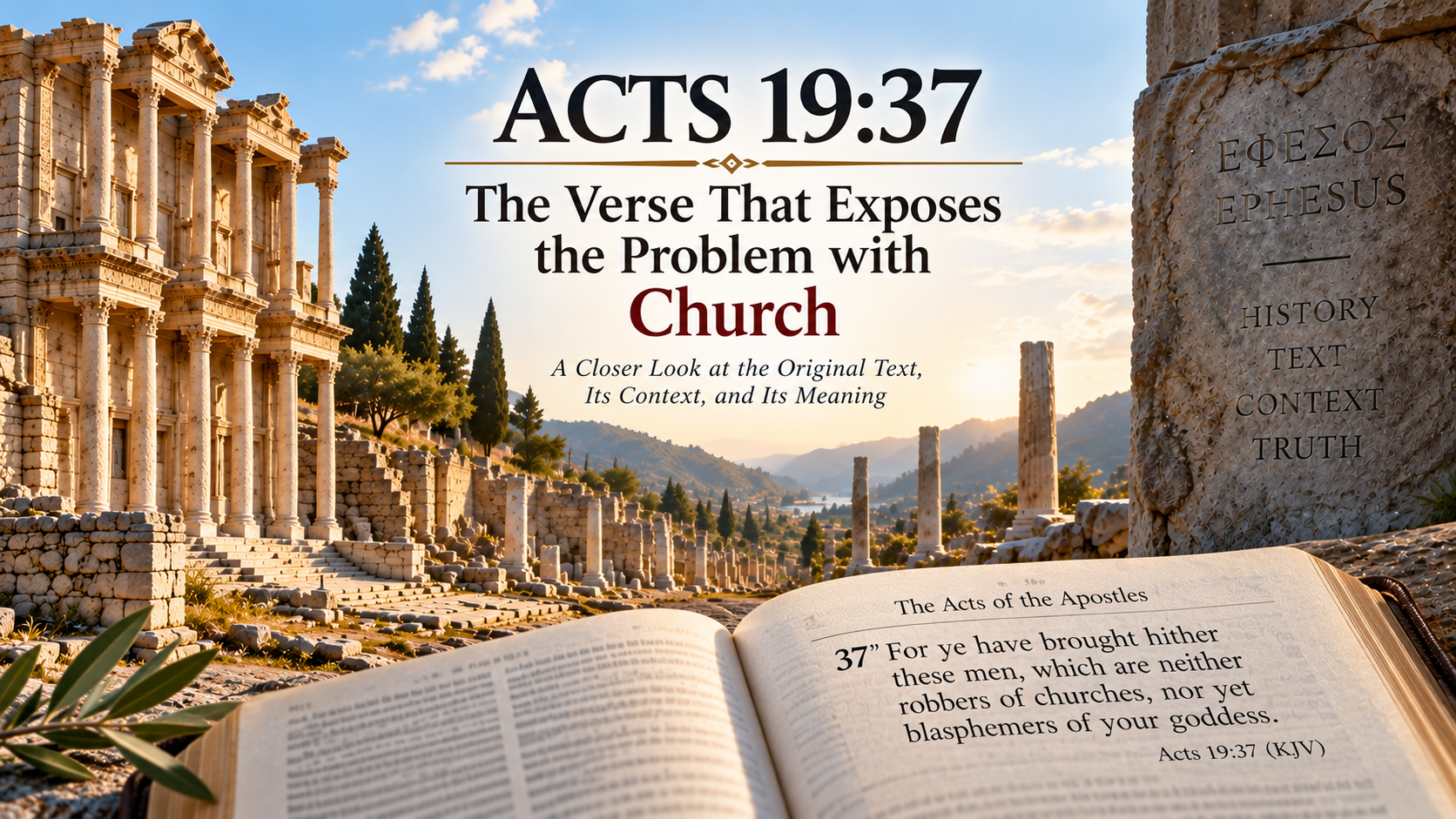
Among the hundreds of translation decisions preserved in the King James Version, one easily overlooked verse in Acts 19 provides an unusually revealing window into the English word “church.” The verse is Acts 19:37, and what makes the passage remarkable is not merely that the King James translators used the word churches, but that they used it where the underlying Greek word is not ekklēsia at all.
For readers unfamiliar with the term, ekklēsia (ἐκκλησία) is the Greek New Testament word commonly translated “church” throughout English Bibles. In its ordinary usage, however, ekklēsia speaks of an assembly or gathering of people, and the New Testament itself provides examples where the word clearly carries that sense. Over centuries of English Bible usage, the repeated translation of ekklēsia as church has made the two words appear so closely identified that many readers naturally assume that ekklēsia simply means “church.” That assumption is precisely what Acts 19 invites us to examine more carefully.
Acts 19 provides an unusually useful setting in which to make that examination because the chapter contains both the Greek word ekklēsia and the English word “churches,” but they do not occur where an English reader might expect. When Luke actually uses ekklēsia in Acts 19:32, 39, and 41, the King James Version translates it “assembly.” Yet in Acts 19:37, where the King James Version speaks of “robbers of churches,” the Greek word ekklēsia is not present at all. The underlying Greek expression concerns the robbing or desecration of temples or sacred places.
The passage therefore provides an opportunity to separate two things that centuries of English Christian usage have caused readers almost automatically to identify with one another: the English word “church” and the Greek word ekklēsia. They are not the same word, they do not share the same linguistic history, and the English word church carries meanings and associations that did not originate with ekklēsia. Acts 19 itself provides a remarkable demonstration of that distinction.
The purpose of this study is therefore not simply to object to a familiar English word, nor to insist that Christians must stop using the word church. Rather, it is to ask a more fundamental question of the biblical text: What word did the New Testament writers actually use, what did that word communicate in its first-century setting, and how closely does the English word chosen to translate it preserve that meaning? Acts 19:37 gives us an unusually revealing place to begin that investigation.
Testing the Claim Against the Text
This study maintains that ekklēsia is properly understood as “assembly.” But that conclusion should not be accepted merely because it is stated here. It should be tested against the Greek New Testament, the contexts in which ekklēsia is used, and the historical usage of the word.
The same standard should be applied to the traditional rendering “church.” If that English word, along with the institutional and theological ideas commonly associated with it, is said to accurately represent ekklēsia, that conclusion should also be demonstrated from the evidence rather than simply assumed because the translation has become familiar.
This study, therefore, does not ask the reader to accept its conclusions simply because they are stated in sections of this webpage. Rather, the reader is invited to examine the evidence and test both positions against the text. The question is not which understanding is older, more familiar, or more widely accepted today, but which one can be demonstrated from the language, context, and usage of the New Testament itself.
I. The Verse in Question
The King James Version reads:
“For ye have brought hither these men, which are neither robbers of churches, nor yet blasphemers of your goddess.”
— Acts 19:37, KJV
The setting is unmistakably pagan. Demetrius the silversmith and the craftsmen of Ephesus have stirred the city into an uproar because Paul’s preaching threatens the worship—and consequently the commercial trade—associated with the goddess Diana, or Artemis. The town clerk eventually quiets the crowd and argues that Paul’s companions have committed no offense warranting the disturbance. They are, he says, neither “robbers of churches” nor “blasphemers of your goddess.” It is the first of these expressions that presents the linguistic problem examined in this article.
II. “Churches” in Acts 19:37 Does Not Translate Ekklēsia
There is a critical distinction in Acts 19:37 that must not be overlooked. When the King James Version says that Paul’s companions were not “robbers of churches,” the word churches does not translate ekklēsia. In fact, ekklēsia does not occur anywhere in that expression.
The underlying Greek is ἱεροσύλους (hierosylous), the accusative plural form of ἱερόσυλος (hierosylos), carrying the sense of those guilty of sacrilege or temple robbers. The word is formed from vocabulary associated with ἱερόν (hieron), a temple or sacred place, and συλάω (sylaō), involving robbing or plundering. The natural meaning therefore concerns the plundering or desecration of sacred places or temples; it does not describe an assembly of people.
This makes the KJV wording extraordinarily revealing. The Greek expression concerns temple robbers, yet the KJV renders it “robbers of churches,” and the sacred places involved in the context are certainly not Christian meeting places. The entire disturbance concerns the pagan worship of Artemis. The KJV translators were therefore willing to employ the English word “churches” in connection with pagan sacred buildings or temples. That observation becomes particularly important when the same English word is used elsewhere to represent an entirely different Greek word—ekklēsia.
III. Acts 19 Supplies Its Own Control Test
We do not even have to leave Acts chapter 19 to demonstrate the distinction because the word ekklēsia actually occurs elsewhere in the same narrative. Acts 19:32 says, “Some therefore cried one thing, and some another: for the assembly was confused...” Acts 19:39 says, “But if ye enquire any thing concerning other matters, it shall be determined in a lawful assembly.” Finally, Acts 19:41 concludes, “And when he had thus spoken, he dismissed the assembly.”
In all three places the KJV translators rendered ekklēsia with the English word “assembly.” This produces an unusually useful comparison within a single chapter. In Acts 19:32, 39, and 41, ekklēsia refers to people assembled together, and the KJV translates the word “assembly.” In Acts 19:37, however, the KJV uses “churches” even though ekklēsia is not present; the underlying Greek concerns temple robbery.
The reader therefore does not need an elaborate etymological argument merely to establish that the English word church and the Greek word ekklēsia are not simply the same word. The KJV itself demonstrates the distinction within Acts 19. Where Luke actually uses ekklēsia for the Ephesian gathering, the translators were perfectly capable of rendering it “assembly.” Where the translators used “churches” in verse 37, ekklēsia is absent altogether.
IV. The Thirty-Seven Occurrences of “Churches”
There is also an interesting numerical curiosity worth noting, provided that it is not made to carry more weight than the textual evidence permits. The plural English word “churches” occurs 37 times in the KJV New Testament, and among those occurrences stands Acts 19:37, the exceptional passage in which “churches” does not represent ekklēsia.
Thus the number 37 unexpectedly appears in two places: there are 37 KJV occurrences of “churches,” and Acts 19:37 is the unusual verse that forces us to stop and ask what the English word actually represents in the underlying Greek. The numerical correspondence proves nothing by itself, particularly because chapter and verse numbering is not part of Luke’s original Greek text. It should therefore not be presented as evidence of authorial intent or as proof of the argument. Nevertheless, it is a remarkable and memorable coincidence because Acts 19:37 happens to be the verse that exposes an important distinction easily hidden from the reader who sees only the English word “churches.”
V. The One “Churches” That Is Not Ekklēsia
Acts 19:37 is exceptional among the KJV occurrences of churches because its underlying Greek vocabulary belongs to the world of sacred places and temple robbery, rather than to ekklēsia. That distinction matters because an English reader repeatedly encounters words such as church, churches, church building, and go to church in ordinary religious language and then encounters that same English word throughout an English New Testament where the Greek text contains ekklēsia. Over time, it becomes very easy to reverse the relationship and assume that ekklēsia itself means “church.”
Acts 19:37 interrupts that assumption because here the English word “churches” is being used where ekklēsia is absent altogether. The verse therefore demonstrates something fundamental about the English terminology: “church” possessed an English ecclesiastical meaning independent of ekklēsia. The translators did not derive the English word church from the Greek word ekklēsia; rather, they brought an already-existing English ecclesiastical word to the Greek text as a translation choice.
This distinction also raises another question that becomes important later in this study. If the English word church did not originate from the Greek word ekklēsia, where did it come from? The answer leads into an entirely different word history, commonly traced through Greek κυριακός (kyriakos), meaning “of the Lord” or “belonging to the Lord,” and related forms such as κυριακόν (kyriakon). That linguistic history is separate from ekklēsia and deserves examination on its own.
For the moment, Acts 19:37 establishes the point that must come first. The existence and meaning of the English word church cannot be derived simply from ekklēsia. Instead of beginning by asking what the English word church means and then reading those meanings back into ekklēsia, we should begin by asking what the Greek word ekklēsia meant in its first-century context. The meaning and usage of the original Greek word must govern our understanding of the translation rather than allowing centuries of English ecclesiastical usage to determine the meaning of the Greek.
VI. This Was Not an Accidental Translation Policy
The retention of church in the King James Version was not merely an unconscious linguistic habit. The translators worked under explicit rules governing their translation, and one of those rules required the retention of established ecclesiastical terminology. Rule Three stated that the old ecclesiastical words were to be kept and specifically gave “church” rather than “congregation” as the example.
This historical fact is enormously important because it means that when the KJV reader encounters church as the translation of ekklēsia, the English terminology cannot simply be assumed to have arisen from an unrestricted lexical decision that church was the only or inevitable English representation of the Greek word. There was an explicit translation policy requiring the established ecclesiastical terminology to remain.
None of this requires us to accuse every individual translator of dishonesty or to speculate about motives that cannot be documented. The historical point is both simpler and stronger: the translators worked under a rule requiring established ecclesiastical terminology to be preserved, and “church” was specifically named. That documented fact deserves consideration whenever the English word is presented as though it were simply the lexical meaning of ekklēsia.
VII. Translation and Ecclesiastical Interpretation Are Not the Same Thing
This brings us to the central problem. If ekklēsia describes an assembly or congregation in a particular context, while translators are instructed to retain an inherited ecclesiastical term rather than replace it with congregation, the resulting English terminology can subtly move the reader away from the concept conveyed by the Greek word and toward meanings accumulated by an English religious term.
The distinction is not insignificant. An assembly naturally directs attention toward people assembled, whereas church, by early modern English usage, could carry additional religious associations, including a religious institution, ecclesiastical body, or sacred building. Acts 19:37 provides particularly clear evidence for the sacred-place sense because the KJV could use “churches” in a passage concerning pagan temples.
Therefore, when church is subsequently presented to English readers as though it were simply what ekklēsia means, two different linguistic histories can become merged. The danger is that the accumulated meanings of the English word begin supplying concepts to the Greek word instead of the Greek word and its context controlling how the English translation is understood.
VIII. Modern Translations Correct Acts 19:37
The peculiarity becomes even clearer when Acts 19:37 is compared with later English translations. Modern translations commonly render the Greek expression with language such as “temple robbers,” “robbers of temples,” or similar expressions that communicate the underlying Greek concept more directly. Significantly, even the New King James Version abandons the KJV’s “robbers of churches” and reads “robbers of temples.”
This correction recognizes that the English expression “robbers of churches” would communicate something quite different to most modern readers in a passage concerning pagan temples. Yet it also raises a larger question. If translators recognize that church is no longer an appropriate way to communicate the temple concept in Acts 19:37, should the inherited ecclesiastical word automatically be assumed to communicate ekklēsia adequately everywhere else? Correcting Acts 19:37 solves one translation problem, but it does not settle the larger lexical question concerning what ekklēsia communicated to its first-century hearers.
IX. The Problem Is Larger Than Acts 19:37
The argument should not be misunderstood. Acts 19:37 does not, by itself, establish the complete semantic range of ekklēsia throughout the New Testament, nor does it prove that every occurrence must mechanically be translated assembly regardless of context. What it demonstrates is more limited but extremely important: the English word “church” and the Greek word ekklēsia cannot simply be treated as though they were lexically identical.
When the town clerk speaks about temple robbery in Acts 19:37, the Greek word involved is hierosylos, not ekklēsia, yet the KJV expresses the idea as “robbers of churches.” This gives us a simple but important lesson: the appearance of the English word “church” in an English Bible does not by itself mean that the Greek word underneath it is ekklēsia. Acts 19:37 demonstrates this directly.
Likewise, the fact that translators frequently used “church” to translate ekklēsia elsewhere does not, by itself, establish that church is the actual lexical meaning of ekklēsia. It establishes that “church” was the English word translators chose to use for it. A translator’s choice of an English word and the lexical meaning and contextual usage of the original Greek word are related questions, but they are not necessarily identical questions.
Acts 19 makes the distinction especially easy to see. In verses 32, 39, and 41, the Greek word ekklēsia refers to people gathered together, and the KJV translates it “assembly.” In verse 37, however, where the KJV uses “churches,” ekklēsia is not there at all; the Greek concerns temple robbery. Therefore, we should not begin with the English word “church” and assume that it defines ekklēsia. We should begin with ekklēsia and determine what that Greek word meant in its original contexts. This keeps the direction of interpretation where it belongs: from the Greek text toward the English translation, rather than from an inherited English ecclesiastical word back into the Greek text.
X. If “Church” Did Not Come From Ekklēsia, Where Did It Come From?
Once the distinction between church and ekklēsia has been established, the historical question becomes unavoidable. If the English word church is not derived from Greek ekklēsia, where did it come from, and what meanings had become associated with it before the King James translators repeatedly used it to represent ekklēsia?
The generally accepted etymological history leads in an entirely different direction. Modern English church comes through Middle and Old English forms such as chirche and cirice, belonging to a Germanic family represented by words such as German Kirche and Scots kirk. This family is commonly traced ultimately to Greek terminology built upon κυριακός (kyriakos), meaning “of the Lord” or “belonging to the Lord,” with later usage of forms such as kyriakon associated with a place or house belonging to the Lord.
The exact historical route by which the Greek-derived term entered the Germanic languages contains questions that should not be stated with greater certainty than the evidence permits. The important point for the present argument, however, is much firmer: the English word “church” is not etymologically descended from ekklēsia. The two words belong to different linguistic histories.
That distinction is important because kyriakos and ekklēsia are not two forms of the same Greek word. Kyriakos expresses the idea of something pertaining or belonging to the Lord, whereas ekklēsia refers to an assembly or gathering in its ordinary Greek usage. Whatever theological associations later became attached to either term, their lexical histories should not be collapsed into one another.
The development of church also helps explain why the English word came to carry a strong building sense. As the Germanic term developed in connection with Christian worship and places devoted to it, its semantic history followed a path quite different from that of ekklēsia. By early modern English, church could readily designate a sacred building as well as an ecclesiastical body or institution. This provides important historical background for understanding why the King James translators could write “robbers of churches” in Acts 19:37 when the underlying Greek concerned temple robbery.
Acts 19:37 therefore becomes even more revealing when viewed against this linguistic history. The translators could not have been taking the meaning “church” from ekklēsia in that verse because ekklēsia is not present there. They were using an English word that already possessed its own history and religious associations. Elsewhere, when that same English word was employed to translate ekklēsia, those preexisting English associations did not necessarily disappear simply because the underlying Greek word had changed.
The relationship therefore should not be imagined as ekklēsia naturally developing into English “church,” because that is not the etymological history. We are dealing instead with two separate linguistic histories that were eventually joined through English Bible translation: ekklēsia has its own Greek history and usage, while church developed through a different linguistic stream commonly associated ultimately with the kyriakos/kyriakon family.
Once those histories are separated, an important methodological principle emerges. We should not automatically use the later meanings of church—building, institution, denomination, or ecclesiastical organization—to define what ekklēsia meant in the first century. The direction of interpretation must remain from the original Greek text toward the translation, rather than from the accumulated history of the English word back into the Greek.
XI. Paul Knew Both Words: Ekklēsia and Kyriakon in 1 Corinthians 11
The historical relationship between the English word church and the Greek kyriakos/kyriakon word-family becomes even more significant when we return to the New Testament itself. We do not have to depend entirely upon later linguistic history to establish that ekklēsia and kyriakon represent different Greek concepts. Paul uses both words within the immediate context of 1 Corinthians 11, and he does so while discussing believers actually coming together.
Paul writes in 1 Corinthians 11:18, “For first of all, when ye come together in the church, I hear that there be divisions among you...” (KJV). The Greek expression translated “in the church” is ἐν ἐκκλησίᾳ (en ekklēsia). The context itself helps explain what is taking place: these people are coming together. Paul is addressing what happens when they assemble, rather than identifying a religious building into which they have entered.
Only two verses later Paul writes, “When ye come together therefore into one place, this is not to eat the Lord’s supper” (1 Corinthians 11:20, KJV). Here the word translated “Lord’s” is κυριακόν (kyriakon), from κυριακός (kyriakos), meaning that which pertains or belongs to the Lord. Paul therefore uses ekklēsia in verse 18 and kyriakon in verse 20 within the same immediate discussion, but he does not use the words interchangeably. Each performs its own function and communicates its own idea.
This distinction deserves careful attention because the later history of the English word church is commonly traced to the kyriakos/kyriakon linguistic family rather than to ekklēsia. Yet here, centuries before the English word church existed, Paul already knew and used both Greek word families. When he wanted to describe something as the Lord’s, he had kyriakon available and used it. When he referred to the assembly in verse 18, he used ekklēsia. The two concepts existed side by side in Paul’s vocabulary without being treated as lexical equivalents.
The surrounding passage makes the distinction even more instructive because Paul’s repeated emphasis is upon the believers coming together. In verse 17 he speaks of their coming together; in verse 18 he says, “when ye come together in the church”; in verse 20 he again says, “When ye come together therefore into one place”; in verse 33 he tells them, “when ye come together to eat, tarry one for another”; and in verse 34 he concludes with instructions concerning what should happen “when ye come together.” The repeated language establishes the setting as an actual gathering of people.
Read in that context, 1 Corinthians 11:18 can naturally be understood as describing what happens when they come together in assembly. The English wording “when ye come together in the church” can easily suggest to a modern reader that believers were coming together inside something called a church, particularly because church now commonly denotes a building or religious institution. The Greek construction does not require that picture. Paul is addressing the Corinthians in their assembled gathering—the very activity repeatedly described throughout the passage as their coming together.
This gives us an important New Testament control on the later linguistic discussion. Ekklēsia and kyriakon should not be blended simply because the English word church eventually developed through a linguistic history associated with the latter and was subsequently employed in English Bibles to translate the former. Paul knew both words and used both words, but he used them for different purposes within two verses of one another.
This does not mean that kyriakon itself meant “church” in 1 Corinthians 11:20. It plainly does not. The expression is κυριακὸν δεῖπνον (kyriakon deipnon), the “Lord’s supper.” The importance of the passage is precisely that kyriakon retains its own meaning—something pertaining or belonging to the Lord—while ekklēsia retains its separate function in the surrounding context. The later development of church must therefore be studied as subsequent linguistic history rather than read backward into Paul’s vocabulary.
First Corinthians 11 consequently adds another dimension to what Acts 19 has already shown us. Acts 19 demonstrates that the KJV could translate ekklēsia as “assembly” while also using “churches” in verse 37 where ekklēsia does not occur at all. First Corinthians 11 then takes us one step further by showing that the New Testament itself contains both ekklēsia and kyriakon in the same immediate context, with each carrying a distinct idea. Together, these passages caution us against treating the later English word church as though it were inherently contained within the meaning of ekklēsia.
The point, therefore, is not merely etymological; it is textual. Long before the English word church developed and long before English translators chose it to represent ekklēsia, Paul possessed the vocabulary necessary to distinguish an assembly from that which was the Lord’s. First Corinthians 11 preserves that distinction for us, and if our purpose is to recover the language and thought of the first-century writers, that distinction should be allowed to remain.
XII. The Institutional Question
At this point, an accusation of conspiracy is unnecessary and historically much harder to establish than the documented evidence. We have something more concrete: the KJV translators were operating within an established Church of England under royal authority, and their translation rules expressly protected established ecclesiastical terminology. The instruction concerning church was not hidden; the translators were specifically instructed to retain the old ecclesiastical word rather than replace it with congregation.
Consequently, the historical argument should rest upon documented translation policy rather than speculation about the private intentions of individual translators. We do not need to prove what every translator privately wanted or believed. The important historical question is whether the translators were instructed to preserve church rather than substitute congregation, and the surviving translation rule shows that they were.
That fact deserves serious consideration whenever church is defended as though it were simply the transparent English equivalent of ekklēsia. The existence of an explicit ecclesiastical translation rule means that the appearance of church in the KJV should be evaluated not only lexically but also historically. This does not establish that every occurrence of church was intentionally mistranslated, but it does establish that ecclesiastical continuity was one of the governing considerations placed upon the translation.
XIII. When Inherited Language Becomes Tradition
If the English word church had never developed, would Christianity be left without a biblical way of identifying God’s people or their gatherings? The New Testament suggests otherwise because its writers did not depend upon one later institutional term to describe every aspect of Christian life. They spoke of disciples, brethren, saints, believers, and those who were in Christ. Acts also repeatedly refers to the faith or movement associated with Christ as “the way” (Acts 9:2; 19:9, 23; 22:4; 24:14, 22). When an assembly was in view, the writers had the Greek word ekklēsia.
This means that if the English word church had never entered our vocabulary, nothing essential would be missing from the vocabulary of the New Testament. We could speak of an assembly where Scripture uses ekklēsia, of the Way where Acts uses that designation, and of disciples, brethren, saints, and believers where the inspired writers employ those descriptions. What would be absent is not a first-century Christian reality, but the later English ecclesiastical term that eventually gathered meanings and associations of its own.
After many centuries, church has become so deeply embedded in English-speaking Christianity and society that expecting the word simply to disappear would be unrealistic and perhaps unnecessarily disruptive. The more important task is education. Christians should understand that when they encounter church in an English translation, they are encountering a translator’s chosen English term. Where the underlying Greek is ekklēsia, the reader should be taught what ekklēsia means in its context and how the New Testament writers actually used it rather than automatically importing every later meaning of church into the text.
This distinction matters because familiarity can eventually acquire the appearance of unquestionable truth. A word repeated for centuries may sound inherently biblical simply because generations of Christians have heard it in their Bibles, preaching, institutions, and everyday speech. Yet longevity by itself does not establish lexical equivalence. The question must remain whether inherited terminology accurately communicates the language and concepts of Scripture.
Here the warning of Jesus concerning tradition provides an important principle. Speaking to the Pharisees and scribes, Jesus said, “Full well ye reject the commandment of God, that ye may keep your own tradition” (Mark 7:9, KJV), and later described them as “Making the word of God of none effect through your tradition” (Mark 7:13, KJV). The subject in Mark 7 was not the English word church, of course, and these verses should not be presented as though Jesus were prophetically addressing later English translation terminology. The principle, however, remains relevant: an inherited religious tradition must never be allowed to overrule or obscure what the text of Scripture actually communicates.
The purpose of examining church, therefore, is not merely to condemn a familiar English word or to demand that Christians suddenly stop using it. The purpose is to restore the proper order of authority. Scripture should teach us what ekklēsia means in its contexts; inherited ecclesiastical terminology should not be allowed to tell Scripture what ekklēsia must mean. Once Christians understand that distinction, they can encounter the word church in an English Bible without automatically assuming that all of its later institutional, architectural, denominational, and organizational associations originated with the apostles.
XIV. The Irony of Acts 19
There is a striking irony within Acts 19 itself. A pagan Ephesian crowd gathers, Luke calls the gathering an ekklēsia, and the KJV calls it an “assembly.” A few verses later, the town clerk discusses temple robbery. Luke does not use ekklēsia there, yet the KJV introduces the English expression “robbers of churches.”
The chapter therefore contains one of the clearest internal demonstrations of the distinction that later English usage can obscure. An ekklēsia in Acts 19 can describe an assembly of pagan Ephesians, while “churches” in the seventeenth-century KJV could be used in connection with pagan sacred places. Neither observation fits comfortably with the assumption that ekklēsia and “church” are simply lexical equivalents. What we encounter instead is an English translation tradition that must be distinguished from the Greek vocabulary itself.
This irony is especially valuable because the evidence does not depend upon imposing a later theological definition upon the text. The comparison occurs within the same chapter, in the same Ephesian narrative, and in connection with the same disturbance. The reader can see ekklēsia translated “assembly” and, only a few verses away, can see “churches” used where ekklēsia does not occur. Acts 19 therefore provides its own internal warning against assuming that the presence of the English word church tells us, by itself, what Greek word lies beneath it or what that Greek word means.
XV. The Question Acts 19:37 Forces Us to Ask
Acts 19:37 therefore deserves considerably more attention than it ordinarily receives because it forces the English reader to confront a question that centuries of familiarity with the word church can easily conceal. When we read “church” in an English New Testament, are we hearing what the first-century Greek writer actually communicated by ekklēsia, or are we also hearing centuries of meaning accumulated by the English ecclesiastical word chosen to translate it?
That question cannot be answered merely by pointing to an English Bible and saying, “The Bible says church.” The English Bible says church because translators placed that English word there; the Greek text says ekklēsia where ekklēsia actually occurs. Those two facts must not be confused, and Acts 19:37 gives us an unusually clear reason why. Here the KJV says “churches” where the Greek text does not contain ekklēsia at all, while elsewhere in the very same chapter, where the Greek actually does contain ekklēsia, the KJV says “assembly.”
First Corinthians 11 deepens the question further because Paul himself uses ekklēsia and kyriakon in close proximity while keeping their meanings distinct. The later English history that eventually connects church with the kyriakos/kyriakon family must therefore not be projected backward as though Paul himself understood ekklēsia through the later English concept of church. The English word and all the meanings it accumulated belong to a history that followed the writing of the New Testament.
This is more than a minor translation curiosity. It opens the door to the larger historical and lexical question of how an assembly of people came to be regularly represented in English by a word capable of describing a sacred building, an ecclesiastical institution, and—in Acts 19:37 itself—even pagan sacred places. Recovering that history does not require us to erase the word church from modern English. It requires us to know the difference between the English word we inherited and the Greek word the New Testament writers actually wrote.
Conclusion
Acts 19:37 does not settle every question concerning ekklēsia, but it exposes a distinction that should not be overlooked. The Greek word ekklēsia and the English word church are not lexical twins, and Acts 19 demonstrates the problem internally. ἱερόσυλος (hierosylos) concerns temple robbery, whereas ἐκκλησία (ekklēsia) describes an assembly in the Acts 19 context. Yet in the KJV the temple-related expression produced “robbers of churches,” while the actual occurrences of ekklēsia in Acts 19:32, 39, and 41 were translated “assembly.”
The history of the English word adds another layer to the distinction. Church is not etymologically descended from ekklēsia but belongs to a different linguistic history commonly traced ultimately to the Greek kyriakos/kyriakon family. First Corinthians 11 is especially instructive because Paul himself uses ekklēsia and kyriakon within two verses of one another, demonstrating that the two Greek concepts were available to him and served different purposes. Paul did not write an English word that would arise centuries later; he wrote the Greek vocabulary available to him in the first century.
The evidence therefore invites the reader to look behind inherited English ecclesiastical vocabulary and return to the language of the text itself. Instead of beginning with the question, “Where does the New Testament speak of the church?”, the more fundamental question should be, “Where does the New Testament use ekklēsia, and what did that word communicate when the New Testament writers actually used it?”
This does not require Christians to abandon every modern use of the word church. The word is deeply established in the English language and is unlikely to disappear. What is required is something more fundamental: Christians should know what they are reading. They should be able to distinguish an inherited English ecclesiastical term from the Greek word it was chosen to represent and should not allow the later meanings of the English word to become the definition of the earlier Greek word.
If Scripture is to remain the authority, the direction must always be from the text to our terminology, not from our inherited terminology back into the text. In the case of ekklēsia, that means allowing the first-century word, its context, and its actual New Testament usage to speak before centuries of tradition tell us what we are supposed to hear.
That is where the investigation must begin.