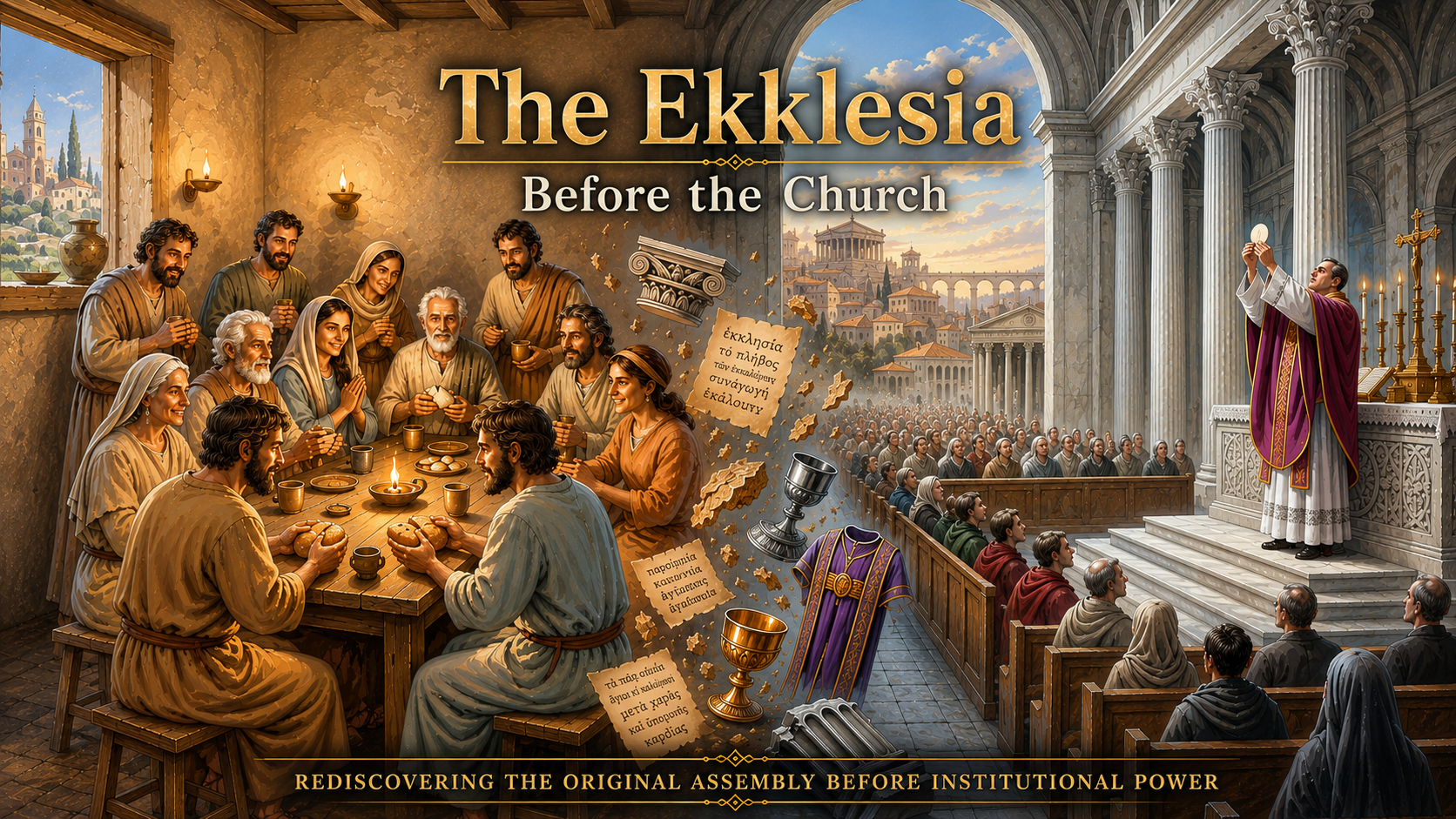
Institutional Subversion of the Apostolic Ekklesia
An Historical and Theological Analysis
Part of Ekklesia — A Closer Look series. Return to Table of Contents
Introduction
The historical trajectory of the Christian faith from the 4th century to the modern era reveals a profound and systemic departure from the apostolic standard. This transition, accelerated by the Constantinian shift, saw the transformation of an organic, spirit-led assembly of believers into a rigid, hierarchical, and sacramental institution. This historical erosion was not merely administrative; it was a fundamental shift that displaced the apostolic definition of the assembly. This paper provides a comprehensive analysis of the systemic displacement of apostolic practices, the corruption of the communal meal, the replacement of the priesthood of all believers with a professional caste, and the persistent failure of 16th-century reformers to fully restore the early apostolic foundations. By grounding this analysis in historical reality and biblical authority, the inherent contradictions between the modern “church” model and the original ekklesia are laid bare.
The Constantinian Shift and the Birth of Institutional Formalism
The integration of the assembly into the Roman state structure in the 4th century initiated an ontological transformation. Under the Edict of Milan, the faith moved from a persecuted, localized body to a tolerated, and eventually state-sponsored, religious system.
- The Adoption of Imperial Architecture: The movement abandoned its reliance on the household gathering—the oikos—in favor of repurposing pagan basilicas and constructing monumental “church” buildings. This move prioritized the structure over the living body. In the apostolic period, the ekklesia gathered in houses (Romans 16:5; Philemon 1:2); they were the people, not the place. The shift redirected the focus of devotion from the assembly to the building. This is antithetical to the apostolic understanding that believers are the living temple of God, as emphasized in 1 Corinthians 3:16 and 6:19.
- Hierarchical Consolidation: Modeling the faith after the Roman civil service, a professional, multi-tiered clergy was established. Historical sources, such as Eusebius of Caesarea, reflect the celebration of this marriage between Church and State, which effectively shattered the organic identity of the body. This created a vertical, patriarchal power structure that superseded the explicit instruction of Christ in Matthew 23:8–10: “But be not ye called Rabbi: for one is your Master, even Christ; and all ye are brethren.” By creating an office-based hierarchy, the leadership replaced the organic functioning of the Spirit through the gifts of all members (1 Corinthians 12).
The Corruption of the Lord’s Supper
The most significant degradation of apostolic practice occurred regarding the communal meal. Originally, the Lord’s Supper was not a ritual, but a substantial, full meal—a “breaking of bread” that provided physical and social sustenance (Acts 2:42).
- From Meal to Ritual: The post-Constantinian period transformed this communal act into a liturgical performance. Historical shifts noted in the writings of Cyprian and later codified by institutional authorities demonstrate a move toward “sacramental” theology. The introduction of the wafer and the small thimble of juice served as a theological instrument to separate the “sacred” from the “profane.” By formalizing this into a rite administered only by a priestly caste, the institutional church effectively killed the horizontal nature of the gathering.
- Loss of Horizontal Oversight: In the early apostolic model, the meal functioned as a mechanism for material care and economic scrutiny within the assembly. 1 Corinthians 11:20–22 reveals the assembly’s failure to wait for one another at the meal, a problem that existed precisely because it was an actual, full meal involving the physical needs of the poor. By ritualizing the act into a tiny token, the institutional church lost its primary safeguard for the destitute, effectively severing the “body” connection meant to be represented by communal eating.
The Abandonment of the Priesthood of All Believers
The apostolic model thrived on the functional operation of the body, where every individual exercised specific spiritual gifts for the edification of the whole. The institutional era replaced this with a caste-like priesthood, mimicking the Old Covenant Levites rather than the New Covenant priesthood of all believers described in 1 Peter 2:9.
- The Rise of Clericalism: By relegating the body of believers to passive observers, the institution localized spiritual authority in a single office. This structural change undermined the individual believer’s direct access to the Spirit, creating a dependency on human mediation that the New Covenant explicitly sought to dismantle.
- Centralized Control vs. Localized Autonomy: In the first century, assemblies functioned autonomously, maintaining doctrinal purity without the need for a global, centralized authority. As seen in the letters to the seven assemblies in Revelation 1-3, each assembly was held individually responsible for its doctrine and practice. The later solidification of a top-down, centralized hierarchy facilitated state control, allowing political interests to dictate the character of the faith.
The Incomplete Restoration of the Reformation
While the 16th-century reformers challenged the legitimacy of the Roman papacy, they largely failed to dismantle the underlying institutional paradigm.
- Persistence of the Clergy-Laity Divide: Most reformist movements retained the distinction between the “ordained” and the “lay,” effectively maintaining the bureaucratic structure inherited from Rome.
- The “Church” as Institution: The term ‘church’ remained synonymous with buildings and state-aligned institutions. By failing to revert to the ekklesia—the actual called-out assembly of people—these movements preserved the Constantinian vestige of a faith bound to the state or its own rigid, steeple-house structure.
- The Missing Remnant: The original understanding of the faith as a “remnant”—a distinct body of believers walking the narrow way—was largely abandoned for the concept of a state-church that included all inhabitants of a territory. This inclusivity, while socially stable, decimated the integrity of the witness required of a set-apart people. The biblical precedent for a remnant, found in Romans 11:5, was sacrificed for the political reality of a “universal” institution, a coupling that has no basis in the Greek scriptures.
Conclusion
The historical shift from the apostolic model to the institutional church was a calculated consolidation of power enabled by the adoption of pagan administrative and legalistic models. The loss of the communal meal, the replacement of the priesthood of all believers with a centralized hierarchy, and the reliance on physical structures have obscured the radical, horizontal nature of Christ’s ekklesia. Even the Reformation failed to purge the influence of this Constantinian corruption, leaving the modern believer with an institutional framework that stands in stark opposition to the apostolic simplicity of the early gatherings. A true restoration requires returning to the autonomy of the living body, governed by the Spirit, and liberated from the political and administrative structures of the world. The evidence is clear: the modern church acts more as a product of 4th-century political convenience than as the original, organic movement of the first century.