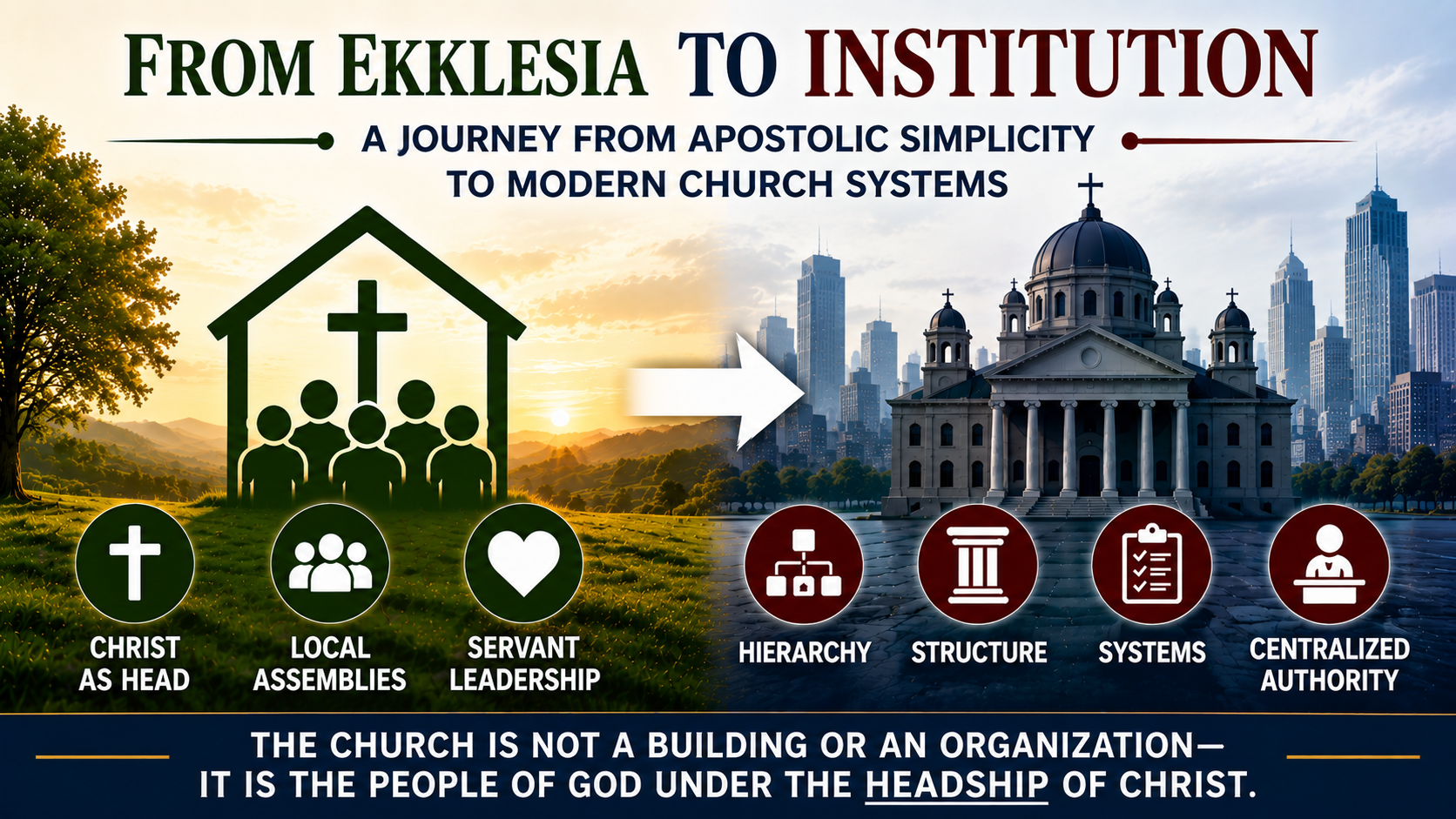
An Historical Journey of Ekklesia &
The Evolution of Church Structure
Part of Ekklesia — A Closer Look series. Return to Table of Contents
Introduction
One of the most significant questions in the study of early Christianity is whether the structure and practice of the modern church reflect the pattern established by Christ and His apostles. The New Testament presents a relatively simple picture of believers gathering together as an ekklesia—an assembly or congregation of saints under the headship of Christ. Leadership existed, but it was primarily local, pastoral, and plural in nature. Christ alone was recognized as the supreme Head of His people.
Yet as one surveys the history of Christianity from the first century to the present, a dramatic transformation becomes evident. The simple assemblies described in the New Testament gradually developed into increasingly organized institutions governed by bishops, councils, patriarchs, and eventually the bishop of Rome. Over the centuries, structures emerged that were largely unknown during the apostolic era. The Protestant Reformation corrected many doctrinal errors but left much of the institutional framework intact.
This raises an important question: How did Christianity move from the apostolic model of the ekklesia to the highly structured institutional systems that dominate much of Christianity today?
To answer that question, it is necessary to examine not only the history of church leadership, but also the evolution of the words used to describe God's people, the gradual development of ecclesiastical authority, and the relationship between the New Testament pattern and the structures that emerged in later centuries.
The Apostolic Pattern of the Ekklesia
The word used throughout the New Testament for the people of God is the Greek term ekklesia. Long before the New Testament was written, the Septuagint (Greek Old Testament) used ekklesia to translate the Hebrew word qahal, referring to the assembly or congregation of Israel gathered before God.
Thus, when the apostles employed the word ekklesia, they were not inventing a new religious term. They were drawing upon an established biblical concept that emphasized God's gathered people rather than an institution, organization, or building.
Whether referring to the assembly at Corinth, Ephesus, Thessalonica, or elsewhere, the emphasis was consistently upon people rather than structures. Several characteristics repeatedly appear throughout the New Testament record:
- Christ is the sole Head of the ekklesia.
- Assemblies are local and identifiable.
- Leadership is shared among multiple elders.
- Overseers function as shepherds rather than rulers.
- Believers actively participate in congregational life.
- No centralized earthly headquarters exists.
- No universal hierarchy is described.
The apostles never present the church as a worldwide institution governed through successive layers of ecclesiastical authority. Instead, the New Testament portrays local congregations united by a common faith in Christ and guided by the Holy Spirit.
When Paul called for the elders of Ephesus in Acts 20:17, those same men were later described as overseers in Acts 20:28. Likewise, Titus 1:5-7 moves naturally from elders to bishops, suggesting that the terms described the same office viewed from different perspectives.
The Greek word translated "bishop" is episkopos, meaning overseer. The word translated "elder" is presbyteros. In the apostolic writings these terms are frequently interconnected, and no distinction appears that would suggest the later development of a separate ruling bishop over multiple congregations.
The overall picture is one of servant leadership operating within local congregations under the authority of Christ.
Scripture and the Apostolic Framework
Any discussion concerning church structure must ultimately return to Scripture. Historical developments may be informative, but the New Testament remains the foundational source for understanding how Christ and His apostles organized the assemblies.
The New Testament repeatedly presents leadership as plural rather than singular.
Acts 14:23 records elders being appointed in every church. Titus 1:5 instructs Titus to ordain elders in every city. Acts 20:17 identifies the elders of Ephesus, while Acts 20:28 describes those same men as overseers.
This pattern appears consistently throughout the apostolic writings, where Christ is likewise presented as the sole Head of His people.
Ephesians 1:22-23 states:
"And hath put all things under his feet, and gave him to be the head over all things to the church, Which is his body, the fulness of him that filleth all in all."
Similarly, Colossians 1:18 declares:
"And he is the head of the body, the church."
No apostle, bishop, council, or ecclesiastical office is ever assigned the role of universal headship over the people of God. Leadership is described in servant terms rather than ruling terms. Peter exhorted elders:
"Feed the flock of God which is among you, taking the oversight thereof, not by constraint, but willingly; not for filthy lucre, but of a ready mind; Neither as being lords over God's heritage, but being ensamples to the flock." (1 Peter 5:2-3)
The Lord Jesus Himself warned against adopting the authority structures common among earthly rulers:
"Ye know that the princes of the Gentiles exercise dominion over them, and they that are great exercise authority upon them. But it shall not be so among you." (Matthew 20:25-26)
Believers were also expected to participate actively in congregational life. Paul wrote:
"How is it then, brethren? when ye come together, every one of you hath a psalm, hath a doctrine, hath a tongue, hath a revelation, hath an interpretation." (1 Corinthians 14:26)
The apostolic model emphasizes participation, mutual edification, servant leadership, and submission to Christ rather than dependence upon a centralized institutional structure. The overall picture is one of active assemblies under Christ's authority rather than a hierarchical organization governed through multiple levels of ecclesiastical administration.
From Ekklesia to Ecclesia
As Christianity spread throughout the Roman Empire, Greek gradually gave way to Latin in the western regions. The Greek word ekklesia became the Latin ecclesia. Initially, this represented a simple translation rather than a theological shift. Both words referred primarily to the gathered people of God.
During the apostolic period and immediately thereafter, the emphasis remained upon the congregation itself. The church was understood as a people called together by God rather than an institution existing above those people. However, language often shapes thought, and thought eventually shapes institutions.
As ecclesiastical structures became more formalized, the term ecclesia increasingly became associated with the governing organization as much as the gathered assembly. The focus slowly shifted from the congregation itself toward the leadership structures that governed the congregation. The transition was gradual rather than sudden, but it would prove significant in later centuries. Over time, the idea of the church increasingly became connected with:
- Official leadership.
- Ecclesiastical authority.
- Recognized structures.
- Institutional continuity.
The farther Christianity moved from its apostolic roots, the more the concept of the church became associated with an organized system rather than simply a gathering of believers.
From Ekklesia to Church: The Evolution of a Word
One of the most overlooked aspects of church history is the evolution of the very word used to describe God's people. The New Testament writers consistently used the Greek word ekklesia. The Latin-speaking world later rendered the word as ecclesia. Neither of these words originally meant a church building, denomination, or ecclesiastical institution.
The English word church followed an entirely different linguistic path. Rather than descending directly from ekklesia, it developed through the Germanic language family from a word associated with the Greek adjective kyriakos, meaning "belonging to the Lord." The progression is generally understood as:
- Kyriakos (Greek)
- Kirche (German)
- Cirice/Cyrice (Old English)
- Church (Modern English)
This distinction is important because the English-speaking reader often assumes that "church" is simply the English equivalent of ekklesia. While it functions as the accepted translation, the two words arrived through different historical routes. As centuries passed, the English word church became increasingly associated with:
- Buildings
- Religious institutions
- Denominations
- Clerical systems
- Ecclesiastical authority
Consequently, many modern readers unconsciously import later institutional ideas into New Testament passages that originally referred to assemblies of believers. The issue is not merely linguistic. Language influences perception.
When modern readers encounter the word "church," they often envision an organization, a building, or a denomination. The apostles, however, were speaking of congregations of believers gathered under Christ. Understanding this distinction helps illuminate how later institutional concepts became attached to biblical terminology.
The Rise of the Bishop
During the late first and early second centuries, significant changes began to emerge. While the apostles were alive, they exercised unique authority as eyewitnesses of Christ and divinely commissioned messengers. Once the apostolic generation passed from the scene, churches faced the challenge of maintaining unity, preserving doctrine, and resisting false teaching without the direct oversight of the apostles.
Gradually, many assemblies moved toward a structure in which a single bishop presided over the congregation while elders functioned beneath him. This represented an important development. The New Testament commonly presents a plurality of elders within a congregation. However, by the early second century, evidence increasingly appears for a single bishop overseeing the church within a city.
The bishop became the central figure of authority, while elders and deacons served under his leadership. Several factors likely contributed to this development:
- Concerns about false teachers.
- Desire for doctrinal stability.
- Need for organizational unity.
- Growth of congregations beyond their earliest size.
Although understandable from a practical standpoint, this development marked a significant shift from the simpler pattern commonly observed in the New Testament. Instead of:
- A plurality of elders overseeing a congregation,
the pattern increasingly became:
- One bishop presiding over elders and deacons.
Over time, bishops became the primary symbols of unity within their communities. This shift laid the foundation for further developments that would eventually reshape the structure of Christianity itself.
Early Witnesses to the Growth of Episcopal Authority
The writings of early Christian leaders provide valuable insight into how church leadership developed after the apostolic era. These sources are important because they allow us to observe the progression from the New Testament pattern to the increasingly structured forms of leadership that emerged in subsequent generations.
Among the most frequently cited examples are the letters of Ignatius of Antioch, written around AD 110. Throughout his correspondence, Ignatius repeatedly emphasized unity under a bishop and encouraged believers to remain closely connected to episcopal leadership.
While the New Testament stresses submission to Christ, mutual accountability among elders, and servant leadership, Ignatius increasingly identified congregational unity with obedience to a single bishop. His writings reflect a stage of development that appears beyond the simple elder-overseer framework commonly found in the apostolic writings.
As the second and third centuries progressed, this trend continued. By the time of Cyprian of Carthage in the third century, episcopal authority had become even more prominent. Cyprian strongly emphasized the visible unity of the church through its bishops and viewed separation from episcopal authority as a serious matter.
These writings do not prove that the apostles established such a system, but they do demonstrate that the movement toward centralized leadership was already underway shortly after the apostolic age.
Whether one views this development as beneficial or problematic, the historical evidence demonstrates that church leadership structures were evolving beyond what is explicitly described in the New Testament.
The Emergence of the “Catholic” Concept
As leadership structures developed, so did the language used to describe the church. Around the early second century, the phrase katholikē ekklesia began to appear. The Greek adjective katholikē means:
- Universal
- General
- According to the whole
Originally, the term functioned simply as a description rather than a title. It distinguished the whole body of believers from isolated sects or groups that had separated themselves from the wider Christian community.
In its earliest usage, the phrase essentially conveyed the idea of the universal assembly of believers. This is an important distinction. The phrase did not originally describe a worldwide institution governed by bishops. Rather, it described the entirety of Christ's people wherever they were found. However, over time the adjective gradually evolved into something more than a simple description. What began as:
- A universal assembly of believers
slowly became:
- A visible institution claiming universal authority.
The progression may be summarized as:
- Ekklesia (Assembly)
- Ecclesia (Latin Assembly)
- Katholikē Ekklesia (Universal Assembly)
- Catholic Church (Institutional Title)
As authority became increasingly centralized, the concept of a visible universal church became easier to define organizationally. Unity was no longer understood solely in terms of common faith in Christ.
Increasingly, unity became associated with participation in recognized ecclesiastical structures and submission to recognized church leaders. The further this process advanced, the more the church became identified with its organizational framework.
The Alliance of Church and Empire
A major turning point occurred during the fourth century.
Prior to Constantine, Christianity existed largely as a persecuted movement scattered throughout the Roman Empire. Although leadership structures had already begun to develop, the church remained largely independent of state power. That changed dramatically after Constantine legalized Christianity.
The church suddenly found itself operating with imperial favor rather than imperial opposition. Several developments accelerated institutionalization:
- Church councils gained governmental support.
- Bishops received civil recognition.
- Major cities acquired ecclesiastical prominence.
- Regional authority structures expanded.
- Political influence became intertwined with church leadership.
This relationship between church and empire fundamentally altered the trajectory of Christian organization. What had once been a network of assemblies became an increasingly organized institution with regional and eventually international authority. The church was no longer merely gathering within the empire. It was becoming one of the empire's most influential institutions.
As Christianity became integrated into the administrative machinery of Roman society, the church naturally adopted many of the organizational features that characterized the empire itself. The result was increasing centralization, increasing bureaucracy, and increasing layers of authority.
A Timeline of Institutional Development
The transformation from apostolic assemblies to modern church systems occurred gradually over many centuries.
First Century (30–100 AD)
- Apostolic leadership
- Local assemblies
- Plurality of elders
- Christ recognized as the sole Head
Second Century (100–200 AD)
- Rise of the monarchical bishop
- Increasing emphasis on episcopal authority
- Growing distinction between bishop and elder
Third Century (200–300 AD)
- Regional influence of bishops expands
- Ecclesiastical authority becomes more centralized
- Appeals increasingly directed to prominent bishoprics
Fourth Century (300–400 AD)
- Constantine legalizes Christianity
- Council of Nicaea convened
- Church and state become closely connected
- Institutional structures rapidly expand
Fifth Through Tenth Centuries
- Patriarchal systems develop
- Papal authority grows
- Ecclesiastical hierarchy becomes firmly established
Eleventh Through Fifteenth Centuries
- Papal monarchy reaches its height
- Ecclesiastical courts expand
- Institutional authority becomes deeply entrenched
- The distinction between clergy and laity becomes increasingly pronounced
Sixteenth Century
- Protestant Reformation challenges Rome's doctrine
- Papal authority rejected by many
- Institutional structures largely retained
Modern Era
- Denominational Christianity expands
- Corporate church models emerge
- Institutional frameworks dominate much of Christianity
This timeline illustrates that institutionalization was not the result of a single event but a progressive historical process spanning many centuries.
The Development of Ecclesiastical Hierarchy
As centuries passed, church leadership became increasingly stratified. What began as local overseers gradually developed into a hierarchy that included:
- Bishop
- Archbishop
- Metropolitan
- Patriarch
- Pope
Each level represented an additional layer of authority beyond the local congregation. The simple oversight of local assemblies evolved into a complex administrative system stretching across regions, nations, and eventually continents.
As this structure expanded, the authority of the institution increasingly became identified with the authority of the church itself. Submission to ecclesiastical structures was often viewed as synonymous with submission to Christ. The distinction between the people of God and the governing institution became increasingly blurred. This represented one of the most significant developments in the history of Christianity.
In the apostolic writings, believers are repeatedly directed to Christ as their Head. In later centuries, ecclesiastical structures increasingly functioned as mediating authorities through which church unity and legitimacy were defined. The center of gravity gradually shifted:
- From assemblies to institutions.
- From congregations to hierarchies.
- From local oversight to centralized administration.
While these developments were often defended as necessary for maintaining unity and doctrinal stability, they nevertheless marked a substantial departure from the comparatively simple framework visible in the New Testament.
The Expansion of Clergy and Laity Distinctions
Closely connected to the rise of hierarchy was the increasing distinction between clergy and laity. The New Testament certainly recognizes leadership offices and spiritual responsibilities. Elders, overseers, and deacons all fulfilled important functions within the assemblies.
Yet the apostolic writings consistently emphasize the priesthood of all believers and the active participation of the entire congregation. Over time, however, leadership became increasingly professionalized. A clearer separation emerged between:
- Those who administered religious affairs.
- Those who received religious instruction.
This distinction gradually became institutionalized. The result was the emergence of a religious class that functioned in many ways differently from the ordinary believer. While intended to provide order and stability, this development further contributed to the growing distance between the apostolic assembly model and the institutional structures that emerged in later centuries.
The Consolidation of Authority
By the medieval period, the cumulative effect of these developments had produced a church structure far removed from the local assemblies described in the New Testament. Authority increasingly flowed downward through layers of hierarchy.
Doctrine, discipline, governance, and ecclesiastical decisions were often determined by higher authorities rather than local congregations. The church had become:
- Administrative.
- Hierarchical.
- Institutional.
- Centralized.
This system provided stability and organizational cohesion across vast geographical regions. At the same time, it represented the culmination of a process that had begun centuries earlier with the elevation of the bishop and the gradual expansion of ecclesiastical authority.
The stage was now set for the tensions that would eventually erupt during the Protestant Reformation.
Comparing the Apostolic and Institutional Models
Having traced the historical development from the apostolic assemblies to the increasingly structured institutions of later centuries, it becomes possible to compare the New Testament pattern with the ecclesiastical systems that eventually emerged.
The purpose of this comparison is not to suggest that every development was inherently evil or that sincere believers did not exist within later church structures. Rather, it is to examine whether the framework that developed over time reflects the same model established by Christ and His apostles.
Apostolic Pattern
- Christ as the sole Head.
- Plurality of elders within local assemblies.
- Local congregational oversight.
- House assemblies commonly used.
- Shared participation among believers.
- Leadership characterized by service.
- Authority rooted in apostolic doctrine.
- Spiritual unity through faith in Christ.
Institutional Pattern
- Hierarchical leadership structures.
- Single bishop over multiple congregations.
- Regional and national authority systems.
- Administrative layers.
- Clergy-centered ministry.
- Institutional governance.
- Authority increasingly vested in offices.
- Visible unity through organizational structures.
One of the most noticeable differences is where authority is located. In the apostolic writings, authority is ultimately rooted in Christ and exercised through His Word. Elders shepherd local congregations, but Christ remains the supreme Head of His people.
In later institutional systems, authority increasingly became associated with offices, councils, hierarchies, and ecclesiastical structures. The center of gravity gradually shifted:
- From Christ's direct headship to institutional administration.
- From local congregations to regional authorities.
- From assemblies of believers to organized systems.
Whether one views this shift as necessary development or significant departure depends largely upon one's understanding of ecclesiology. Nevertheless, the differences between the apostolic framework and later institutional structures are difficult to ignore.
Reformation or Partial Restoration?
The Protestant Reformation stands as one of the most significant events in church history. Men such as Martin Luther, John Calvin, Ulrich Zwingli, and others challenged doctrines and practices that they believed had departed from the authority of Scripture. Among the issues they addressed were:
- Papal supremacy.
- Indulgences.
- Salvation by works.
- Sacramental abuses.
- Traditions elevated above Scripture.
- Restrictions on access to the Bible.
These reforms were substantial and historically significant. The Reformers restored the principle of Sola Scriptura, emphasizing that Scripture rather than ecclesiastical tradition must serve as the final authority for Christian faith and practice. Yet an important question remains. Did the Reformation fully restore the apostolic model of the ekklesia?
Many historians would answer that it did not. Although Rome's authority was challenged, many institutional structures remained largely intact. The Reformers generally retained:
- Professional clergy systems.
- Formal church offices.
- Ecclesiastical administration.
- State-church relationships in many regions.
- Denominational structures.
The primary focus of the Reformation was doctrinal correction rather than complete ecclesiological reconstruction. In other words, the Reformers addressed many of the theological consequences of institutionalization without necessarily dismantling the institutional framework itself. For this reason, some later movements concluded that the Reformation was only a partial restoration.
Groups such as the Anabaptists, later Congregationalists, various Brethren movements, and other restorationist groups argued that a more complete return to the apostolic pattern was still needed. Their concern was not merely what Christians believed, but how believers gathered, functioned, and related to one another as the people of God.
From this perspective, the Reformation corrected many errors but did not fully recover the simplicity of the New Testament assembly.
The Modern Institutional Church
The twenty-first century church landscape reflects nearly two thousand years of historical development. Many modern churches operate through structures that include:
- Corporate charters.
- Denominational headquarters.
- Executive leadership systems.
- Professional clergy.
- Administrative organizations.
- Extensive property ownership.
- Multi-layered governance.
These structures vary widely across denominations, yet most share characteristics that differ significantly from the local assemblies described in the New Testament. Modern Christians commonly identify the church with:
- A denomination.
- A corporation.
- A building.
- A ministry organization.
- A religious institution.
By contrast, the New Testament consistently identifies the church with people. The apostolic assemblies were generally characterized by:
- Simplicity.
- Local accountability.
- Shared leadership.
- Congregational participation.
- Dependence upon Christ as Head.
Modern institutions often emphasize:
- Organizational efficiency.
- Administrative structure.
- Professional leadership.
- Programmatic ministry.
- Institutional continuity.
To be clear, none of these features automatically prove that a church is faithful or unfaithful. The issue is not whether modern churches use buildings, technology, salaries, or organizational tools. The issue is whether the structure itself has become so dominant that it obscures the simplicity and spiritual reality of the ekklesia described in Scripture.
The danger is not merely institutionalization. The danger is allowing the institution to become the focus rather than Christ. When believers begin to identify the church primarily as an organization rather than as the people of God, the language and priorities of the New Testament can become increasingly difficult to recognize.
The Continuing Influence of Tradition
One of the most powerful forces in church history has been tradition. Traditions are not inherently wrong. Every generation inherits certain practices from those who came before. The problem arises when inherited traditions become accepted without careful examination.
Jesus repeatedly challenged religious leaders who elevated tradition above the Word of God. He warned:
"Making the word of God of none effect through your tradition." (Mark 7:13)
The Bereans provide the opposite example.
"These were more noble than those in Thessalonica, in that they received the word with all readiness of mind, and searched the scriptures daily, whether those things were so." Acts 17:11
The question facing modern believers is the same question faced by believers throughout history: Are our practices rooted in Scripture, or are they rooted primarily in traditions that developed after the apostolic age? This question is not limited to any one denomination or movement.
Every Christian tradition must ultimately be examined in light of Scripture. The issue is not age, popularity, or acceptance. The issue is biblical fidelity.
A Berean Challenge for the Modern Reader
The purpose of examining these historical developments is not to attack sincere Christians or question the faith of believers who gather within institutional churches. Many faithful followers of Christ have lived, served, suffered, and died within a wide variety of church structures.
The purpose of this study is not condemnation but examination. The Bereans were commended because they searched the Scriptures daily to determine whether what they were being taught was true. Their example remains relevant today. Every generation of believers faces the same responsibility:
- To distinguish Scripture from tradition.
- To distinguish apostolic practice from later developments.
- To evaluate church structures in light of the New Testament.
- To ensure that Christ remains the true Head of His people.
- To test every doctrine and practice against the Word of God.
The ultimate question is not whether a particular structure is ancient, popular, successful, or widely accepted. The ultimate question is whether it reflects the pattern and principles revealed by Christ and His apostles. If the New Testament provides the divinely inspired foundation of the ekklesia, then every subsequent development should be measured against that standard.
Visual Summary
The video player provided below features a representation of ekklesia to institution. This visual summary of the concepts discussed may assist in solidifying the main ideas before the final closing statements. Horizontal viewing is recommended on mobile phone devices.
~ Ekklesia to Institutional Church ~

Conclusion
The journey from the apostolic ekklesia to the modern institutional church was not the result of a single event but of a gradual historical process spanning many centuries. The rise of the bishop, the development of ecclesiastical hierarchy, the emergence of the concept of a universal church, the alliance with imperial power, and the increasing centralization of authority all contributed to a transformation of Christian organization.
The New Testament presents a model centered upon Christ as the Head of a gathered people led by servant overseers within local assemblies. Leadership existed, but it functioned within a framework characterized by plurality, participation, and direct accountability to Christ. Over time, that model evolved into increasingly complex institutional systems that eventually shaped much of global Christianity.
The transformation occurred gradually. Each generation inherited structures from the generation before it. What may have begun as practical measures intended to preserve unity and order eventually became permanent features of Christian organization. The Protestant Reformation corrected many doctrinal departures and restored essential biblical truths. Yet much of the institutional framework that had developed during the preceding centuries remained largely intact. As a result, many of the organizational features present in Christianity today are products of historical development rather than explicit apostolic instruction.
This reality does not diminish the sincerity of countless believers who have worshipped Christ throughout church history. Nor does it suggest that God's people have been absent from institutional churches. Rather, it highlights the continuing responsibility of every generation to compare its beliefs and practices with the Scriptures.
The central issue is not whether a structure is old or new, traditional or modern. The central issue is whether the church remains aligned with the pattern established by Christ and His apostles under the inspiration of the Holy Spirit. If the New Testament provides the divinely inspired foundation of the ekklesia, then every subsequent development should be measured against that standard.
The challenge before believers today is the same challenge faced by the Bereans: to examine all things carefully, hold fast to what is true, and continually seek conformity to the Word of God above the traditions of men.
For nearly two thousand years, Christianity has experienced growth, controversy, reform, division, and institutional development. Yet the question remains unchanged:
Has the modern church retained the apostolic framework revealed in Scripture, or has the framework itself become one of the traditions that must be reexamined in the light of God's Word? That question is not answered by councils, denominations, traditions, or institutions. It can only be answered by returning to the Scriptures and allowing the inspired testimony of Christ and His apostles to remain the final authority.