The Historical Transition of The
Lord's Supper
Part of Ekklesia — A Closer Look series. Return to Table of Contents
What began as a simple, vibrant assembly of called-out believers gathered in homes for a shared meal has, over the centuries, become an institution that in many ways resembles the very structures the New Testament sought to transcend. The words translated as church carry DNA from a post-apostolic mutation that began in the second century and was never fully reversed, even by the Reformation. This article traces that drift and shows how it created the theological conditions that made modern futurist premillennial frameworks thinkable.
The argument unfolds in six movements. We begin with the apostolic ekklesia as the New Testament actually describes it, an assembly without sacred buildings, without a sacerdotal priesthood, with Jew and Gentile united as one new man. We then trace the gradual mutation of that assembly through the second to fourth centuries: the rise of the monarchical bishop, the Hellenization of thought, the Constantinian catastrophe, and the resulting institutional church. A brief look at historic premillennialism, the early chiliast view, shows that premillennial belief need not require the radical Israel-Church distinction that later systems imposed.
We then examine the Reformation's half-finished work: what it recovered in soteriology, and what it failed to recover in ecclesiology. A case study in the Lord's Supper illustrates how partial reform left the original apostolic pattern largely unrestored. With that foundation laid, we turn to futurist premillennial frameworks: what they teach, where their internal tensions lie, and how the inherited institutional church made their entire architecture possible. The conclusion calls for a recovery of the ekklesia, the called-out assembly that Christ promised to build.
Approaching these writings with an open mind is essential, recognizing that the only final authority is the Word of God. With that foundation established, the following perspectives outline the nature and function of these frameworks as they developed historically.
Return to the Study OverviewTable of Contents
?? Click Image to Enlarge | Click Section to Expand Sub-Sections
-
 ›
›Section One
The Apostolic Ekklesia — What the New Testament Actually Describes
The Greek ekklesia meant a called-out assembly, not an institution. We examine the New Testament baseline before any drift occurred.
-
 ›
›Section Two
The Gradual Mutation — Second Through Fourth Century Developments
From Ignatius to Augustine, the ekklesia was transformed into an institution with sacred buildings, a clerical hierarchy, and state entanglement.
-
 ›
›Section Three
Historic Premillennialism — The Early Chiliast View
From Papias to Lactantius, the early chiliasts held a premillennial view that did not require dividing Israel from the Church or rapture the ekklesia.
-
 ›
›Section Four
The Reformation's Half-Finished Work
Luther and Calvin recovered the gospel. They did not recover the ekklesia. The Lord's Supper is a case study in incomplete reform.
-
 ›
›Section Five
Futurist Premillennial Frameworks — What They Teach and Where Their Tensions Lie
The classic dispensational scheme: rapture, tribulation, millennium, rebuilt temple. We summarize fairly and identify the internal tensions.
-
 ›
›Section Six
How the Inherited 'Church' Made Futurist Frameworks Thinkable
These systems require the ekklesia to be something other than the true Israel. Only a weakened ecclesiology made that thinkable.
-
 ›
›Conclusion
Recovering the Ekklesia
The path forward is not to refine these frameworks but to recover what was lost: the assembly Christ promised to build.
Introduction
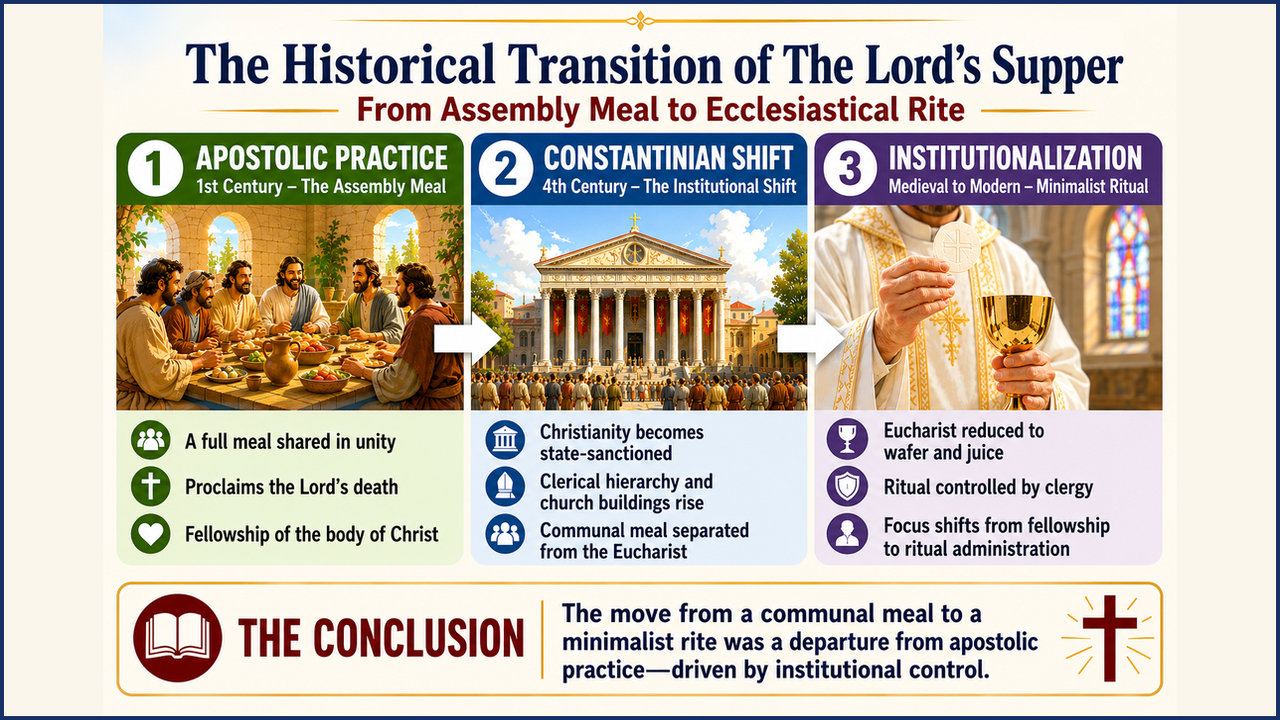
The evolution of the practice known as the Lord’s Supper from a communal meal—the original context of the first-century ekklesia—to the ritualized consumption of a wafer and a small amount of juice represents a profound shift in both theology and ecclesiology. This transformation correlates directly with the structural changes that occurred as the early assemblies reorganized under the influence of the Constantinian shift and the rise of a centralized, hierarchical ecclesiastical system. The transition reflects the displacement of the apostolic assembly model by an institutional framework that prioritized clerical control and ritualized orthodoxy over the organic, household-based fellowship of early believers.
The Apostolic Practice of the Communal Meal
In the first century, the gathering of Christ’s assembly was characterized by participation in a full meal, often referred to as the “breaking of bread.” This practice was rooted in the teachings of Christ and the traditions established by the apostles. As evidenced in the descriptions of the early assemblies (e.g., Acts 2:42, 20:7; 1 Corinthians 11), the focus was on communal unity, where the physical act of eating together served as a tangible proclamation of the Lord’s death and an expression of the unity of the body. There is no evidence in the New Testament of an “ordinance” utilizing symbolic, minimal elements, as the meal itself embodied the fellowship and spiritual nourishment of the gathered believers.
The Constantinian Shift and Hierarchical Formalization
The transition beginning in the fourth century under Emperor Constantine fundamentally altered the nature of the assembly. As Christianity shifted from an illicit, house-based gathering to a state-sanctioned religion, the architecture and the administration of the faith were reshaped to mirror Roman administrative structures. The “church” became a public, imperial institution, necessitating buildings (basilicas) and a distinct priestly class to manage the “sacred” rites.
This move toward clericalism necessitated the separation of the “Eucharist” from the communal meal (the agape feast). Clerical control was consolidated by removing the communal aspect, which was inherently democratic and household-focused, and re-branding the rite as an official liturgical act performed by an ordained celebrant. This shift ensured that the rite remained under the exclusive jurisdiction of the hierarchy, effectively removing the congregational autonomy that existed when the Lord’s Supper was a legitimate, food-based banquet of the assembly.
The Institutionalization of the Minimalist Ritual
The introduction of the wafer and the thimble—or the modern equivalent of standardized, bite-sized portions—serves as the final crystallization of this institutional transition. By stripping the event of its character as a meal, the ecclesiastical system achieved several objectives:
- Standardization for Mass Control: A ritualized, miniature dose of elements is easily commodified and administered, requiring minimal logistical effort and no social interaction between members. It shifts the focus from the horizontal fellowship of the assembly to a vertical, formalistic administration by a priest.
- Separation of the Sacred and Profane: Constantinian influence helped enforce a dualism where the “sacred” rite was cordoned off from daily life. By reducing the meal to a tiny token, the church leadership made the physical, daily sustenance of the believers irrelevant to the act of remembrance, reinforcing the clergy’s role as the sole dispensers of “grace.”
- Replacement of Meaning: As the early Jewish roots of the assembly were suppressed, the understanding of bread and wine as symbols sanctifying a full meal was lost. The institutional church replaced the foundational practice of the body’s communal gathering with a rigid, theological abstraction that could be managed and policed.
Conclusion
The historical record confirms that the movement from a communal, full-meal assembly to the modern minimal ordinance of the wafer and juice is not a development of biblical practice, but an explicit departure from it. This change was a direct consequence of the organizational shift into a hierarchical, institutionalized system following the third and fourth centuries. By stripping the Lord’s Supper of its status as a communal meal, the ecclesiastical system effectively insulated itself from the organic assembly of believers, opting instead for a ritualistic framework that prioritized central administrative control over the original apostolic practice of gathering as Christ’s assembly.
Visual Summary
The video player provided below features a representation of 1st century communal meal to a ecclesiastical system of administrating the Lord's Supper. This visual summary of the concepts discussed may assist in solidifying the main ideas before the final closing statements. Horizontal viewing is recommended on mobile phone devices.
~ Transition of The Lord's Supper ~