
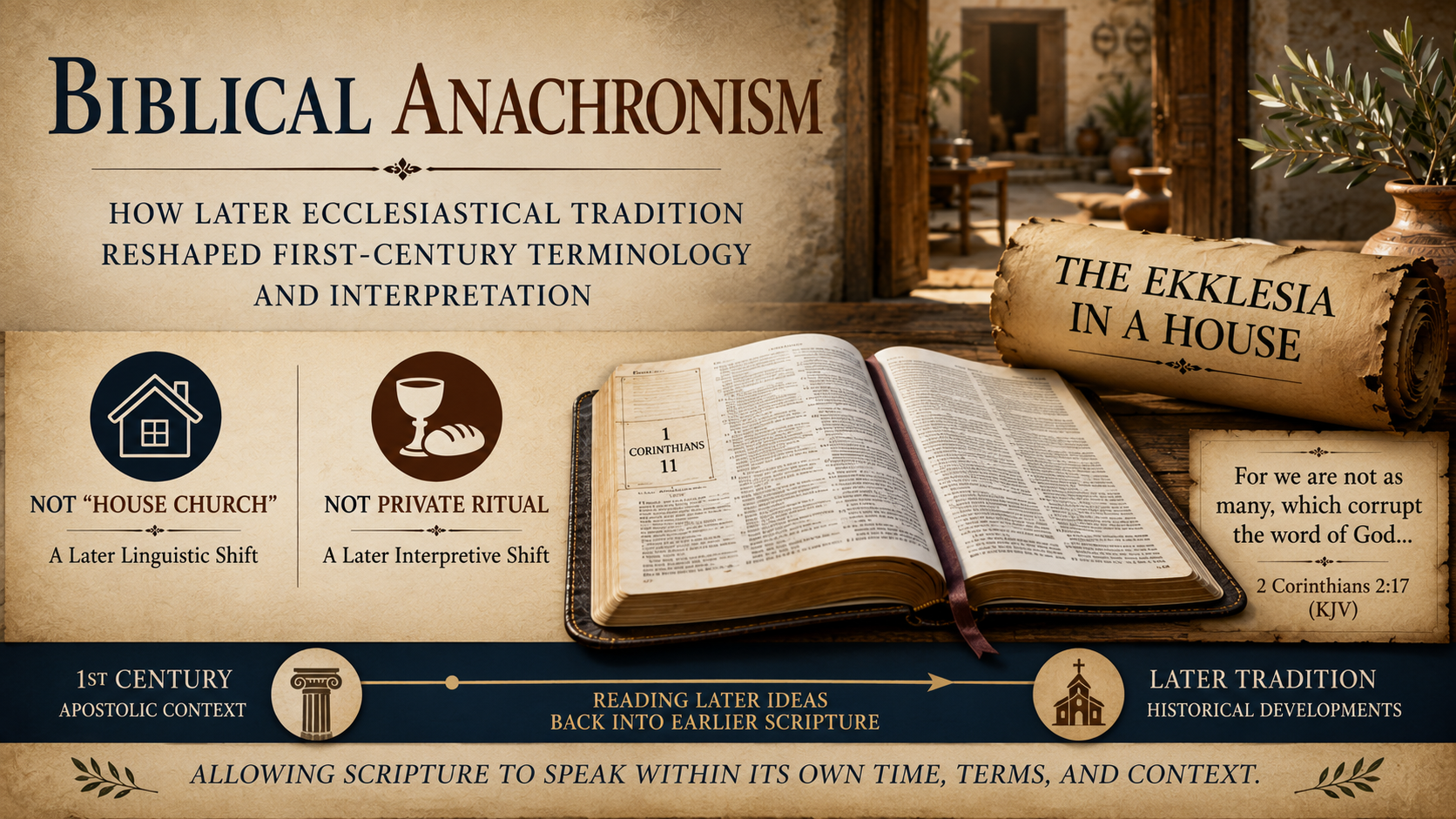
How Later Ecclesiastical Tradition Reshaped First-Century Terminology and Interpretation
Forward
The material presented on this website may differ from commonly held or traditional views within modern evangelical Christianity. Some of the conclusions may challenge long-held assumptions and are offered in the spirit of careful biblical and historical examination.
This work is not intended to provoke controversy for its own sake, nor to diminish the sincerity of those who hold differing interpretations. Rather, it is offered in the spirit of careful biblical examination and historical inquiry. The purpose of this site is to encourage thoughtful study of the Scriptures, the original language of the biblical text, and the historical context in which the early believers lived and gathered.
Readers are encouraged not to accept or reject these conclusions on the basis of tradition (Mark 7:7–9), popularity (Matthew 7:13–14), or personal preference (Proverbs 14:12), but to examine the Scriptures daily to see whether these things are so (Acts 17:11).
If the content here challenges long-held assumptions, it is hoped that such challenge will lead not to division, but to deeper study, humility, and renewed confidence in the authority of God’s Word.
Introduction
If it can be demonstrated that the English word church, with its accumulated institutional and architectural meanings, no longer communicates what the Greek word ekklesia denoted in the first century—an assembled people—then many familiar expressions and interpretations deserve to be reexamined.
Throughout church history, later vocabulary, traditions, and religious practices have often been read back into the New Testament. When this occurs, Scripture may come to be understood through concepts that did not yet exist when the biblical authors wrote. The result is what this study refers to as biblical anachronism.
For the purposes of this study, a biblical anachronism is not an error in Scripture itself. Rather, it is an interpretive error that occurs when later vocabulary, institutions, practices, or theological assumptions are read back into the biblical text, causing it to be understood differently than its original historical setting and literary context warrant.
The purpose of this study is not to criticize Christians for using familiar terminology or long-standing practices. Rather, it is to ask whether our language and interpretations faithfully reflect the terminology, concepts, and context employed by the inspired writers themselves.
Methodological Note: The conclusions presented in this study are derived from the hermeneutical principles outlined in Appendix A: Methodological Framework, which defines the interpretive approach used throughout this work.
Part I
The Term “House Church”—A First-Century Linguistic and Biblical Anachronism
1. The Biblical Standard
The New Testament consistently speaks of the ekklesia in a house, never of a house church. In every occurrence, the house identifies the location of the gathering, while ekklesia identifies the assembled people.
2. The Conceptual Error
The expression house church subtly reverses the biblical relationship. It gives the impression that the house defines the church, whereas the apostles consistently present the house as nothing more than the place where the assembly meets.
3. The Etymological Shift
The English word church developed historically from kyriakos, not from ekklesia. Over centuries it acquired institutional and architectural associations distinct from the New Testament meaning of ekklesia. Reading those later meanings back into the apostolic writings blurs the distinction between the meeting place and the assembled people.
4. The Resulting Contradiction
The apostles consistently distinguished between the house (oikos) as the place of meeting and the ekklesia as the assembled people. The modern expression house church merges concepts that the inspired writers themselves kept separate. It is therefore best understood as a first-century linguistic and biblical anachronism.
Part II
The Biblical Expression
Rather than asking how modern Christianity describes these gatherings, the better question is how the New Testament itself describes them.
The answer is remarkably consistent.
- Romans 16:5
- 1 Corinthians 16:19
- Colossians 4:15
- Philemon 2
Each passage follows the same pattern. The house identifies the location. The ekklesia identifies the assembled people. The biblical writers never combine those two ideas into the expression house church. That terminology belongs to a later period of church history, not to the vocabulary of the apostles.
Transition
The expression house church is not an isolated example of biblical anachronism. The same interpretive phenomenon appears elsewhere when later ecclesiastical assumptions are allowed to shape the reading of Scripture.
One of the clearest examples is found in the traditional interpretation of 1 Corinthians 11:17–34. Just as later terminology reshaped the language surrounding ekklesia, later liturgical practices have often supplied the interpretive framework through which Paul’s instructions concerning the Lord’s Supper are understood.
The issue is the same in both cases.
Later concepts have been read back into a first-century text.
Part III
Biblical Anachronism in Interpretation — The Traditional Reading of 1 Corinthians 11:17–34
The traditional interpretation of 1 Corinthians 11:17–34 provides one of the clearest examples of biblical anachronism in contemporary Christian practice. Rather than allowing Paul’s argument to be understood within its first-century setting, later liturgical traditions have frequently supplied the interpretive framework.
Modern pulpit tradition often presents these verses as an individualistic exercise in private introspection. Believers are instructed to examine themselves for unconfessed personal sins before partaking of a symbolic wafer and cup, lest they eat and drink judgment upon themselves.
Yet Paul begins neither in verse 27 nor with individual self-examination. He begins in verse 17 by rebuking divisions within the assembly and concludes in verse 34 by correcting abuses associated with a communal meal. The entire passage therefore forms a single argument and should be interpreted as such.
The Historical Context
The abuse was not hidden personal sin but public mistreatment of fellow believers. The wealthy arrived early, consumed their own food, became filled, and even became drunk, while poorer believers were left hungry and publicly humiliated. Paul’s rebuke in verse 22 identifies the offense:
“What! have ye not houses to eat and to drink in? or despise ye the church of God, and shame them that have not?” (KJV)
“Unworthily”
The adverb anaksiōs (“unworthily”) describes the manner in which the meal was being observed, not the moral perfection of those participating. Paul’s concern is the disgraceful conduct surrounding the communal meal rather than the impossibility of attaining sinless personal worthiness.
“Discerning the Body”
Within the immediate context, “discerning the body” concerns recognizing the gathered body of believers and treating fellow members accordingly. The Corinthians were failing to recognize the significance of the very people they were humiliating during the meal.
An Interpretive Anachronism
As the communal meal gradually gave way to a symbolic ritual of wafer and cup, later generations naturally approached Paul’s instructions through that newer practice. The result was an interpretive shift in which a rebuke about divisions and selfishness within a communal meal came to be widely understood as a warning about private introspection before participating in a symbolic ordinance.
The biblical anachronism is not the passage itself. The anachronism lies in reading a later liturgical practice back into Paul’s first-century correction.
Conclusion
The two studies presented in this article illustrate the same hermeneutical principle.
In the first, later ecclesiastical terminology replaced the apostolic expression the ekklesia in a house with house church. In the second, later liturgical practice supplied an interpretive framework through which many readers came to understand Paul’s correction concerning the Lord’s Supper.
In both examples, the same phenomenon is observed. Later vocabulary, practices, and assumptions have been read back into the New Testament.
Faithful interpretation requires more than translating Greek words into English. It requires allowing the inspired writers to speak within their own historical setting, vocabulary, and literary context. When Scripture is permitted to define its own terminology and interpret its own context, many long-standing assumptions give way to a clearer understanding of the biblical text.
~ Appendices ~
Appendix A: Methodological Framework
A.1 Defining the Hermeneutical Principle
To ensure the integrity of the linguistic analysis found in this work, we employ the Literal-Grammatical-Historical method. This principle operates on the postulation that the author’s intent is fixed at the moment of composition. Therefore, any interpretation must correspond to the vocabulary, syntax, and cultural conventions available to the original audience. We reject “canonical” or “ecclesial” interpretations that rely on later developments—effectively prioritizing the Qahal (Hebrew) and Ekklesia (Greek) as distinct, historical civic entities over against the modern “universal” institutional construct.
A.2 The Anachronistic Fallacy
As used throughout this text, Biblical Anachronism refers to the interpretative error of superimposing post-Constantinian theological frameworks (specifically 4th-century and later ecclesiastical nomenclature) onto the apostolic texts.
- Prohibition against anachronistic reading: This work explicitly rejects the assumption that the term “church” (a late, localized reference to kyriakon) can be used as a synonym for ekklesia without committing a fundamental error in historical linguistics.
- Application: In cases where our analysis highlights contradictions between the text and current church doctrines, we adopt the priority of the original text’s literal, civic, and domestic reality.
Appendix B: Defining Biblical Anachronism
B.1 What Is Biblical Anachronism?
Throughout this study the expression Biblical Anachronism refers to a specific hermeneutical error. It does not suggest that Scripture itself contains anachronisms. Rather, it describes an error committed by the interpreter.
A biblical anachronism occurs when later vocabulary, institutions, religious practices, or theological assumptions are read back into the biblical text, causing it to be understood differently than its original historical setting, literary context, and linguistic usage warrant.
The literal-grammatical-historical method seeks to understand Scripture as its original authors intended and as its first readers would have understood it. Consequently, meanings derived from later historical developments should not be imposed upon earlier biblical texts.
This principle is not unique to biblical studies. Historians universally recognize that historical documents must be interpreted according to the language, customs, and institutions that existed when they were written. To attribute later concepts to earlier writings is to commit an anachronism. The same principle applies to Scripture.
B.2 Linguistic Anachronism
One form of biblical anachronism occurs when later vocabulary replaces the terminology employed by the biblical writers. The New Testament consistently employs the Greek noun ekklesia, a word denoting an assembly or gathering of people. The apostles also consistently distinguished the assembled people from the location in which they met.
For example, Romans 16:5, 1 Corinthians 16:19, Colossians 4:15, and Philemon 2 all refer to the ekklesia in a house. In each instance, the house identifies the place of assembly, while ekklesia identifies the assembled people.
The later expression house church combines these two distinct concepts into a single compound expression unknown to the New Testament writers. While the expression may be widely understood today, it represents later terminology rather than apostolic terminology.
The issue is not whether the expression is convenient. The question is whether it accurately reflects the language employed by the inspired writers.
B.3 Interpretive Anachronism
Biblical anachronism may also occur in interpretation. A passage may retain its original wording while its meaning becomes shaped by later religious practices rather than by its immediate historical context.
The discussion of the Lord’s Supper in 1 Corinthians 11:17–34 provides an important example. Modern Christian practice commonly approaches this passage through the lens of a symbolic communion service consisting of a wafer or small piece of bread and an individual cup. Consequently, verses 27–29 are frequently interpreted primarily as a warning concerning private self-examination before participating in that ceremony.
Yet Paul’s discussion begins in verse 17 with divisions within the assembly and concludes in verse 34 with practical instructions concerning a communal meal. The immediate context concerns selfish conduct toward fellow believers rather than the performance of an isolated religious ritual.
The biblical anachronism therefore does not lie within Paul’s inspired words. It lies in allowing later liturgical practices to become the framework through which those words are interpreted.
B.4 Institutional Anachronism
Institutions also develop over time. As Christianity expanded throughout subsequent centuries, organizational structures, ecclesiastical offices, denominational systems, and institutional terminology became increasingly complex. These historical developments are important subjects of church history. They should not, however, be assumed to define the vocabulary employed by first-century writers.
When later institutional concepts are unconsciously projected backward into the apostolic writings, Scripture may be interpreted according to structures that did not yet exist. Historical development should therefore be distinguished from historical interpretation.
B.5 Liturgical Anachronism
Religious practices likewise undergo historical development. Throughout Christian history, forms of worship, ceremonial observances, and liturgical customs have changed considerably across cultures and traditions. Such developments are matters of historical record.
The interpretive question is whether those later practices should govern the reading of first-century texts. Whenever later ceremonial forms become the primary lens through which apostolic instructions are understood, the interpreter risks reading later practice back into the biblical narrative rather than allowing the biblical narrative to define the practice.
This distinction is particularly important when studying the Lord’s Supper, baptism, congregational life, and other practices whose historical forms have undergone substantial development.
B.6 Why Biblical Anachronism Matters
The purpose of identifying biblical anachronism is not to criticize sincere Christians, nor to diminish the value of historical theological reflection. Rather, its purpose is to encourage careful interpretation by allowing Scripture to speak within its own historical world.
Every generation inherits religious vocabulary and traditions from those who came before. Responsible interpretation continually asks whether those inherited concepts accurately reflect the meaning intended by the biblical authors. When later terminology, institutions, or practices replace the language and context of Scripture, the reader may unknowingly inherit conclusions that the biblical text itself never requires.
For this reason, the consistent application of the literal-grammatical-historical method requires that Scripture first be understood according to its own language, historical circumstances, and literary context before later theological developments are considered. Only then can the distinction between apostolic teaching and subsequent historical interpretation be carefully maintained.
Appendix C: Passages Commonly Cited in Support of the Universal Church Interpretation
C.1 Purpose of This Appendix
The New Testament contains over one hundred occurrences of the Greek noun ekklesia. The overwhelming majority unmistakably refer to identifiable assemblies meeting in particular places. Nevertheless, a relatively small number of passages have traditionally been interpreted as referring to a universal or invisible church composed of all believers.
The purpose of this appendix is not to dismiss those interpretations, but to examine whether the passages themselves require that conclusion or whether they may be understood consistently with the ordinary lexical meaning of ekklesia as an assembly.
Throughout this study, the question is not whether all believers belong to Christ, nor whether all who are redeemed constitute His people. Scripture plainly affirms both truths. The question is more specific:
Did the New Testament writers employ the noun ekklesia to describe a universal institution, or did they continue to use the word according to its established meaning as an assembly?
Each passage below is therefore examined according to four principles:
- The immediate literary context.
- The historical setting.
- The ordinary lexical meaning of ekklesia.
- Whether the passage requires a universal institutional interpretation.
C.2 Matthew 16:18
“…upon this rock I will build my ekklesia…” (KJV)
Common Interpretation
This verse is frequently regarded as the foundational proof that Christ established one universal church embracing all believers throughout history.
Contextual Analysis
The emphasis of the passage is not upon the geographical extent of Christ’s people but upon His promise that He Himself would build His ekklesia. The future tense (“I will build”) points forward from the time of Jesus’ earthly ministry.
Nothing within the immediate context defines the scope of the ekklesia or transforms the ordinary meaning of the word into an abstract institution. The passage emphasizes ownership, authority, and certainty of Christ’s work rather than providing a technical definition of ekklesia.
Observations
- The promise concerns Christ’s future work.
- The verse does not describe organizational structure.
- It does not define ekklesia.
- It does not discuss local versus universal assemblies.
Conclusion
Matthew 16:18 affirms that Christ would build His ekklesia. Whether that building occurs through identifiable assemblies or through an abstract universal institution is not answered by this verse alone. Consequently, the passage should not be required to bear more theological weight than its context permits.
C.3 Matthew 18:17
“…tell it unto the ekklesia…”
Common Interpretation
Some regard this passage as evidence that ekklesia possesses a broad institutional meaning independent of any local gathering.
Contextual Analysis
The surrounding verses describe the resolution of personal offenses among identifiable disciples. The injured believer is instructed first to speak privately, then with witnesses, and finally to bring the matter before the ekklesia.
Such instructions assume a body capable of hearing testimony, rendering judgment, and exercising discipline.
These are practical actions requiring an actual assembly rather than an abstract collection of believers scattered throughout the world.
Observations
- The ekklesia hears.
- The ekklesia evaluates.
- The ekklesia renders judgment.
- The offender may refuse to hear the ekklesia.
Each activity presupposes an identifiable gathering.
Conclusion
Matthew 18:17 naturally reflects the ordinary functional meaning of ekklesia as an assembly capable of acting collectively.
C.4 Acts 20:28
“…to feed the ekklesia of God…”
Common Interpretation
Because Paul speaks of “the church of God,” some conclude that he refers to the universal church.
Contextual Analysis
Paul is addressing the elders of Ephesus. Their responsibility concerns the flock over which the Holy Spirit had made them overseers.
- The pastoral responsibility described is local and practical.
- Elders cannot shepherd every believer throughout the world.
- Their oversight necessarily concerns a definable body of believers entrusted to their care.
Observations
- The audience consists of Ephesian elders.
- The responsibility is pastoral oversight.
- The flock is identifiable.
- The ministry is local.
Conclusion
Acts 20:28 does not require a universal institutional understanding of ekklesia. The immediate context favors a concrete assembly under recognized oversight.
C.5 1 Corinthians 12:28
“And God hath set some in the ekklesia…”
Common Interpretation
This passage is often cited because Paul speaks broadly of gifts placed within “the church.”
Contextual Analysis
First Corinthians is addressed to “the ekklesia of God which is at Corinth” (1 Corinthians 1:2). Throughout the letter Paul repeatedly addresses the life, worship, discipline, fellowship, and spiritual gifts of that assembly.
Chapter 12 continues this discussion by explaining how God distributes gifts for the benefit of the body.
The context never abandons the practical concerns of the Corinthian assembly.
Observations
- The letter consistently addresses one identifiable assembly.
- The gifts are exercised among assembled believers.
- The chapter prepares for orderly assembly in chapter 14.
Conclusion
Nothing within the immediate context requires ekklesia to be understood as a universal institution. The discussion naturally continues Paul’s instruction to the Corinthian assembly concerning its corporate life.
C.6 Ephesians 1:22–23
“…gave him to be the head over all things to the ekklesia…”
Common Interpretation
This passage is commonly viewed as one of the strongest arguments for a universal church because Christ is described as the Head of the ekklesia.
Contextual Analysis
Paul emphasizes Christ’s supreme authority over all creation and His unique relationship to His redeemed people.
The passage identifies Christ as Head but does not redefine the lexical meaning of ekklesia. Headship describes His authority and relationship rather than the geographical extent or organizational structure of those under His lordship.
Observations
- The emphasis is Christ.
- The emphasis is His authority.
- No definition of ekklesia is supplied.
Conclusion
The passage teaches Christ’s supreme headship but does not, by itself, establish that ekklesia has acquired a new meaning different from its ordinary first-century usage.
C.7 Ephesians 3:10
“To the intent that now unto the principalities and powers in heavenly places might be known by the ekklesia the manifold wisdom of God.” (KJV)
This verse is frequently cited as evidence that ekklesia denotes a universal, invisible entity transcending local assemblies. Because Paul speaks of God’s wisdom being made known “by the church,” some conclude that the word must describe the collective body of all believers rather than an actual assembly.
The immediate context, however, focuses on God’s redemptive purpose in Christ and the inclusion of both Jews and Gentiles in the same covenant relationship. Paul is explaining the mystery previously hidden but now revealed through the gospel. His emphasis rests upon the unity created in Christ, not upon redefining ekklesia.
Nothing in the passage requires the reader to abandon the ordinary meaning of ekklesia. Throughout the New Testament, assemblies collectively bear witness to God’s wisdom before the world. The text emphasizes God’s purpose being displayed through His redeemed people, but it does not pause to redefine the noun itself.
The passage therefore teaches the revelatory purpose of God’s people rather than introducing a new ecclesiological definition of ekklesia.
C.8 Ephesians 5:23–32
“…Christ is the head of the ekklesia…” (KJV)
This section is often regarded as one of the strongest arguments for a universal church because Paul compares the relationship between husband and wife to that between Christ and the ekklesia. Since Christ has but one bride, many conclude that ekklesia must refer to one universal institution.
The comparison, however, is theological rather than lexical. Paul’s purpose is to illustrate sacrificial love, submission, and covenant faithfulness. The analogy depends upon Christ’s relationship to His people, not upon redefining the meaning of ekklesia.
Throughout Scripture, singular collective nouns frequently describe groups without altering the ordinary meaning of the words employed. The singular form does not by itself establish universality. Nor does the passage discuss organizational structure, geographical scope, or the existence of an invisible institution.
Rather, Paul presents Christ as the perfect model of covenant love. The focus remains upon His care, nourishment, and sanctifying work among His people. The passage therefore contributes significantly to the doctrine of Christ’s relationship with believers while leaving the ordinary lexical meaning of ekklesia unchanged.
“And he is the head of the body, the ekklesia…” (KJV)
C.9 Colossians 1:18
As in Ephesians, this verse is frequently cited because Christ is identified as the Head of the ekklesia. The argument commonly assumes that because Christ possesses only one body, ekklesia must necessarily refer to a universal entity.
Paul’s concern, however, is Christ’s absolute supremacy. The surrounding verses magnify His preeminence over creation, redemption, and the new creation. His headship establishes His authority and priority in all things.
The verse defines Christ far more than it defines ekklesia. Nothing in the immediate context suggests that Paul intends to assign the noun a meaning different from its established first-century usage. Instead, the emphasis rests upon the Lordship of Christ over His redeemed people.
Consequently, the passage teaches Christ’s supremacy while remaining silent on whether ekklesia should be understood as a universal institution or as assemblies united under one Lord.
C.10 Colossians 1:24
“…for his body’s sake, which is the ekklesia.” (KJV)
Paul speaks here of his sufferings on behalf of Christ’s body, identified as the ekklesia. Once again, the emphasis falls upon Paul’s ministry to God’s people rather than upon defining the word itself.
The broader context of Colossians repeatedly addresses practical concerns within identifiable assemblies. Paul sends greetings, instructions, and letters to particular congregations meeting in specific locations (Colossians 4:15–16). Nothing in the epistle suggests that the ordinary meaning of ekklesia has been abandoned.
Instead, Paul’s statement reflects his sacrificial ministry for the benefit of Christ’s people wherever they assembled. The text emphasizes the object of his service rather than introducing a new ecclesiological category.
C.11 Hebrews 12:22–24
“…to the general assembly and ekklesia of the firstborn…” (KJV)
Hebrews 12:22–24 is perhaps the most frequently discussed passage in this debate because it describes believers as having come to Mount Zion, the heavenly Jerusalem, “the general assembly and church of the firstborn.”
Unlike the preceding passages, this text employs highly figurative and covenantal language. The writer contrasts Mount Sinai with Mount Zion, the old covenant with the new, and earthly realities with heavenly privileges. The imagery is richly theological and should be interpreted within that literary framework.
Several observations deserve careful consideration. First, the expression “general assembly” translates the Greek panēgyris, a word referring to a festive gathering. Second, ekklesia immediately follows and is connected with “the firstborn.” Even within this exalted description, the imagery remains that of an assembled company rather than an abstract institution.
The passage describes the covenant privileges enjoyed by believers through Christ. Whether the gathering is viewed proleptically, liturgically, or eschatologically, the imagery continues to be that of an assembly. The text therefore presents no compelling lexical evidence that ekklesia has ceased to denote an assembled people.
Because Hebrews employs highly symbolic language throughout the epistle, caution should be exercised before allowing this unique passage to redefine the ordinary meaning consistently found elsewhere in the New Testament.
C.12 Summary Observations
The passages examined in this appendix are those most commonly cited in support of the universal church interpretation. They deserve careful and respectful consideration, for each contributes important truths concerning Christ’s authority, His redemptive work, and the unity of His people.
A consistent pattern nevertheless emerges. None of these passages pauses to define ekklesia or explicitly states that the word has acquired a new lexical meaning distinct from its established first-century usage. Instead, the discussions center on Christ’s headship, the unity of believers, the progress of redemption, or the covenant relationship between Christ and His people.
This observation is significant. Theological truths concerning the unity of all believers do not, by themselves, establish that the noun ekklesia has become a technical term for a universal institution. To reach that conclusion requires an inference that extends beyond what these texts explicitly state.
The literal-grammatical-historical method therefore begins with the ordinary meaning of ekklesia and asks whether any passage clearly requires that meaning to be abandoned. The passages examined here, while rich in theological significance, do not unambiguously make that transition. For this reason, the interpreter should exercise caution before reading later ecclesiological developments back into the apostolic writings. Such a reading risks committing the very interpretive anachronism defined in Appendix B by allowing later theological constructs to reshape the historical and linguistic world of the New Testament.
Appendix D: The Consistent Pattern of Ekklesia in the New Testament
D.1 Purpose of This Appendix
Much of the discussion surrounding ekklesia has focused upon a relatively small number of passages whose interpretation is debated. While those texts deserve careful consideration, they should not overshadow the consistent pattern established throughout the New Testament.
Language is ordinarily understood by its regular usage rather than by isolated or disputed examples. If a word appears repeatedly in similar contexts, those contexts establish its normal range of meaning. Only compelling contextual evidence should justify assigning a fundamentally different sense to the same word.
The Greek noun ekklesia follows this pattern. Across the New Testament it consistently describes an identifiable assembly of people. Whether the gathering is civic, as in Acts 19, or Christian, the defining characteristic remains the same: people are assembled for a recognized purpose.
This appendix surveys the recurring characteristics of ekklesia as they appear throughout the apostolic writings.
D.2 The Ekklesia Assembles
The most fundamental characteristic of an ekklesia is that it assembles. This observation may appear self-evident, yet it is foundational. The noun itself denotes an assembly or gathering rather than merely the existence of individuals who happen to belong to the same group.
Paul assumes this understanding throughout his correspondence with the Corinthians.
“When ye come together in the church…” (1 Corinthians 11:18, KJV)
Again,
“If therefore the whole church be come together into one place…” (1 Corinthians 14:23, KJV)
These statements are significant because Paul does not describe believers becoming the ekklesia by assembling. Rather, he speaks of the ekklesia assembling because it already exists as an identifiable body capable of gathering. The language presupposes that an ekklesia is known by its assembled expression.
D.3 The Ekklesia Meets in Identifiable Locations
The New Testament repeatedly associates assemblies with specific places. Paul greets:
“the ekklesia that is in their house” (Romans 16:5; 1 Corinthians 16:19; Colossians 4:15; Philemon 2).
The house is never identified as the ekklesia. Rather, it serves as the location where the ekklesia gathers. This distinction is easily overlooked in modern English because later expressions such as “house church” have become common. The apostolic writers, however, consistently distinguish between the people and the place.
The location may vary, but the identity of the assembly remains the gathered people.
D.4 The Ekklesia Hears and Responds
An assembly is capable of receiving instruction, responding to exhortation, and acting collectively. In Matthew 18:17, disputes are brought before the ekklesia. In Acts 15, the assembly hears testimony, deliberates, and reaches a common judgment.
In Paul’s letters, assemblies receive instruction concerning doctrine, worship, discipline, generosity, and daily conduct. These activities require an identifiable body capable of hearing and responding together. Such descriptions naturally fit an assembled congregation.
D.5 The Ekklesia Exercises Discipline
One of the clearest demonstrations of an assembled body appears in the exercise of discipline. In 1 Corinthians 5, Paul instructs the believers concerning an immoral member:
“In the name of our Lord Jesus Christ, when ye are gathered together…” (1 Corinthians 5:4, KJV)
The disciplinary action is not described as an individual responsibility but as the action of the assembled congregation. Likewise, Matthew 18 concludes with the offender either hearing or refusing to hear the ekklesia. Both passages assume an identifiable assembly capable of collective judgment.
D.6 The Ekklesia Observes the Lord’s Supper Together
The apostolic pattern consistently presents the Lord’s Supper as an activity of believers assembled together. Paul’s repeated expression “when ye come together” (1 Corinthians 11:17–34) frames the entire discussion. The abuses he condemns arise because some eat before others arrive, while others are left hungry. His solution is equally practical:
“Wherefore, my brethren, when ye come together to eat, tarry one for another.” (1 Corinthians 11:33, KJV)
The passage presupposes an assembled body sharing a common meal. The ekklesia is not merely a collection of scattered believers sharing a common faith; it is believers gathered in fellowship.
D.7 The Ekklesia Sends and Receives Representatives
Assemblies also act corporately in sending and receiving messengers.
- The church at Antioch sends Barnabas and Saul (Acts 13:1–3).
- The Jerusalem assembly receives reports from missionary journeys (Acts 14:27).
- Delegates are appointed and commissioned (Acts 15).
These activities demonstrate organized, collective action. They belong to an identifiable assembly rather than to an undefined abstraction.
D.8 The Ekklesia Is Counted and Recognized
Throughout Acts, Luke speaks of assemblies in ways that imply recognizable identity.
- Assemblies have elders (Acts 14:23).
- Assemblies receive letters (Acts 15:30–31).
- Assemblies grow numerically (Acts 16:5).
- Assemblies support missionaries (Philippians 4:15).
- Assemblies are greeted by name (Romans 16; Colossians 4).
These descriptions consistently portray real congregations existing in real places among real people.
D.9 Summary of the New Testament Pattern
When the New Testament evidence is considered as a whole, a remarkably consistent picture emerges.
- The ekklesia assembles.
- The ekklesia meets in identifiable locations.
- The ekklesia hears instruction.
- The ekklesia disciplines members.
- The ekklesia shares the Lord’s Supper.
- The ekklesia appoints leaders.
- The ekklesia sends representatives.
- The ekklesia receives correspondence.
- The ekklesia acts corporately.
These characteristics are not presented as exceptional; they constitute the ordinary life of the apostolic assemblies.
Taken together, they reveal a consistent and coherent pattern. The ekklesia is repeatedly portrayed as a gathered body of identifiable believers who assemble for worship, instruction, fellowship, discipline, prayer, and the breaking of bread. This pattern is not incidental to the New Testament record; it is woven throughout its narrative and epistolary writings.
Consequently, any interpretation that assigns ekklesia a meaning fundamentally detached from its assembled character bears the burden of demonstrating that such a shift is explicitly required by the biblical text. Absent such evidence, the ordinary lexical and functional pattern should remain the controlling framework for interpretation.
Appendix E: The Historical Development of the English Word Church
E.1 Purpose of This Appendix
Throughout this study, the Greek noun ekklesia has been examined according to its ordinary lexical meaning and consistent New Testament usage. The evidence repeatedly demonstrates that the word describes an assembly of people rather than a building, denomination, or religious institution.
This naturally raises another question. If the New Testament writers consistently employed ekklesia, how did the English-speaking world come to read the word church in its place? The answer lies not in the New Testament itself, but in the historical development of language. The English word church follows an entirely different linguistic path from ekklesia. Understanding that distinction is essential for recognizing how later vocabulary can shape modern interpretation.
E.2 Ekklesia and Kyriakos: Two Different Words
The New Testament employs the noun ekklesia more than one hundred times to describe assemblies of people. The word derives from common Greek usage and was already well established before the New Testament era. Whether referring to civic gatherings, Israel assembled before the Lord, or Christian assemblies, the central idea remains that of a people gathered together.
By contrast, the Greek adjective kyriakos (κυριακός) means “belonging to the Lord” or “pertaining to the Lord.” It is not a synonym for ekklesia. In the New Testament, kyriakos appears only twice:
- 1 Corinthians 11:20 — the Lord’s Supper (kyriakon deipnon)
- Revelation 1:10 — the Lord’s Day (kyriakē hēmera)
In both instances the adjective simply identifies something as belonging to or associated with the Lord. It does not denote an assembly, a congregation, or an institution. This distinction is fundamental. One word identifies people assembled; the other expresses possession or relationship. The New Testament never substitutes kyriakos for ekklesia, nor does it redefine one by means of the other.
E.3 The Historical Development of Church
Following the apostolic period, Christianity expanded into regions where Germanic languages were spoken. During this process, forms derived from kyriakos entered those languages. A simplified historical progression may be represented as follows:
κυριακόν (kyriakon) — “that which belongs to the Lord”
↓
Germanic kirika / kirche
↓
Old English cirice
↓
Middle English chirche
↓
Modern English church
As this linguistic development progressed, the word increasingly became associated with places of Christian worship and, eventually, with organized religious institutions. Over the centuries, church accumulated additional meanings that extended well beyond the lexical meaning of ekklesia. In ordinary English usage today, the word may refer to a building, a denomination, an institution, a worship service, or the worldwide community of Christians.
These later meanings reflect the natural development of language and ecclesiastical history. They do not, however, establish what the New Testament writers meant when they used the word ekklesia.
E.4 Language Development and Biblical Interpretation
Languages continually change. Words acquire broader meanings, narrower meanings, and entirely new associations over time. Such developments are neither unusual nor inherently problematic.
Difficulties arise, however, when later meanings are unconsciously projected backward into earlier texts. A first-century reader encountering the word ekklesia would have understood an assembly. A modern English reader encountering the word church may immediately think of a building, a denomination, a worship service, or an abstract worldwide institution. Those associations arise from centuries of linguistic and historical development rather than from the ordinary lexical meaning of ekklesia itself.
Recognizing this distinction does not require abandoning the English word church. It does require acknowledging that the modern word carries meanings which the Greek noun did not necessarily convey. The task of the interpreter is therefore to recover the meaning intended by the inspired writers rather than allowing later linguistic developments to determine that meaning.
E.5 Anachronism and the Development of Church
The historical development of the English word church should not be confused with the meaning of ekklesia in the first century. Historical development is a fact of language. Biblical interpretation is the task of recovering the meaning of the biblical text within its original historical setting. The two questions must remain distinct.
When later meanings associated with church—whether building, denomination, institutional organization, or abstract universal entity—are assumed to define ekklesia, the interpreter has crossed from historical linguistics into historical projection. The result is not simply a translation choice but a hermeneutical decision that imports later concepts into an earlier text.
This is precisely the kind of interpretive movement defined in Appendix B as biblical anachronism. The issue is not that the English word church exists or has legitimate uses within modern language. Rather, the issue is whether those later meanings should govern the interpretation of a first-century Greek noun that followed a different lexical history and consistently described an assembled people.
The distinction is not merely academic. It affects how readers understand the nature of the apostolic ekklesia, the relationship between believers and their assemblies, and the vocabulary through which the New Testament presents its own theology. Recovering the historical meaning of ekklesia therefore requires allowing the first-century text to speak within its own linguistic world before later developments are brought into the discussion.
E.6 Concluding Observations
The New Testament writers consistently employed ekklesia when speaking of God’s assembled people. They did not substitute kyriakos for ekklesia, nor did they use the adjective to define the assembly itself.
The English word church emerged centuries later through a different linguistic history. During that development, it acquired meanings associated with buildings, institutions, denominations, and broader ecclesiastical structures. Those meanings are part of the history of the English language, but they should not be assumed to define the vocabulary of the apostolic writings.
For this reason, careful interpretation requires distinguishing between the historical development of Christian terminology and the lexical meaning of the words actually used by the New Testament authors. To conflate those two histories is to risk reading later linguistic developments back into the biblical text—a practice that this study has identified as biblical anachronism.
Comparative Table of Ekklesia and Kyriakos
The below table ends this appendix to visually reinforce the distinction the two Greek words presented:
| Ekklesia | Kyriakos / Church |
|---|---|
| Noun | Adjective (source of later “church”) |
| Assembly | Belonging to the Lord |
| People gathered | Describes possession or relationship |
| Common Greek civic term | Rare NT adjective (only twice) |
| Used over 100 times in the NT | Never used as a synonym for ekklesia in the NT |
Appendix F: The Context of 1 Corinthians 11:17–34
F.1 Purpose of This Appendix
Few New Testament passages have shaped Christian practice more profoundly than 1 Corinthians 11:17–34. For many believers, this text immediately evokes the observance commonly known as Communion or the Lord’s Supper. In numerous Christian traditions, the passage is read almost exclusively through the lens of a formal liturgical ceremony centered on bread and a small cup, accompanied by private self-examination.
This appendix asks a different question: How would the Corinthians themselves have understood Paul’s words?
Rather than beginning with later ecclesiastical practice, this study begins with the historical circumstances that prompted Paul’s letter. The aim is not to diminish the reverence due the Lord’s Supper, but to allow Paul’s argument to unfold according to its own context.
F.2 The Occasion for Paul’s Rebuke
Paul opens the discussion with unusually strong language:
“Now in this that I declare unto you I praise you not, that ye come together not for the better, but for the worse.” (1 Corinthians 11:17, KJV)
The problem is immediately identified. The issue is not the existence of the gathering but the manner in which the assembly conducts itself when it comes together. Paul continues:
“For first of all, when ye come together in the ekklesia, I hear that there be divisions among you…” (v.18)
The opening verses establish the setting for everything that follows. The assembly has gathered, yet its conduct contradicts the unity that ought to characterize the people of God.
F.3 The Problem Was Social Before It Was Ceremonial
Verses 20–22 describe the abuse. Some believers began eating before others arrived.Some possessed an abundance of food. Others went hungry. Some even became intoxicated.
Paul’s rebuke leaves little doubt that a genuine meal is in view:
“One is hungry, and another is drunken.” (v.21)
These statements cannot naturally describe the consumption of a symbolic wafer and a small cup. They reflect the realities of a shared meal in which economic and social divisions became painfully visible.
The wealthy were treating what should have expressed fellowship as though it were a private banquet. The poor were being humiliated. The apostle therefore condemns behavior that contradicts the very meaning of the gathering.
F.4 Why Paul Repeats the Institution Narrative
At this point Paul recalls the words of the Lord Jesus. Rather than introducing an entirely new subject, Paul explains what the Corinthians have forgotten.
- The meal they are abusing originated with Christ Himself.
- It proclaims His sacrificial death.
- It expresses covenant fellowship among His people.
By contrasting the Lord’s self-giving with their selfish conduct, Paul exposes the seriousness of their actions. The institution narrative is therefore corrective. It reminds the assembly what the meal is intended to proclaim.
F.5 Eating “Unworthily”
Perhaps no expression in the passage has received more attention than Paul’s warning:
“Whosoever shall eat this bread, and drink this cup of the Lord, unworthily…” (v.27)
The adverb “unworthily” describes the manner in which the meal is being eaten, not the personal worthiness of the participant. Paul’s concern is the selfish, divisive conduct already described in verses 17–22.
The Corinthians were not condemned because they were imperfect sinners. They were rebuked because they were treating fellow believers with contempt while claiming to participate in a meal that proclaimed the Lord’s sacrificial love. The warning therefore addresses behavior inconsistent with the significance of the meal.
F.6 “Discerning the Body”
Verse 29 has long been interpreted as referring primarily to recognizing Christ’s physical body represented by the bread. While that understanding has historical support within many Christian traditions, the immediate context suggests a broader and more immediate concern.
Throughout chapters 10–12, Paul repeatedly uses the imagery of the body to describe the community of believers. Chapter 12, in particular, develops this metaphor extensively, emphasizing that the members belong to one another and must care for one another.
Within this context, “discerning the body” naturally includes recognizing the gathered people of God whose unity the meal proclaims. The Corinthians failed to do this by humiliating poorer believers and allowing divisions to persist within the assembly.
Paul’s concern is therefore both theological and practical. One cannot rightly proclaim the unity established through Christ while simultaneously disregarding the brothers and sisters with whom one shares the meal.
F.7 Divine Discipline
Paul explains that many among the Corinthians were weak, sickly, and some had died because of their conduct.
These statements should be understood within the immediate context of covenant discipline upon an assembly that persistently dishonored the purpose of the Lord’s Supper. The discipline described is corrective rather than vindictive.
“But when we are judged, we are chastened of the Lord, that we should not be condemned with the world.” (v.32)
The purpose is restoration, repentance, and the preservation of the assembly’s witness.
F.8 Paul’s Practical Solution
The conclusion of the passage is remarkably straightforward.
“Wherefore, my brethren, when ye come together to eat, tarry one for another.” (v.33)
Paul does not institute a new ceremony. He does not replace the communal meal with a symbolic observance. Instead, he addresses the very problem introduced in verses 17–22.
Wait for one another. Share together. Honor one another. If anyone is merely hungry, Paul adds,
“If any man hunger, let him eat at home…” (v.34)
The assembly is not to become an occasion for satisfying private appetite but for expressing covenant fellowship in Christ.
F.9 The Hermeneutical Significance
This appendix has not attempted to resolve every theological question surrounding the Lord’s Supper. Rather, it has sought to establish the historical context within which Paul’s instructions were originally given.
When the passage is read from verse 17 through verse 34 as a continuous argument, a consistent picture emerges. Paul addresses the conduct of an assembled ekklesia sharing a communal meal. His concern is not the creation of a later liturgical form but the preservation of unity, mutual care, and reverence within the gathered people of God.
Later Christian traditions have developed various forms of commemorating the Lord’s Supper, many of which are practiced with sincere devotion. Those historical developments, however, should not be allowed to obscure the immediate circumstances that gave rise to Paul’s instruction. To interpret verses 27–29 apart from the social, communal, and ecclesial setting established in the opening verses is to risk allowing later practice to shape the meaning of the apostolic text.
Recognizing that distinction is consistent with the methodological principles set forth in Appendix A and the definition of biblical anachronism established in Appendix B. The interpreter’s first responsibility is to hear Paul’s words as the Corinthian assembly would have heard them, allowing the historical context to govern interpretation before later theological or liturgical developments are considered.
Concluding Observations
The passages most frequently cited in support of the universal church interpretation certainly deserve careful study. They contain profound theological truths concerning Christ’s authority, His redemptive work, and the unity of His people.
Yet upon close examination, these texts generally assume the meaning of ekklesia rather than redefine it. Their primary concern is the relationship of Christ to His people, the responsibilities of believers, or the life of the assembly—not the introduction of a new technical definition of the word itself.
For this reason, caution is warranted before allowing later theological systems to assign a meaning to ekklesia that its first-century readers would not naturally have understood. The consistent application of the literal-grammatical-historical method requires that the ordinary lexical sense remain the starting point unless the context clearly demands otherwise.

