The Historical Transition of The
Lord's Supper
Part of Ekklesia — A Closer Look series. Return to Table of Contents
Introduction
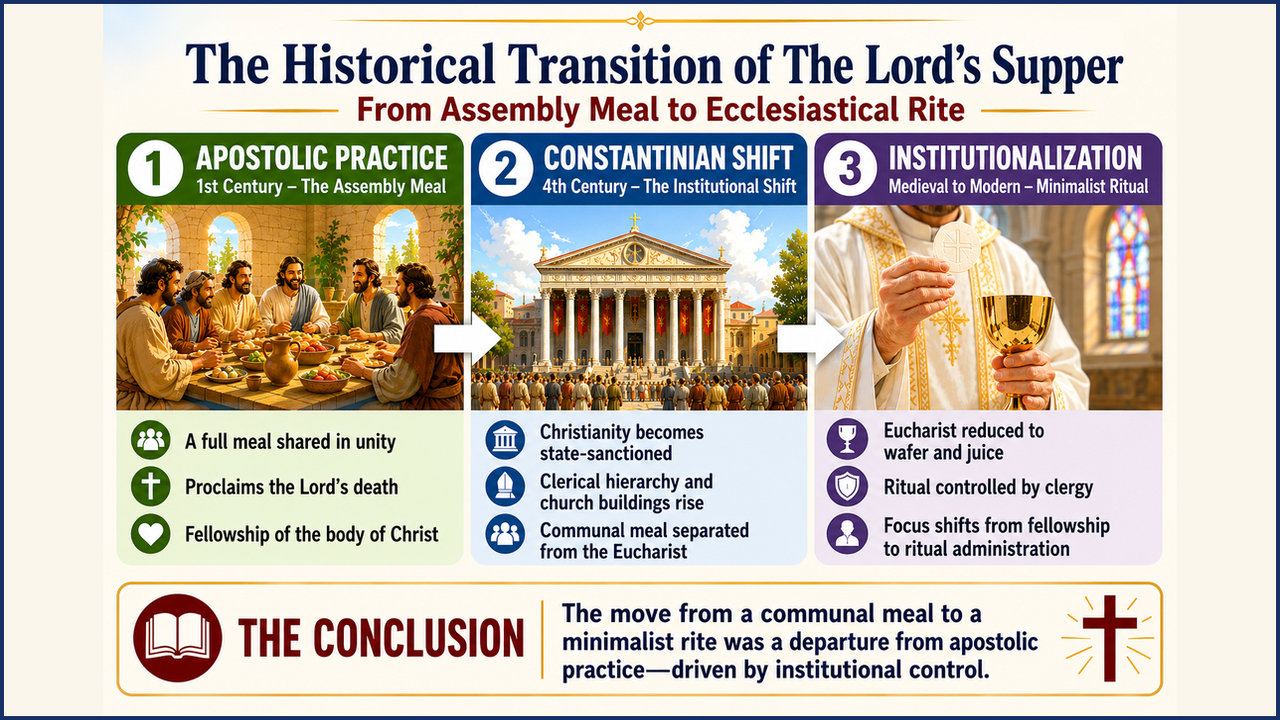
The evolution of the Lord’s Supper from a full communal meal—the foundational context of the first-century ekklesia—to the modern ritualized consumption of a wafer and a thimble of juice represents a profound theological and ecclesiological shift. This transformation marks the drift of 1st-century apostolic teaching, catalyzed by the structural reorganization that followed the Constantinian shift and the rise of a centralized, hierarchical clergy. Ultimately, this transition reflects the displacement of the organic, household-based assembly—once rooted in genuine fellowship—by an institutional framework that prioritized ritualized orthodoxy and clerical control over the apostolic model.
The Apostolic Practice of the Communal Meal
In the first century, the gathering of the ekklesia was marked by the shared meal commonly described as the “breaking of bread.” Rooted in the teaching of Christ and practiced by the apostles, this gathering was more than a religious ceremony; it was an expression of fellowship, covenant unity, and participation in the life of the body. The New Testament consistently presents believers coming together to eat, share, and remember the Lord within the context of a communal meal (Acts 2:42, 46; Acts 20:7; 1 Corinthians 11).
The Lord’s Supper in the apostolic period was not a ritual morsel distributed by a priest at an altar. It was a meal shared among gathered believers. Paul's instruction in 1 Corinthians 11 presupposes eating and drinking within the context of assembling together.
“When ye come together therefore into one place, this is not to eat the Lord's supper. For in eating every one taketh before other his own supper: and one is hungry, and another is drunken” (1 Corinthians 11:20–21).
The problem Paul addresses is not an incorrect ceremonial format, but improper conduct during an actual meal. Some were eating excessively while others were left without enough. Paul's correction was not to replace the meal with a token portion of bread and a small cup. Rather, he called the believers to wait for one another, discern the body, and examine themselves. The meal remained the setting in which the Lord's death was proclaimed through the sharing of bread and the cup.
Paul further writes:
“This do, as oft as ye drink it, in remembrance of me” (1 Corinthians 11:25).
The phrase “as oft as” indicates repeated observance within the life of the assembly, but does not establish a fixed schedule. The New Testament provides no command limiting the practice to an annual, quarterly, or other prescribed observance. While Scripture does not specify an exact frequency, the evidence suggests that the breaking of bread was a regular and defining feature of the gathered ekklesia (Acts 2:42, 46; Acts 20:7). The burden of proof therefore rests upon any claim that the practice was intended to be infrequent or merely ceremonial.
This apostolic pattern provides the baseline from which later developments must be measured: assemblies gathering in homes, the active participation of all believers, Jew and Gentile united as one body in Christ, and a covenant meal shared together in remembrance of the Lord. It is this New Testament model that forms the foundation for understanding the Lord's Supper before the later institutional and liturgical changes that emerged in subsequent centuries.
The Constantinian Shift and Hierarchical Formalization
The transition beginning in the fourth century under Emperor Constantine fundamentally altered the nature of the assembly. As Christianity shifted from an illicit, house-based gathering to a state-sanctioned religion, the architecture and the administration of the faith were reshaped to mirror Roman administrative structures. The “ekklesia” became a public, imperial institution, necessitating buildings (basilicas) and a distinct priestly class to manage the “sacred” rites.
This move toward clericalism necessitated the separation of the “Eucharist” from the communal meal (the agape feast). Clerical control was consolidated by removing the communal aspect, which was inherently household-focused, and re-branding the rite as an official liturgical act performed by an ordained celebrant. This shift ensured that the rite remained under the exclusive jurisdiction of the hierarchy, effectively removing the congregational autonomy that existed when the Lord’s Supper was a legitimate, food-based banquet of the assembly.
The Institutionalization of the Minimalist Ritual
The introduction of the wafer and the thimble—or the modern equivalent of standardized, bite-sized portions—serves as the final crystallization of this institutional transition. By stripping the event of its character as a meal, the ecclesiastical system achieved several objectives:
- Standardization for Mass Control: A ritualized, miniature dose of elements is easily commodified and administered, requiring minimal logistical effort and no social interaction between members. It shifts the focus from the horizontal fellowship of the assembly to a vertical, formalistic administration by a priest.
- Separation of the Sacred and Profane: Constantinian influence helped foster a dualism in which the “sacred” rite was increasingly separated from ordinary life. By reducing the communal meal to a symbolic token, the emerging ecclesiastical hierarchy marginalized the role of shared physical nourishment in the act of remembrance and reinforced the clergy's function as the primary mediators of “grace.”
- Replacement of Meaning: As the early Jewish roots of the assembly were suppressed, the understanding of bread and wine as symbols sanctifying a full meal was lost. The institutional church replaced the foundational practice of the body’s communal gathering with a rigid, theological abstraction that could be managed and policed.
Visual Summary
The video player below features 2 videos within the video display. First an overview of the ekklesia, and the 2nd that follows is a visual of 1st century communal meal to a ecclesiastical system of administrating the Lord's Supper. This visual summary of the concepts discussed may assist in solidifying the main ideas before the final closing statements. Horizontal viewing is recommended on mobile phone devices.
~ The Ekklesia & The Transition of The Lord's Supper ~

Conclusion
The historical record confirms that the movement from a communal, full-meal assembly to the modern minimal ordinance of the wafer and juice is not a development of biblical practice, but an explicit departure from it. This change was a direct consequence of the organizational shift into a hierarchical, institutionalized system following the third and fourth centuries. By stripping the Lord’s Supper of its status as a communal meal, the ecclesiastical system effectively insulated itself from the organic assembly of believers, opting instead for a ritualistic framework that prioritized central administrative control over the original apostolic practice of gathering as Christ’s assembly.